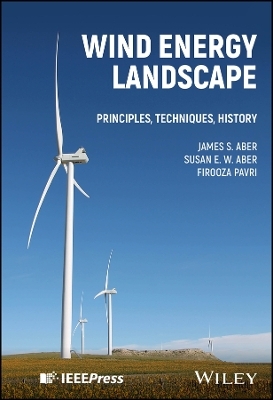
Wind Energy Landscape
Wiley-IEEE Press (Verlag)
978-1-394-21287-3 (ISBN)
- Noch nicht erschienen (ca. März 2026)
- Versandkostenfrei
- Auch auf Rechnung
- Artikel merken
Wind Energy Landscape presents a comprehensive treatment of wind energy history, principles, and techniques as well as environmental, health, aesthetic, social, and political impacts. Focusing primarily on the European and North American markets with additional reviews from Asia, this book enables readers to gain a practical overview and understanding of modern wind energy, supported by in-depth case studies throughout.
Fully illustrated with maps, satellite images, drawings, and photographs taken on the ground or via kite aerial photography, this book disproves many myths about wind energy—such as by demonstrating that wind farms may exist in rural land or offshore settings with minimal impacts—and promotes the radical-middle approach for integrated and evolving energy resources in which wind power has come to play a prominent role. The authors suggest that wind power in global energy development should be given prominent treatment, particularly for renewable, non-polluting energy sources.
Wind Energy Landscape discusses topics including:
History of wind energy electricity generation through the late 19th and 20th centuries
Environmental and aesthetic issues, including impacts on wildlife such as birds and bats as well as visibility and turbine noise
Public policy for wind energy, covering subsidies, financial and import-export incentives, feed-in tariffs, local-content requirements, and R&D investments
Energy production and consumption of wind energy in comparison to nuclear energy, solar energy, and hydro and tidal energy, as well as fossil fuels including coal, oil, and natural gases
Bridging the gap between advanced engineering and popular books, Wind Energy Land-scape is an essential reference on the subject for students in introductory courses on electrical, mechanical, and aerodynamic engineering, engineers working with renewable and sustainable energy, and public policy makers.
James S. Aber, PhD, Roe R. Cross Distinguished Emeritus Professor, Emporia State University, Kansas, USA. Professor Aber’s interests and research experiences spread across energy resources, geology, landscape evolution, aerial photography, and wetland environments. Susan E. W. Aber, PhD, is the former Director of the Science and Math Education Center and Peterson Planetarium at Emporia State University (ESU), Emporia, Kansas, USA. Dr. Aber’s interests are mineralogy, gemology, and energy resources as well as maps and GIS for librarians. Firooza Pavri, PhD, Professor of Geography and Associate Dean, Edmund S. Muskie School of Public Service, University of Southern Maine, USA. Professor Pavri’s teaching and research interests include environmental change, resource and energy management, and remote sensing.
About the Authors
Preface
Chapter 1. History of wind energy
Chapter 2. Windscape methodology
Chapter 3. Converting wind into electricity
Chapter 4. Public policy for wind energy
Chapter 5. Environmental and aesthetic issues
Chapter 6. Europe and Asia
Chapter 7. North American case studies
Chapter 8. Energy production and consumption
Chapter 9. Ideal energy
Chapter 10. Windscape summary and conclusion
Index
| Erscheinungsdatum | 14.05.2025 |
|---|---|
| Sprache | englisch |
| Themenwelt | Technik ► Elektrotechnik / Energietechnik |
| ISBN-10 | 1-394-21287-9 / 1394212879 |
| ISBN-13 | 978-1-394-21287-3 / 9781394212873 |
| Zustand | Neuware |
| Informationen gemäß Produktsicherheitsverordnung (GPSR) | |
| Haben Sie eine Frage zum Produkt? |
aus dem Bereich