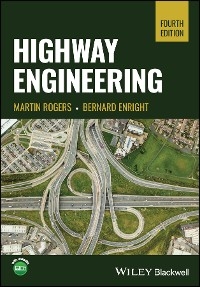
Highway Engineering (eBook)
John Wiley & Sons (Verlag)
978-1-119-88331-9 (ISBN)
Understand a foundational area of civil engineering with this up-to-date textbook
Highway construction is a complex discipline within civil engineering, with the potential to transform national economies and transportation infrastructures. With car infrastructure coming under both increasing demand and increasing scrutiny for its environmental impact, the challenges and complexities of highway engineering have never been a more vital subject. The future of sustainable transportation depends on an engineering profession with a solid grasp of the fundamentals of highway design and construction.
Highway Engineering provides a comprehensive overview of these fundamentals, preparing civil engineers and engineering students to analyze, design, and build highways. Situating its subject in the context of a broader political economy, social and ecological reality, and more, it proceeds in a logical sequence from planning to design to construction to maintenance. The result is a fully up-to-date introduction to this subject at the heart of transport engineering.
Readers of the fourth edition of Highway Engineering will also find:
- Strong integration of material from the UK Design Manual for Roads and Bridges, incorporating recent significant changes in the design of highway pavements
- Detailed examples and case studies to cultivate deepened understanding
- Increased attention to the growing importance of non-car-based modes of highway transportation-walking, cycling and public transport.
Highway Engineering is essential for engineering students studying civil engineering or transport engineering, as well as for professional civil engineers looking for a reference work.
Martin Rogers, PhD, is a Transport Planning Practitioner and Senior Lecturer in the School of Transport and Civil Engineering, Technological University Dublin, Ireland. He is a Transport Planning Professional (TPS), a Chartered Civil Engineer (ICE) and Chartered Town Planner (RTPI), with extensive experience in both the private and public sectors, including membership in the Dublin Transport Initiative Study Team that devised the Dublin city region's first integrated transportation plan.
Bernard Enright, PhD, is a Lecturer in the School of Transport and Civil Engineering, Technological University Dublin, Ireland. He has considerable experience in the engineering and information technology industries and has published extensively on highway engineering and related subjects.
Martin Rogers, PhD, is a Transport Planning Practitioner and Senior Lecturer in the School of Transport and Civil Engineering, Technological University Dublin, Ireland. He is a Transport Planning Professional (TPS), a Chartered Civil Engineer (ICE) and Chartered Town Planner (RTPI), with extensive experience in both the private and public sectors, including membership in the Dublin Transport Initiative Study Team that devised the Dublin city region's first integrated transportation plan. Bernard Enright, PhD, is a Lecturer in the School of Transport and Civil Engineering, Technological University Dublin, Ireland. He has considerable experience in the engineering and information technology industries and has published extensively on highway engineering and related subjects.
1
The Transportation Planning Process
1.1 Why Are Highways So Important?
Highways are vitally important to a country's economic development. The construction of a high‐quality road network directly increases a nation's economic output by reducing journey times and costs, making a region more attractive economically. The actual construction process will have the added effect of stimulating the construction market.
1.2 The Administration of Highway Schemes
The administration of highway projects differs from one country to another, depending on social, political, and economic factors. The design, construction, and maintenance of major national primary routes such as motorways or dual carriageways are generally the responsibility of a designated government department or an agency of it, with funding, in the main, coming from the central government. Those of secondary importance, feeding into the national routes, together with local roads, tend to be the responsibility of local authorities. The central government or an agency of it will usually take responsibility for the development of national standards.
National Highways (formerly Highways England) is an executive organisation charged within England with responsibility for the maintenance and improvement of the motorway/trunk road network. National Highways is also the statutory consultant in the planning process. Any development proposal likely to result in an adverse impact on safety or efficiency levels must interact with the organisation (in Ireland, Transport Infrastructure Ireland, formerly the National Roads Authority, has a similar function). It operates on behalf of the relevant government minister who still retains responsibility for overall policy, determines the framework within which the agency is permitted to operate and establishes its goals and objectives and the time frame within which these should take place.
In the United States, the US Federal Highway Administration has the responsibility at the federal level for formulating national transportation policy and for funding major projects that are subsequently constructed, operated, and maintained at the state level. It is one of the nine primary organisational units within the US Department of Transportation (USDOT). The Secretary of Transportation, a member of the President's cabinet, is the USDOT's principal.
Each state government has a department of transportation, which occupies a pivotal position in the development of road projects. Each has responsibility for the planning, design, construction, maintenance, and operation of its federally funded highway system. In most states, its highway agency has the responsibility for developing routes within the state‐designated system. These involve roads of both primary and secondary statewide importance. The state department also allocates funds to the local government. At the city/county level, the local government in question sets design standards for local roadways and has the responsibility for maintaining and operating them.
1.3 Sources of Funding
Obtaining adequate sources of funding for highway projects has been an ongoing problem throughout the world. Highway construction has been funded in the main by public monies. However, increasing competition for government funds from the health and education sector has led to an increasing desire to remove the financing of major highway projects from such competition by the introduction of user or toll charges.
Within the United Kingdom, the New Roads and Street Works Act 1991 gave the Secretary of State for Transport the power to create highways using private funds, where access to the facility is limited to those who have paid a toll charge. In most cases, however, the private sector has been unwilling to take on substantial responsibility for expanding the road network within the United Kingdom. Roads still tend to be financed from the public purse, with the central government being fully responsible for the capital funding of major trunk road schemes. For roads of lesser importance, each local authority receives a block grant from the central government that can be utilised to support a maintenance programme at the local level or to aid in the financing of a capital works programme. These funds will supplement monies raised by the authority through local taxation. A local authority is also permitted to borrow money for highway projects but only with the central government's approval.
In 2018, the UK Government announced a £28.8 billion National Roads Fund for 2020–2025. Within the National Roads fund, the Roads Investment Strategy 2 (RIS2), published in March 2020, will receive funding of £27.4 billion. Some of this funding will be used to build new road capacity, but much more will be used to improve the quality and reduce the negative impacts of the existing Strategic Road Network.
Within the United States, fuel taxes have financed a significant proportion of the highway system, with road tolls being charged for the use of some of the more expensive highway facilities. Tolling declined between 1960 and 1990, partly because of the introduction of the Interstate and Defense Highways Act in 1956, which prohibited the charging of tolls on newly constructed sections of the interstate highway system, and because of the wide availability of federal funding at the time for such projects. Within the past 10 years, however, the use of toll charges, user fees, and user taxes as methods of highway funding have returned. In 2016, Hawaii's roads were 71% funded by these sources.
The question of whether public or private funding should be used to construct a highway facility is a complex political issue. Some feel that public ownership of all infrastructures is a central role of government and under no circumstances should it be constructed and operated by private interests. Others take the view that any measure that reduces taxes and encourages private enterprise should be encouraged. Both arguments have some validity, and any responsible government must strive to strike the appropriate balance between these two distinct forms of infrastructure funding.
Within the United Kingdom, not all items in RIS2 are funded directly from the Statement of Funds detailed by the government. For example, while the government will continue to deliver road enhancements in partnership with developers and local partners, in certain situations, particularly those where an enhancement predominantly benefits a new development, suitable contributions will be secured from key beneficiaries.
While the United Kingdom's current roads spending plan reflects that the clear majority of longer journeys, passenger, and freight will be made by road; and that rural, remote areas will always depend more heavily on roads, there is an ultimate policy aim within the United Kingdom to decarbonise motor transport. As stated in the document ‘Decarbonising Transport, A Better, Greener Britain’, published by the UK Department of Transport (2021), all new cars and vans are planned to be fully zero emission at the tailpipe from 2035. In addition, the aim will also be to reduce the priority given to private car transport, making public transport, cycling, and walking the natural first choice for all who can take it, and reducing urban road traffic in overall terms. Improvements to public transport, walking and cycling, promoting ridesharing and higher car occupancy, and the changes in commuting, shopping, and business travel accelerated by the COVID‐19 pandemic are seen as offering the opportunity for a reduction, or at least a stabilisation, in traffic more widely. The government policy aims to reduce congestion through more efficient use of limited road space, for example, through vehicle sharing/increasing occupancy and consolidating freight.
1.4 Highway Planning
1.4.1 Introduction
The process of transportation planning entails developing a transportation plan for an urban region. It is an ongoing process that seeks to address the transport needs of the inhabitants of the area and with the aid of a process of consultation with all relevant groups strives to identify and implement an appropriate plan to meet these needs.
The process takes place at a number of levels. At an administrative/political level, a transportation policy is formulated, and politicians must decide on the general location of the transport corridors/networks to be prioritised for development, on the level of funding to be allocated to the different schemes, and on the mode or modes of transport to be used within them.
Below this level, professional planners and engineers undertake a process to define in some detail the corridors/networks that comprise each of the given systems selected for development at a higher political level. This is the level at which what is commonly termed a transportation study takes place. It defines the links and networks and involves forecasting future population and economic growth, predicting the level of potential movement within the area, and describing both the physical nature and modal mix of the system required to cope with the region's transport needs, be they road, rail, cycling, or pedestrian based. The methodologies for estimating the distribution of traffic over a transport network are detailed in Chapter 2.
At the lowest planning level, each project within a given system is defined in detail in terms of its physical extent and layout. In the case of road schemes, these functions are the...
| Erscheint lt. Verlag | 12.7.2023 |
|---|---|
| Sprache | englisch |
| Themenwelt | Technik ► Bauwesen |
| Schlagworte | Bauingenieur- u. Bauwesen • Civil Engineering • Civil Engineering & Construction • Civil Engineering & Construction Special Topics • Department of Transport • Highway Design • highway deterioration • highway maintenance • highway pavements • mass transit • National highways • pedestrians • Political Economy • Public Transport • Spezialthemen Bauingenieur- u. Bauwesen • Strassenbau • Traffic • Transportation Engineering • Verkehrsbau |
| ISBN-10 | 1-119-88331-8 / 1119883318 |
| ISBN-13 | 978-1-119-88331-9 / 9781119883319 |
| Informationen gemäß Produktsicherheitsverordnung (GPSR) | |
| Haben Sie eine Frage zum Produkt? |
 EPUB (Adobe DRM)
Kopierschutz: Adobe-DRM
Adobe-DRM ist ein Kopierschutz, der das eBook vor Mißbrauch schützen soll. Dabei wird das eBook bereits beim Download auf Ihre persönliche Adobe-ID autorisiert. Lesen können Sie das eBook dann nur auf den Geräten, welche ebenfalls auf Ihre Adobe-ID registriert sind.
Details zum Adobe-DRM
Dateiformat: EPUB (Electronic Publication)
EPUB ist ein offener Standard für eBooks und eignet sich besonders zur Darstellung von Belletristik und Sachbüchern. Der Fließtext wird dynamisch an die Display- und Schriftgröße angepasst. Auch für mobile Lesegeräte ist EPUB daher gut geeignet.
Systemvoraussetzungen:
PC/Mac: Mit einem PC oder Mac können Sie dieses eBook lesen. Sie benötigen eine
eReader: Dieses eBook kann mit (fast) allen eBook-Readern gelesen werden. Mit dem amazon-Kindle ist es aber nicht kompatibel.
Smartphone/Tablet: Egal ob Apple oder Android, dieses eBook können Sie lesen. Sie benötigen eine
Geräteliste und zusätzliche Hinweise
Buying eBooks from abroad
For tax law reasons we can sell eBooks just within Germany and Switzerland. Regrettably we cannot fulfill eBook-orders from other countries.
aus dem Bereich