


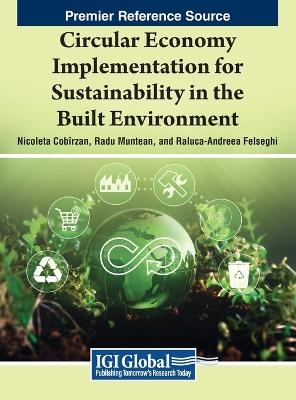
Circular Economy Implementation for Sustainability in the Built Environment
Seiten
2023
IGI Global (Verlag)
9781668482384 (ISBN)
IGI Global (Verlag)
9781668482384 (ISBN)
Focuses on the need to implement a circular economy model in the built environment and how to create a system that optimizes the use of resources and construction materials while preserving their properties and values. Topics covered include automobile industries, lean manufacturing, and operation strategy.
The construction sector plays an essential role in the global economy, using many exhaustible natural resources, most of which are renewable in low percentages. Moving towards a circular economy is essential because optimizing the consumption of materials and energy contributes to the development of an economic system that is independent, more competitive, and more resilient in the face of economic and social crises and various environmental factors. The current "take, make, and dispose" model of the economy is unsustainable, so a shift in thinking towards a circular economy is necessary. This circular economy is an economic model that minimizes the use of natural resources by selecting them intelligently and minimizing the use of raw materials, favoring the use of recyclable materials wherever possible while managing the resources used and maintaining and reusing them in the economic system for as long as possible.
Circular Economy Implementation for Sustainability in the Built Environment emphasizes the need to implement a circular economy model in the built environment and how to create a system that optimizes the use of resources and construction materials while preserving their properties and values. Covering topics such as automobile industries, lean manufacturing, and operation strategy, this premier reference source is an excellent resource for engineers, construction managers, business leaders, urban planners, students and educators of higher education, researchers, and academicians.
The construction sector plays an essential role in the global economy, using many exhaustible natural resources, most of which are renewable in low percentages. Moving towards a circular economy is essential because optimizing the consumption of materials and energy contributes to the development of an economic system that is independent, more competitive, and more resilient in the face of economic and social crises and various environmental factors. The current "take, make, and dispose" model of the economy is unsustainable, so a shift in thinking towards a circular economy is necessary. This circular economy is an economic model that minimizes the use of natural resources by selecting them intelligently and minimizing the use of raw materials, favoring the use of recyclable materials wherever possible while managing the resources used and maintaining and reusing them in the economic system for as long as possible.
Circular Economy Implementation for Sustainability in the Built Environment emphasizes the need to implement a circular economy model in the built environment and how to create a system that optimizes the use of resources and construction materials while preserving their properties and values. Covering topics such as automobile industries, lean manufacturing, and operation strategy, this premier reference source is an excellent resource for engineers, construction managers, business leaders, urban planners, students and educators of higher education, researchers, and academicians.
Nicoleta Cobȋrzan is an Associate Professor at Faculty of Civil Engineering, Technical University of Cluj-Napoca, Romania. She has a master's degree in Energy, Energy Resources and Environment and a Ph.D. in Civil Engineering. The main fields of interest and research expertise areas are in structural analysis of masonry and concrete buildings, design of low energy buildings, structural and thermal rehabilitation of existing buildings, seismic vulnerability assessment, microscopical and macroscopical investigations of building materials, investigation of recovered materials, ecological and low intensive materials, circular economy issues, sustainability.
| Erscheinungsdatum | 11.07.2023 |
|---|---|
| Verlagsort | Hershey |
| Sprache | englisch |
| Maße | 178 x 254 mm |
| Gewicht | 272 g |
| Themenwelt | Technik ► Bauwesen |
| Wirtschaft ► Betriebswirtschaft / Management ► Unternehmensführung / Management | |
| Wirtschaft ► Volkswirtschaftslehre | |
| ISBN-13 | 9781668482384 / 9781668482384 |
| Zustand | Neuware |
| Informationen gemäß Produktsicherheitsverordnung (GPSR) | |
| Haben Sie eine Frage zum Produkt? |
Mehr entdecken
aus dem Bereich

aus dem Bereich
warum etablierte Unternehmen den Wettbewerb um bahnbrechende …
Buch | Softcover (2025)
Vahlen (Verlag)
CHF 48,85
ein Navigationssystem für Führungskräfte
Buch (2023)
Carl-Auer Verlag
CHF 48,90
DIN 277 und alle relevanten Richtlinien – Kommentar, Erläuterungen, …
Buch | Hardcover (2023)
Springer Fachmedien Wiesbaden GmbH (Verlag)
CHF 118,95


