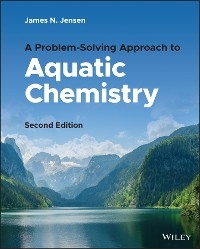
A Problem-Solving Approach to Aquatic Chemistry (eBook)
John Wiley & Sons (Verlag)
978-1-119-88436-1 (ISBN)
Enables civil and environmental engineers to understand the theory and application of aquatic equilibrium chemistry
The second edition of A Problem-Solving Approach to Aquatic Chemistry provides a detailed introduction to aquatic equilibrium chemistry, calculation methods for systems at equilibrium, applications of aquatic chemistry, and chemical kinetics. The text directly addresses two required ABET program outcomes in environmental engineering: '... chemistry (including stoichiometry, equilibrium, and kinetics)' and 'material and energy balances, fate and transport of substances in and between air, water, and soil phases.'
The book is very student-centered, with each chapter beginning with an introduction and ending with a summary that reviews the chapter's main points. To aid in reader comprehension, important terms are defined in context and key ideas are summarized. Many thought-provoking discussion questions, worked examples, and end of chapter problems are also included. Each part of the text begins with a case study, a portion of which is addressed in each subsequent chapter, illustrating the principles of that chapter. In addition, each chapter has an Historical Note exploring connections with the people and cultures connected to topics in the text.
A Problem-Solving Approach to Aquatic Chemistry includes:
- Fundamental concepts, such as concentration units, thermodynamic basis of equilibrium, and manipulating equilibria
- Solutions of chemical equilibrium problems, including setting up the problems and algebraic, graphical, and computer solution techniques
- Acid-base equilibria, including the concepts of acids and bases, titrations, and alkalinity and acidity
- Complexation, including metals, ligands, equilibrium calculations with complexes, and applications of complexation chemistry
- Oxidation-reduction equilibria, including equilibrium calculations, graphical approaches, and applications
- Gas-liquid and solid-liquid equilibrium, with expanded coverage of the effects of global climate change
- Other topics, including chemical kinetics of aquatic systems, surface chemistry, and integrative case studies
For advanced/senior undergraduates and first-year graduate students in environmental engineering courses, A Problem-Solving Approach to Aquatic Chemistry serves as an invaluable learning resource on the topic, with a variety of helpful learning elements included throughout to ensure information retention and the ability to apply covered concepts in practical settings.
James N. Jensen is Professor in the Department of Civil, Structural and Environmental Engineering at the State University of New York at Buffalo.
James N. Jensen is Professor in the Department of Civil, Structural and Environmental Engineering at the State University of New York at Buffalo.
CHAPTER 1
Getting Started with the Fundamental Concepts
1.1 INTRODUCTION
The first part of this text reviews fundamental concepts that must be mastered prior to learning how to calculate and interpret species concentrations in aquatic systems. In this chapter, the motivation for studying chemical species and a few general principles concerning aquatic systems are presented.
In Section 1.2, the motivation for why engineers and scientists are interested in individual chemical species concentrations at equilibrium will be discussed. Important water quality parameters, called primary variables, are introduced in Section 1.3. It is impossible to study water chemistry without a little knowledge of the structure of water. A few of the unique properties of water will be explored in Section 1.4, especially as they relate to the chemical reactions that occur in water. In Section 1.5, a road map for Part I of the text is presented and discussed. Finally, the Part I case study is presented at the conclusion of this chapter. Before beginning Part I of the text, you are urged to review the chemistry background material in Appendix A (Section A.2).
1.2 WHY CALCULATE CHEMICAL SPECIES CONCENTRATIONS AT EQUILIBRIUM?
1.2.1 Overview
The bulk of this book is dedicated to the calculation of species concentrations at equilibrium. The focus here is on chemical species that undergo chemical reactions; in other words, reactive species. More specifically, the emphasis here is on chemical species which react with water. Reactions with water are called hydrolysis reactions (from the Greek hydōr water + lyein to loosen). When substances react with water, numerous other compounds can be formed. Indeed, the richness of aquatic chemistry stems from the large number of substances that react not only with water but also with the products of myriad other hydrolysis reactions.
hydrolysis reactions :
reactions with water
Key idea: Hydrolysis reactions produce a wealth of dissolved chemical species
This richness is illustrated in Figure 1.1. Inputs of chemical species (from aqueous discharge, runoff, atmospheric deposition, and dissolution from sediments) react with water to form hydrolysis products. The hydrolysis products and input chemicals react further to increase the complexity of aquatic systems.
FIGURE 1.1 Complexity of Aquatic Systems
(rain cloud image: OpenClipart‐Vectors/Pixabay)
So why so much interest in calculating the equilibrium concentrations of chemical species? This question is really two questions. First, why calculate the concentrations of individual chemical species? Second, why calculate species concentrations at equilibrium?
1.2.2 Importance of Individual Chemical Species
Throughout this text, you will see that knowing the concentrations of individual chemical species is critically important in analyzing many environmental problems. At first glance, this statement may not make sense. After all, many environmental regulations are based on total concentrations of classes of compounds rather than on the concentrations of individual species. Should you be more concerned about the total amount of mercury or phenol or ammonia than about individual species stemming from the hydrolysis of mercury, phenol, or ammonia?
Key idea: The ability to calculate the concentrations of individual chemical species is critically important in analyzing many environmental problems
In fact, you will find that individual species frequently are more important. Three general examples will illustrate this point. First, adverse impacts on human health and ecosystem viability may be due to only one or several of a large number of related hydrolysis products. A prime example is the transition metals (such as mercury, copper, zinc, cadmium, iron, and lead), in which toxicity varies dramatically among the hydrolysis products. Another example is cyanide. Hydrogen cyanide (HCN) is much more toxic to humans than cyanide ion (CN–).
Second, the success of engineered treatment systems may depend on knowledge of the concentrations of key individual species. Since hydrolysis products vary in their physical, chemical, and biochemical properties, the design and operation of treatment processes depend on quantitative models for the concentrations of individual chemical species. For example, the addition of gaseous chlorine to wastewater for disinfection results in the formation of many chemical species (including HOCl, OCl–, NH2Cl, and NHCl2), each of which differs in its ability to inactivate (i.e., kill) microorganisms.
Third, individual species vary greatly in how readily they cross cell membranes or cell walls and are assimilated by aquatic biota. Thus, understanding the cycling of trace nutrients in the aquatic environment (and humankind's impact on nutrient cycling) requires knowledge of the concentrations of individual chemical species.
As an example of the importance of the concentrations of individual chemical species, consider the soup created when copper sulfate crystals, CuSO4(s),1 are added to a reservoir for algae control. The CuSO4(s) dissolves in water to form a copper‐containing ion (called the aquo cupric ion) and sulfate. The structure of the aquo cupric ion is usually abbreviated as Cu2+. The Cu2+ ions thus formed react very quickly with water to form a number of hydrolysis products, including CuOH+, Cu(OH)2(aq), Cu(OH)3–, Cu(OH)42–, and Cu2(OH)22+. Under certain chemical conditions, copper may precipitate as CuO(s). As you spread the copper sulfate from the back of a boat, carbon dioxide in the atmosphere is equilibrating with the reservoir water to form its own hydrolysis products. The hydrolysis products of carbon dioxide are H2CO3, HCO3–, and CO32–. The aquo cupric ion will react to some extent with the hydrolysis products of carbon dioxide to form CuCO3(aq), Cu(CO3)22–, and perhaps even solids containing copper and carbonate (CO32–). By adding one copper compound to a natural water body, you may be faced with accounting for as many as 10 copper‐containing species even in a relatively simple chemical model.
Of course, the real world is even more complex. The reservoir water contains many more species that can react with copper than just hydroxide (OH–) and carbonate. A realistic model for copper in the reservoir would have to include the reactions of Cu2+ with (among other chemical species) chloride, amino acids, ammonia, particulates, and microorganisms. In reality, the act of throwing copper sulfate crystals into the reservoir will produce dozens of chemical species containing copper.
Key idea: Doses depend on both the required concentration of the target individual species and the chemistry of the water
Why should you care that copper sulfate forms many copper‐containing species in a lake? Remember that copper is added to kill algae. It is well‐established that copper toxicity to algae is due almost entirely to one chemical species: Cu2+ (Jackson and Morgan 1978). Thus, to determine the copper sulfate dose, you must be able to calculate the concentration of Cu2+ after a certain amount of copper sulfate is added to the reservoir. Since the Cu2+ concentration usually is exceedingly small, this is akin to counting needles of Cu2+ in this haystack of copper‐containing species. In practice, you would back‐calculate the copper sulfate dose required to achieve a required level of Cu2+. Even if two reservoirs had the same amounts of algae, different water chemistries in the reservoirs may lead to very different copper sulfate doses to achieve the same Cu2+ concentration. The chemistry of the water determines how the required concentration of one species (Cu2+) is translated back into a copper sulfate dose.
The process of relating a dose to a required concentration of an individual chemical species is illustrated in Figure 1.2. The arrows in Figure 1.2 indicate chemical reactions that must be included in a mathematical model to allow for the determination of the copper sulfate dose. In this text, you will learn the tools to make quantitative decisions to solve similar problems in the aquatic environment.
FIGURE 1.2 Qualitative Relationship Between the Dose Required and End Species Concentrations Desired
1.2.3 Importance of Equilibrium
An entire chapter of this book (Chapter 3) is devoted to developing the thermodynamic basis of equilibrium. For the present, you can think of the equilibrium state as the condition in which the concentrations of all chemical species do not change with time. To impose equilibrium on a chemical system, the interesting and important time‐dependent nature of chemical concentrations are excluded. The study of the rates of chemical reaction is called chemical kinetics and is covered in Chapter 23. Why constrain the discussion mainly to the equilibrium state here, with shorter coverage of chemical kinetics?
chemical kinetics: the study of chemical reaction rates
There are two reasons for focusing on equilibrium. First, many of the chemical reactions you will examine in this text are fast. For example, the reaction of H+ and OH– to form water occurs on the time scale of 10–5 s at...
| Erscheint lt. Verlag | 20.12.2022 |
|---|---|
| Sprache | englisch |
| Themenwelt | Technik ► Bauwesen |
| Schlagworte | acidity • acids and bases • Alkalinity • aqueous systems • Bauingenieur- u. Bauwesen • chemical equilibrium • Chemie • Chemistry • Civil Engineering & Construction • concentration units • equilibrium calculations with complexes • Hydraulic/Water Engineering • Hydraulik • Hydraulik, Wasserbau • Ligands • manipulating equilibria • metals • thermodynamic basis of equilibrium • Titrations • Wasserchemie • Wasserwirtschaft • water chemistry • water resources |
| ISBN-10 | 1-119-88436-5 / 1119884365 |
| ISBN-13 | 978-1-119-88436-1 / 9781119884361 |
| Informationen gemäß Produktsicherheitsverordnung (GPSR) | |
| Haben Sie eine Frage zum Produkt? |
 EPUB (Adobe DRM)
Kopierschutz: Adobe-DRM
Adobe-DRM ist ein Kopierschutz, der das eBook vor Mißbrauch schützen soll. Dabei wird das eBook bereits beim Download auf Ihre persönliche Adobe-ID autorisiert. Lesen können Sie das eBook dann nur auf den Geräten, welche ebenfalls auf Ihre Adobe-ID registriert sind.
Details zum Adobe-DRM
Dateiformat: EPUB (Electronic Publication)
EPUB ist ein offener Standard für eBooks und eignet sich besonders zur Darstellung von Belletristik und Sachbüchern. Der Fließtext wird dynamisch an die Display- und Schriftgröße angepasst. Auch für mobile Lesegeräte ist EPUB daher gut geeignet.
Systemvoraussetzungen:
PC/Mac: Mit einem PC oder Mac können Sie dieses eBook lesen. Sie benötigen eine
eReader: Dieses eBook kann mit (fast) allen eBook-Readern gelesen werden. Mit dem amazon-Kindle ist es aber nicht kompatibel.
Smartphone/Tablet: Egal ob Apple oder Android, dieses eBook können Sie lesen. Sie benötigen eine
Geräteliste und zusätzliche Hinweise
Buying eBooks from abroad
For tax law reasons we can sell eBooks just within Germany and Switzerland. Regrettably we cannot fulfill eBook-orders from other countries.
aus dem Bereich