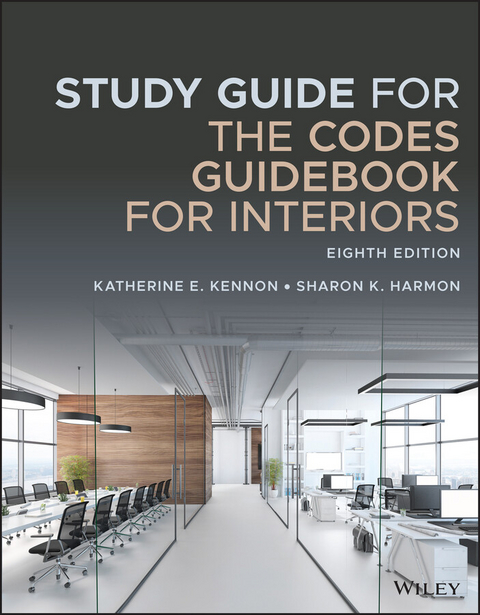
Study Guide for The Codes Guidebook for Interiors (eBook)
John Wiley & Sons (Verlag)
978-1-119-72089-8 (ISBN)
The comprehensive study guide for understanding interior codes
This revised and updated eighth edition of the Study Guide for the Codes Guidebook for Interiors is an essential companion to The Codes Guidebook for Interiors, the industry's reference of choice. It offers complete coverage of the major codes and standards that apply to interior projects. This Study Guide includes lists of terms, practice questions, practical application exercises, code tables, and checklists. This companion study guide is a comprehensive measure of a designer's understanding and application of codes for interior projects. It can help design students learn and practitioners keep their skills up to date and prepare for the NCIDQ and ARE exams.
It is vital that designers and architects have an up-to-date working knowledge of the various codes involved with building interiors, whether during renovation or new construction, and this study guide offers the opportunity to:
- Study with many new questions, in both the short answer and application sections
- Review the key terms of the industry
- Use the practice questions and exercises to test working knowledge of codes
- Utilize the code tables during the design process
- Employ the numerous checklists on proposed and real life projects to ensure complete compliance
The revised Study Guide is a useful companion to The Codes Guidebook for Interiors, the essential reference for all interior professionals. For the designer, architect, or student, the Study Guide for The Codes Guidebook for Interiors is a must-have resource.
KATHERINE E. KENNON is a professional architect and principal at the Architect WORKSHOP. She has extensive experience in commercial, healthcare, and residential projects. She continues to teach as an adjunct instructor in interior design and architectural programs on the subjects of codes, accessibility, and design. She has conducted various seminars on design, building codes, and accessibility throughout the US.
SHARON K. HARMON has more than twenty-five years' experience in interior design and project management. Combining this with her strong interest in natural health, she now owns Life Design for Health, which helps people pursue a holistic approach to health and well-being.
KATHERINE E. KENNON is a professional architect and principal at the Architect WORKSHOP. She has extensive experience in commercial, healthcare, and residential projects. She continues to teach as an adjunct instructor in interior design and architectural programs on the subjects of codes, accessibility, and design. She has conducted various seminars on design, building codes, and accessibility throughout the US. SHARON K. HARMON has more than twenty-five years' experience in interior design and project management. Combining this with her strong interest in natural health, she now owns Life Design for Health, which helps people pursue a holistic approach to health and well-being.
INTRODUCTION
SECTION 1 KEY TERMS BY CHAPTER
Chapter 1 About the Codes
Chapter 2 Accessibility
Chapter 3 Occupancy Classifications and Loads
Chapter 4 Construction Types and Building Sizes
Chapter 5 Means of Egress
Chapter 6 Fire and Smoke Resistant Assemblies
Chapter 7 Fire Protection Systems
Chapter 8 Plumbing and Mechanical Requirements
Chapter 9 Electrical and Communication Requirements
Chapter 10 Finish and Furniture Selection
Chapter 11 Code Officials and the Code Process
SECTION 2 SHORT-ANSWER QUESTIONS
Chapter 1 About the Codes
Chapter 2 Accessibility
Chapter 3 Occupancy Classifications and Loads
Chapter 4 Construction Types and Building Sizes
Chapter 5 Means of Egress
Chapter 6 Fire and Smoke Resistant Assemblies
Chapter 7 Fire Protection Systems
Chapter 8 Plumbing and Mechanical Requirements
Chapter 9 Electrical and Communication Requirements
Chapter 10 Finish and Furniture Selection
Chapter 11 Code Officials and the Code Process
SECTION 3 STUDY PROBLEMS
Chapter 1 About the Codes
Chapter 2 Accessibility
Chapter 3 Occupancy Classifications and Loads
Chapter 4 Construction Types and Building Sizes
Chapter 5 Means of Egress
Chapter 6 Fire and Smoke Resistant Assemblies
Chapter 7 Fire Protection Systems
Chapter 8 Plumbing and Mechanical Requirements
Chapter 9 Electrical and Communication Requirements
Chapter 10 Finish and Furniture Selection
Chapter 11 Code Officials and the Code Process
SECTION 4 ANSWERS TO SHORT-ANSWER QUESTIONS
Chapter 1 About the Codes
Chapter 2 Accessibility
Chapter 3 Occupancy Classifications and Loads
Chapter 4 Construction Types and Building Sizes
Chapter 5 Means of Egress
Chapter 6 Fire and Smoke Resistant Assemblies
Chapter 7 Fire Protection Systems
Chapter 8 Plumbing and Mechanical Requirements
Chapter 9 Electrical and Communication Requirements
Chapter 10 Finish and Furniture Selection
Chapter 11 Code Officials and the Code Process
SECTION 5 ANSWERS TO STUDY PROBLEMS
Chapter 1 About the Codes
Chapter 2 Accessibility
Chapter 3 Occupancy Classifications and Loads
Chapter 4 Construction Types and Building Sizes
Chapter 5 Means of Egress
Chapter 6 Fire and Smoke Resistant Assemblies
Chapter 7 Fire Protection Systems
Chapter 8 Plumbing and Mechanical Requirements
Chapter 9 Electrical and Communication Requirements
Chapter 10 Finish and Furniture Selection
Chapter 11 Code Officials and the Code Process
APPENDIX A CODE TABLES
APPENDIX B FULL-SIZE CHECKLISTS
SECTION 1
KEY TERMS BY CHAPTER
CHAPTER 1: About the Codes
- Alternative materials, design, and methods
- American National Standards Institute (ANSI)
- American Society of Heating, Refrigeration, and Air‐Conditioning Engineers (ASHRAE)
- ANS process (ANS consensus process)
- ASHRAE/IESNA 90.1, Energy Standard for Buildings Except Low‐Rise Residential Buildings
- ASHRAE/IESNA 90.2, Energy Efficient Design of Low‐Rise Residential Buildings
- ASHRAE/USGBC/IES 189.1, Standard for the Design of High‐Performance Green Buildings
- ASTM International (ASTM)
- California Green Building Standards Code (CALGreen)
- Certification
- Code
- Code of Federal Regulations (CFR)
- Common Code Format
- Department of Energy (DOE)
- Energy Policy Act (EPAct)
- Federal Register (FR)
- Federal regulation
- Fire Code (NFPA 1)
- ICC Performance Code for Buildings and Facilities (ICCPC)
- International Association of Plumbing and Mechanical Officials (IAPMO)
- International Building Code (IBC)
- International Code Council (ICC)
- International Energy Conservation Code (IECC)
- International Existing Building Code (IEBC)
- International Fire Code (IFC)
- International Green Construction Code (IgCC)
- International Mechanical Code (IMC)
- International Organization for Standardization (ISO)
- International Plumbing Code (IPC)
- International Residential Code (IRC)
- Legacy code
- Life Safety Code (LSC)
- Manual of Style
- National Electrical Code (NEC or NFPA 70)
- National Fire Protection Association (NFPA)
- National Green Building Standard (NGBS or ICC 700)
- National Standard Plumbing Code (NSPC)
- NFPA 900, Building Energy Code
- NFPA 5000, Building Construction and Safety Code (NFPA 5000)
- NSF International (NSF)
- Performance code (or criteria)
- Prescriptive code
- Public accommodation
- Standard
- Sustainability
- Sustainable Design
- Underwriters Laboratories (UL)
- Uniform Mechanical Code (UMC)
- Uniform Plumbing Code (UPC)
- U.S. Green Building Council (USGBC)
CHAPTER 2: Accessibility
- ADA Standards (or 2010 ADA Standards)
- ADA‐ABA Accessibility Guidelines (2004)
- Accessible route
- Accommodation
- Americans with Disabilities Act (ADA)
- Americans with Disabilities Act Accessibility Guidelines (ADAAG, or 1994 ADA Standards)
- Architectural and Transportation Barriers Compliance Board (ATBCB or U.S. Access Board)
- Architectural Barriers Act (ABA)
- Certified document
- Commercial facility
- Department of Housing and Urban Development (HUD)
- Department of Justice (DOJ)
- Department of Transportation (DOT)
- Fair Housing Accessibility Guidelines (FHAG)
- Fair Housing Act (FHA)
- ICC A117.1, American Standard Specification for Making Buildings and Facilities Accessible to and Usable by the Physically Handicapped
- Maximum extent feasible
- Place of public accommodation
- Primary function
- Readily achievable
- Safe harbor
- Social service center
- Undue burden
- Uniform Federal Accessibility Standards (UFAS)
CHAPTER 3: Occupancy Classifications and Loads
- Accessory occupancy
- Ambulatory Health Care
- Ancillary space
- Assembly occupancy
- Building type (or use)
- Business occupancy
- Care suite
- Custodial care
- Detentional/correctional occupancy
- Dwelling unit
- Educational occupancy
- Factory occupancy
- Fixed seating
- Floor area
- Fuel load
- Gross square feet
- Guest room or suite
- Habitable room
- Hazard
- Hazardous occupancy
- Health Care occupancy
- Incidental use
- Industrial occupancy
- Institutional occupancy
- Live/work unit
- Living area or room
- Load factor
- Medical care
- Mercantile occupancy
- Mixed multiple occupancy
- Multiple occupancy
- Net square feet
- Nonseparated mixed occupancy
- Occupancy classification
- Occupancy subclassification
- Occupant
- Occupant load
- Occupiable space (or room)
- Primary space (or use)
- Residential occupancy
- Risk factor
- Separated mixed occupancy
- Separated multiple occupancy
- Sleeping area, unit or room
- Storage occupancy
- Subclassification
- Transient lodging
- Utility occupancy
CHAPTER 4: Construction Types and Building Sizes
- Atrium
- Basement
- Building area
- Building element
- Building height
- Combustible
- Construction type
- Fire resistance rating
- Fire resistive
- Fire retardant
- Fire wall
- Floor area
- Heavy timber
- High‐rise building
- Limited combustible
- Mezzanine
- Noncombustible
- Party wall
- Protected
- Story
- Structural element
- Unprotected
CHAPTER 5: Means of Egress
- Accessible means of egress
- Aisle
- Aisle accessway
- Alcove
- Area of refuge
- Common path of travel
- Corridor
- Dead‐end corridor
- Discharge corridor
- Egress court
- Elevator
- Emergency Escape and Rescue Opening
- Emergency lighting
- Escalator
- Exit
- Exit access
- Exit discharge
- Exit passageway
- Exit sign
- Exit stair
- Exit width
- Exterior exit door
- Foyer
- Freight elevator
- Guard
- Half‐diagonal rule
- Handrail
- Horizontal exit
- Intervening room
- Landing
- Means of egress
- Moving walk
- Multi‐story building
- Natural path of travel
- Nosing
- Occupant load
- Passageway
- Public way
- Ramp
- Remoteness
- Riser
- Stair variable
- Stairway
- Story
- Travel distance
- Tread
- Turning space (or circle)
- Unobstructed path
- Vertical rise
- Vestibule
CHAPTER 6: Fire and Smoke Resistant Assemblies
- Active fire protection system
- Automatic closing
- Ceiling damper
- Ceramic glazing
- Compartmentation
- Construction assembly
- Corridor damper system
- Demising wall
- Draftstop
- Evacuation
- Fire area
- Fire barrier
- Fireblock
- Fire damper
- Fire door assembly
- Fire exit hardware
- Fire partition
- Fire protection rating
- Fire‐rated assembly
- Fire rating
- Fire resistance rating
- Firestop
- Fire wall
- Fire window assembly
- Floor/ceiling assembly
- F‐rating
- Fuel load
- Glass block
- Horizontal assembly
- Horizontal exit
- Incidental use
- Label
- Laminated glass
- L‐rating
- Membrane penetration
- Occupancy separation
- Opening protective
- Panic hardware
- Party wall
- Passive fire protection system
- Rated glazing
- Roof/ceiling assembly
- Safety glass
- Self‐closing
- Smoke barrier
- Smoke compartment
- Smoke damper
- Smoke partition
- Smokestop
- Smokestop door
- Sound transmission
- Tenant separation
- Test ratings
- Through‐penetration
- Through‐penetration protective
- Transparent wall unit
- T‐rating
- Vertical shaft enclosure
- Vestibule
- Wall assembly
- Window assembly
- Wired glass
CHAPTER 7: Fire Protection Systems
- Accessible warning system
- Alarm system
- Audible alarm
- Automatic sprinkler system
- Carbon monoxide detector
- Deluge (sprinkler) system
- Detection system
- Dry pipe (sprinkler) system
- Emergency communication system (ECS)
- Extended coverage sprinkler head
- Extinguishing system
- Fast‐response sprinkler head
- Fire area
- Fire detector
- Fire extinguisher
- Fire hose
- Fire protection system
- Fire zone
- Heat detector
- Initiating device
- Integrated alarm
- Large‐drop sprinkler head
- Manual fire alarm
- Mass notification system (MNS)
- Multiple‐station detector
- Open sprinkler head
- Preaction (sprinkler) system
- Quick‐response sprinkler head
- Residential sprinkler head
- Single‐station detector
- Smoke detector
- Sprinkler head
- Standard spray...
| Erscheint lt. Verlag | 10.2.2022 |
|---|---|
| Sprache | englisch |
| Themenwelt | Kunst / Musik / Theater ► Design / Innenarchitektur / Mode |
| Technik ► Architektur | |
| Schlagworte | ADA • Architecture • Architektur • are • ARE exam • ASI • Bauentwurf • Berufspraxis i. d. Architektur • Building Design • ICC • Innenarchitektur • interior architecture codes • interior architecture standards • Interior codes • interior codes guide • Interior design • interior design codes • interior design standards • interior standards • interior standards guide • ncidq • NCIDQ exam • NFPA • Professional Practice |
| ISBN-10 | 1-119-72089-3 / 1119720893 |
| ISBN-13 | 978-1-119-72089-8 / 9781119720898 |
| Informationen gemäß Produktsicherheitsverordnung (GPSR) | |
| Haben Sie eine Frage zum Produkt? |
 EPUB (Adobe DRM)
Kopierschutz: Adobe-DRM
Adobe-DRM ist ein Kopierschutz, der das eBook vor Mißbrauch schützen soll. Dabei wird das eBook bereits beim Download auf Ihre persönliche Adobe-ID autorisiert. Lesen können Sie das eBook dann nur auf den Geräten, welche ebenfalls auf Ihre Adobe-ID registriert sind.
Details zum Adobe-DRM
Dateiformat: EPUB (Electronic Publication)
EPUB ist ein offener Standard für eBooks und eignet sich besonders zur Darstellung von Belletristik und Sachbüchern. Der Fließtext wird dynamisch an die Display- und Schriftgröße angepasst. Auch für mobile Lesegeräte ist EPUB daher gut geeignet.
Systemvoraussetzungen:
PC/Mac: Mit einem PC oder Mac können Sie dieses eBook lesen. Sie benötigen eine
eReader: Dieses eBook kann mit (fast) allen eBook-Readern gelesen werden. Mit dem amazon-Kindle ist es aber nicht kompatibel.
Smartphone/Tablet: Egal ob Apple oder Android, dieses eBook können Sie lesen. Sie benötigen eine
Geräteliste und zusätzliche Hinweise
Buying eBooks from abroad
For tax law reasons we can sell eBooks just within Germany and Switzerland. Regrettably we cannot fulfill eBook-orders from other countries.
aus dem Bereich