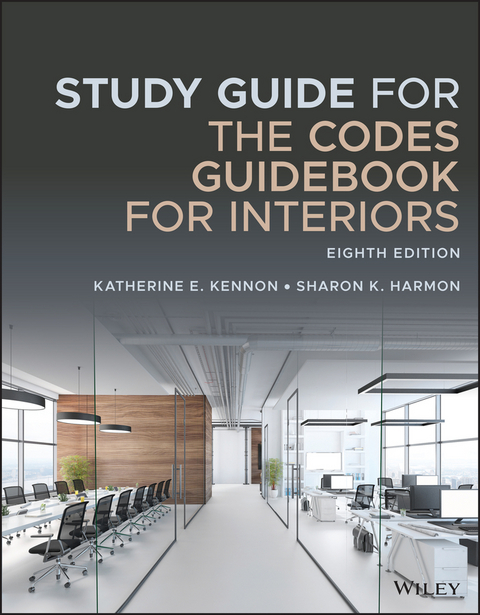
Study Guide for The Codes Guidebook for Interiors (eBook)
John Wiley & Sons (Verlag)
978-1-119-72091-1 (ISBN)
The comprehensive study guide for understanding interior codes
This revised and updated eighth edition of the Study Guide for the Codes Guidebook for Interiors is an essential companion to The Codes Guidebook for Interiors, the industry's reference of choice. It offers complete coverage of the major codes and standards that apply to interior projects. This Study Guide includes lists of terms, practice questions, practical application exercises, code tables, and checklists. This companion study guide is a comprehensive measure of a designer's understanding and application of codes for interior projects. It can help design students learn and practitioners keep their skills up to date and prepare for the NCIDQ and ARE exams.
It is vital that designers and architects have an up-to-date working knowledge of the various codes involved with building interiors, whether during renovation or new construction, and this study guide offers the opportunity to:
- Study with many new questions, in both the short answer and application sections
- Review the key terms of the industry
- Use the practice questions and exercises to test working knowledge of codes
- Utilize the code tables during the design process
- Employ the numerous checklists on proposed and real life projects to ensure complete compliance
The revised Study Guide is a useful companion to The Codes Guidebook for Interiors, the essential reference for all interior professionals. For the designer, architect, or student, the Study Guide for The Codes Guidebook for Interiors is a must-have resource.
KATHERINE E. KENNON is a professional architect and principal at the Architect WORKSHOP. She has extensive experience in commercial, healthcare, and residential projects. She continues to teach as an adjunct instructor in interior design and architectural programs on the subjects of codes, accessibility, and design. She has conducted various seminars on design, building codes, and accessibility throughout the US.
SHARON K. HARMON has more than twenty-five years' experience in interior design and project management. Combining this with her strong interest in natural health, she now owns Life Design for Health, which helps people pursue a holistic approach to health and well-being.
STUDY GUIDE FOR THE CODES GUIDEBOOK FOR INTERIORS The comprehensive study guide for understanding interior codes This revised and updated eighth edition of the Study Guide for the Codes Guidebook for Interiors is an essential companion to The Codes Guidebook for Interiors, the industry s reference of choice. It offers complete coverage of the major codes and standards that apply to interior projects. This Study Guide includes lists of terms, practice questions, practical application exercises, code tables, and checklists. This companion study guide is a comprehensive measure of a designer s understanding and application of codes for interior projects. It can help design students learn and practitioners keep their skills up to date and prepare for the NCIDQ and ARE exams. It is vital that designers and architects have an up-to-date working knowledge of the various codes involved with building interiors, whether during renovation or new construction, and this study guide offers the opportunity to: Study with many new questions, in both the short answer and application sections Review the key terms of the industry Use the practice questions and exercises to test working knowledge of codes Utilize the code tables during the design process Employ the numerous checklists on proposed and real life projects to ensure complete compliance The revised Study Guide is a useful companion to The Codes Guidebook for Interiors, the essential reference for all interior professionals. For the designer, architect, or student, the Study Guide for The Codes Guidebook for Interiors is a must-have resource.
KATHERINE E. KENNON is a professional architect and principal at the Architect WORKSHOP. She has extensive experience in commercial, healthcare, and residential projects. She continues to teach as an adjunct instructor in interior design and architectural programs on the subjects of codes, accessibility, and design. She has conducted various seminars on design, building codes, and accessibility throughout the US. SHARON K. HARMON has more than twenty-five years' experience in interior design and project management. Combining this with her strong interest in natural health, she now owns Life Design for Health, which helps people pursue a holistic approach to health and well-being.
INTRODUCTION
SECTION 1 KEY TERMS BY CHAPTER
Chapter 1 About the Codes
Chapter 2 Accessibility
Chapter 3 Occupancy Classifications and Loads
Chapter 4 Construction Types and Building Sizes
Chapter 5 Means of Egress
Chapter 6 Fire and Smoke Resistant Assemblies
Chapter 7 Fire Protection Systems
Chapter 8 Plumbing and Mechanical Requirements
Chapter 9 Electrical and Communication Requirements
Chapter 10 Finish and Furniture Selection
Chapter 11 Code Officials and the Code Process
SECTION 2 SHORT-ANSWER QUESTIONS
Chapter 1 About the Codes
Chapter 2 Accessibility
Chapter 3 Occupancy Classifications and Loads
Chapter 4 Construction Types and Building Sizes
Chapter 5 Means of Egress
Chapter 6 Fire and Smoke Resistant Assemblies
Chapter 7 Fire Protection Systems
Chapter 8 Plumbing and Mechanical Requirements
Chapter 9 Electrical and Communication Requirements
Chapter 10 Finish and Furniture Selection
Chapter 11 Code Officials and the Code Process
SECTION 3 STUDY PROBLEMS
Chapter 1 About the Codes
Chapter 2 Accessibility
Chapter 3 Occupancy Classifications and Loads
Chapter 4 Construction Types and Building Sizes
Chapter 5 Means of Egress
Chapter 6 Fire and Smoke Resistant Assemblies
Chapter 7 Fire Protection Systems
Chapter 8 Plumbing and Mechanical Requirements
Chapter 9 Electrical and Communication Requirements
Chapter 10 Finish and Furniture Selection
Chapter 11 Code Officials and the Code Process
SECTION 4 ANSWERS TO SHORT-ANSWER QUESTIONS
Chapter 1 About the Codes
Chapter 2 Accessibility
Chapter 3 Occupancy Classifications and Loads
Chapter 4 Construction Types and Building Sizes
Chapter 5 Means of Egress
Chapter 6 Fire and Smoke Resistant Assemblies
Chapter 7 Fire Protection Systems
Chapter 8 Plumbing and Mechanical Requirements
Chapter 9 Electrical and Communication Requirements
Chapter 10 Finish and Furniture Selection
Chapter 11 Code Officials and the Code Process
SECTION 5 ANSWERS TO STUDY PROBLEMS
Chapter 1 About the Codes
Chapter 2 Accessibility
Chapter 3 Occupancy Classifications and Loads
Chapter 4 Construction Types and Building Sizes
Chapter 5 Means of Egress
Chapter 6 Fire and Smoke Resistant Assemblies
Chapter 7 Fire Protection Systems
Chapter 8 Plumbing and Mechanical Requirements
Chapter 9 Electrical and Communication Requirements
Chapter 10 Finish and Furniture Selection
Chapter 11 Code Officials and the Code Process
APPENDIX A CODE TABLES
APPENDIX B FULL-SIZE CHECKLISTS
| Erscheint lt. Verlag | 4.2.2022 |
|---|---|
| Sprache | englisch |
| Themenwelt | Kunst / Musik / Theater ► Design / Innenarchitektur / Mode |
| Technik ► Architektur | |
| Schlagworte | ADA • Architecture • Architektur • are • ARE exam • ASI • Bauentwurf • Berufspraxis i. d. Architektur • Building Design • ICC • Innenarchitektur • interior architecture codes • interior architecture standards • Interior codes • interior codes guide • Interior design • interior design codes • interior design standards • interior standards • interior standards guide • ncidq • NCIDQ exam • NFPA • Professional Practice |
| ISBN-10 | 1-119-72091-5 / 1119720915 |
| ISBN-13 | 978-1-119-72091-1 / 9781119720911 |
| Informationen gemäß Produktsicherheitsverordnung (GPSR) | |
| Haben Sie eine Frage zum Produkt? |
 PDF (Adobe DRM)
Kopierschutz: Adobe-DRM
Adobe-DRM ist ein Kopierschutz, der das eBook vor Mißbrauch schützen soll. Dabei wird das eBook bereits beim Download auf Ihre persönliche Adobe-ID autorisiert. Lesen können Sie das eBook dann nur auf den Geräten, welche ebenfalls auf Ihre Adobe-ID registriert sind.
Details zum Adobe-DRM
Dateiformat: PDF (Portable Document Format)
Mit einem festen Seitenlayout eignet sich die PDF besonders für Fachbücher mit Spalten, Tabellen und Abbildungen. Eine PDF kann auf fast allen Geräten angezeigt werden, ist aber für kleine Displays (Smartphone, eReader) nur eingeschränkt geeignet.
Systemvoraussetzungen:
PC/Mac: Mit einem PC oder Mac können Sie dieses eBook lesen. Sie benötigen eine
eReader: Dieses eBook kann mit (fast) allen eBook-Readern gelesen werden. Mit dem amazon-Kindle ist es aber nicht kompatibel.
Smartphone/Tablet: Egal ob Apple oder Android, dieses eBook können Sie lesen. Sie benötigen eine
Geräteliste und zusätzliche Hinweise
Buying eBooks from abroad
For tax law reasons we can sell eBooks just within Germany and Switzerland. Regrettably we cannot fulfill eBook-orders from other countries.
aus dem Bereich