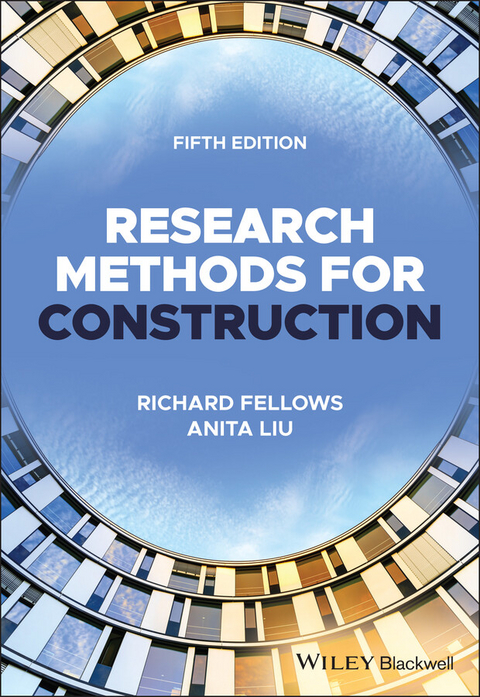
Research Methods for Construction (eBook)
384 Seiten
Wiley-Blackwell (Verlag)
978-1-119-81475-7 (ISBN)
Research Methods for Construction is designed to help construction students develop the research skills needed to achieve success in their research projects. Providing clear guidance on research formulation, methodologies, and methods, this comprehensive textbook addresses the theoretical, philosophical, and practical aspects of research in many areas of construction. The authors explain the requirements for data and analysis and describe the methods used for scientific and engineering experiments, modelling and simulations, research on management and socio-economic issues, and more.
Now in its fifth edition, Research Methods for Construction is fully revised to reflect contemporary developments and emerging areas of construction research. New and expanded chapters cover topics including data protection and ethics, theory borrowing, sensemaking, and directionally motivated reasoning. This edition includes additional models and details relating to translation, and offers fresh discussion of axiology, determinism, and stochasticism. Providing students with coherent, well-structured account of construction research, this market-leading textbook:
- Emphasizes and instils rigor into construction students' problem-solving, reports, and publications
- Assists researchers in selecting appropriate methods to execute research
- Articulates the stages of construction research processes: producing a proposal, executing the research, and reporting the results
- Examines qualitative and quantitative approaches and statistical considerations for a wide range of construction research
- Discusses current ethical, legal, and regulatory issues pertaining to research in construction
The fifth edition of Research Methods for Construction is the ideal textbook for advanced undergraduate and postgraduate students embarking on a research project, at bachelors, masters or doctoral level, in construction, surveying, architecture, civil engineering, and other built environment disciplines.
Richard Fellows is Emeritus Professor of Construction Business Management, Loughborough University, UK. He is an experienced quantity surveyor and in his academic career has taught at several universities in the UK and other countries. His research interests concern economics, contracts and law, and the management of people in construction - especially cultural issues as drivers of behaviour and performance. He was a founder and for many years was joint coordinator of the CIB group, W112 - Culture in Construction. Richard is an editor of a leading construction journal and frequent reviewer of papers for international conferences and journals.
Anita Liu graduated from the University of Reading and returned to Hong Kong to work in a quantity surveying consultancy, for the Hong Kong government, and for a major contractor. She then moved into academia, obtaining an MSc and a PhD from the University of Hong Kong. She became Chair Professor of Commercial Management and Quantity Surveying at Loughborough University and subsequently Head of Department and Professor in the Department of Real Estate and Construction at The University of Hong Kong. She was also joint co-coordinator of CIB group W112: Culture in Construction.
Richard Fellows is Emeritus Professor of Construction Business Management, Loughborough University, UK. He is an experienced quantity surveyor and in his academic career has taught at several universities in the UK and other countries. His research interests concern economics, contracts and law, and the management of people in construction - especially cultural issues as drivers of behaviour and performance. He was a founder and for many years was joint coordinator of the CIB group, W112 - Culture in Construction. Richard is an editor of a leading construction journal and frequent reviewer of papers for international conferences and journals. Anita Liu graduated from the University of Reading and returned to Hong Kong to work in a quantity surveying consultancy, for the Hong Kong government, and for a major contractor. She then moved into academia, obtaining an MSc and a PhD from the University of Hong Kong. She became Chair Professor of Commercial Management and Quantity Surveying at Loughborough University and subsequently Head of Department and Professor in the Department of Real Estate and Construction at The University of Hong Kong. She was also joint co-coordinator of CIB group W112: Culture in Construction.
1
Introduction
The objectives of this chapter are to:
- introduce the concept of research
- provide awareness of different classifications of research
- outline the essentials of theories and paradigms
- discuss the various research styles
- introduce quantitative, qualitative, and triangulated approaches
- consider where, and how, to begin.
1.1 The concept of research
Chambers English Dictionary defines research as:
- a careful search
- investigation
- systematic investigation towards increasing the sum of knowledge.
For many people, the prospect of embarking on a research project is a daunting one. However, especially for people who are associated with a project‐oriented industry, such as property development, building design, construction or facilities management, familiarity with the nature of projects and their management is a significant advantage. Dr Martin Barnes, an ex‐chairperson of the Association of Project Managers (APM), has described a project as a task or an activity which has a beginning (start), a middle, and an end that involves a process which leads to an output (product/solution). Thus, getting married is a project but staying married is not a project! Staying married is a process. Despite the situation that much research is carried out as part of a long‐term ‘rolling’ programme, each individual package of research is an entity which is complete in itself, while contributing to the overall programme.
Indeed, any work which assists in the advancement of knowledge, whether of society, a group or an individual, involves research; it will also involve enquiry and learning.
1.1.1 Research: a careful search/investigation
Research can be considered to be a ‘voyage of discovery’, whether anything is discovered or not. In fact, it is highly likely that some discovery will result because discovery can concern the process of investigation as well as the ‘technical subject’ (the topic of investigation). Even if no new knowledge is apparent, the investigation may lend further support for existing theory.
What is discovered depends on the question(s) or topic which the research addresses, the patterns and techniques of searching, the location and subject material investigated, the analyses carried out and, importantly, reflection by the researcher on the results of the analyses in the context of the theory and literature, the methodology and the methods employed. The knowledge and abilities of researchers and their associates are important in executing the investigative work and, perhaps more especially, in the production of results, discussion of them, and the drawing of conclusions. Being open‐minded, self‐aware and as objective as possible is vital for good research.
1.1.2 Research: contribution to knowledge
The Economic and Social Research Council (ESRC) defines research as ‘… any form of disciplined inquiry that aims to contribute to a body of knowledge or theory’ (ESRC 2007). That definition demonstrates that the inquiry must be designed and structured appropriately and that it is the intent of the inquiry which is important (to distinguish from casual inquiries) rather than the outcome per se.
The Concise Oxford Dictionary (1995) provides a more extensive definition of research as ‘the systematic investigation into and study of materials, sources, etc. in order to establish facts and reach new conclusions’. Here the emphasis lies on determining facts in order to reach new conclusions – hence, new knowledge. The issue of ‘facts’ is not as clear, philosophically speaking, as is commonly assumed, and will be considered later.
The dictionary continues: ‘an endeavour to discover new or collate old facts, etc. by the scientific study of a subject or by a course of critical investigation’. Here there is added emphasis on the method(s) of study; the importance of being both scientific and critical is reinforced.
Therefore, research comprises what (facts and conclusions) and how (systematic; scientific; critical) components. Being critical, even sceptical, rather than merely accepting is vital; evidence to support assertions, use of methods, production of findings, etc. is essential. ‘…critical analysis questions the authority and objective necessity of the normative framework that is taken for granted…also challenges the adequacy of…accounts…’ (Willmott 1993: 522). Further, it is concerned to ‘…situate the development and popularity of ideas and practices…in the material and historical contexts of their emergence and application…’ (ibid: 521).
The history of the nature of investigations constituting research is paralleled by the continuum of activities undertaken in a modern research project – description, classification, comparison, measurement, establishing (any) association, determining cause and effect (Bonoma 1985). ‘Studies toward the description end of the continuum might be associated more frequently with theory building, whereas those near the cause‐and‐effect end are more frequently used for theory disconfirmation [testing]’ ([..] added, ibid: 201).
Traditionally, the essential feature of research for a doctoral degree (PhD – Doctor of Philosophy) is that the work makes an original (incremental) contribution to knowledge. This is a requirement for a PhD, and many other research projects make original contributions to knowledge also. A vast number of research projects synthesise and analyse existing theory, ideas, and findings of other research, in seeking to answer a particular question or to provide new insights. Often, such research is referred to as scholarship; scholarship forms a vital underpinning for almost every type of research project (including PhD). However, the importance of scholarship is, all too often, not appreciated adequately – it informs and provides a major foundation upon which further knowledge is built, for both the topic of investigation and the methodology and methods by which investigations may be carried out.
Despite its image, research is not an activity which is limited to academics, scientists, etc.; it is carried out by everyone many times each day. Some research projects are larger, need more resources and are more important than others.
Example
Consider what you would do in response to being asked, ‘What is the time, please?’
Having heard and understood the question, your response process might be:
- look at watch/clock
- read time
- formulate answer
- state answer (‘The time is …’).
In providing an answer to the original question, a certain amount of research has been done.
Clearly, it is the research question, issue or problem, that drives the research. However, considerable skill is required to frame (articulate the essentials of) the problem to be investigated. In framing a research question, it is important to clarify whether the question is a ‘mystery’ or a ‘puzzle’ – i.e. is it a real‐world question (mystery) involving unknowns and uncertainties, or is it a ‘small world’ question (puzzle) involving well‐known variables and processes as risks (occurrences governed by stationary probability distributions) (Kuhn 1996; Kay and King 2020). Methodology, method(s), data, etc. are determined to best suit answering the question validly, accurately, and reliably. It is dangerous to adopt a method and then to hunt for questions and problems to which the method may be applied – it may not be (very) suitable and so, lead to difficulties and dubious results.
1.1.3 A learning process
Research is a learning process … perhaps the only learning process.
Commonly, teaching is believed to be the passing on of knowledge, via instructions given by the teacher, to the learner. Learning is the process of acquiring knowledge and understanding. Thus, teaching exists only through the presence of learning and constitutes a communication process to stimulate learning; teaching is ‘facilitation of learning’. If someone is determined not to learn, they cannot be forced to do so, although they may be persuaded to learn through forceful means.
1.1.4 Contextual factors affecting research
Research does not occur in a vacuum. Research projects take place in contexts – of the researcher’s interests, expertise and experiences; of human contacts; of the physical environment, etc. Thus, despite the best intentions and rigorous precautions, it seems inevitable that circumstances, purpose, and constraints will impact the work and its results (a ‘Hawthorne effect’ or a ‘halo effect’). The fact that research is being carried out will, itself, influence the results, as described in the Hawthorne investigations of Elton Mayo (1949) and noted in the writings of Karl Popper (1989) on the philosophy of research. Research is never a completely closed system. Indeed, much research is, of necessity, an open system which allows for, and accommodates, adaptability (e.g. exploratory studies; processual research).
As...
| Erscheint lt. Verlag | 11.9.2021 |
|---|---|
| Sprache | englisch |
| Themenwelt | Technik ► Bauwesen |
| Schlagworte | Bauausführung • Baubetrieb • Bauingenieur- u. Bauwesen • Civil Engineering & Construction • Construction • Construction Management • construction research • (construction) research ethics • construction research execution • construction research formulation • construction research methodologies • construction research methods • construction research practice • construction research projects • construction research textbook • research methods for construction students |
| ISBN-10 | 1-119-81475-8 / 1119814758 |
| ISBN-13 | 978-1-119-81475-7 / 9781119814757 |
| Informationen gemäß Produktsicherheitsverordnung (GPSR) | |
| Haben Sie eine Frage zum Produkt? |
 EPUB (Adobe DRM)
Kopierschutz: Adobe-DRM
Adobe-DRM ist ein Kopierschutz, der das eBook vor Mißbrauch schützen soll. Dabei wird das eBook bereits beim Download auf Ihre persönliche Adobe-ID autorisiert. Lesen können Sie das eBook dann nur auf den Geräten, welche ebenfalls auf Ihre Adobe-ID registriert sind.
Details zum Adobe-DRM
Dateiformat: EPUB (Electronic Publication)
EPUB ist ein offener Standard für eBooks und eignet sich besonders zur Darstellung von Belletristik und Sachbüchern. Der Fließtext wird dynamisch an die Display- und Schriftgröße angepasst. Auch für mobile Lesegeräte ist EPUB daher gut geeignet.
Systemvoraussetzungen:
PC/Mac: Mit einem PC oder Mac können Sie dieses eBook lesen. Sie benötigen eine
eReader: Dieses eBook kann mit (fast) allen eBook-Readern gelesen werden. Mit dem amazon-Kindle ist es aber nicht kompatibel.
Smartphone/Tablet: Egal ob Apple oder Android, dieses eBook können Sie lesen. Sie benötigen eine
Geräteliste und zusätzliche Hinweise
Buying eBooks from abroad
For tax law reasons we can sell eBooks just within Germany and Switzerland. Regrettably we cannot fulfill eBook-orders from other countries.
aus dem Bereich