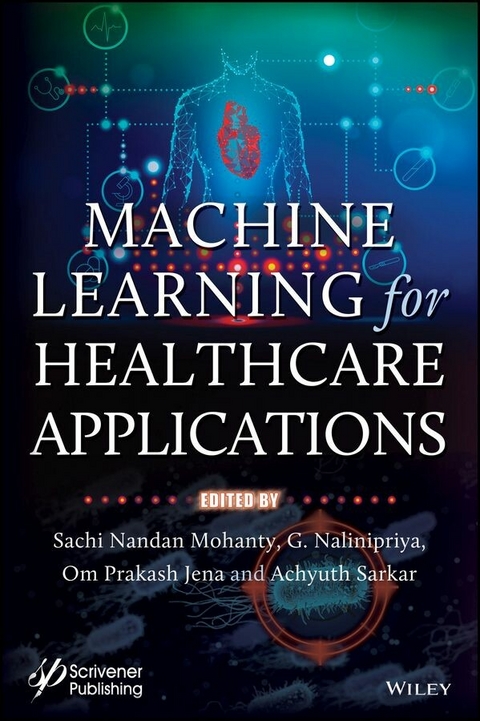
Machine Learning for Healthcare Applications (eBook)
John Wiley & Sons (Verlag)
978-1-119-79259-8 (ISBN)
When considering the idea of using machine learning in healthcare, it is a Herculean task to present the entire gamut of information in the field of intelligent systems. It is, therefore the objective of this book to keep the presentation narrow and intensive. This approach is distinct from others in that it presents detailed computer simulations for all models presented with explanations of the program code. It includes unique and distinctive chapters on disease diagnosis, telemedicine, medical imaging, smart health monitoring, social media healthcare, and machine learning for COVID-19. These chapters help develop a clear understanding of the working of an algorithm while strengthening logical thinking. In this environment, answering a single question may require accessing several data sources and calling on sophisticated analysis tools. While data integration is a dynamic research area in the database community, the specific needs of research have led to the development of numerous middleware systems that provide seamless data access in a result-driven environment.
Since this book is intended to be useful to a wide audience, students, researchers and scientists from both academia and industry may all benefit from this material. It contains a comprehensive description of issues for healthcare data management and an overview of existing systems, making it appropriate for introductory and instructional purposes. Prerequisites are minimal; the readers are expected to have basic knowledge of machine learning.
This book is divided into 22 real-time innovative chapters which provide a variety of application examples in different domains. These chapters illustrate why traditional approaches often fail to meet customers' needs. The presented approaches provide a comprehensive overview of current technology. Each of these chapters, which are written by the main inventors of the presented systems, specifies requirements and provides a description of both the chosen approach and its implementation. Because of the self-contained nature of these chapters, they may be read in any order. Each of the chapters use various technical terms which involve expertise in machine learning and computer science.
Sachi Nandan Mohanty received his PhD from IIT Kharagpur in 2015. He has recently joined as an associate professor in the Department of Computer Science & Engineering at ICFAI Foundation for Higher Education Hyderabad. His research areas include data mining, big data analysis, cognitive science, fuzzy decision making, brain-computer interface, and computational intelligence. He has published 20 SCI journal articles and has authored/edited 7 books.
G. Nalinipriya is a professor in the Department of Information Technology, Anna University, Chennai where she also obtained her PhD. She has more than 23 years of experience in the field of teaching, industry and research and her interests include artificial intelligence, machine learning, data science and cloud security.
Om Prakash Jena is an assistant professor in the Department of Computer Science, Ravenshaw University, Cuttack, Odisha. He has 10 years of teaching and research experience and has published several technical papers in international journals/conferences/edited books. His current research interests include pattern recognition, cryptography, network security, soft computing, data analytics and machine automation.
Achyuth Sarkar received his PhD in Computer Science and Engineering from the National Institute of Technology, Arunachal Pradesh in 2019. He has teaching experience of more than 10 years.
When considering the idea of using machine learning in healthcare, it is a Herculean task to present the entire gamut of information in the field of intelligent systems. It is, therefore the objective of this book to keep the presentation narrow and intensive. This approach is distinct from others in that it presents detailed computer simulations for all models presented with explanations of the program code. It includes unique and distinctive chapters on disease diagnosis, telemedicine, medical imaging, smart health monitoring, social media healthcare, and machine learning for COVID-19. These chapters help develop a clear understanding of the working of an algorithm while strengthening logical thinking. In this environment, answering a single question may require accessing several data sources and calling on sophisticated analysis tools. While data integration is a dynamic research area in the database community, the specific needs of research have led to the development of numerous middleware systems that provide seamless data access in a result-driven environment. Since this book is intended to be useful to a wide audience, students, researchers and scientists from both academia and industry may all benefit from this material. It contains a comprehensive description of issues for healthcare data management and an overview of existing systems, making it appropriate for introductory and instructional purposes. Prerequisites are minimal; the readers are expected to have basic knowledge of machine learning. This book is divided into 22 real-time innovative chapters which provide a variety of application examples in different domains. These chapters illustrate why traditional approaches often fail to meet customers needs. The presented approaches provide a comprehensive overview of current technology. Each of these chapters, which are written by the main inventors of the presented systems, specifies requirements and provides a description of both the chosen approach and its implementation. Because of the self-contained nature of these chapters, they may be read in any order. Each of the chapters use various technical terms which involve expertise in machine learning and computer science.
Sachi Nandan Mohanty received his PhD from IIT Kharagpur in 2015. He has recently joined as an associate professor in the Department of Computer Science & Engineering at ICFAI Foundation for Higher Education Hyderabad. His research areas include data mining, big data analysis, cognitive science, fuzzy decision making, brain-computer interface, and computational intelligence. He has published 20 SCI journal articles and has authored/edited 7 books. G. Nalinipriya is a professor in the Department of Information Technology, Anna University, Chennai where she also obtained her PhD. She has more than 23 years of experience in the field of teaching, industry and research and her interests include artificial intelligence, machine learning, data science and cloud security. Om Prakash Jena is an assistant professor in the Department of Computer Science, Ravenshaw University, Cuttack, Odisha. He has 10 years of teaching and research experience and has published several technical papers in international journals/conferences/edited books. His current research interests include pattern recognition, cryptography, network security, soft computing, data analytics and machine automation. Achyuth Sarkar received his PhD in Computer Science and Engineering from the National Institute of Technology, Arunachal Pradesh in 2019. He has teaching experience of more than 10 years.
Preface
Machine learning is one of the principal components of computational methodology. In today’s highly integrated world, when solutions to problems are cross-disciplinary in nature, machine learning promises to become a powerful means for obtaining solutions to problems very quickly, yet accurately and acceptably.
When considering the idea of using machine learning in healthcare, it is a Herculean task to present before the reader the entire gamut of information in the field of intelligent systems. It was therefore our objective to keep the presentation narrow and intensive. The approach of this book is distinct from others in that it presents detailed computer simulations for all models presented with explanations of the program code. It includes unique and distinctive chapters on disease diagnosis, telemedicine, medical imaging, smart health monitoring, social media healthcare, and machine learning for COVID-19. These chapters help develop a clear understanding of the working of an algorithm while strengthening logical thinking. In this environment, answering a single question may require accessing several data sources and calling on sophisticated analysis tools. While data integration is a dynamic research area in the database community, the specific needs of research have led to the development of numerous middleware systems that provide seamless data access in a result-driven environment.
Since this book is intended to be useful to a wide audience, students, researchers and scientists from both academia and industry may all benefit from this material. It contains a comprehensive description of issues for healthcare data management and an overview of existing systems, making it appropriate for introductory and instructional purposes. Prerequisites are minimal; the readers are expected to have basic knowledge of machine learning.
This book is divided into 22 real-time innovative chapters which provide a variety of application examples in different domains. These chapters illustrate why traditional approaches often fail to meet customers’ needs. The presented approaches provide a comprehensive overview of current technology. Each of these chapters, which are written by the main inventors of the presented systems, specifies requirements and provides a description of both the chosen approach and its implementation. Because of the self-contained nature of these chapters, they may be read in any order. Each of the chapters use various technical terms which involve expertise in machine learning and computer science.
The chapters of the book are organized as follows:
- Chapter 1 introduces the fundamental concepts of machine learning and its applications, and describes the setup used throughout the book. It is now realized that complex real-world problems require intelligent systems that combine knowledge, techniques and methodologies from various sources.
- Chapter 2 describes the actual machine learning algorithms that are most widely used in practice, and discusses their advantages and shortcomings. It is therefore necessary to work through conventional machine learning algorithms while relating the underlying theme to cutting-edge neuroscience research findings.
- Chapter 3 explains the study of neuromarketing with EEG signals and machine learning techniques. This is followed by a detailed review of the global function of classifiers and the inner workings. Such a premise provides the fabric for presentation of ideas throughout this text.
- Chapter 4 elaborates on an expert system-based clinical decision support system for hepatitis B prediction and diagnosis. It develops a working model of the decision support system and its application domain. The clinical decision helps to improve the diagnostic performance.
- Chapter 5 works on disease prediction to develop an intuitive understanding of fundamental design principles. These concepts are carried to their fullest complexity with neural networks and their learning. The working of artificial neurons and the architecture stands in stark contrast with their biological counterparts.
- Chapter 6 introduces machine learning as a public safety tool. A solid discussion on the relationship between public safety and video surveillance systems is provided. The topic of offline crime prevention leads to the extremely important topic of public safety, which is discussed in the context of machine learning theory.
- Chapter 7 introduces semantic web ontology, multi-agent system in a semantic framework, decision-making ontology and query optimizer agent. These unified methods open up a new avenue of research.
- Chapter 8 focuses on the detection, prediction and intervention strategies of attention deficiency in the brain. These important topics are missing from many current texts on machine learning.
- Chapter 9 summarizes the issues concerning the progression of osteoporosis using machine learning and the treatment models, and culminates in the presentation of K-nearest neighbor and decision tree algorithms.
- Chapter 10 covers the issues in biomedical text processing and the food industry. It addresses the latest topics of face recognition systems for domestic cattle, assortment of vegetables and fruits, plant leaf disease detection and approaches for sentiment analysis on drug reviews.
- Chapter 11 discusses hyperparameter tuning of the MobileNet-based CNN model and also explains ResNet5.0. It presents a variety of important machine learning concepts found in the literature, including confusion matrix and classification results.
- Chapter 12 presents a detailed introduction to the theory and terminology of deep learning, image classifier, and data preprocessing with augmentation. It talks about malaria cell detection and finally the results are tabulated in a meaningful manner for further fruitful research.
- Chapter 13 considers various approaches for the design of transfer learning, including CNN architecture with ROC curve as a core neural network model, which can incorporate human expertise as well as adapt themselves through repeated learning.
- Chapter 14 provides a model for early stage detection. It gives a variety of application examples in different domains such as multivariate regression, model building, and different learning algorithms.
- Chapter 15 presents the concept of using the internet of things (IoT) in healthcare applications. It focuses on networking system using the IoT, smart hospital environments, emerging vulnerabilities and threat analysis.
- Chapter 16 explains real-time health monitoring. It proposes a framework for model construction, supervised learning, neural networks for classification and decision-making. An application is presented that supports health monitoring by implementing IoT concepts. A multiple linear regression algorithm and random forest algorithm are used to map the requirement of distance health monitoring.
- Chapter 17 introduces ontology in healthcare. It also explains NLP-based retrieval for COVID-19 dataset. Query formulation and retrieval from a knowledgebase are handled in an effective manner. Included are several examples in the literature to travel further in this research direction.
- Chapter 18 summarizes the topics necessary for COVID-19 research. It details the public discourse and sentiment during the coronavirus pandemic. Moreover, how to understand text semantics and semantic analysis using social media are explained.
- Chapter 19 is devoted to basic COVID-19 research and its relationship to various data mining techniques. Prediction and analysis of COVID-19 dataset, dataset collection, backpropagation neural network, and several algorithms are discussed in detail.
- Chapter 20 details automated diagnosis of COVID-19. Topics treated include the feature extraction, genetic algorithm and image segmentation technique. The presented approach provides a description of both the chosen approach and its implementation.
- Chapter 21 provides users and developers with a methodology to evaluate the present system. It focuses on the future of telemedicine with machine learning. The state-of-the-art, existing solutions and new challenges to be addressed are emphasized. Fast electronics health record retrieval, intelligent assistance for patient diagnosis and remote monitoring of patients are discussed very clearly.
- Chapter 22 discusses the challenges faced by chronic disease patients and the lightweight convolutional neural network used to address these challenges. Experimental results are tabulated, leading to active research in the healthcare field
- Chapter 23 discusses disease diagnosis. Active solutions using machine learning techniques are given along with the generalize tools used to implement the concepts. A wide range of research areas are also given for future work.
- Chapter 24 explains the detection of disease and its related solution in machine learning. The chapter continues with the treatment of machine leaning algorithms that are dynamic in nature. It presents a number of powerful machine learning models with the associated learnings. A discussion section is provided that briefly explains what can be computed with the models.
Finally, we would like to sincerely thank all those involved in the successful completion of the book. First, our sincere gratitude goes to the chapters’ authors who contributed their time and expertise to this book. Second, the editors wish to acknowledge the valuable contributions of the reviewers regarding...
| Erscheint lt. Verlag | 4.5.2021 |
|---|---|
| Sprache | englisch |
| Themenwelt | Informatik ► Theorie / Studium ► Künstliche Intelligenz / Robotik |
| Technik ► Elektrotechnik / Energietechnik | |
| Schlagworte | Artificial Intelligence • Bioinformatics • Biological disorder • biomedical engineering • Biomedical Signal and Image Processing • Biomedizintechnik • Bio-modelling • Computational Intelligence • Computer Science • convolutional neural network • COVID-19 Analysis • Deep learning • Dieses classification and prediction • Electrical & Electronics Engineering • Elektrotechnik u. Elektronik • Genomics and Genetic Data Analysis • Healthcare • healthcare system • health data modelling • Health Informatics • Informatik • Intelligent diagnosis • Intelligente Systeme u. Agenten • Intelligent Systems & Agents • Internet of Medical Things • Kidney diseases Analysis • Künstliche Intelligenz • machine learning • Maschinelles Lernen • Medical Data Analysis • Medical data-driven decision • medical data processing • Medical Imaging • Medical Informatics & Biomedical Information Technology • Medizininformatik u. biomedizinische Informationstechnologie • Model design • Neural networks • Ontologies Construction • Ontology • Physiological signals • Protein Structure Prediction • Retrieval in Healthcare System • scalability models • Simulation of Medical Data • Structured and Unstructured Clinical reports • tele-medicine • X-ray analysis |
| ISBN-10 | 1-119-79259-2 / 1119792592 |
| ISBN-13 | 978-1-119-79259-8 / 9781119792598 |
| Informationen gemäß Produktsicherheitsverordnung (GPSR) | |
| Haben Sie eine Frage zum Produkt? |
 EPUB (Adobe DRM)
Kopierschutz: Adobe-DRM
Adobe-DRM ist ein Kopierschutz, der das eBook vor Mißbrauch schützen soll. Dabei wird das eBook bereits beim Download auf Ihre persönliche Adobe-ID autorisiert. Lesen können Sie das eBook dann nur auf den Geräten, welche ebenfalls auf Ihre Adobe-ID registriert sind.
Details zum Adobe-DRM
Dateiformat: EPUB (Electronic Publication)
EPUB ist ein offener Standard für eBooks und eignet sich besonders zur Darstellung von Belletristik und Sachbüchern. Der Fließtext wird dynamisch an die Display- und Schriftgröße angepasst. Auch für mobile Lesegeräte ist EPUB daher gut geeignet.
Systemvoraussetzungen:
PC/Mac: Mit einem PC oder Mac können Sie dieses eBook lesen. Sie benötigen eine
eReader: Dieses eBook kann mit (fast) allen eBook-Readern gelesen werden. Mit dem amazon-Kindle ist es aber nicht kompatibel.
Smartphone/Tablet: Egal ob Apple oder Android, dieses eBook können Sie lesen. Sie benötigen eine
Geräteliste und zusätzliche Hinweise
Buying eBooks from abroad
For tax law reasons we can sell eBooks just within Germany and Switzerland. Regrettably we cannot fulfill eBook-orders from other countries.
aus dem Bereich