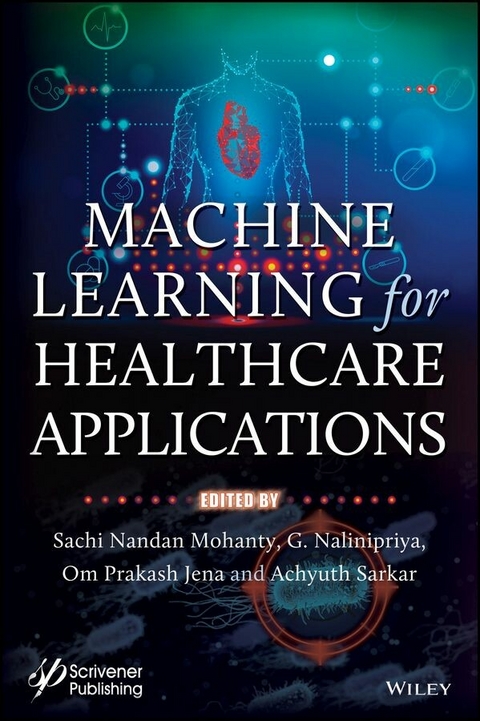
Machine Learning for Healthcare Applications (eBook)
John Wiley & Sons (Verlag)
978-1-119-79260-4 (ISBN)
When considering the idea of using machine learning in healthcare, it is a Herculean task to present the entire gamut of information in the field of intelligent systems. It is, therefore the objective of this book to keep the presentation narrow and intensive. This approach is distinct from others in that it presents detailed computer simulations for all models presented with explanations of the program code. It includes unique and distinctive chapters on disease diagnosis, telemedicine, medical imaging, smart health monitoring, social media healthcare, and machine learning for COVID-19. These chapters help develop a clear understanding of the working of an algorithm while strengthening logical thinking. In this environment, answering a single question may require accessing several data sources and calling on sophisticated analysis tools. While data integration is a dynamic research area in the database community, the specific needs of research have led to the development of numerous middleware systems that provide seamless data access in a result-driven environment.
Since this book is intended to be useful to a wide audience, students, researchers and scientists from both academia and industry may all benefit from this material. It contains a comprehensive description of issues for healthcare data management and an overview of existing systems, making it appropriate for introductory and instructional purposes. Prerequisites are minimal; the readers are expected to have basic knowledge of machine learning.
This book is divided into 22 real-time innovative chapters which provide a variety of application examples in different domains. These chapters illustrate why traditional approaches often fail to meet customers' needs. The presented approaches provide a comprehensive overview of current technology. Each of these chapters, which are written by the main inventors of the presented systems, specifies requirements and provides a description of both the chosen approach and its implementation. Because of the self-contained nature of these chapters, they may be read in any order. Each of the chapters use various technical terms which involve expertise in machine learning and computer science.
Sachi Nandan Mohanty received his PhD from IIT Kharagpur in 2015. He has recently joined as an associate professor in the Department of Computer Science & Engineering at ICFAI Foundation for Higher Education Hyderabad. His research areas include data mining, big data analysis, cognitive science, fuzzy decision making, brain-computer interface, and computational intelligence. He has published 20 SCI journal articles and has authored/edited 7 books.
G. Nalinipriya is a professor in the Department of Information Technology, Anna University, Chennai where she also obtained her PhD. She has more than 23 years of experience in the field of teaching, industry and research and her interests include artificial intelligence, machine learning, data science and cloud security.
Om Prakash Jena is an assistant professor in the Department of Computer Science, Ravenshaw University, Cuttack, Odisha. He has 10 years of teaching and research experience and has published several technical papers in international journals/conferences/edited books. His current research interests include pattern recognition, cryptography, network security, soft computing, data analytics and machine automation.
Achyuth Sarkar received his PhD in Computer Science and Engineering from the National Institute of Technology, Arunachal Pradesh in 2019. He has teaching experience of more than 10 years.
When considering the idea of using machine learning in healthcare, it is a Herculean task to present the entire gamut of information in the field of intelligent systems. It is, therefore the objective of this book to keep the presentation narrow and intensive. This approach is distinct from others in that it presents detailed computer simulations for all models presented with explanations of the program code. It includes unique and distinctive chapters on disease diagnosis, telemedicine, medical imaging, smart health monitoring, social media healthcare, and machine learning for COVID-19. These chapters help develop a clear understanding of the working of an algorithm while strengthening logical thinking. In this environment, answering a single question may require accessing several data sources and calling on sophisticated analysis tools. While data integration is a dynamic research area in the database community, the specific needs of research have led to the development of numerous middleware systems that provide seamless data access in a result-driven environment. Since this book is intended to be useful to a wide audience, students, researchers and scientists from both academia and industry may all benefit from this material. It contains a comprehensive description of issues for healthcare data management and an overview of existing systems, making it appropriate for introductory and instructional purposes. Prerequisites are minimal; the readers are expected to have basic knowledge of machine learning. This book is divided into 22 real-time innovative chapters which provide a variety of application examples in different domains. These chapters illustrate why traditional approaches often fail to meet customers needs. The presented approaches provide a comprehensive overview of current technology. Each of these chapters, which are written by the main inventors of the presented systems, specifies requirements and provides a description of both the chosen approach and its implementation. Because of the self-contained nature of these chapters, they may be read in any order. Each of the chapters use various technical terms which involve expertise in machine learning and computer science.
Sachi Nandan Mohanty received his PhD from IIT Kharagpur in 2015. He has recently joined as an associate professor in the Department of Computer Science & Engineering at ICFAI Foundation for Higher Education Hyderabad. His research areas include data mining, big data analysis, cognitive science, fuzzy decision making, brain-computer interface, and computational intelligence. He has published 20 SCI journal articles and has authored/edited 7 books. G. Nalinipriya is a professor in the Department of Information Technology, Anna University, Chennai where she also obtained her PhD. She has more than 23 years of experience in the field of teaching, industry and research and her interests include artificial intelligence, machine learning, data science and cloud security. Om Prakash Jena is an assistant professor in the Department of Computer Science, Ravenshaw University, Cuttack, Odisha. He has 10 years of teaching and research experience and has published several technical papers in international journals/conferences/edited books. His current research interests include pattern recognition, cryptography, network security, soft computing, data analytics and machine automation. Achyuth Sarkar received his PhD in Computer Science and Engineering from the National Institute of Technology, Arunachal Pradesh in 2019. He has teaching experience of more than 10 years.
| Erscheint lt. Verlag | 24.3.2021 |
|---|---|
| Sprache | englisch |
| Themenwelt | Informatik ► Theorie / Studium ► Künstliche Intelligenz / Robotik |
| Technik ► Elektrotechnik / Energietechnik | |
| Schlagworte | Artificial Intelligence • Bioinformatics • Biological disorder • biomedical engineering • Biomedical Signal and Image Processing • Biomedizintechnik • Bio-modelling • Computational Intelligence • Computer Science • convolutional neural network • COVID-19 Analysis • Deep learning • Dieses classification and prediction • Electrical & Electronics Engineering • Elektrotechnik u. Elektronik • Genomics and Genetic Data Analysis • Healthcare • healthcare system • health data modelling • Health Informatics • Informatik • Intelligent diagnosis • Intelligente Systeme u. Agenten • Intelligent Systems & Agents • Internet of Medical Things • Kidney diseases Analysis • Künstliche Intelligenz • machine learning • Maschinelles Lernen • Medical Data Analysis • Medical data-driven decision • medical data processing • Medical Imaging • Medical Informatics & Biomedical Information Technology • Medizininformatik u. biomedizinische Informationstechnologie • Model design • Neural networks • Ontologies Construction • Ontology • Physiological signals • Protein Structure Prediction • Retrieval in Healthcare System • scalability models • Simulation of Medical Data • Structured and Unstructured Clinical reports • tele-medicine • X-ray analysis |
| ISBN-10 | 1-119-79260-6 / 1119792606 |
| ISBN-13 | 978-1-119-79260-4 / 9781119792604 |
| Informationen gemäß Produktsicherheitsverordnung (GPSR) | |
| Haben Sie eine Frage zum Produkt? |
 PDF (Adobe DRM)
Kopierschutz: Adobe-DRM
Adobe-DRM ist ein Kopierschutz, der das eBook vor Mißbrauch schützen soll. Dabei wird das eBook bereits beim Download auf Ihre persönliche Adobe-ID autorisiert. Lesen können Sie das eBook dann nur auf den Geräten, welche ebenfalls auf Ihre Adobe-ID registriert sind.
Details zum Adobe-DRM
Dateiformat: PDF (Portable Document Format)
Mit einem festen Seitenlayout eignet sich die PDF besonders für Fachbücher mit Spalten, Tabellen und Abbildungen. Eine PDF kann auf fast allen Geräten angezeigt werden, ist aber für kleine Displays (Smartphone, eReader) nur eingeschränkt geeignet.
Systemvoraussetzungen:
PC/Mac: Mit einem PC oder Mac können Sie dieses eBook lesen. Sie benötigen eine
eReader: Dieses eBook kann mit (fast) allen eBook-Readern gelesen werden. Mit dem amazon-Kindle ist es aber nicht kompatibel.
Smartphone/Tablet: Egal ob Apple oder Android, dieses eBook können Sie lesen. Sie benötigen eine
Geräteliste und zusätzliche Hinweise
Buying eBooks from abroad
For tax law reasons we can sell eBooks just within Germany and Switzerland. Regrettably we cannot fulfill eBook-orders from other countries.
aus dem Bereich