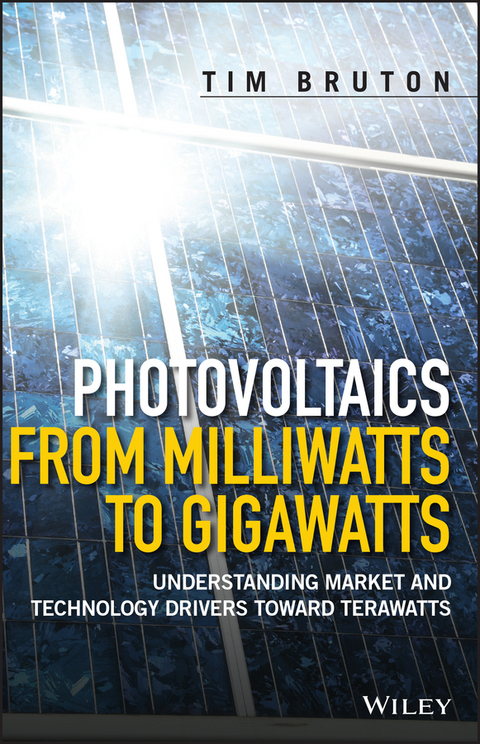
Photovoltaics from Milliwatts to Gigawatts (eBook)
John Wiley & Sons (Verlag)
978-1-119-13006-2 (ISBN)
An essential guide through the rapid evolution of PV technology
Photovoltaics from Milliwatts to Gigawatts: Understanding Market and Technology Drivers toward Terawatts covers the history of silicon based PV, from the earliest discoveries to present and future practice.
Divided into 9 chapters, the book includes the following topics: Early History; The 1973 Oil crisis and the drive for alternative energies; The emergence in the 1980's of the off grid PV market, the significant small scale PV consumer market and the establishment of a manufacturing industry; Advantages of silicon for solar cells; The evolution of PV installations; The history of the incentive programme for PV; Difficulties of alternative technologies in challenging silicon dominance; Current status of the silicon manufacturing technology and The future.
Key features:
- An authoritative first-hand account of an emerging technology from laboratory to global significance for electricity generation by an industry expert.
- Provides a framework for policy makers on future trends in the PV industry.
- Examines the lessons learnt from the interaction of research laboratories, major industry and government.
- Signposts the route to future high efficiency silicon solar cells giving new researchers a background for further development.
- Highlights the critical success factors for the emerging alternative manufacturing technologies.
An essential PV guide aimed at researchers and students in electrical engineering and physical sciences through the rapid evolution of PV technology to commercial viability and the challenges ahead for increased performance, efficiency and global deployment.
TIM BRUTON graduated with a BSc in Physics and a PhD in Materials Science from Imperial College London. He has held a number of technical positions with multinational companies including Executive Director (Solar Research) at BP Solar from 1983 to 2003 mainly in crystalline silicon but also for thin film and OPV developments. Between 2003 and 2007, Tim led the PV group at NaREC where it carried out UK and European R&D projects and small scale manufacturing of custom solar cells. Since January 2008, He has worked as an independent consultant. Tim has published over 100 papers in the PV field and is managing co-editor of Wiley's Progress in Photovoltaics. He is an independent expert in PV for the European Commission and a Fellow of the Institute of Physics.
An essential guide through the rapid evolution of PV technology Photovoltaics from Milliwatts to Gigawatts: Understanding Market and Technology Drivers toward Terawatts covers the history of silicon based PV, from the earliest discoveries to present and future practice. Divided into 9 chapters, the book includes the following topics: Early History; The 1973 Oil crisis and the drive for alternative energies; The emergence in the 1980's of the off grid PV market, the significant small scale PV consumer market and the establishment of a manufacturing industry; Advantages of silicon for solar cells; The evolution of PV installations; The history of the incentive programme for PV; Difficulties of alternative technologies in challenging silicon dominance; Current status of the silicon manufacturing technology and The future. Key features: An authoritative first-hand account of an emerging technology from laboratory to global significance for electricity generation by an industry expert. Provides a framework for policy makers on future trends in the PV industry. Examines the lessons learnt from the interaction of research laboratories, major industry and government. Signposts the route to future high efficiency silicon solar cells giving new researchers a background for further development. Highlights the critical success factors for the emerging alternative manufacturing technologies. An essential PV guide aimed at researchers and students in electrical engineering and physical sciences through the rapid evolution of PV technology to commercial viability and the challenges ahead for increased performance, efficiency and global deployment.
TIM BRUTON graduated with a BSc in Physics and a PhD in Materials Science from Imperial College London. He has held a number of technical positions with multinational companies including Executive Director (Solar Research) at BP Solar from 1983 to 2003 mainly in crystalline silicon but also for thin film and OPV developments. Between 2003 and 2007, Tim led the PV group at NaREC where it carried out UK and European R&D projects and small scale manufacturing of custom solar cells. Since January 2008, He has worked as an independent consultant. Tim has published over 100 papers in the PV field and is managing co-editor of Wiley's Progress in Photovoltaics. He is an independent expert in PV for the European Commission and a Fellow of the Institute of Physics.
1
The Photovoltaics: The Birth of a Technology and Its First Application
1.1 Introduction
‘For more than a generation, solar power was an environmentalist fantasy, an expensive and impractical artefact from the Jimmy Carter era. That was true right up to the moment it wasn’t’ [1]. This quotation neatly encapsulates the theme of this book: how a technology grew from a high‐cost product in a specialist application to a global technology supplying a significant proportion of the world’s electricity against a background of at best scepticism and at worst open hostility. In 2018, 102 GWp of photovoltaic modules were installed globally, leading to a total installed capacity of 509 GWp, while an independent study showed that photovoltaics was the lowest‐cost means of generation of new‐build electricity‐generating capacity, including nuclear and fossil fuel sources [2]. At the end of 2019, photovoltaics provided 3% of the global electricity supply, but the expectation is that this percentage will continue to rise until it is the dominant electricity‐generating technology by 2050, with 60% of global output [3,4]. Figure 1.1 shows the expected growth of all generating technologies to 2050.
This dramatic development of photovoltaic installations has been the work of many inspired individuals. Their stories are told in other places [5–7]. The aim of this book is to describe how the technology changed from small‐area solar cells of 10% efficiency conversion of sunlight to electricity to the mass‐production cells of today, with efficiencies in the range 20–24%, and the route to >30% becoming clear. The present chapter describes how the potential for photovoltaic conversion was first recognised and how it moved into the early stages of commercialisation as a high‐technology product for use in powering space satellites. Later chapters will describe how this space technology became a terrestrial one and the driving forces and technology developments that made it the global force it is today. Furthermore, the options for going beyond the current technology will be reviewed and the route to achieving terawatt global installations discussed.
It should be no surprise that photovoltaics has achieved the advances it has. Since the invention of the semiconductor transistor in 1948, solid‐state electronics has transformed the way in which we live. Computers, mobile phones, the Internet, and so much else would not exist without the underlying semiconductor technology. Photovoltaic solar energy conversion is the application of solid‐state technology to the energy field. Electricity is generated simply by the absorption of sunlight in a semiconducting diode. There are no moving parts. No liquid or gaseous fuels are needed. There are no effluents requiring disposal and no noise is generated. Sunlight is abundant, delivering to the earth’s surface 6000 times humanity’s total energy usage [8]. It is the only renewable resource capable of delivering the world’s energy needs carbon‐free by 2050, and it will remain available for the next 5 billion years. The photovoltaic technology is easily scalable, so that small cells can generate the few milliwatts required for consumer devices such as calculators and watches, while larger ones can be used to assemble modules for deployment at the gigawatt level. It is these advantages which spurred many advocates to continue to promote photovoltaics in the face of significant opposition.
Figure 1.1 Evolution of electricity‐generating technologies to 2050
Source: DNV GL Energy Transition Outlook 2018
1.2 Sunlight and Electricity
1.2.1 The Early Years
While the potency of the sun has been recognised from ancient times, its role has been mainly that of a source of heat and lighting [9]. It was only relatively recently that the connection between sunlight and electricity was established. Through the nineteenth century, there was an important discovery in this regard about once every decade. Probably the first connection between light and electricity was made by Edmond Becquerel in Paris in 1839 [10]. He observed the flow of an electric current when gold or platinum electrodes were immersed into an electrolyte (acidic or alkaline) and exposed to uneven solar radiation. Some ten years later, Alfred Smee in London observed a current in an electrochemical cell on exposure to intense light, which he called a ‘photo‐voltaic’ circuit – linking the Greek word for light phos and the name ‘Volta’, the original inventor of the galvanic cell [11].
The next step was the observation of photoconductivity in a solid material. A British engineer, Willoughby Smith, in search of a high‐resistance metal for use in testing the trans‐Atlantic telegraph cable, was recommended selenium. He purchased some selenium rods of between 5 and 10 cm in length and 1 and 1.5 mm in diameter [12]. These were hermetically sealed in glass cylinders, with leads to the outside. They worked well at night, but in bright daylight they became too conducting. Smith concluded that there was no heating effect and that the change in resistance was purely due to the action of light [13]. This stimulated further research into the properties of selenium. The British scientists William Grylls Adams and Richard Evans Day observed current flowing in their selenium sample when no external voltage was applied and were able to show that ‘a current could be started in the selenium by the action of light alone’ [14]. They had demonstrated for the first time that light caused the flow of electricity in a solid material. They used the term ‘photoelectric’ to describe their device, and Adams believed it could be used as a means of measuring light intensity [15].
The narrative now switches to America, where Charles Fritts made the first working solar module by covering a copper plate with a layer of selenium and applying a semitransparent gold layer as the top electrode [16]. An example is shown in Figure 1.2. Fritts described the module as producing a ‘current that is constant and of considerable force … not only by exposure to sunlight but also to dim diffused light and even to lamplight.’ He supplied samples to the German electricity pioneer Werner von Siemens, who greeted them enthusiastically, announcing Fritts’ module to be ‘scientifically of the most far‐reaching importance’. However, its low efficiency – below 1% – made it of little commercial importance. Indeed, there was considerable scepticism at the time, with solar cells viewed as some kind of perpetual‐motion machine. The principles of their operation were not understood. One of the leading physicists of the day, James Clerk Maxwell, while welcoming photoelectrcity as ‘a very valuable contribution to science’, wondered ‘is the radiation the immediate cause or does it act by producing some change in the chemical state’ [16].
Figure 1.2 Charles Fritts’ first photovoltaic array, produced in New York City in 1884 [16]
(Courtesy New World Library)
The underlying science of photovoltaics was given a big boost by the parallel discoveries and developments in photoemission. Hertz observed in 1887 that ultraviolet light caused a significant increase in the sparks in an air gap between electrodes and that it was a function of the wavelength of the light rather than its intensity [17]. While a number of physicists worked on the effect, it was Albert Einstein in 1905 who explained it in terms of different wavelengths behaving as particles of energy, which he called ‘quanta’ but which were later renamed ‘photons’. These quanta had different energies depending on their wavelength. Einstein was awarded the Nobel Prize in 1921 for this work [15]. While these discoveries and other advances in quantum mechanics at the start for the twentieth century did not directly explain photovoltaic effects, they did provide a scientific basis for understanding the interaction of light and materials.
Although research continued on developing solar cells, little progress was made. However, photovoltaics still had its advocates in the 1930s. Ludwig Lange, a German physicist, predicted in 1931 that ‘in the distant future huge plants will employ thousands of these plates to transform sunlight into electric power … that can compete with hydroelectricity and steam driven generators in running factories and lighting homes’ [15]. A more pragmatic view was taken by E.D. Wilson at Westinghouse Electric, who stated that the efficiency of the photovoltaic cell would need to be increased by a factor of 50 in order for them to be of practical use, and this was unlikely to happen [15]. Actually, as will be shown in later chapters, a factor of 20 was achieved, and this was sufficient to create the current global markets.
While progress in other areas of technology was immense in the nineteenth and early twentieth centuries, little real advancement in photovoltaics had been made since Becquerel’s discovery a hundred years previously. Entering into the second half of the twentieth century, everything would change.
1.2.2 The Breakthrough to Commercial Photovoltaic Cells
It...
| Erscheint lt. Verlag | 1.2.2021 |
|---|---|
| Sprache | englisch |
| Themenwelt | Naturwissenschaften ► Physik / Astronomie |
| Technik ► Elektrotechnik / Energietechnik | |
| Schlagworte | Electrical & Electronics Engineering • Elektrotechnik u. Elektronik • Energie • Energy • Halbleiter • Photovoltaics, PV, Silicon, PV power generating, solar panels, solar cells, solar power, renewable energy • Photovoltaik • semiconductors • Solarenergie • Solarenergie u. Photovoltaik • Solar Energy & Photovoltaics |
| ISBN-10 | 1-119-13006-9 / 1119130069 |
| ISBN-13 | 978-1-119-13006-2 / 9781119130062 |
| Informationen gemäß Produktsicherheitsverordnung (GPSR) | |
| Haben Sie eine Frage zum Produkt? |
 EPUB (Adobe DRM)
Kopierschutz: Adobe-DRM
Adobe-DRM ist ein Kopierschutz, der das eBook vor Mißbrauch schützen soll. Dabei wird das eBook bereits beim Download auf Ihre persönliche Adobe-ID autorisiert. Lesen können Sie das eBook dann nur auf den Geräten, welche ebenfalls auf Ihre Adobe-ID registriert sind.
Details zum Adobe-DRM
Dateiformat: EPUB (Electronic Publication)
EPUB ist ein offener Standard für eBooks und eignet sich besonders zur Darstellung von Belletristik und Sachbüchern. Der Fließtext wird dynamisch an die Display- und Schriftgröße angepasst. Auch für mobile Lesegeräte ist EPUB daher gut geeignet.
Systemvoraussetzungen:
PC/Mac: Mit einem PC oder Mac können Sie dieses eBook lesen. Sie benötigen eine
eReader: Dieses eBook kann mit (fast) allen eBook-Readern gelesen werden. Mit dem amazon-Kindle ist es aber nicht kompatibel.
Smartphone/Tablet: Egal ob Apple oder Android, dieses eBook können Sie lesen. Sie benötigen eine
Geräteliste und zusätzliche Hinweise
Buying eBooks from abroad
For tax law reasons we can sell eBooks just within Germany and Switzerland. Regrettably we cannot fulfill eBook-orders from other countries.
aus dem Bereich