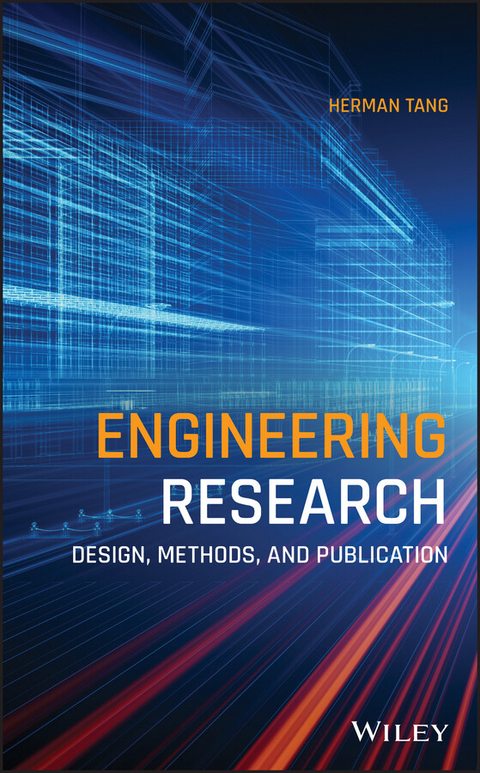
Engineering Research (eBook)
John Wiley & Sons (Verlag)
978-1-119-62453-0 (ISBN)
Master the fundamentals of planning, preparing, conducting, and presenting engineering research with this one-stop resource
Engineering Research: Design, Methods, and Publication delivers a concise but comprehensive guide on how to properly conceive and execute research projects within an engineering field. Accomplished professional and author Herman Tang covers the foundational and advanced topics necessary to understand engineering research, from conceiving an idea to disseminating the results of the project.
Organized in the same order as the most common sequence of activities for an engineering research project, the book is split into three parts and nine chapters. The book begins with a section focused on proposal development and literature review, followed by a description of data and methods that explores quantitative and qualitative experiments and analysis, and ends with a section on project presentation and preparation of scholarly publication.
Engineering Research offers readers the opportunity to understand the methodology of the entire process of engineering research in the real word. The author focuses on executable process and principle-guided exercise as opposed to abstract theory. Readers will learn about:
- An overview of scientific research in engineering, including foundational and fundamental concepts like types of research and considerations of research validity
- How to develop research proposals and how to search and review the scientific literature
- How to collect data and select a research method for their quantitative or qualitative experiment and analysis
- How to prepare, present, and submit their research to audiences and scholarly papers and publications
Perfect for advanced undergraduate and engineering students taking research methods courses, Engineering Research also belongs on the bookshelves of engineering and technical professionals who wish to brush up on their knowledge about planning, preparing, conducting, and presenting their own scientific research.
HERMAN TANG, PHD, is Associated Professor at Eastern Michigan University. He is also Associate Editor for a scientific journal and a paper series, as well as a peer reviewer for over ten journals. He was Lead Engineering Specialist at Fiat Chrysler Automobiles and has published two books on vehicle manufacturing and many research papers.
HERMAN TANG, PHD, is Associated Professor at Eastern Michigan University. He is also Associate Editor for a scientific journal and a paper series, as well as a peer reviewer for over ten journals. He was Lead Engineering Specialist at Fiat Chrysler Automobiles and has published two books on vehicle manufacturing and many research papers.
Preface
Research Book?
Research Matters
Research is both one of the most important elements in the technical world and one of the most interesting learning features in higher education. Many universities have undergraduate research programs and offer research methodology courses to graduate students. The more advanced degree a student pursues, the greater the amount of research is required for success. Without research, an organization cannot develop or improve its products, processes, or services.
There are many types of engineering work, such as analysis, design, and construct. As engineers, we often ask “how” questions. On the other hand, research exploration is different as we more address “what” and “why” questions. In addition to engineering and technical knowledge, the following key traits can help researchers to be more successful. A skilled researcher is
- Innovative
- Collaborative
- Interdisciplinary
- Ethical
For applied research and engineering R&D, cost-effectiveness is critical as well. The contents of this book focus on research methodology with these imperatives.
Book Intent
This book serves a concise overview of critical aspects of research development, which includes thinking, planning, executing, administration, and disseminating of a research project. Its aim is to provide an essential body of work that is focused on the comprehension of general guidelines for new researchers. In addition, the basic doctrines, principles, procedure, methods, and considerations of research are also a valuable guide to undergraduate students who are just delving into the research field.
New researchers entering the field need systematic training on research methodology to learn the best and most effective practices. This book is a systematic guide for learning how to plan and execute a research project, report research findings, and publish research results. This text can also be useful for improving research practice and achievements for both new and experienced researchers alike.
The methodology in this book has been taught in my master's level course. Through the course learning, all students established better confidence, increased interests, and demonstrated more concrete knowledge. They were able to move forward in conducting research projects.
Book Characteristics
General Principles and Methods
While the research methods described in this book are applicable for all areas of studies, I have prepared this text primarily for the students who are in engineering and technology fields and with an assumption that readers have a basic mathematical and technical background. For every method described in this book, I have selected many examples and citations across multiple engineering disciplines that readers can reference for a better understanding of each concept.
Various practices and standards of R&D are sometimes specialized within each academic and professional field. Research in social sciences, for example, utilize the standard ISO 20252:2019 Market, opinion and social research, including insights and data analytics – vocabulary and service requirements. Many research methods can be applicable to almost all areas. The methods used medical sciences may have good application potentials in engineering and technology. The methods presented in this work are not exclusively limited to research in a specific engineering area. Hence, this book is comprehensive in its contents, including some uncommon approaches in engineering and technology, so that all readers have a reference of most available methods for their particular research projects.
Various Examples
One effective way to begin research work is to learn from other professionals and their current practices. The book cites over 460 scholarly papers and other types of sources in various engineering and technical areas. While not all the examples may be relevant to other specific research topics, the information, approaches, processes, and suggestions in the examples are the proven techniques that can be useful as a guide for readers perusing their own research projects.
Furthermore, as an engineer myself, I intentionally designed this book with many illustrations: 147 diagrams and 70 tables. Hopefully, you the readers can find the illustrations effective for your comprehension of research principles and methods.
As to be discussed more in Chapter 1, an emphasis on critical thinking is central when it comes to research. Readers are highly encouraged to bear critical thinking in mind when reading the text and to consider implementing these suggestions to improve the current techniques and progress with improved research methods.
Practice Guidelines
Regardless of technical discipline or research subject, one basic principle never changes: the best way to learn research is to practice. One cannot learn how to do research just by reading books but rather, one can use their books as guidance to make research more effective.
For learning, an old adage says that I hear and I forget. I see and I remember. I do and I understand. Referring to the learning pyramid (Figure 1) below, which is adapted from the original developed by Edgar Dale in his book Audio-Visual Methods in Teaching published in 1946, one can learn research better if we practice through exercise, discussion, developing research proposals, etc. When one is able to apply the knowledge learned toward conducting a real research project, one effectively learned the knowledge and improved our research capability and skills.
Figure 1 A learning pyramid.
Along with learning research methodology, my students develop their own research plans, section by section, corresponding to the relevant chapters of this book. At the end of my class, every student will have a good proposal, ready to move forward with conducting their own research. The guidelines and sample proposals developed from the course are included in the Appendices for instruction and learning references.
Organization and Contents
Overall Information Flow
I arrange the contents of this book in typical sequence for the execution of a research project. There are three parts and nine chapters, as described in the Figure 2.
Figure 2 Parts, chapters, and subjects of this book.
If readers want to learn research methodology systematically, it is a good idea to follow the chapters in order. If using this book as a reference manual, one can jump directly to the most relevant chapters.
Parts and Chapters
Part 1: Research introduction and development, including proposal writing and literature review.
Chapter 1 Research Overview. This first chapter introduces the concepts and building blocks of research. The chapter reviews three types (basic research, applied research, and R&D) and discusses the validity of research results. Providing a basic understanding of research, this chapter serves a starting point for preparing and executing research work.
Chapter 2 Research Proposal Development. This chapter presents the entire process of research development, focusing on a proposal development. Introducing an overall develop process, Chapter 2 explains how to draft, review, and revise a proposal, and addresses the key issues of the development process.
Chapter 3 Literature Search and Review. This chapter talks about the techniques and considerations of a literature search and many engineering literature sources. The chapter discusses the tasks and focal points of a literature review. The chapter also offers guidance on how to prepare a review, as well as some suggestions for review writing up.
Part 2: Various types of research methods.
Chapter 4 Data Collection and Method Selection. Starting with the discussion on the roles of data in research and the types of data, later on, this chapter addresses the main aspects of data collection and sampling. Based on data and other considerations, the chapter explains the selection considerations of different research methods.
Chapter 5 Quantitative and Experimental Research. This chapter presents the methods for research as four topics. The first one is about quantitative data analysis, including statistical analysis and interpretation. The second section is on engineering quantitative research methods. The third section discusses common experimental studies, and the fourth section introduces on Design of Experiment (DOE).
Chapter 6 Qualitative and Mix Methods. The chapter reviews characteristics of qualitative research and mixed-methods. The chapter discusses main qualitative approaches, including survey, interview, and observational studies. Based on these characteristics of methods, the chapter further discusses mixed-method approaches.
Part 3: Management, scholarly writing, and publication of research.
Chapter 7 Research Execution and Management. Performing research, particularly an external-funded project, can be complex and may require more teamwork with institutional administration. This chapter introduces the functions and requirements of project management for research execution. Then, the chapter presents the...
| Erscheint lt. Verlag | 18.12.2020 |
|---|---|
| Sprache | englisch |
| Themenwelt | Technik ► Bauwesen |
| Technik ► Elektrotechnik / Energietechnik | |
| Schlagworte | Electrical & Electronics Engineering • Elektrotechnik u. Elektronik • engineering experiments • Engineering Management • engineering research design • engineering research development • engineering research methods • engineering research planning • engineering research presentation • engineering study • engineering study design • engineering study presentation • Ingenieurwesen • Management im Ingenieurwesen • Research Methodologies • Scientific publication • Sociology • Soziologie • Soziologische Forschungsmethoden |
| ISBN-10 | 1-119-62453-3 / 1119624533 |
| ISBN-13 | 978-1-119-62453-0 / 9781119624530 |
| Informationen gemäß Produktsicherheitsverordnung (GPSR) | |
| Haben Sie eine Frage zum Produkt? |
 EPUB (Adobe DRM)
Kopierschutz: Adobe-DRM
Adobe-DRM ist ein Kopierschutz, der das eBook vor Mißbrauch schützen soll. Dabei wird das eBook bereits beim Download auf Ihre persönliche Adobe-ID autorisiert. Lesen können Sie das eBook dann nur auf den Geräten, welche ebenfalls auf Ihre Adobe-ID registriert sind.
Details zum Adobe-DRM
Dateiformat: EPUB (Electronic Publication)
EPUB ist ein offener Standard für eBooks und eignet sich besonders zur Darstellung von Belletristik und Sachbüchern. Der Fließtext wird dynamisch an die Display- und Schriftgröße angepasst. Auch für mobile Lesegeräte ist EPUB daher gut geeignet.
Systemvoraussetzungen:
PC/Mac: Mit einem PC oder Mac können Sie dieses eBook lesen. Sie benötigen eine
eReader: Dieses eBook kann mit (fast) allen eBook-Readern gelesen werden. Mit dem amazon-Kindle ist es aber nicht kompatibel.
Smartphone/Tablet: Egal ob Apple oder Android, dieses eBook können Sie lesen. Sie benötigen eine
Geräteliste und zusätzliche Hinweise
Buying eBooks from abroad
For tax law reasons we can sell eBooks just within Germany and Switzerland. Regrettably we cannot fulfill eBook-orders from other countries.
aus dem Bereich