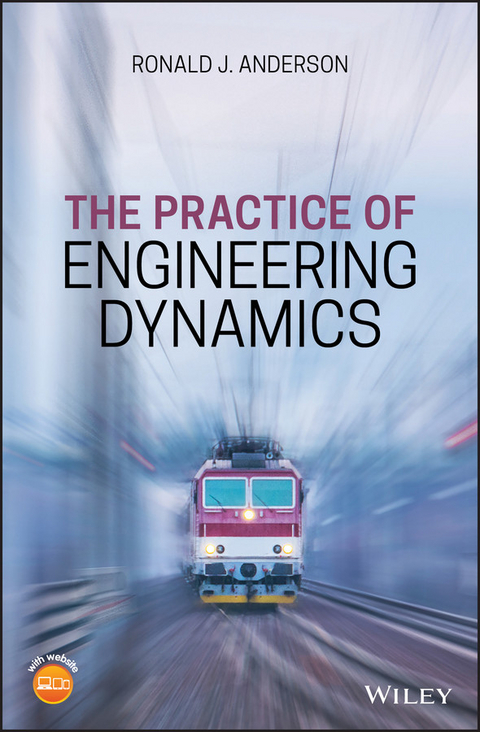
The Practice of Engineering Dynamics (eBook)
John Wiley & Sons (Verlag)
978-1-119-05369-9 (ISBN)

| The Practice of Engineering Dynamics is a textbook that takes a systematic approach to understanding dynamic analysis of mechanical systems. It comprehensively covers dynamic analysis of systems from equilibrium states to non-linear simulations and presents frequency analysis of experimental data. It divides the practice of engineering dynamics into three parts: Part 1 - Modelling: Deriving Equations of Motion; Part 2 - Simulation: Using the Equations of Motion; and Part 3- Experimental Frequency Domain Analysis. This approach fulfils the need to be able to derive the equations governing the motion of a system, to then use the equations to provide useful design information, and finally to be able to analyze experimental data measured on dynamic systems. The Practice of Engineering Dynamics includes end of chapter exercises and is accompanied by a website hosting a solutions manual.
|
DR. RONALD J. ANDERSON is a Professor in the Department of Mechanical and Materials Engineering, Queen's University at Kingston, Canada. He received his B.Sc.(Eng) from the University of Alberta in 1973, his M.Sc.(Eng) from Queen's University in 1974, and his Ph.D. from Queen's University in 1977. His doctoral research was in the field of road vehicle dynamics. From 1977 to 1979, he was a Defence Scientist with the Defence Research Establishment Atlantic where he was engaged in research on the dynamics of novel ships. From 1979 to 1981 he was Senior Dynamicist with the Urban Transportation Development Corporation where he worked on rail vehicle dynamics, particularly suspension design for steerable rail vehicles. He joined Queen's University in 1981 and, while conducting research into vehicle dynamics and multibody dynamics, has been teaching undergraduate courses on dynamics and vibrations and postgraduate courses on advanced dynamics and engineering analysis. Dr. Anderson has been the recipient of several departmental and faculty-wide teaching awards. He has also served the University in the academic administrative roles of Head of Department, Associate Dean (Research), and Dean of Graduate Studies.
DR. RONALD J. ANDERSON is a Professor in the Department of Mechanical and Materials Engineering, Queen's University at Kingston, Canada. He received his B.Sc.(Eng) from the University of Alberta in 1973, his M.Sc.(Eng) from Queen's University in 1974, and his Ph.D. from Queen's University in 1977. His doctoral research was in the field of road vehicle dynamics. From 1977 to 1979, he was a Defence Scientist with the Defence Research Establishment Atlantic where he was engaged in research on the dynamics of novel ships. From 1979 to 1981 he was Senior Dynamicist with the Urban Transportation Development Corporation where he worked on rail vehicle dynamics, particularly suspension design for steerable rail vehicles. He joined Queen's University in 1981 and, while conducting research into vehicle dynamics and multibody dynamics, has been teaching undergraduate courses on dynamics and vibrations and postgraduate courses on advanced dynamics and engineering analysis. Dr. Anderson has been the recipient of several departmental and faculty-wide teaching awards. He has also served the University in the academic administrative roles of Head of Department, Associate Dean (Research), and Dean of Graduate Studies.
1
Kinematics
Kinematics is defined as the study of motion without reference to the forces that cause the motion. A proper kinematic analysis is an essential first step in any dynamics problem. This is where the analyst defines the degrees of freedom and develops expressions for the absolute velocities and accelerations of the bodies in the system that satisfy all of the physical constraints. The ability to differentiate vectors with respect to time is a critical skill in kinematic analysis.
1.1 Derivatives of Vectors
Vectors have two distinct properties – magnitude and direction. Either or both of these properties may change with time and the time derivative of a vector must account for both.
The rate of change of a vector with respect to time is therefore formed from,
- The rate of change of magnitude .
- The rate of change of direction .
Figure 1.1 A vector changing with time.
Figure 1.1 shows the vector that changes after a time increment, , to .
The difference between and can be defined as the vector shown in Figure 1.1 and, by the rules of vector addition,
or,
Then, using the definition of the time derivative,
Imagine now that Figure 1.1 is compressed to show only an infinitesimally small time interval, . The components of for the interval are shown in Figure 1.1. They are,
- A component aligned with the vector . This is a component that is strictly due to the rate of change of magnitude of . The magnitude of is where is the rate of change of length (or magnitude) of the vector . The direction of is the same as the direction of . Let be designated1 as .
- A component that is perpendicular to the vector . That is, a component due to the rate of change of direction of the vector. Terms of this type arise only when there is an angular velocity. The rate of change of direction term arises from the time rate of change of the angle in Figure 1.1 and is the magnitude of the angular velocity of the vector. The rate of change of direction therefore arises from the angular velocity of the vector. The magnitude of is where is the length of . By definition the rate of change of the angle (i.e. ) has the same positive sense as the angle itself. It is clear that is the “tip speed” one would expect from an object of length rotating with angular speed .
The angular velocity is itself a vector quantity since it must specify both the angular speed (i.e. magnitude) and the axis of rotation (i.e. direction). In Figure 1.1, the speed of rotation is and the axis of rotation is perpendicular to the page. This results in an angular velocity vector,
where the right handed set of unit vectors, , is defined in Figure 1.2. Note that it is essential that right handed coordinate systems be used for dynamic analysis because of the extensive use of the cross product and the directions of vectors arising from it. If there is a right handed coordinate system , with respective unit vectors , then the cross products are such that,
Figure 1.2 Even 2D problems are 3D.
Using this definition of the angular velocity, the motion of the tip of vector , resulting from the angular change in time , can be determined from the cross product
which, by the rules of the vector cross product, has magnitude,
and a direction that, according to the right hand rule2 used for cross products, is perpendicular to both and and, in fact, lies in the direction of .
Combining these two terms to get and substituting into Equation 1.3 results in,
The time derivative of any vector, , can therefore be written as,
It is important to understand that the angular velocity vector, , is the angular velocity of the coordinate system in which the vector, , is expressed. There is a danger that the rate of change of direction terms will be included twice if the angular velocity of the vector with respect to the coordinate system in which it measured is used instead. The example presented in Section 1.3 shows a number of different ways to arrive at the derivative of a vector which rotates in a plane.
1.2 Performing Kinematic Analysis
Before proceeding with examples of kinematic analyses we state here the steps that are necessary in achieving a successful result. This first step in any dynamic analysis is vitally important. The goal is to derive expressions for the absolute velocities and accelerations of the centers of mass of the bodies making up the system being analyzed. In addition, expressions for the absolute angular velocities and angular accelerations of the bodies will be required. It is at this first step of the analysis that degrees of freedom are defined and constraints on relative motion between bodies are satisfied.
For this general description of kinematic analysis, we assume that we are analyzing a system that has multiple bodies connected to each other by joints and that we are attempting to derive an expression for the acceleration of the center of mass of a body that is not the first in the assembly.
The procedure is as follows.
- Find a fixed point (i.e. one having no velocity or acceleration) in the system from which you can begin to write relative position vectors that will lead to the centers of mass of bodies in the system.
- Define a position vector that goes from the fixed point, through the first body, to the next joint in the system. This is the position of the joint relative to the fixed point.
- Determine how many degrees of freedom, both translational and rotational, are required to define the motion of the relative position vector just defined. The degrees of freedom must be chosen to satisfy the constraints imposed by the joint that connects this body to ground.
- Define a coordinate system in which the relative position vector will be written and determine the angular velocity of the coordinate system.
- Repeat the previous three steps as you go from joint to joint in the system, always being careful to satisfy the joint constraints by defining appropriate degrees of freedom.
- When the desired body is reached, define a final relative position vector from the joint to the center of mass.
- The sum of all the relative position vectors will be the absolute position of the center of mass and the derivatives of the sum of vectors will yield the absolute velocity and acceleration of the center of mass.
1.3 Two Dimensional Motion with Constant Length
Figure 1.3 shows a rigid rod of length, , rotating about a fixed point, , in a plane. An expression for the velocity of the free end of the rod, , relative to point is desired.
Figure 1.3 A rigid rod rotating about a fixed point.
By definition, the velocity of relative to is the time derivative of the position of relative to . This position vector is designated and is shown in the figure.
In order to differentiate the position vector, we must have an expression for it and this means we must first choose a coordinate system3 in which to work. For a start, we can choose a right handed coordinate system fixed in the ground. The set of unit vectors is such a system. The angular velocity of this coordinate system is zero (i.e. ) since it is fixed in the ground.
An expression for the position of relative to in this system is,
We apply Equation 1.6 to to get,
In this coordinate system, it is clear that there is a rate of change of magnitude of the vector only and the velocity of point relative to after performing the simple differentiation is,
Another derivation of the velocity of relative to might use the system of unit vectors that are fixed in the rod. The advantage of using this system is that the position vector is easily expressed as,
Note that the length of this vector is a constant so that the total derivative must come from its rate of change of direction. The angular velocity of the coordinate system is equal to the angular velocity of the rod since the coordinate system is fixed in the rod. That is,
and the velocity of relative to is therefore4,
Since is constant, , and the final result is,
We now have two expressions for (Equations 1.9 and 1.13). Since there can only be one value of this relative velocity, the two expressions must be equal to each other. However, the use of two different coordinate systems makes them look different. In order to compare them, we must be able to transform results from one coordinate system to the other.
Keep in mind that sequential sets of unit vectors are related to each other by simple plane rotations. Also note that the unit vectors are not related to any point in the system – they simply express directions. Given these two facts, we can relate the two sets of unit vectors we have been using by noting that...
| Erscheint lt. Verlag | 2.6.2020 |
|---|---|
| Sprache | englisch |
| Themenwelt | Technik ► Maschinenbau |
| Schlagworte | Applied Mathematics in Engineering • Chaos • Chaos / Fractal / Dynamical Systems • Chaos, Fraktale u. dynamische Systeme • Dynamic Analysis • Engineering Dynamics • Equations of motion • Equilibrium • experimental data • Experimental Frequency Domain Analysis • Festkörpermechanik • Frequency analysis • Maschinenbau • Mathematics • Mathematik • Mathematik in den Ingenieurwissenschaften • mechanical engineering • Mechanical Systems • Modelling • Simulation • solid mechanics • Systematic • Textbook |
| ISBN-10 | 1-119-05369-2 / 1119053692 |
| ISBN-13 | 978-1-119-05369-9 / 9781119053699 |
| Informationen gemäß Produktsicherheitsverordnung (GPSR) | |
| Haben Sie eine Frage zum Produkt? |
 EPUB (Adobe DRM)
Kopierschutz: Adobe-DRM
Adobe-DRM ist ein Kopierschutz, der das eBook vor Mißbrauch schützen soll. Dabei wird das eBook bereits beim Download auf Ihre persönliche Adobe-ID autorisiert. Lesen können Sie das eBook dann nur auf den Geräten, welche ebenfalls auf Ihre Adobe-ID registriert sind.
Details zum Adobe-DRM
Dateiformat: EPUB (Electronic Publication)
EPUB ist ein offener Standard für eBooks und eignet sich besonders zur Darstellung von Belletristik und Sachbüchern. Der Fließtext wird dynamisch an die Display- und Schriftgröße angepasst. Auch für mobile Lesegeräte ist EPUB daher gut geeignet.
Systemvoraussetzungen:
PC/Mac: Mit einem PC oder Mac können Sie dieses eBook lesen. Sie benötigen eine
eReader: Dieses eBook kann mit (fast) allen eBook-Readern gelesen werden. Mit dem amazon-Kindle ist es aber nicht kompatibel.
Smartphone/Tablet: Egal ob Apple oder Android, dieses eBook können Sie lesen. Sie benötigen eine
Geräteliste und zusätzliche Hinweise
Buying eBooks from abroad
For tax law reasons we can sell eBooks just within Germany and Switzerland. Regrettably we cannot fulfill eBook-orders from other countries.
aus dem Bereich