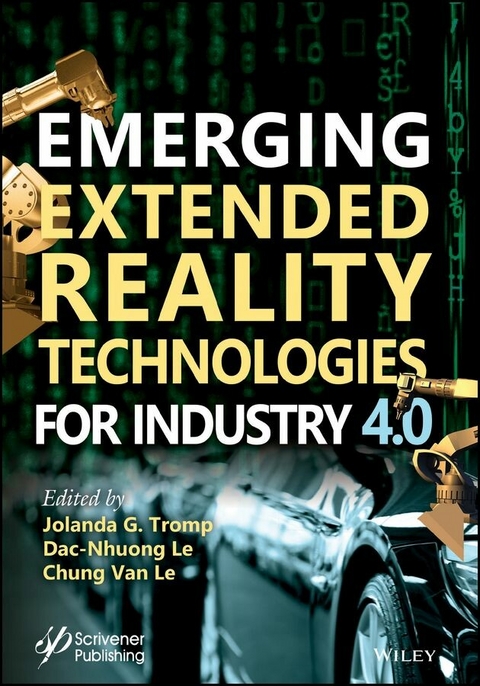
Emerging Extended Reality Technologies for Industry 4.0 (eBook)
John Wiley & Sons (Verlag)
978-1-119-65473-5 (ISBN)
In the fast-developing world of Industry 4.0, which combines Extended Reality (XR) technologies, such as Virtual Reality (VR) and Augmented Reality (AR), creating location aware applications to interact with smart objects and smart processes via Cloud Computing strategies enabled with Artificial Intelligence (AI) and the Internet of Things (IoT), factories and processes can be automated and machines can be enabled with self-monitoring capabilities. Smart objects are given the ability to analyze and communicate with each other and their human co-workers, delivering the opportunity for much smoother processes, and freeing up workers for other tasks. Industry 4.0 enabled smart objects can be monitored, designed, tested and controlled via their digital twins, and these processes and controls are visualized in VR/AR. The Industry 4.0 technologies provide powerful, largely unexplored application areas that will revolutionize the way we work, collaborate and live our lives. It is important to understand the opportunities and impact of the new technologies and the effects from a production, safety and societal point of view.
Jolanda G. Tromp is a Human-Computer Interaction expert for User-Centered design and evaluation of new technologies (VR/AR/AI/IoT), with 20 years' experience as principal Usability investigator. She has a PhD in Systematic Usability Design and Evaluation for Collaborative Virtual Environments, 2001, University of Nottingham, United Kingdom, a BSc in Psychology (with honors) University of Amsterdam, Holland (1995). She is a research consultant for the Center of Visualization and Simulation at Duy Tan University, Vietnam; for the Mixed Reality Task Group of the State University of New York; and for the global Simulations Working Group.
Dac-Nhuong Le is PhD Deputy-Head of Faculty of Information Technology, Haiphong University, Vietnam. His areas of research include: evolutionary computation, specialized with evolutionary multiobjective optimization, approximate algorithms, network communication, security and vulnerability, network performance analysis and simulation, cloud computing, image processing in biomedical. His core work in evolutionary multi-objective optimization, network security, wireless, mobile computing and virtual reality. He has edited several books for the Wiley-Scrivener imprint.
Chung Van Le is Vice-Director Center of Visualization and Simulation. He has a MSc in Computer Science from Duy Tan University, 2011, Vietnam and a BSc in Computer Science at Da Nang University, 2004, Vietnam. He is currently pursuing a PhD at Duy Tan University, Vietnam. He researches medical image processing, e-Health, virtual simulation in medicine. He is Duy Tan University Lead Software Developer for 3D virtual body system for teaching anatomy and virtual endoscopic techniques for medical students.
In the fast-developing world of Industry 4.0, which combines Extended Reality (XR) technologies, such as Virtual Reality (VR) and Augmented Reality (AR), creating location aware applications to interact with smart objects and smart processes via Cloud Computing strategies enabled with Artificial Intelligence (AI) and the Internet of Things (IoT), factories and processes can be automated and machines can be enabled with self-monitoring capabilities. Smart objects are given the ability to analyze and communicate with each other and their human co-workers, delivering the opportunity for much smoother processes, and freeing up workers for other tasks. Industry 4.0 enabled smart objects can be monitored, designed, tested and controlled via their digital twins, and these processes and controls are visualized in VR/AR. The Industry 4.0 technologies provide powerful, largely unexplored application areas that will revolutionize the way we work, collaborate and live our lives. It is important to understand the opportunities and impact of the new technologies and the effects from a production, safety and societal point of view.
Jolanda G. Tromp is a Human-Computer Interaction expert for User-Centered design and evaluation of new technologies (VR/AR/AI/IoT), with 20 years' experience as principal Usability investigator. She has a PhD in Systematic Usability Design and Evaluation for Collaborative Virtual Environments, 2001, University of Nottingham, United Kingdom, a BSc in Psychology (with honors) University of Amsterdam, Holland (1995). She is a research consultant for the Center of Visualization and Simulation at Duy Tan University, Vietnam; for the Mixed Reality Task Group of the State University of New York; and for the global Simulations Working Group. Dac-Nhuong Le is PhD Deputy-Head of Faculty of Information Technology, Haiphong University, Vietnam. His areas of research include: evolutionary computation, specialized with evolutionary multiobjective optimization, approximate algorithms, network communication, security and vulnerability, network performance analysis and simulation, cloud computing, image processing in biomedical. His core work in evolutionary multi-objective optimization, network security, wireless, mobile computing and virtual reality. He has edited several books for the Wiley-Scrivener imprint. Chung Van Le is Vice-Director Center of Visualization and Simulation. He has a MSc in Computer Science from Duy Tan University, 2011, Vietnam and a BSc in Computer Science at Da Nang University, 2004, Vietnam. He is currently pursuing a PhD at Duy Tan University, Vietnam. He researches medical image processing, e-Health, virtual simulation in medicine. He is Duy Tan University Lead Software Developer for 3D virtual body system for teaching anatomy and virtual endoscopic techniques for medical students.
List of Figures
| I.1 | Seventeen sustainable development goals. |
| 1.1 | Task group projected workflow. |
| 1.2 | Detail from Zotero group. |
| 1.3 | Respondents reported the challenges of using MR in the classroom. |
| 1.4 | Research categories for which respondents reported use of MR. |
| 1.5 | Challenges in use of MR for researchers. |
| 2.1 | Human body simulation. |
| 2.2 | Simulated jaw and limb activity. |
| 2.3 | Simulation of the heart and circulatory system. |
| 2.4 | The process of marking and remembering anatomical points. |
| 2.5 | Users interact with the system via computer, mobile device and VR device. |
| 2.6 | Study group interacting via AR-enabled smartphones. |
| 3.1 | Ways to track children as they travel to and from school. |
| 3.2 | Systems parents want implemented in school buses. |
| 3.3 | School bus tracking sensor system use case. |
| 3.4 | Diagram of safety tracking and sensor system. |
| 3.5 | Sign up/sign in page. |
| 3.6 | Informing the bus driver and tracking the bus. |
| 3.7 | Add bus driver. |
| 3.8 | Bus driver. |
| 3.9 | School administrator. |
| 4.1 | Construction flowchart of aquantized speech image. |
| 4.2 | Flowchart of the proposed encryption technique applied to the quantized speech image for secure internet of things. |
| 4.3 | Image encrypted/decrypted. |
| 4.4 | Original speech signal. |
| 4.5 | Reconstructed speech signal after decryption and dequantization. |
| 4.6 | (a) The beginning of the original speech signal (zoomed); (b) the same region of the reconstructed speech signal after decryption and dequantization (zoomed). |
| 4.7 | (a) The middle of the original speech signal (zoomed); (b) the same region of the reconstructed speech signal after decryption and dequantization (zoomed). |
| 4.8 | (a) The end of the original speech signal (zoomed); (b) the same region of the reconstructed speech signal after decryption and dequantization (zoomed). |
| 4.9 | Correlation comparison. |
| 4.10 | (a) Histogram of the original speech quantized image; (b) Histogram of the encrypted speech quantized image. |
| 5.1 | The entrepreneurship ecosystem actors. |
| 6.1 | (left) Original navigation page with three cards on one screen; (right) redesigned navigation page with eight cards on one screen. |
| 6.2 | (left) The original 3D model page with 20 buttons; (right) new 3D model page with 8 buttons. |
| 6.3 | (left) The original buttons were small and located far from the thumb; (right) redesigned buttons are bigger and located at the bottom of the screen. |
| 6.4 | The redesigned buttons have a highlight effect. |
| 7.1 | An example of an early cumbersome HMD. |
| 7.2 | Examples of see-through AR interfaces, both of which are lightweight and hands-free augmented reality glasses that permit the user to view the world around them; Google Glass (left) and Magic Leap One (right). |
| 7.3 | Example of gesture-based interaction through the HoloLens and HoloMuse application. |
| 7.4 | An example of natural feature-based point detection for using AR on rock art. Recognition of multiple known points is required to permit accurate registrationofthe augmented image [40]. |
| 7.5 | A range of white balance settings which match color temperature at set times, increasing consistency of color tone with the real scene. |
| 7.6 | An example of real-world shadow creation under varied environmental conditions; virtual teapot (left) and real teapot (right). |
| 7.7 | Virtual and augmented design space consists of layers of meaning: architectural, semantic, social, and temporal. |
| 7.8 | A user constructs a sense of presence from successful interaction with the virtual or augmented world (adapted from Tromp [49]). |
| 7.9 | Virtual and augmented design space consists of layers of possible interactive functionality and optimization of the user interactions in terms of task-flow and interaction-feedback loop mappings between real world, virtual world and augmented world/object at the architectural, semantic, social, and temporal level [50]. |
| 7.10 | AR within the TombSeer project: testing functionality of gaze selection with the Meta headset (left), and in-situ testing within the replica of an Egyptian tomb (right). |
| 8.1 | A real student learning experience operating in LMS after upgrades based on the TELECI approach. |
| 8.2 | Knowledge tests and course content adaptation process diagram. |
| 8.3 | Detailed process of Preliminary Survey analysis. |
| 8.4 | TELECI Interface to VS subsystem. |
| 8.5 | Energy flow model for virtual student’s ecosystem: System Energy Depot (Depot), Virtual Student’s Energy Buffer (VS), and k Energy Storages for Learning Objects (LO1 ... LOk). |
| 8.6 | TELECI interface to AI component. |
| 8.7 | The organizational landscape environment holds TELECI system controlling learners’ data gathering, distribution, and flow among computational and storage resources. |
| 8.8 | SABI algorithm key variables in action. |
| 8.9 | Learning related events { an arrival process. |
| 8.10 | The model of behavior noise impact on data produced by Real Learner. Modality decoding can lead to detection errors. |
| 8.11 | Interaction time detection error. A small learning object requires less time to interact. Distractions produce “behavior noise.” |
| 10.1 | Components of the electronic engine control system for gas diesel engines: (1) information calculation block, (2, 10) intake manifold temperature and pressure sensors, (3, 9) cooling agent temperature sensors, (4) barometric correction sensor, (5) crankshaft position sensor, (6) camshaft position sensor, (7) crankshaft and camshaft position sensors adapter, (8) block of thermocouples. |
| 10.2 | Common rail fuel supply system for a truck diesel engine: (1) fuel feed pump, (2) filter, (3) low pressure fuel lines, (4) high pressure fuel pump, (5.1, 5.2, 5.3) high pressure fuel lines, (6.1) coupler, (6.2) common rail, (7) pressure sensor, (8) emergency valve, (9) CR injector. |
| 10.3 | HP fuel pump: (1) HP fuel pump body, (2) tappet, (3) push fitting, (4) insert section body, (5) plunger support, (6) tappet roller, (7) camshaft, (8) plunger spring, (9) plunger, (10) plunger liner, (11) delivery valve, (12) delivery valve seat, (13) delivery valve spring, (14) control valve, (15) plate fastening the HP fuel pump to the engine, (16) HP fuel pump drive flange; (17) HP fuel pump rear cover, (18) bypass valve. |
| 10.4 | CR injectors: (1) injection nozzle, (2) spacer, (3) armature, (4) armature spring, (5) electromagnet, (6) magnet spring, (7) valve seat, (8) armature body, (9) spacer, (10) ring, (11) nozzle nut, (12) injector body, (13, 14) connectors, (15) electromagnet power wires, (16) needle valve, (17) needle valve spring, (18) control chamber, (19) clamp mounting point. |
| 10.5 | Injector nozzle diagram: (1) injector nozzle body, (2) needle valve, (3, 4) spray holes of the first (lower) and second (upper) groups, (5) intake edges of the first group of spray holes in the sack volume, (6) sack volume, (7) intake edges of the second group of spray holes on the locking cone, (8) locking cone of the injector nozzle body... |
| Erscheint lt. Verlag | 14.4.2020 |
|---|---|
| Sprache | englisch |
| Themenwelt | Informatik ► Theorie / Studium ► Künstliche Intelligenz / Robotik |
| Technik ► Umwelttechnik / Biotechnologie | |
| Schlagworte | Artificial Intelligence • biomedical engineering • Biomedizintechnik • Chemie • Chemistry • Computer Science • extended reality ai • extended reality applications • extended reality handbook • extended reality implementation • extended reality technology • Industrial Chemistry • Informatik • Künstliche Intelligenz • Medical Informatics & Biomedical Information Technology • Medizininformatik u. biomedizinische Informationstechnologie • Technische u. Industrielle Chemie • XR • XR applications • xr deployment • xr implementation • xr tech • xr technologies • xr technology |
| ISBN-10 | 1-119-65473-4 / 1119654734 |
| ISBN-13 | 978-1-119-65473-5 / 9781119654735 |
| Informationen gemäß Produktsicherheitsverordnung (GPSR) | |
| Haben Sie eine Frage zum Produkt? |
 EPUB (Adobe DRM)
Kopierschutz: Adobe-DRM
Adobe-DRM ist ein Kopierschutz, der das eBook vor Mißbrauch schützen soll. Dabei wird das eBook bereits beim Download auf Ihre persönliche Adobe-ID autorisiert. Lesen können Sie das eBook dann nur auf den Geräten, welche ebenfalls auf Ihre Adobe-ID registriert sind.
Details zum Adobe-DRM
Dateiformat: EPUB (Electronic Publication)
EPUB ist ein offener Standard für eBooks und eignet sich besonders zur Darstellung von Belletristik und Sachbüchern. Der Fließtext wird dynamisch an die Display- und Schriftgröße angepasst. Auch für mobile Lesegeräte ist EPUB daher gut geeignet.
Systemvoraussetzungen:
PC/Mac: Mit einem PC oder Mac können Sie dieses eBook lesen. Sie benötigen eine
eReader: Dieses eBook kann mit (fast) allen eBook-Readern gelesen werden. Mit dem amazon-Kindle ist es aber nicht kompatibel.
Smartphone/Tablet: Egal ob Apple oder Android, dieses eBook können Sie lesen. Sie benötigen eine
Geräteliste und zusätzliche Hinweise
Buying eBooks from abroad
For tax law reasons we can sell eBooks just within Germany and Switzerland. Regrettably we cannot fulfill eBook-orders from other countries.
aus dem Bereich