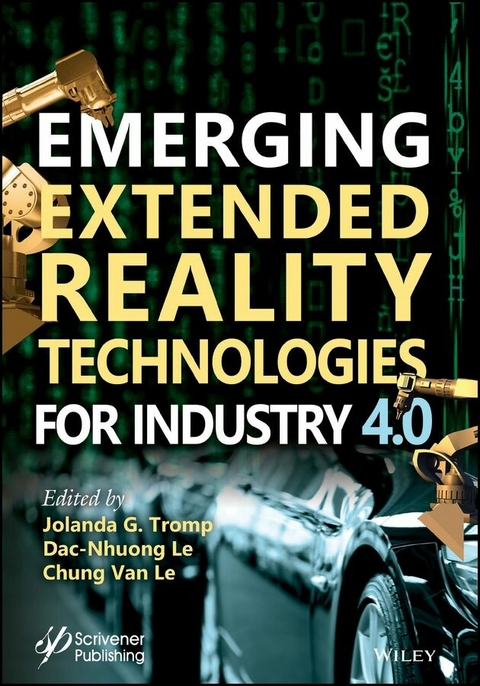
Emerging Extended Reality Technologies for Industry 4.0 (eBook)
John Wiley & Sons (Verlag)
978-1-119-65469-8 (ISBN)
In the fast-developing world of Industry 4.0, which combines Extended Reality (XR) technologies, such as Virtual Reality (VR) and Augmented Reality (AR), creating location aware applications to interact with smart objects and smart processes via Cloud Computing strategies enabled with Artificial Intelligence (AI) and the Internet of Things (IoT), factories and processes can be automated and machines can be enabled with self-monitoring capabilities. Smart objects are given the ability to analyze and communicate with each other and their human co-workers, delivering the opportunity for much smoother processes, and freeing up workers for other tasks. Industry 4.0 enabled smart objects can be monitored, designed, tested and controlled via their digital twins, and these processes and controls are visualized in VR/AR. The Industry 4.0 technologies provide powerful, largely unexplored application areas that will revolutionize the way we work, collaborate and live our lives. It is important to understand the opportunities and impact of the new technologies and the effects from a production, safety and societal point of view.
Jolanda G. Tromp is a Human-Computer Interaction expert for User-Centered design and evaluation of new technologies (VR/AR/AI/IoT), with 20 years' experience as principal Usability investigator. She has a PhD in Systematic Usability Design and Evaluation for Collaborative Virtual Environments, 2001, University of Nottingham, United Kingdom, a BSc in Psychology (with honors) University of Amsterdam, Holland (1995). She is a research consultant for the Center of Visualization and Simulation at Duy Tan University, Vietnam; for the Mixed Reality Task Group of the State University of New York; and for the global Simulations Working Group.
Dac-Nhuong Le is PhD Deputy-Head of Faculty of Information Technology, Haiphong University, Vietnam. His areas of research include: evolutionary computation, specialized with evolutionary multiobjective optimization, approximate algorithms, network communication, security and vulnerability, network performance analysis and simulation, cloud computing, image processing in biomedical. His core work in evolutionary multi-objective optimization, network security, wireless, mobile computing and virtual reality. He has edited several books for the Wiley-Scrivener imprint.
Chung Van Le is Vice-Director Center of Visualization and Simulation. He has a MSc in Computer Science from Duy Tan University, 2011, Vietnam and a BSc in Computer Science at Da Nang University, 2004, Vietnam. He is currently pursuing a PhD at Duy Tan University, Vietnam. He researches medical image processing, e-Health, virtual simulation in medicine. He is Duy Tan University Lead Software Developer for 3D virtual body system for teaching anatomy and virtual endoscopic techniques for medical students.
In the fast-developing world of Industry 4.0, which combines Extended Reality (XR) technologies, such as Virtual Reality (VR) and Augmented Reality (AR), creating location aware applications to interact with smart objects and smart processes via Cloud Computing strategies enabled with Artificial Intelligence (AI) and the Internet of Things (IoT), factories and processes can be automated and machines can be enabled with self-monitoring capabilities. Smart objects are given the ability to analyze and communicate with each other and their human co-workers, delivering the opportunity for much smoother processes, and freeing up workers for other tasks. Industry 4.0 enabled smart objects can be monitored, designed, tested and controlled via their digital twins, and these processes and controls are visualized in VR/AR. The Industry 4.0 technologies provide powerful, largely unexplored application areas that will revolutionize the way we work, collaborate and live our lives. It is important to understand the opportunities and impact of the new technologies and the effects from a production, safety and societal point of view.
Jolanda G. Tromp is a Human-Computer Interaction expert for User-Centered design and evaluation of new technologies (VR/AR/AI/IoT), with 20 years' experience as principal Usability investigator. She has a PhD in Systematic Usability Design and Evaluation for Collaborative Virtual Environments, 2001, University of Nottingham, United Kingdom, a BSc in Psychology (with honors) University of Amsterdam, Holland (1995). She is a research consultant for the Center of Visualization and Simulation at Duy Tan University, Vietnam; for the Mixed Reality Task Group of the State University of New York; and for the global Simulations Working Group. Dac-Nhuong Le is PhD Deputy-Head of Faculty of Information Technology, Haiphong University, Vietnam. His areas of research include: evolutionary computation, specialized with evolutionary multiobjective optimization, approximate algorithms, network communication, security and vulnerability, network performance analysis and simulation, cloud computing, image processing in biomedical. His core work in evolutionary multi-objective optimization, network security, wireless, mobile computing and virtual reality. He has edited several books for the Wiley-Scrivener imprint. Chung Van Le is Vice-Director Center of Visualization and Simulation. He has a MSc in Computer Science from Duy Tan University, 2011, Vietnam and a BSc in Computer Science at Da Nang University, 2004, Vietnam. He is currently pursuing a PhD at Duy Tan University, Vietnam. He researches medical image processing, e-Health, virtual simulation in medicine. He is Duy Tan University Lead Software Developer for 3D virtual body system for teaching anatomy and virtual endoscopic techniques for medical students.
| Erscheint lt. Verlag | 26.3.2020 |
|---|---|
| Sprache | englisch |
| Themenwelt | Informatik ► Theorie / Studium ► Künstliche Intelligenz / Robotik |
| Technik ► Umwelttechnik / Biotechnologie | |
| Schlagworte | Artificial Intelligence • biomedical engineering • Biomedizintechnik • Computer Science • extended reality ai • extended reality applications • extended reality handbook • extended reality implementation • extended reality technology • Informatik • Künstliche Intelligenz • Medical Informatics & Biomedical Information Technology • Medizininformatik u. biomedizinische Informationstechnologie • XR • XR applications • xr deployment • xr implementation • xr tech • xr technologies • xr technology |
| ISBN-10 | 1-119-65469-6 / 1119654696 |
| ISBN-13 | 978-1-119-65469-8 / 9781119654698 |
| Informationen gemäß Produktsicherheitsverordnung (GPSR) | |
| Haben Sie eine Frage zum Produkt? |
 PDF (Adobe DRM)
Kopierschutz: Adobe-DRM
Adobe-DRM ist ein Kopierschutz, der das eBook vor Mißbrauch schützen soll. Dabei wird das eBook bereits beim Download auf Ihre persönliche Adobe-ID autorisiert. Lesen können Sie das eBook dann nur auf den Geräten, welche ebenfalls auf Ihre Adobe-ID registriert sind.
Details zum Adobe-DRM
Dateiformat: PDF (Portable Document Format)
Mit einem festen Seitenlayout eignet sich die PDF besonders für Fachbücher mit Spalten, Tabellen und Abbildungen. Eine PDF kann auf fast allen Geräten angezeigt werden, ist aber für kleine Displays (Smartphone, eReader) nur eingeschränkt geeignet.
Systemvoraussetzungen:
PC/Mac: Mit einem PC oder Mac können Sie dieses eBook lesen. Sie benötigen eine
eReader: Dieses eBook kann mit (fast) allen eBook-Readern gelesen werden. Mit dem amazon-Kindle ist es aber nicht kompatibel.
Smartphone/Tablet: Egal ob Apple oder Android, dieses eBook können Sie lesen. Sie benötigen eine
Geräteliste und zusätzliche Hinweise
Buying eBooks from abroad
For tax law reasons we can sell eBooks just within Germany and Switzerland. Regrettably we cannot fulfill eBook-orders from other countries.
aus dem Bereich