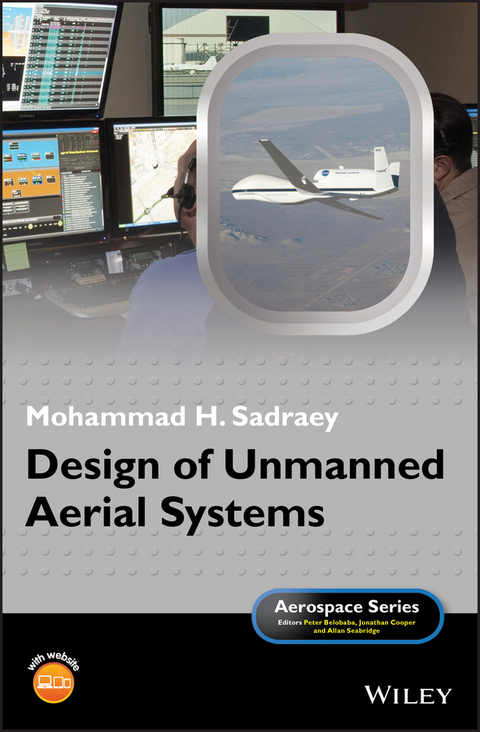
Design of Unmanned Aerial Systems (eBook)
John Wiley & Sons (Verlag)
978-1-119-50862-5 (ISBN)
Provides a comprehensive introduction to the design and analysis of unmanned aircraft systems with a systems perspective
Written for students and engineers who are new to the field of unmanned aerial vehicle design, this book teaches the many UAV design techniques being used today and demonstrates how to apply aeronautical science concepts to their design.
Design of Unmanned Aerial Systems covers the design of UAVs in three sections-vehicle design, autopilot design, and ground systems design-in a way that allows readers to fully comprehend the science behind the subject so that they can then demonstrate creativity in the application of these concepts on their own. It teaches students and engineers all about: UAV classifications, design groups, design requirements, mission planning, conceptual design, detail design, and design procedures. It provides them with in-depth knowledge of ground stations, power systems, propulsion systems, automatic flight control systems, guidance systems, navigation systems, and launch and recovery systems. Students will also learn about payloads, manufacturing considerations, design challenges, flight software, microcontroller, and design examples. In addition, the book places major emphasis on the automatic flight control systems and autopilots.
- Provides design steps and procedures for each major component
- Presents several fully solved, step-by-step examples at component level
- Includes numerous UAV figures/images to emphasize the application of the concepts
- Describes real stories that stress the significance of safety in UAV design
- Offers various UAV configurations, geometries, and weight data to demonstrate the real-world applications and examples
- Covers a variety of design techniques/processes such that the designer has freedom and flexibility to satisfy the design requirements in several ways
- Features many end-of-chapter problems for readers to practice
Design of Unmanned Aerial Systems is an excellent text for courses in the design of unmanned aerial vehicles at both the upper division undergraduate and beginning graduate levels.
Mohammad H. Sadraey, PhD, is Associate Professor (Aeronautical Engineering) at Southern New Hampshire University. He has authored five books, including Aircraft Design: A Systems Engineering Approach and Aircraft Performance Analysis. He is a member of the American Institute of Aeronautics and Astronautics, the American Society for Engineering Education, and Sigma Gamma Tau Honor Society. Dr. Sadraey is also the guest editor of the Journal of Aerospace special issue on 'Aircraft design.'
Provides a comprehensive introduction to the design and analysis of unmanned aircraft systems with a systems perspective Written for students and engineers who are new to the field of unmanned aerial vehicle design, this book teaches the many UAV design techniques being used today and demonstrates how to apply aeronautical science concepts to their design. Design of Unmanned Aerial Systems covers the design of UAVs in three sections vehicle design, autopilot design, and ground systems design in a way that allows readers to fully comprehend the science behind the subject so that they can then demonstrate creativity in the application of these concepts on their own. It teaches students and engineers all about: UAV classifications, design groups, design requirements, mission planning, conceptual design, detail design, and design procedures. It provides them with in-depth knowledge of ground stations, power systems, propulsion systems, automatic flight control systems, guidance systems, navigation systems, and launch and recovery systems. Students will also learn about payloads, manufacturing considerations, design challenges, flight software, microcontroller, and design examples. In addition, the book places major emphasis on the automatic flight control systems and autopilots. Provides design steps and procedures for each major component Presents several fully solved, step-by-step examples at component level Includes numerous UAV figures/images to emphasize the application of the concepts Describes real stories that stress the significance of safety in UAV design Offers various UAV configurations, geometries, and weight data to demonstrate the real-world applications and examples Covers a variety of design techniques/processes such that the designer has freedom and flexibility to satisfy the design requirements in several ways Features many end-of-chapter problems for readers to practice Design of Unmanned Aerial Systems is an excellent text for courses in the design of unmanned aerial vehicles at both the upper division undergraduate and beginning graduate levels.
Mohammad H. Sadraey, PhD, is Associate Professor (Aeronautical Engineering) at Southern New Hampshire University. He has authored five books, including Aircraft Design: A Systems Engineering Approach and Aircraft Performance Analysis. He is a member of the American Institute of Aeronautics and Astronautics, the American Society for Engineering Education, and Sigma Gamma Tau Honor Society. Dr. Sadraey is also the guest editor of the Journal of Aerospace special issue on "Aircraft design."
Preface
Definitions
An Unmanned Aerial System (UAS) is a group of coordinated multidisciplinary elements for an aerial mission by employing various payloads in flying vehicle(s). In contrast, an Unmanned Aerial Vehicle (UAV) is a remotely piloted or self‐piloted aircraft that can carry payloads such as camera, radar, sensor, and communications equipment. All flight operations (including takeoff and landing) are performed without on‐board human pilot. In news and media reports, the expression “drone” – as a short term – is preferred.
A UAS basically includes five main elements: 1. Air vehicle; 2. Control station; 3. Payload; 4. Launch and recovery system, 5. Maintenance and support system. Moreover, the environment in which the UAV(s) or the systems elements operate (e.g., the airspace, the data links, relay aircraft, etc.) may be assumed as the sixth (6) inevitable element.
A UAV is much more than a reusable air vehicle. UAVs are to perform critical missions without risk to personnel and more cost effectively than comparable manned system. UAVs are air vehicles; they fly like airplanes and operate in an airplane environment. They are designed like air vehicles; they have to meet flight critical air vehicle requirements. A designer needs to know how to integrate complex, multi‐disciplinary systems, and to understand the environment, the requirements and the design challenges.
UAVs are employed in numerous flight missions; in scientific projects and research studies such as hurricane tracking, volcano monitoring, and remote sensing; and in commercial applications such as tall building and bridge observation, traffic control, tower maintenance, and fire monitoring. UAVs also present very unique opportunities for filmmakers in aerial filming/photography.
The UAVs are about to change how directors make movies in capturing the perfect aerial shot. In military arenas, UAVs may be utilized in flight missions such as surveillance, reconnaissance, intelligent routing, offensive operations, and combat. A UAV must typically be flexible, adaptable, capable of performing reconnaissance work, geo‐mapping ready, able to collect samples of various pollutants, ready to conduct “search and destroy” missions, and prepared to research in general.
There is no consensus for the definition of autonomy in UAV community. The main systems drivers for autonomy are that it should provide more flexible operation, in that the operator tells the system what is wanted from the mission (not how to do it) with the flexibility of dynamic changes to the mission goals being possible in flight with minimal operation re‐planning. Autonomy is classified in 10 levels, from remotely piloted, to fully autonomous swarm. Autonomy includes a level of artificial intelligence. An autopilot is the main element by which the level of autonomy is determined. For instance, stabilization of an unstable UAV is a function for autopilot.
In 2018, at least 122 000 people in the U.S. are certified to fly UAVs professionally, according to the Federal Aviation Administration (FAA), which sparked the UAVs explosion in 2016 when it simplified its process for allowing their commercial use. FAA has ruled that commercial UAV flight outside a pilot's line of sight is not allowed. About three million UAVs were sold [1] worldwide in 2017, according to Time Magazine, and more than one million UAVs are registered for US use with the FAA.
By January 2019, at least 62 countries are developing or using over 1300 various UAVs. The contributions of unmanned UAV in sorties, hours, and expanded roles continue to increase. These diverse systems range in cost from a few hundred dollars (Amazon sells varieties) to tens of millions of dollars. Range in capability from Micro Air Vehicles (MAV) weighing less than 1 lb to aircraft weighing over 40 000 lbs. UAVs will have to fit into a pilot based airspace system. Airspace rules are based on manned aircraft experience.
Objectives
The objective of this book is to provide a basic text for courses in the design of UASs and UAVs at both the upper division undergraduate and beginning graduate levels. Special effort has been made to provide knowledge, lessons, and insights into UAS technologies and associated design techniques across various engineering disciplines. The author has attempted to comprehensively cover all the main design disciplines that are needed for a successful UAS design project. To cover such a broad scope in a single book, depths in many areas have to be sacrificed.
UAVs share much in common with manned aircraft. The design of manned aircraft and the design of UAVs have many similarities; and some differences. The similarities include: 1. Design process; 2. Constraints (e.g., g‐load, pressurization); and 3. UAV main components (e.g., wing, tail, fuselage, propulsion system, structure, control surfaces, and landing gear). The differences include: 1. Autopilot, 2. Communication system, 3. Sensors, 4. Payload, 5. Launch and recovery system, and 6. Ground control station.
The book is primarily written with the objective to be a main source for a UAS chief designer. The techniques presented in this book are suitable for academic study, and teaching students. The book can be adopted as the main text for a single elective course in UAS and UAV design for engineering programs. This text is also suitable for professional continuing education for individuals who are interested in UASs. Industries engineers with various backgrounds can learn about UAS and prepare themselves for new roles in UAS design project.
Approach
The process of UAS design is a complex combination of numerous disciplines which have to be blended together to yield the optimum design to meet a given set of requirements. This is a true statement “the design techniques are not understood unless practiced.” Therefore, the reader is highly encouraged to experience the design techniques and concepts through application projects. The instructors are also encouraged to define an open‐ended semester−/year‐long UAS design project to help the students to practice and learn through the application and experiencing the iterative nature of the design technique. It is my sincere wish that this book will help aspiring students and design engineers to learn and create more efficient and safer UASs, and UAVs.
In this text, the coverage of the topics which are similar to that of a manned aircraft is reviewed. However, the topics which are not covered in a typical manned aircraft design book, are presented in detail. The author has written a book on manned aircraft design – Aircraft Design, a Systems Engineering Approach – published by Wiley. In several topics, the reader recommends the reader to study that text for the complete details. Some techniques (e.g., matching plot) deviate from traditional aircraft design. Throughout the text, the systems engineering approach is examined and implemented.
A UAV designer must: (a) be knowledgeable on the various related engineering topics; (b) be aware of the latest UAV developments; (c) be informed of the current technologies; (d) employ lessons learned from past failures; and (e) appreciate breadth of UAV design options.
A design process requires both integration and iteration. A design process includes: 1. Synthesis: the creative process of putting known things together into new and more useful combinations. 2. Analysis: the process of predicting the performance or behavior of a design candidate. 3. Evaluation: the process of performance calculation and comparing the predicted performance of each feasible design candidate to determine the deficiencies.
UAVs are typically smaller than manned aircraft, have a reduced radar signature, and an increased range and endurance. A UAV designer is also involved in mission planning. Payload type has a direct effect of mission planning. For any mission, the commander seeks to establish criteria that maximize his probability of success. Planning considerations are cost dependent. A UAV can be designed for both scientific purposes and for the military. Their once reconnaissance only role is now shared with strike, force protection, and signals collection.
Beyond traditional aircraft design topics, this text presents detail design of launchers, recovery systems, communication systems, electro‐optic/infrared cameras, ground control station, autopilot, radars, scientific sensors, flight control system, navigation system, guidance system, and microcontrollers.
Outline
The objective of the book is to review the design fundamentals of UAVs, as well as the coverage of the design techniques of the UASs. The book is organized into 14 Chapters. Chapter 1 is devoted to design fundamentals including design process, and three design phases (i.e., conceptual, preliminary, and detail). The preliminary design phase is presented in Chapter 2 to determine maximum takeoff weight, wing reference planform area, and engine thrust/power. Various design disciplines including propulsion system, electric system, landing gear, and safety analysis are covered in Chapter 3. The aerodynamic design of wing, horizontal tail, vertical tail, and fuselage is provided in Chapter 4.
Fundamentals of autopilot design including UAV dynamic modeling, autopilot categories, flight simulation, flying qualities for UAVs, and autopilot design process is discussed in Chapter 5. The detail...
| Erscheint lt. Verlag | 25.3.2020 |
|---|---|
| Reihe/Serie | Aerospace Series |
| Aerospace Series (PEP) | Aerospace Series (PEP) |
| Mitarbeit |
Herausgeber (Serie): Peter Belobaba, Jonathan Cooper, Allan Seabridge |
| Sprache | englisch |
| Themenwelt | Technik ► Elektrotechnik / Energietechnik |
| Technik ► Maschinenbau | |
| Schlagworte | Aeronautic & Aerospace Engineering • Aerospace Engineering • aircraft design • Automatic Flight Control • Autopilot • Communication Systems • Control Systems Technology • drone • Electrical & Electronics Engineering • Elektrotechnik u. Elektronik • Ground station • Ground stations • Guidance Systems • launch and recovery</p> • <p>UAV • Luft- u. Raumfahrttechnik • Maschinenbau • Maschinenbau - Entwurf • mechanical engineering • Mechanical Engineering - Design • payloads • Regelungstechnik • unmanned aircraft • unmanned vehicle design |
| ISBN-10 | 1-119-50862-2 / 1119508622 |
| ISBN-13 | 978-1-119-50862-5 / 9781119508625 |
| Informationen gemäß Produktsicherheitsverordnung (GPSR) | |
| Haben Sie eine Frage zum Produkt? |
 EPUB (Adobe DRM)
Kopierschutz: Adobe-DRM
Adobe-DRM ist ein Kopierschutz, der das eBook vor Mißbrauch schützen soll. Dabei wird das eBook bereits beim Download auf Ihre persönliche Adobe-ID autorisiert. Lesen können Sie das eBook dann nur auf den Geräten, welche ebenfalls auf Ihre Adobe-ID registriert sind.
Details zum Adobe-DRM
Dateiformat: EPUB (Electronic Publication)
EPUB ist ein offener Standard für eBooks und eignet sich besonders zur Darstellung von Belletristik und Sachbüchern. Der Fließtext wird dynamisch an die Display- und Schriftgröße angepasst. Auch für mobile Lesegeräte ist EPUB daher gut geeignet.
Systemvoraussetzungen:
PC/Mac: Mit einem PC oder Mac können Sie dieses eBook lesen. Sie benötigen eine
eReader: Dieses eBook kann mit (fast) allen eBook-Readern gelesen werden. Mit dem amazon-Kindle ist es aber nicht kompatibel.
Smartphone/Tablet: Egal ob Apple oder Android, dieses eBook können Sie lesen. Sie benötigen eine
Geräteliste und zusätzliche Hinweise
Buying eBooks from abroad
For tax law reasons we can sell eBooks just within Germany and Switzerland. Regrettably we cannot fulfill eBook-orders from other countries.
aus dem Bereich