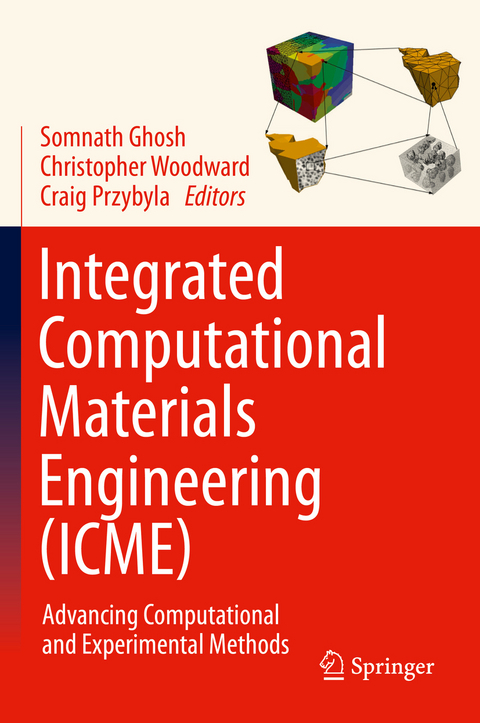
Integrated Computational Materials Engineering (ICME) (eBook)
XX, 405 Seiten
Springer International Publishing (Verlag)
978-3-030-40562-5 (ISBN)

?This book introduces research advances in Integrated Computational Materials Engineering (ICME) that have taken place under the aegis of the AFOSR/AFRL sponsored Center of Excellence on Integrated Materials Modeling (CEIMM) at Johns Hopkins University. Its author team consists of leading researchers in ICME from prominent academic institutions and the Air Force Research Laboratory. The book examines state-of-the-art advances in physics-based, multi-scale, computational-experimental methods and models for structural materials like polymer-matrix composites and metallic alloys. The book emphasizes Ni-based superalloys and epoxy matrix carbon-fiber composites and encompasses atomistic scales, meso-scales of coarse-grained models and discrete dislocations, and micro-scales of poly-phase and polycrystalline microstructures. Other critical phenomena investigated include the relationship between microstructural morphology, crystallography, and mechanisms to the material response at different scales; methods of identifying representative volume elements using microstructure and material characterization, and robust deterministic and probabilistic modeling of deformation and damage.
Encompassing a slate of topics that enable readers to comprehend and approach ICME-related issues involved in predicting material performance and failure, the book is ideal for mechanical, civil, and aerospace engineers, and materials scientists, in in academic, government, and industrial laboratories.
Dr. Somnath Ghosh is Michael G. Callas Chair Professor in the Departments of Civil, Mechanical and Materials Science & Engineering, Johns Hopkins University and Director of the Center for Integrated Structure-Materials Modeling and Simulations (CISMMS).
Dr. Christopher Woodward is Principal Materials Research Engineer within the Materials and Manufacturing Directorate, Air Force Research Laboratory/RX, Wright Patterson Air Force Base.
Dr. Craig Przybyla is Senior Materials Engineer & Research Team Leader within the Air Force Research Laboratory/RX, Wright Patterson Air Force Base, OH.
Preface 6
Acknowledgment 11
Contents 12
Contributors 14
Acquisition of 3D Data for Prediction of Monotonic and Cyclic Properties of Superalloys 18
1 Superalloys and Fatigue 18
2 Importance of 3D Data 20
3 The TriBeam 21
4 Targeted 3D Data 28
5 Future Needs 30
Appendix 30
References 31
Data Structures and Workflows for ICME 36
1 Introduction 36
2 ICME Software Tools 39
3 Simulation Tools 39
3.1 Analytic Tools 40
3.2 Example Tools from Other Fields 41
4 Building an Extensible ICME Data Schema and Workflow Tool 42
4.1 Data Handling Requirements 43
4.2 Modular Workflow Requirements 44
4.3 Data Access and Metadata Labeling Requirements 46
5 SIMPL and DREAM.3D: Enabling ICME Workflows 46
5.1 SIMPL Data Structure 48
5.2 Filters, Pipelines, and Plugins 53
5.3 SIMPLView: The Standard SIMPL Graphical Interface 55
5.4 DREAM.3D: An ICME Workflow Tool 56
6 Case Study: Ti-6242Si Pancake Forging 57
6.1 Zoning Process Histories 58
6.2 Processing Characterization Data 62
6.3 Registration and Fusion 62
7 Summary 66
References 66
Multi-scale Microstructure and Property-Based Statistically Equivalent RVEs for Modeling Nickel-Based Superalloys 71
1 Introduction 71
2 M-SERVE and P-SERVE for Intragranular Microstructures at the Subgrain Scale 75
2.1 Experimental Data Acquisition and Image Processing 76
2.2 Parametric Representation of Precipitate Morphology and Statistical Distributions 78
2.3 Generating Intragranular Statistically Equivalent Virtual Microstructures 81
2.3.1 Finalizing SEVMs Through Optimization of the Two-Point Correlation Function 81
2.3.2 Validation of SEVM Generation Method by Convergence Tests 82
2.4 Determining the M-SERVE from Statistical Convergence 83
2.4.1 Convergence of Morphological Distributions 84
2.4.2 Convergence of Spatial Distributions 84
2.5 Determining the Property-Based Statistically Equivalent RVE (P-SERVE) 85
2.5.1 Crystal Plasticity Models for Ni-Based Superalloys 86
2.5.2 CPFE Simulations for Analyzing Response Variables 87
2.5.3 Spatially Averaged Mechanical Fields 88
2.5.4 Local Response Field Variables 89
2.6 Summary of the Subgrain-Scale Analysis 90
3 M-SERVE and P-SERVE for Polycrystalline Microstructures of Ni-Based Superalloys 90
3.1 Image Extraction from Electron Backscattered Diffraction Maps 91
3.2 Statistically Equivalent Virtual Microstructure (SEVM) Generation from Characterization and Statistical Analysis 92
3.2.1 Validation of the SEVM Generation Method 95
3.3 Estimating M-SERVEs for Polycrystalline Microstructure with Twins 98
3.4 Estimating the P-SERVE Through Convergence Studies 99
3.4.1 P-SERVE Convergence Studies with the Crystal Plasticity Model 101
3.5 Summary of the Polycrystalline Scale Analysis 103
References 104
Microscale Testing and Characterization Techniques for Benchmarking Crystal Plasticity Models at Microstructural Length Scales 107
1 Introduction 107
2 Background 108
3 Machining Methods for Microscale Samples 113
3.1 Focused Ion Beam Machining 114
3.2 Wire EDM Machining 116
3.3 Femtosecond Laser Machining 118
3.4 Comparison of Machining Techniques 123
4 Sample Size Effects on Strength in René 88DT 125
5 Orientation and Deformation Maps 131
6 Chapter Summary 136
References 137
Computational Micromechanics Modeling of Polycrystalline Superalloys Application to Inconel 718 142
1 Introduction 142
2 Material Description 143
3 Experimental Characterization 144
3.1 Micromechanical Characterization 145
3.1.1 Experimental Procedure 145
3.1.2 Results 145
3.2 Macromechanical Characterization 148
3.2.1 Uniaxial Monotonic Tests 148
3.2.2 Low Cycle Fatigue Tests 150
4 Polycrystalline Homogenization Framework 153
4.1 Boundary Value Problem and Boundary Conditions 154
4.2 Microstructure Representation 156
4.3 Single Crystal Behavior 158
5 Monotonic Behavior 159
5.1 Elastic Behavior 160
5.2 Elastoplastic Behavior 160
5.3 Grain Size-Dependent Model 162
6 Cyclic Behavior 163
6.1 Crystal Plasticity Model for Cyclic Behavior 164
6.1.1 Model Parameter Identification 165
6.2 Simulation of the Cyclic Behavior 166
6.3 Grain Size-Dependent Cyclic Behavior 169
7 Microstructure-Dependent Fatigue Life Simulation 169
7.1 Microstructure-Sensitive Crack Initiation Model 169
7.2 Results 172
8 Conclusions 174
References 175
Non-deterministic Calibration of Crystal Plasticity ModelParameters 179
1 Introduction 179
2 Acquiring and Processing Experiment Data 182
2.1 Global Data 182
2.2 Local Data 182
2.2.1 Digital Image Correlation 183
2.2.2 High-Resolution EBSD 184
2.2.3 Combining DIC and HREBSD 185
3 Crystal Plasticity 185
3.1 Concepts 187
4 Calibration 189
4.1 General Process 189
4.2 Global Methods 190
4.2.1 Data Flow 191
4.2.2 Computational Model 192
4.3 Global-Local Methods 193
4.3.1 Data Flow 193
4.3.2 Computational Model 193
4.4 Local Methods 194
4.4.1 Data Flow 194
4.4.2 Computational Model 195
5 Uncertainty Quantification Model for Calibration 195
6 Demonstration Using Simulated Experiments 198
6.1 Using Global Calibration 202
6.2 Using Global-Local Calibration 204
6.3 Using Local Calibration 205
7 Summary 207
8 Outlook 209
References 210
Local Stress and Damage Response of Polycrystal Materials to Light Shock Loading Conditions via Soft Scale-Coupling 213
1 Introduction 213
2 Nomenclature 215
3 Experimental Overview 215
4 Macroscale Damage Modeling 217
4.1 Damage Constitutive Model 217
4.2 Numerical Simulation Results 222
5 Local-Scale Modeling 223
5.1 Single Crystal Model 223
5.2 Polycrystal Numerical Results 226
6 Conclusion 233
References 233
A Framework for Quantifying Effects of Characterization Error on the Predicted Local Elastic Response in Polycrystalline Materials 236
1 Introduction 236
2 Methods 238
2.1 Step 1: Synthetic Material Generation – Phantoms 239
2.2 Step 2: Simulation of Data Collection 240
2.2.1 Resolution 240
2.2.2 Interaction Volume 240
2.2.3 Random Noise 241
2.2.4 Summary of Data Collection Model 242
2.3 Additional Notes on Methodology 243
3 Individual Parameter Variation Examples 243
3.1 Step 3: Error Measurements 244
3.2 Resolution 245
3.2.1 Analytical Model of Error Associated with Sample Spacing 247
3.3 Interaction Volume 250
3.4 Unindexed Pixels 251
3.5 Data Processing Parameters 251
3.6 Brief Discussion on Data Collection and Processing Error 253
4 Case Study: Application to Finite Element Model 254
4.1 Conclusions from the Case Study 257
5 Conclusions 258
References 259
Material Agnostic Data-Driven Framework to Develop Structure-Property Linkages 261
1 Introduction 261
2 Material Agnostic Data-Driven Framework to Process-Structure-Property Linkages 262
2.1 Microstructure Quantification 264
2.2 Data-Driven Workflow for Extracting P-S-P Linkages 266
3 Application of the Material Agnostic Framework to Different Material Systems 268
3.1 Composites 268
3.2 Polycrystalline Metallic Materials 272
4 Challenges 276
5 Summary 276
References 277
Multiscale Modeling of Epoxies and Epoxy-Based Composites 279
1 Introduction 279
2 Overview of Multiscale Simulation Methods for Epoxies 281
2.1 Molecular Dynamics Simulation 281
2.2 Coarse-Grained Molecular Dynamics Methods 283
2.3 Finite Element Method 284
3 Multiscale Simulations of Epoxies and Their Properties 285
3.1 Modeling the Curing Process of Epoxies 285
3.2 Epoxy Density and Volume Shrinkage 288
3.3 Glass Transition Temperature 289
3.4 Free Volume Distribution 291
3.5 Elastic Modulus 293
3.6 Failure Properties 294
4 Multiscale Simulations of Epoxy Interfacial Properties 296
4.1 Epoxy-Based Composites and the Interphase Region 296
4.2 Coatings and Adhesives 301
5 Summary and Conclusions 302
References 303
Microstructural Statistics Informed Boundary Conditions for Statistically Equivalent Representative Volume Elements (SERVEs) of Polydispersed Elastic Composites 309
1 Introduction 309
2 Formulation of the Exterior Statistics-Based Boundary Conditions for a SERVE 313
2.1 Exterior Statistics-Based Perturbed Fields 316
2.2 Implementation of the Exterior Statistics-Based Boundary Conditions (ESBCs) 319
3 Validation of ESBCs for SERVEs in Nonhomogeneous Microstructures with Clustering 319
3.1 Comparing ESBCs Generated by the 2-Point Correlation and Radial Distribution Functions 321
3.2 ESBCs for SERVEs Intersecting Clustered Regions 324
4 Convergence of Elastic Homogenized Stiffness 325
4.1 Selection of SERVE Size from Convergence Characteristics 325
4.2 Comparing Convergence of ESBC-Based SERVE with Statistical Volume Elements (SVEs) 327
5 ESBCs for Polydispersed Microstructures of Carbon Fiber Polymer Matrix Composites 329
5.1 Microstructure Imaging, Characterization, and Mechanical Testing 329
5.2 Statistical Characterization of the Polydispersed Microstructure 330
5.3 Creating Statistically Equivalent MVEs from Experimental Micrographs 331
5.4 Micromechanical Analysis of the Polydispersed SERVE with ESBCs 333
5.5 Candidate SERVE Selection from Stiffness Convergence 334
5.6 Comparing the SERVE and SVE Stiffness with Experimental Observations 335
6 Summary and Conclusions 336
Appendix: Eshelby Tensors for Circular Cylindrical Fibers 336
References 338
Transverse Failure of Unidirectional Composites: Sensitivity to Interfacial Properties 341
1 Introduction 341
2 Experimental Observations 343
3 Modeling 345
3.1 Cohesive Zone Model 345
3.2 Interface-Enriched Generalized Finite Element Method (IGFEM) 347
3.3 Mesoscale Simulations 348
3.4 Validation 349
4 Sensitivity Analysis: Formulation 350
5 Sensitivity Analysis: Verification 353
6 Sensitivity Analysis: Results 355
7 Conclusion 357
Appendix: Sensitivity to Critical Displacement Jumps 357
References 358
Geometric Modeling of Transverse Cracking of Composites 360
1 Introduction 360
2 Problem Description 362
3 Fiber-Pair Stress Concentration 367
4 Stress Shielding from Transverse Cracks 370
5 Model Testing and Calibration 371
6 Statistical Analysis of the Impact of the Interface Strength Distribution 374
7 Conclusion 376
References 377
Challenges in Understanding the Dynamic Behavior of Heterogeneous Materials 378
1 Introduction 378
1.1 The Challenge of Dynamic Property Measurements 379
1.2 ICMSE Approaches to Probing Dynamic Behavior of Materials 381
1.2.1 Molecular Dynamics and Coarse-Grained Methods 381
1.2.2 Meso-scale and Microstructure-Based Simulation at the Continuum Scale 385
1.3 Outline of Chapter 388
2 Background on Shock Compression Science 388
2.1 Shock Compression Science and Theory 389
2.2 Conservation Relations for a Shock Wave 390
2.2.1 Theoretical Equations of State for Reactive Powders 393
2.3 Reactive Powder Mixtures and Explosives 394
3 Case Study: Dynamic Behavior of Reactive Powder Mixtures 395
3.1 Impact-Induced Chemical Reactions 396
3.2 Shock-Induced Chemical Reactions 400
4 Summary and Conclusions: Where Can ICMSE Continue to Provide Value in Understanding Dynamic Behavior of Heterogeneous Materials? 403
References 404
Correction to: Transverse Failure of Unidirectional Composites: Sensitivity to Interfacial Properties 409
Index 410
| Erscheint lt. Verlag | 20.3.2020 |
|---|---|
| Zusatzinfo | XX, 405 p. 210 illus., 188 illus. in color. |
| Sprache | englisch |
| Themenwelt | Technik ► Bauwesen |
| Technik ► Maschinenbau | |
| Schlagworte | 3D Characterization • Coarse-grained models • computational materials science • Computational Mechanics of Materials • Data-driven Science, Modeling and Theory Building • Discrete Dislocation Dynamics • Gamma-gamma’ • Integrated Computational Materials Engineering (ICME) • Micro- tensile testing • molecular dynamics • multiscale modeling • Ni-based superalloys • Polycrystalline Microstructures • polymer matrix composites • Sub-grain • uncertainty quantification |
| ISBN-10 | 3-030-40562-1 / 3030405621 |
| ISBN-13 | 978-3-030-40562-5 / 9783030405625 |
| Informationen gemäß Produktsicherheitsverordnung (GPSR) | |
| Haben Sie eine Frage zum Produkt? |
 PDF (Wasserzeichen)
DRM: Digitales Wasserzeichen
Dieses eBook enthält ein digitales Wasserzeichen und ist damit für Sie personalisiert. Bei einer missbräuchlichen Weitergabe des eBooks an Dritte ist eine Rückverfolgung an die Quelle möglich.
Dateiformat: PDF (Portable Document Format)
Mit einem festen Seitenlayout eignet sich die PDF besonders für Fachbücher mit Spalten, Tabellen und Abbildungen. Eine PDF kann auf fast allen Geräten angezeigt werden, ist aber für kleine Displays (Smartphone, eReader) nur eingeschränkt geeignet.
Systemvoraussetzungen:
PC/Mac: Mit einem PC oder Mac können Sie dieses eBook lesen. Sie benötigen dafür einen PDF-Viewer - z.B. den Adobe Reader oder Adobe Digital Editions.
eReader: Dieses eBook kann mit (fast) allen eBook-Readern gelesen werden. Mit dem amazon-Kindle ist es aber nicht kompatibel.
Smartphone/Tablet: Egal ob Apple oder Android, dieses eBook können Sie lesen. Sie benötigen dafür einen PDF-Viewer - z.B. die kostenlose Adobe Digital Editions-App.
Buying eBooks from abroad
For tax law reasons we can sell eBooks just within Germany and Switzerland. Regrettably we cannot fulfill eBook-orders from other countries.
aus dem Bereich