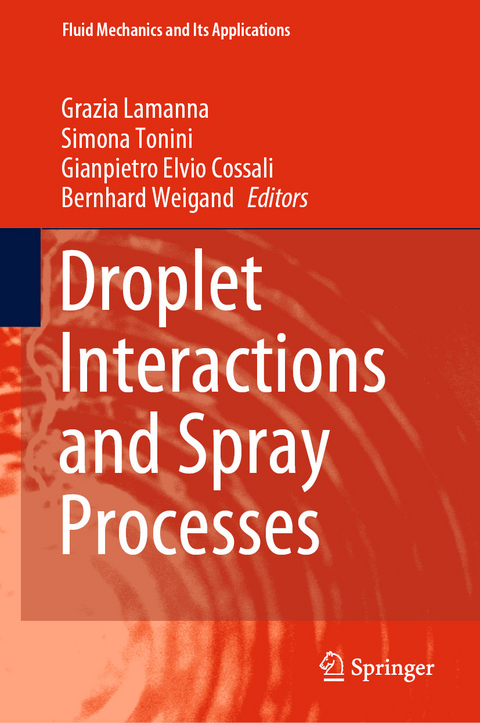
Droplet Interactions and Spray Processes (eBook)
311 Seiten
Springer International Publishing (Verlag)
978-3-030-33338-6 (ISBN)

Foreword by the University Rectors (Università degli Studi di Bergamo and Universität Stuttgart-A Strategic Partnership) 6
Preface 8
Contents 11
Droplet–Gas Interaction 14
An Analytical Approach to Model the Effect of Evaporation on Oscillation Amplitude of Liquid Drops in Gaseous Environment 15
1 Introduction 15
2 The Mathematical Model 16
2.1 Bulk Kinetic Energy Approach 19
2.2 Surface Kinetic Energy Approach 20
3 Model Implementation 21
3.1 The Conditions for Oscillation Damping 22
4 Results and Discussion 23
5 Conclusions 25
Appendix 26
References 27
Improvement of the Level-Set Ghost-Fluid Method for the Compressible Euler Equations 29
1 Introduction 29
2 Governing Equations 30
3 Numerics 31
3.1 The DGSEM Framework with Finite Volume Sub-cells 31
3.2 The Solution of the Hamilton-Jacobi Equations and the Derivatives of the Level-Set Field 32
3.3 The Level-Set Ghost-Fluid Method (LSGFM) 32
4 Results 35
4.1 Parasitic Currents Around a Stationary Droplet 35
4.2 Merging Droplets Without Surface Tension 37
4.3 Shock-Droplet Interaction at Ma = 2.40 37
5 Conclusion and Outlook 40
References 40
A Solver for Stiff Finite-Rate Relaxation in Baer–Nunziato Two-Phase Flow Models 42
1 Introduction 42
2 Model Equations 43
3 Description of the Numerical Method 45
3.1 Timestepping 46
3.2 Iterative Computation of the Timestep Solution 46
3.3 Analytical Solution of the Linearised Problem 48
4 Test Problems 49
5 Conclusions 54
References 54
An Investigation of Different Splitting Techniques for the Isentropic Euler Equations 56
1 Introduction 56
2 A Generalized Splitting 58
3 Numerical Method 59
3.1 Discretization 59
3.2 Calculation of the RS-IMEX Reference Solution 59
3.3 Discretization of HJL and DeTa Splitting 60
4 Numerical Results 60
4.1 Testcase 1: HOT-Vortex 60
4.2 Testcase 2: Taylor-Green-Vortex 62
5 Conclusion and Outlook 64
References 65
Enabling Simulations of Droplets with the Direct Simulation Monte Carlo Method 67
1 Introduction 67
2 Liquid Surface 69
3 Spheres Inside the DSMC Domain 70
3.1 Extension of the Tracking Routines 70
3.2 Intersection with Spheres After Boundary Interactions 72
3.3 Influence of Collisions on Macroscopic Spheres 72
4 Simulations 73
4.1 Droplet Evaporation 74
4.2 Brownian Motion 75
5 Conclusion and Outlook 75
References 77
Droplet–Wall Interaction 79
Fabrication and Evaluation Methods of Micro-structured Surfaces for Droplet Impact Experiments 80
1 Introduction 81
2 Surface Reproduction and Experimental Methods 82
2.1 Reproduction of Micro-structured Surface Samples 82
2.2 Mold Insert Fabrication 83
2.3 Evaluation Methods for Investigating Micro-structured Surfaces 85
2.4 Experimental Test Facility for Investigating Dynamic Droplet Impacts 86
3 Results and Discussion 86
3.1 Surface Evaluation 86
3.2 Droplet Impact on Micro-structured Surfaces 90
3.3 Film Thickness Measurement of Droplet Lamella 93
4 Conclusion 93
References 94
Use of X-ray Micro Computed Tomography for the Investigation of Drying and Salt Precipitation in a Regular Glass Bead Structure 96
1 Introduction 97
2 Materials and Methods 97
2.1 Tomography Equipment 97
2.2 Materials 98
2.3 Sample Production and Filling 98
2.4 Scanning Parameters 100
2.5 Reconstruction 100
2.6 Segmentation 101
3 Results and Discussion 102
3.1 Preliminary Experiments 102
3.2 Evaporation Experiments 102
3.3 Pore Size Distribution 103
3.4 Distribution of the Fluid Clusters 104
3.5 Salt Precipitation 106
4 Conclusions 107
References 108
Image Processing of Two-Phase Data for Drop-Surface Interaction Obtained by X-Ray Microtomography 110
1 Introduction 110
2 Analysis and Quantification 111
2.1 Segmentation 111
2.2 Resolution 114
3 Surface Triangulations and Curvature Estimation 116
4 Conclusions 118
References 119
A Phase Field Approach to Compressible Droplet Impingement 121
1 Introduction 121
2 Phase Field Models 122
2.1 A Compressible Navier–Stokes–Allen–Cahn System 122
2.2 Boundary Conditions 124
2.3 Energy Inequality 126
2.4 Surface Tension 128
3 Numerical Experiments 130
3.1 Choice of Parameters 130
3.2 Merging Droplets 130
3.3 Contact Angle 131
3.4 Droplet Impingement 132
4 Summary and Conclusions 133
References 134
Numerical Simulation for Drop Impact on Textured Surfaces 135
1 Introduction 135
2 Numerical Methods 137
2.1 FS3D's Advection Scheme 138
2.2 Solution of the Discretized Poisson Problem 139
3 Treatment of Embedded Boundaries 139
3.1 The Simplified Approach 139
3.2 The New Approach 140
4 Results 143
5 Conclusions 145
References 145
Upscaling of Coupled Free-Flow and Porous-Medium-Flow Processes 147
1 Introduction 147
2 Model and Coupling Concept 149
2.1 Free Flow 150
2.2 Flow in Porous Media 150
2.3 Interfacial Drops 151
2.4 Coupling Concept 153
2.5 Numerical Model 154
3 Results and Discussion 154
4 Conclusions 156
References 156
A Locally-Refined Locally-Conservative Quadtree Finite-Volume Staggered-Grid Scheme 157
1 Introduction 157
2 Methods 159
2.1 Governing Equations 160
2.2 Discretization Concept 160
3 Numerical Test 165
4 Conclusion 166
References 166
Droplet–Liquid Interaction 168
A New Perspective for the Characterization of Crown Rim Kinematics 169
1 Introduction to Rim Kinematics 169
1.1 Impact Process and Morphological Features 170
1.2 Experimental Set-Up and Methodology 172
2 Classical Geometrical Parameters of Crown Rim and Associated Problems 173
2.1 Radial and Axial Expansions of Crown Rim 174
2.2 Crown Aspect Ratio Dependent on Impact Parameters 175
3 Relevance of the Crown Rim Displacement from the Impact Point 177
3.1 Length Scale of Crown Rim Expansion 177
3.2 Quadratic Distancing from the Impact Point 178
4 Conclusion 179
References 180
Analytical Model for Crown Spreading During Drop Impact onto Wetted Walls: Effect of Liquids Viscosity on Momentum Transfer 182
1 Introduction 182
2 Modelling Approach 185
2.1 Description of the Film Thickness Decay Rate 186
2.2 Momentum Loss Estimation 187
2.3 Implementation in Crown Base Evolution Model 188
3 Results and Discussion 189
3.1 How Momentum Transfer is Affected by Fluids Viscosity and Initial Film Thickness 189
3.2 Effectiveness of SPF-Based Modelling Approach 191
4 Conclusion 191
References 193
An Implicit High-Order Discontinuous Galerkin Approach for Variable Density Incompressible Flows 196
1 Introduction 196
2 Variable Density Incompressible Flow Model 197
3 The Discontinuous Galerkin Discretization 198
3.1 Numerical Fluxes 200
3.2 Working Variables 200
3.3 Spurious Oscillations Control 201
3.4 Time Integration 202
4 Numerical Results 203
4.1 Dry Bed Inviscid Dambreak Problem 203
4.2 Dry Bed Inviscid Double-Dambreak Problem 204
5 Conclusions 206
References 206
Visualization Techniques for Droplet Interfaces and Multiphase Flow 208
1 Introduction 208
2 Interface Deformation 209
2.1 Method 210
2.2 Results 210
3 Machine Learning for Droplet Behavior Prediction 212
3.1 Method 212
3.2 Results 213
4 Droplet-Local Flow 214
4.1 Method 215
4.2 Results 216
5 Conclusion 217
References 217
On the Measurement of Velocity Field Within Wall-Film During Droplet Impact on It Using High-Speed Micro-PIV 220
1 Introduction 220
2 Materials and Methods 222
3 Results and Discussion 223
4 Conclusions 227
References 228
Single-Camera 3D PTV Methods for Evaporation-Driven Liquid Flows in Sessile Droplets 229
1 Introduction 229
2 Materials and Methods 231
2.1 Experimental Setup 231
2.2 Single-Camera 3D PTV Methods 233
3 Results and Discussion 234
3.1 Ultrapure Water 235
3.2 Mineral Water 236
3.3 Salty Solution 237
3.4 Surfactants 238
4 Conclusions 239
References 239
Towards Sprays 241
Drop Shape Oscillations 242
1 Introduction 242
2 The Physics of Drop Shape Oscillations 243
2.1 Linear Oscillations 243
2.2 Nonlinear Oscillations 247
2.3 Shape Oscillations of Non-Newtonian Liquid Drops 249
3 Measuring Techniques Building on Drop Shape Oscillations 249
4 Summary and Conclusions 251
References 251
Classical and Novel Approaches to Modelling Droplet Heating and Evaporation 253
1 Introduction 253
2 Classical Approaches 254
3 The Tonini and Cossali Model 256
4 Modelling of the Liquid Phase 258
5 Recent Developments 259
References 260
The Influence of Curvature on the Modelling of Droplet Evaporation at Different Scales 261
1 Introduction 262
2 Drop Evaporation Models at Different Scales 264
2.1 Effect of Surface Curvature at the Macroscopic Scale 264
2.2 Effect of Surface Curvature at the Microscopic Scale 271
3 Conclusions 276
References 277
On the Importance of Kinetic Effects in the Modelling of Droplet Evaporation at High Pressure and Temperature Conditions 279
1 Introduction 279
2 Review of Kinetic Boundary Conditions for Engineering Applications 282
3 Results 283
4 Conclusion 286
References 287
Direct Numerical Simulations of Evaporating Droplets at Higher Temperatures: Application of a Consistent Numerical Approach 289
1 Introduction 289
2 Mathematical Formulation 290
2.1 Interface Capturing and Material Properties 290
2.2 Conservation Equations 291
2.3 Jump Conditions 292
3 Numerical Approach 293
3.1 Advection of Liquid and Gaseous Phase 293
3.2 Phase Change Loop 294
4 Results 294
4.1 Single Isooctane Droplets 295
4.2 Water Droplet Tandem 297
5 Conclusion 299
References 300
Effects of Very High Injection Pressures on GDI Spray Structure 302
1 Introduction 302
2 Materials and Methods 303
3 Results and Discussion 304
4 Conclusions 311
References 312
| Erscheint lt. Verlag | 14.3.2020 |
|---|---|
| Reihe/Serie | Fluid Mechanics and Its Applications | Fluid Mechanics and Its Applications |
| Zusatzinfo | XIII, 311 p. 152 illus., 107 illus. in color. |
| Sprache | englisch |
| Themenwelt | Naturwissenschaften ► Physik / Astronomie |
| Technik ► Maschinenbau | |
| Schlagworte | DIPSI • droplet dynamics • Gas Interactions • sprays • Wall Interactions |
| ISBN-10 | 3-030-33338-8 / 3030333388 |
| ISBN-13 | 978-3-030-33338-6 / 9783030333386 |
| Informationen gemäß Produktsicherheitsverordnung (GPSR) | |
| Haben Sie eine Frage zum Produkt? |
 PDF (Wasserzeichen)
DRM: Digitales Wasserzeichen
Dieses eBook enthält ein digitales Wasserzeichen und ist damit für Sie personalisiert. Bei einer missbräuchlichen Weitergabe des eBooks an Dritte ist eine Rückverfolgung an die Quelle möglich.
Dateiformat: PDF (Portable Document Format)
Mit einem festen Seitenlayout eignet sich die PDF besonders für Fachbücher mit Spalten, Tabellen und Abbildungen. Eine PDF kann auf fast allen Geräten angezeigt werden, ist aber für kleine Displays (Smartphone, eReader) nur eingeschränkt geeignet.
Systemvoraussetzungen:
PC/Mac: Mit einem PC oder Mac können Sie dieses eBook lesen. Sie benötigen dafür einen PDF-Viewer - z.B. den Adobe Reader oder Adobe Digital Editions.
eReader: Dieses eBook kann mit (fast) allen eBook-Readern gelesen werden. Mit dem amazon-Kindle ist es aber nicht kompatibel.
Smartphone/Tablet: Egal ob Apple oder Android, dieses eBook können Sie lesen. Sie benötigen dafür einen PDF-Viewer - z.B. die kostenlose Adobe Digital Editions-App.
Buying eBooks from abroad
For tax law reasons we can sell eBooks just within Germany and Switzerland. Regrettably we cannot fulfill eBook-orders from other countries.
aus dem Bereich