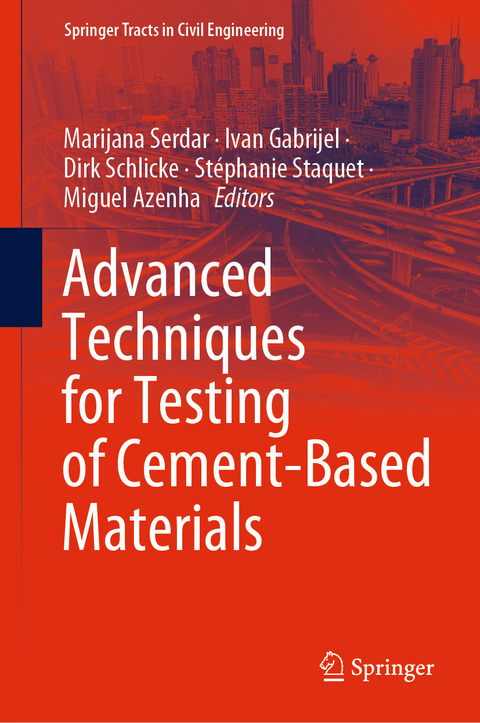
Advanced Techniques for Testing of Cement-Based Materials (eBook)
239 Seiten
Springer International Publishing (Verlag)
978-3-030-39738-8 (ISBN)
The book examines advanced, non-standardized techniques that have been developed for determining different properties of cement paste, mortar and concrete, and provides state-of-the-art information on methods for monitoring hydration-induced changes in cement-based materials (CBMs). These methods are often nondestructive and allow quasi-continuous monitoring covering the time span from placement of the material to formation of a fully hardened cement composite. The book also presents various applications of acoustic emission for characterizing fresh concrete, recent developments in ultrasonic methods for characterizing CBMs since placement, application of ambient response methods for measuring elastic modulus, methods for determining deformational characteristics of CBMs since setting and methods for in situ measurements of stresses in concrete elements during hardening.
Preface 6
Contents 8
1 Acoustic Emission Characterization of Fresh Cement-Based Materials 9
1.1 Introduction 9
1.2 Overview of Acoustic Emission 11
1.3 Related Literature 12
1.4 Discussion 22
1.5 Conclusions 27
References 27
2 Ultrasonic Techniques for Determination and Monitoring Various Properties of Cementitious Materials at Early Ages 31
2.1 Introduction 32
2.2 Ultrasonic Techniques for Measuring Early Age Properties of CBM 33
2.2.1 Theoretical Basics 33
2.2.2 Different Types of Ultrasonic Techniques 53
2.3 Monitoring of CBMs at Early Ages 58
2.3.1 Determination of Different Time Periods Within Structure Formation Process 58
2.3.2 Determination of Setting Process 60
2.3.3 Monitoring of Microstructural Properties 65
2.3.4 Ultrasonic Testing and Early Age Mechanical Properties 66
2.4 Conclusion 70
References 71
3 Elastic Modulus Measurement Through Ambient Response Method 77
3.1 Introduction 77
3.2 EMM-ARM Testing Apparatus 78
3.2.1 Concrete Testing 79
3.2.2 Mortar Testing 79
3.2.3 Cement Paste Testing 79
3.3 Frequency Identification 81
3.3.1 Operational Modal Analysis (OMA) 83
3.3.2 Experimental Modal Analysis (EMA) 85
3.4 E-modulus Estimation 88
3.5 Comparison of EMM-ARM with Other Methods 90
3.5.1 Concrete 90
3.5.2 Cement Paste 93
3.6 Repeatability of E-modulus Estimations 95
3.6.1 Concrete 96
3.6.2 Cement Paste 98
3.7 Accuracy of the E-modulus Estimations 99
3.7.1 Concrete 99
3.7.2 Cement Paste 101
3.8 Conclusions 101
References 102
4 Monitoring the Viscoelastic Behaviour of Cement Based Materials by Means of Repeated Minute-Scale-Duration Loadings 107
4.1 Introduction 107
4.2 Physical Mechanisms of the Basic Creep 109
4.3 Development of a Test Protocol 110
4.3.1 Preliminary Observations Performed on Creep Test of Long Duration 111
4.3.2 Testing Devices 114
4.3.3 Parameters of the Protocol 121
4.4 Results and Data Treatment 123
4.4.1 Data Treatment 124
4.4.2 Impact of the Devices on the Determination of the Elastic and Creep Properties 128
4.4.3 Microstructural Interpretation of the Results 132
4.5 Application of the Repeated Minute-Scale-Duration Loadings 134
4.5.1 Modelling Basic Creep Since Setting Time 134
4.5.2 Identification of Concrete Properties by Means of Multiscale Modelling 135
4.6 Conclusion and Outlook 137
References 137
5 Monitoring of the Thermal and Autogenous Strain 143
5.1 Introduction 144
5.2 Physical Mechanisms 145
5.2.1 Autogenous Deformation 145
5.2.2 Coefficient of Thermal Expansion 148
5.2.3 Correlation Between the Development of the Autogenous Strain and the CTE 151
5.3 Test Setup 152
5.3.1 Cement Paste and Mortar 153
5.3.2 Concrete 154
5.4 Test Protocol and Data Treatment 158
5.4.1 Review of the Literature 158
5.4.2 Development of a New Test Protocol for Concrete 162
5.5 Investigations and Results 169
5.5.1 Sensitivity Analysis on the Determination of the CTE Induced by the Data Processing 169
5.5.2 Extension to Cement Paste and Mortar Scale 174
5.5.3 Correlation Between the Early Development of the CTE and the Autogenous Strain and the Setting 175
5.5.4 Further Recommendation for the Monitoring of the CTE and Autogenous Strain at Very Early Age 176
5.6 Conclusion and Outlook 176
References 177
6 Testing Concrete Since Setting Time Under Free and Restrained Conditions 185
6.1 Introduction 185
6.2 Test Rig Designed for the Study of the Risk of Cracking of Cement Based Materials 189
6.2.1 Passive Restrained Shrinkage Test 189
6.2.2 Active Restrained Shrinkage Test 193
6.3 The TSTM (Temperature Stress Testing Machine) 194
6.3.1 Principle of TSTM’s 194
6.3.2 History of the Development of TSTM’s 195
6.4 Design Testing System 199
6.4.1 Test Setup 199
6.4.2 Test Protocol for the Restrained Shrinkage 205
6.5 Applications 206
6.5.1 Monitoring of the Viscoelastic Properties Since Setting 207
6.5.2 Implementation of Non-destructive Methods on a TSTM Device 207
6.5.3 Testing Concrete in Its Plastic State 208
6.5.4 Influence of Cyclic Loading/Displacement on the Hardening Process of Grout Material 208
6.5.5 Structural Scale 210
6.5.6 Degree of Restraint 210
6.6 Conclusions 211
References 212
7 Adjustable Restraining Frames for Systematic Investigation of Cracking Risk and Crack Formation in Reinforced Concrete Under Restrained Conditions 218
7.1 Introduction 219
7.2 Motivation and Concept 220
7.3 Technical Specification of the Frames 221
7.3.1 General Setup and Functionality 221
7.3.2 Passive Frame for Simulation of Hardening-Induced Stress History 226
7.3.3 Activation of the Frame for Superimposition of Hardening-Induced Stresses with Additional Stresses During Service Life 231
7.3.4 Modified Frame for Investigation of Cracking in Thick Members 233
7.4 Selected Results 236
7.4.1 General Remarks on the Testing Programme Conducted So Far 236
7.4.2 Hardening-Induced Stress History and Risk of Early Age Cracking 237
7.4.3 Superimposition of Hardening-Induced Stressing with Further Imposed Deformations Representative for Service Life 239
7.4.4 Crack Opening During Service Life 240
7.4.5 Evolution of the Restraint Force During Cracking in Thick Members with Reinforcement Near the Surface 241
7.5 Conclusion and Outlook 243
References 244
| Erscheint lt. Verlag | 18.2.2020 |
|---|---|
| Reihe/Serie | Springer Tracts in Civil Engineering | Springer Tracts in Civil Engineering |
| Zusatzinfo | VII, 239 p. 142 illus., 100 illus. in color. |
| Sprache | englisch |
| Themenwelt | Technik ► Bauwesen |
| Technik ► Maschinenbau | |
| Schlagworte | cement-based materials • concrete performance • construction materials • COST Action TU1404 • elasticity modulus • hardening concrete • non-destructive testing • Stress analysis • Structural behaviour |
| ISBN-10 | 3-030-39738-6 / 3030397386 |
| ISBN-13 | 978-3-030-39738-8 / 9783030397388 |
| Informationen gemäß Produktsicherheitsverordnung (GPSR) | |
| Haben Sie eine Frage zum Produkt? |
 PDF (Wasserzeichen)
DRM: Digitales Wasserzeichen
Dieses eBook enthält ein digitales Wasserzeichen und ist damit für Sie personalisiert. Bei einer missbräuchlichen Weitergabe des eBooks an Dritte ist eine Rückverfolgung an die Quelle möglich.
Dateiformat: PDF (Portable Document Format)
Mit einem festen Seitenlayout eignet sich die PDF besonders für Fachbücher mit Spalten, Tabellen und Abbildungen. Eine PDF kann auf fast allen Geräten angezeigt werden, ist aber für kleine Displays (Smartphone, eReader) nur eingeschränkt geeignet.
Systemvoraussetzungen:
PC/Mac: Mit einem PC oder Mac können Sie dieses eBook lesen. Sie benötigen dafür einen PDF-Viewer - z.B. den Adobe Reader oder Adobe Digital Editions.
eReader: Dieses eBook kann mit (fast) allen eBook-Readern gelesen werden. Mit dem amazon-Kindle ist es aber nicht kompatibel.
Smartphone/Tablet: Egal ob Apple oder Android, dieses eBook können Sie lesen. Sie benötigen dafür einen PDF-Viewer - z.B. die kostenlose Adobe Digital Editions-App.
Buying eBooks from abroad
For tax law reasons we can sell eBooks just within Germany and Switzerland. Regrettably we cannot fulfill eBook-orders from other countries.
aus dem Bereich