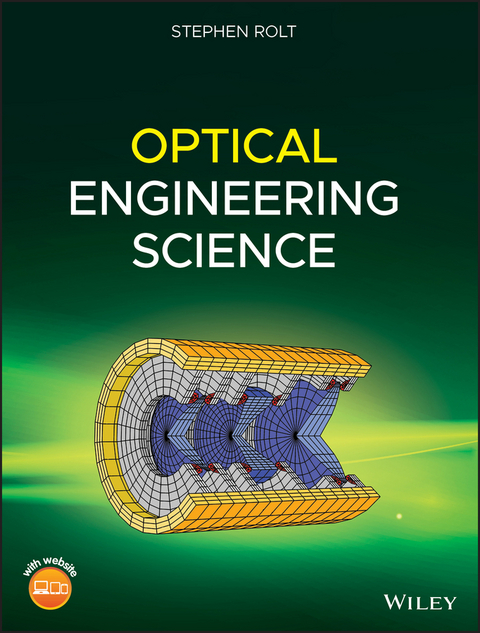
Optical Engineering Science (eBook)
John Wiley & Sons (Verlag)
978-1-119-30281-0 (ISBN)
A practical guide for engineers and students that covers a wide range of optical design and optical metrology topics
Optical Engineering Science offers a comprehensive and authoritative review of the science of optical engineering. The book bridges the gap between the basic theoretical principles of classical optics and the practical application of optics in the commercial world. Written by a noted expert in the field, the book examines a range of practical topics that are related to optical design, optical metrology and manufacturing. The book fills a void in the literature by coving all three topics in a single volume.
Optical engineering science is at the foundation of the design of commercial optical systems, such as mobile phone cameras and digital cameras as well as highly sophisticated instruments for commercial and research applications. It spans the design, manufacture and testing of space or aerospace instrumentation to the optical sensor technology for environmental monitoring. Optics engineering science has a wide variety of applications, both commercial and research. This important book:
- Offers a comprehensive review of the topic of optical engineering
- Covers topics such as optical fibers, waveguides, aspheric surfaces, Zernike polynomials, polarisation, birefringence and more
- Targets engineering professionals and students
- Filled with illustrative examples and mathematical equations
Written for professional practitioners, optical engineers, optical designers, optical systems engineers and students, Optical Engineering Science offers an authoritative guide that covers the broad range of optical design and optical metrology topics and their applications.
STEPHEN ROLT, D.Phil, formerly Senior Optical Engineer at Durham University, United Kingdom. He has had a thirty-year career in optics that has embraced both industry and academia. Dr. Rolt spent 20 years in applied research at the Standard Communication Laboratories and has filed over 25 patents in the optical technology field.
STEPHEN ROLT, D.Phil, formerly Senior Optical Engineer at Durham University, United Kingdom. He has had a thirty-year career in optics that has embraced both industry and academia. Dr. Rolt spent 20 years in applied research at the Standard Communication Laboratories and has filed over 25 patents in the optical technology field.
1
Geometrical Optics
1.1 Geometrical Optics – Ray and Wave Optics
In describing optical systems, in the narrow definition of the term, we might only consider systems that manipulate visible light. However, for the optical engineer, the application of the science of optics extends well beyond the narrow boundaries of human vision. This is particularly true for modern instruments, where reliance on the human eye as the final detector is much diminished. In practice, the term optical might also be applied to radiation that is manipulated in the same way as visible light, using components such as lenses, mirrors, and prisms. Therefore, the word ‘optical’, in this context might describe electromagnetic radiation extending from the vacuum ultraviolet to the mid-infrared (wavelengths from ∼120 to ∼10 000 nm) and perhaps beyond these limits. It certainly need not be constrained to the narrow band of visible light between about 430 and 680 nm. Figure 1.1 illustrates the electromagnetic spectrum.
Geometrical optics is a framework for understanding the behaviour of light in terms of the propagation of light as highly directional, narrow bundles of energy, or rays, with ‘arrow like’ properties. Although this is an incomplete description from a theoretical perspective, the use of ray optics lies at the heart of much of practical optical design. It forms the basis of optical design software for designing complex optical instruments and geometrical optics and, therefore, underpins much of modern optical engineering.
Geometrical optics models light entirely in terms of infinitesimally narrow beams of light or rays. It would be useful, at this point, to provide a more complete conceptual description of a ray. Excluding, for the purposes of this discussion, quantum effects, light may be satisfactorily described as an electromagnetic wave. These waves propagate through free space (vacuum) or some optical medium such as water and glass and are described by a wave equation, as derived from Maxwell's equations:
E is a scalar representation of the local electric field; c is the velocity of light in free space, and n is the refractive index of the medium.
Of course, in reality, the local electric field is a vector quantity and the scalar theory presented here is a useful initial simplification. Breakdown of this approximation will be considered later when we consider polarisation effects in light propagation. If one imagines waves propagating from a central point, the wave equation offers solutions of the following form:
Equation (1.2) represents a spherical wave of angular frequency, ω, and spatial frequency, or wavevector, k. The velocity that the wave disturbance propagates with is ω/k or c/n. In free space, light propagates at the speed of light, c, a fundamental and defined constant in the SI system of units. Thus, the refractive index, n, is the ratio of the speed of light in free space to that in the specified medium. All points lying at the same distance, r, from the source, will oscillate at an angular frequency, ω, and in the same phase. Successive surfaces, where all points are oscillating entirely in phase are referred to as wavefronts and can be viewed at the crests of ripples emanating from a point disturbance. This is illustrated in Figure 1.2. This picture provides us with a more coherent definition of a ray. A ray is represented by the vector normal to the wavefront surface in the direction of propagation. Of course, Figure 1.2 represents a simple spherical wave, with waves spreading from a single point. However, in practice, wavefront surfaces may be much more complex than this. Nevertheless, the precise definition of a ray remains clear:
Figure 1.1 The electromagnetic spectrum.
Figure 1.2 Relationship between rays and wavefronts.
At any point in space in an optical field, a ray may be defined as the unit vector perpendicular to the surface of constant phase at that point with its sense lying in the same direction as that of the energy propagation.
1.2 Fermat's Principle and the Eikonal Equation
Intuition tells us that light ‘travels in straight lines’. That is to say, light propagates between two points in such a way as to minimise the distance travelled. More generally, in fact, all geometric optics is governed by a very simple principle along similar lines. Light always propagates between two points in space in such a way as to minimise the time taken. If we consider two points, A and B, and a ray propagating between them within a medium whose refractive index is some arbitrary function, n(r), of position then the time taken is given by:
c is the speed of light in vacuo and ds is an element of path between A and B
This is illustrated in Figure 1.3.
Figure 1.3 Arbitrary ray path between two points.
Fermat's principle may then be stated as follows:
Light will travel between two points A and B such that the path taken represents a local minimum in the total optical path between these points.
Fermat's principle underlies all ray optics. All laws governing refraction and reflection of rays may be derived from Fermat's principle. Most importantly, to demonstrate the theoretical foundation of ray optics and its connection with physical or wave optics, Fermat's principle may be directly derived from the wave equation. This proof demonstrates that the path taken represents, in fact, a stationary solution with respect to other possible paths. That is to say, technically, the optical path taken could represent a local maximum or inflexion point rather than a minimum. However, for most practical purposes it is correct to say that the path taken represents the minimum possible optical path.
Fermat's principle is more formally set out in the Eikonal equation. Referring to Figure 1.2, if instead of describing the light in terms of rays it is described by the wavefront surfaces themselves. The function S(r) describes the phase of the wave at any point and the Eikonal equation, which is derived from the wave equation, is set out thus:
The important point about the Eikonal equation is not the equation itself, but the assumptions underlying it. Derivation of the Eikonal equation assumes that the rate of change in phase is small compared to the wavelength of light. That is to say, the radius of curvature of the wavefronts should be significantly larger than the wavelength of light. Outside this regime the assumptions underlying ray optics are not justified. This is where the effects of the wave nature of light (i.e. diffraction) must be considered and we enter the realm of physical optics. But for the time being, in the succeeding chapters we may consider that all optical systems are adequately described by geometrical optics.
So, for the purposes of this discussion, it is one simple principle, Fermat's principle, that provides the foundation for all ray optics. For the time being, we will leave behind specific consideration of the detailed behaviour of individual optical surfaces. In the meantime, we will develop a very generalised description of an idealised optical system that does not attribute specific behaviours to individual components. Later on, this ‘black box model’ will be used, in conjunction with Gaussian optics to provide a complete first order description of complex optical systems.
1.3 Sequential Geometrical Optics – A Generalised Description
In applying geometrical optics to a real system, we are attempting to determine the path of a ray(s) through the system. There are a few underlying characteristics that underpin most optical systems and help to simplify analysis. First, most optical systems are sequential. An optical system might comprise a number of different elements or surfaces, e.g. lenses, mirrors, or prisms. In a sequential optical system, the order in which light propagates through these components is unique and pre-determined. Second, in most practical systems, light is constrained with respect to a mechanical or optical axis of symmetry, the optical axis, as illustrated in Figure 1.4. In real optical systems, light is constrained by the use of physical apertures or ‘stops’; this will be discussed in more detail later.
Of course, in practice, the optical axis need not be a continuous, straight line through an optical system. It may be bent, or folded by mirrors or prisms. Nevertheless, there exists an axis throughout the system with respect to which the rays are constrained.
Figure 1.4 Constraint of rays with respect to optical axis.
Figure 1.5 Generalised optical system and conjugate points.
1.3.1 Conjugate Points and Perfect Image Formation
We consider an ideal optical system which consists of a point source of light, the object, and an optical system that collects the light and re-directs all rays emanating from this point source or object, such that the rays converge onto a single point, the...
| Erscheint lt. Verlag | 31.12.2019 |
|---|---|
| Sprache | englisch |
| Themenwelt | Naturwissenschaften ► Physik / Astronomie |
| Technik ► Elektrotechnik / Energietechnik | |
| Schlagworte | commercial optical systems • Electrical & Electronics Engineering • Elektrotechnik u. Elektronik • <p>Understanding the science of optical engineering • Optical Communications • optical design</p> • Optics & Photonics • Optik • Optik u. Photonik • Optische Nachrichtentechnik • overview of optical engineering • Physics • Physik • research applications of optical engineering • sensor technology of optical engineering • technology of optical engineering |
| ISBN-10 | 1-119-30281-1 / 1119302811 |
| ISBN-13 | 978-1-119-30281-0 / 9781119302810 |
| Informationen gemäß Produktsicherheitsverordnung (GPSR) | |
| Haben Sie eine Frage zum Produkt? |
 EPUB (Adobe DRM)
Kopierschutz: Adobe-DRM
Adobe-DRM ist ein Kopierschutz, der das eBook vor Mißbrauch schützen soll. Dabei wird das eBook bereits beim Download auf Ihre persönliche Adobe-ID autorisiert. Lesen können Sie das eBook dann nur auf den Geräten, welche ebenfalls auf Ihre Adobe-ID registriert sind.
Details zum Adobe-DRM
Dateiformat: EPUB (Electronic Publication)
EPUB ist ein offener Standard für eBooks und eignet sich besonders zur Darstellung von Belletristik und Sachbüchern. Der Fließtext wird dynamisch an die Display- und Schriftgröße angepasst. Auch für mobile Lesegeräte ist EPUB daher gut geeignet.
Systemvoraussetzungen:
PC/Mac: Mit einem PC oder Mac können Sie dieses eBook lesen. Sie benötigen eine
eReader: Dieses eBook kann mit (fast) allen eBook-Readern gelesen werden. Mit dem amazon-Kindle ist es aber nicht kompatibel.
Smartphone/Tablet: Egal ob Apple oder Android, dieses eBook können Sie lesen. Sie benötigen eine
Geräteliste und zusätzliche Hinweise
Buying eBooks from abroad
For tax law reasons we can sell eBooks just within Germany and Switzerland. Regrettably we cannot fulfill eBook-orders from other countries.
aus dem Bereich