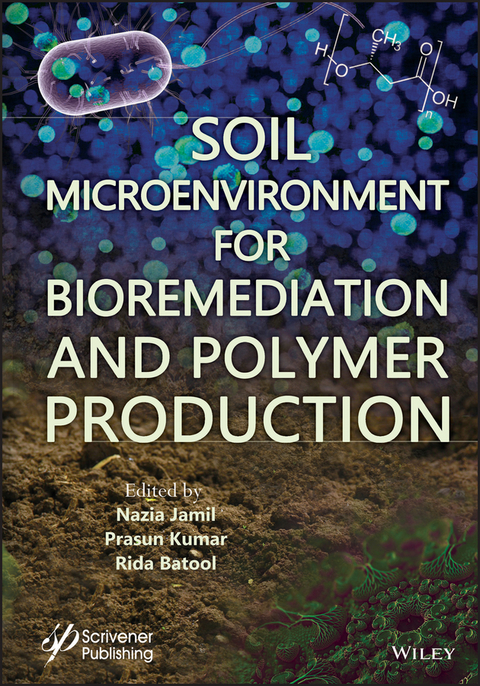
Soil Microenvironment for Bioremediation and Polymer Production (eBook)
420 Seiten
John Wiley & Sons (Verlag)
978-1-119-59217-4 (ISBN)
Microenvironmental conditions in soil provide a natural niche for ultra-structures, microbes and microenvironments. The natural biodiversity of these microenvironments is being disturbed by industrialization and the proliferation of urban centers, and synthetic contaminants found in these micro-places are causing stress and instability in the biochemical systems of microbes. The development of new metabolic pathways from intrinsic metabolic cycles facilitate microbial degradation of diverse resistant synthetic compounds present in soil. These are a vital, competent and cost-effective substitute to conventional treatments. Highly developed techniques for bioremediation of these synthetic compounds are increasing and these techniques facilitate the development of a safe environment using renewable biomaterial for removal of toxic heavy metals and xenobiotics.
Soil Microenvironment for Bioremediation and Polymer Production consists of 21 chapters by subject matter experts and is divided into four parts: Soil Microenvironment and Biotransformation Mechanisms; Synergistic Effects between Substrates and Microbes; Polyhydroxyalakanoates: Resources, Demands and Sustainability; and Cellulose-Based Biomaterials.
This timely and important book highlights
* Chapters on classical bioremediation approaches and advances in the use of nanoparticles for removal of radioactive waste
* Discusses the production of applied emerging biopolymers using diverse microorganisms
* Provides the most innovative practices in the field of bioremediation
* Explores new techniques that will help to improve biopolymer production from bacteria
* Provides novel concepts for the most affordable and economic societal benefits.
Nazia Jamil holds a PhD in genetics from the University of Karachi, Pakistan. Her research as a microbiologist and geneticist centers on investigating the synthesis of biodegradable plastic by indigenous bacteria from renewable sources. She has international and national funded projects from IFS-Sweden and HEC Pakistan to carry out research on biopolymers and antimicrobial compounds. She has authored 60 national and international research papers in peer-reviewed journals. Prasun Kumar is an applied microbiologist and biotechnologist and his main areas of research are microbial biodiversity, bioenergy, and biopolymers. Dr. Prasun holds a PhD in biotechnology from CSIR-Institute of Genomics and Integrative Biology, Delhi, India. He has over seven years of experience in applied microbiological research and bioprocessing including over 2 years of post-doctoral research experience at Chungbuk National University, Republic of Korea. He made significant contributions while working on valorising lignocellulosic biowastes of cheap raw materials into value-added products including bioenergy, biopolymers, polyhydroxyalkanoates etc. He has more than 27 articles published in various peer-reviewed SCI journals and has authored 1 book. Rida Batool PhD is an Assistant Professor in the Department of Microbiology and Molecular Genetics at University of the Punjab, Lahore, Pakistan. Her main research interests are in environmental microbiology/biotechnology with a focus on metal-microbe interaction, wastewater treatment, biosorption and mechanisms of metal resistance. Other aspects of her research involve the isolation and characterization of bioactive compounds of indigenous plant and bacterial origin. She has authored more than 20 national and international journal articles.
| Erscheint lt. Verlag | 2.12.2019 |
|---|---|
| Sprache | englisch |
| Themenwelt | Naturwissenschaften ► Biologie ► Mikrobiologie / Immunologie |
| Naturwissenschaften ► Chemie ► Organische Chemie | |
| Technik ► Maschinenbau | |
| Schlagworte | Biopolymere • biopolymers • Chemie • Chemistry • Environmental Chemistry • Environmental Microbiology • Environmental Studies • Polymer Science & Technology • Polymerwissenschaft u. -technologie • Umweltchemie • Umweltforschung • Umwelt-Mikrobiologie |
| ISBN-10 | 1-119-59217-8 / 1119592178 |
| ISBN-13 | 978-1-119-59217-4 / 9781119592174 |
| Informationen gemäß Produktsicherheitsverordnung (GPSR) | |
| Haben Sie eine Frage zum Produkt? |
 EPUB (Adobe DRM)
Kopierschutz: Adobe-DRM
Adobe-DRM ist ein Kopierschutz, der das eBook vor Mißbrauch schützen soll. Dabei wird das eBook bereits beim Download auf Ihre persönliche Adobe-ID autorisiert. Lesen können Sie das eBook dann nur auf den Geräten, welche ebenfalls auf Ihre Adobe-ID registriert sind.
Details zum Adobe-DRM
Dateiformat: EPUB (Electronic Publication)
EPUB ist ein offener Standard für eBooks und eignet sich besonders zur Darstellung von Belletristik und Sachbüchern. Der Fließtext wird dynamisch an die Display- und Schriftgröße angepasst. Auch für mobile Lesegeräte ist EPUB daher gut geeignet.
Systemvoraussetzungen:
PC/Mac: Mit einem PC oder Mac können Sie dieses eBook lesen. Sie benötigen eine
eReader: Dieses eBook kann mit (fast) allen eBook-Readern gelesen werden. Mit dem amazon-Kindle ist es aber nicht kompatibel.
Smartphone/Tablet: Egal ob Apple oder Android, dieses eBook können Sie lesen. Sie benötigen eine
Geräteliste und zusätzliche Hinweise
Buying eBooks from abroad
For tax law reasons we can sell eBooks just within Germany and Switzerland. Regrettably we cannot fulfill eBook-orders from other countries.
aus dem Bereich