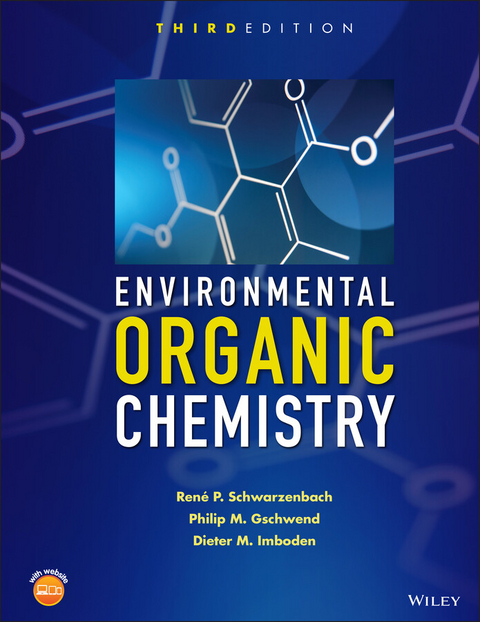
Environmental Organic Chemistry (eBook)
John Wiley & Sons (Verlag)
978-1-118-76719-1 (ISBN)
- Treats fundamental aspects of chemistry, physics, and mathematical modeling as applied to environmentally relevant problems, and gives a state of the art account of the field
- Teaches the reader how to relate the structure of a given chemical to its physical chemical properties and intrinsic reactivities
- Provides a holistic and teachable treatment of phase partitioning and transformation processes, as well as a more focused and tailor-made presentation of physical, mathematical, and modeling aspects that apply to environmental situations of concern
- Includes a large number of questions and problems allowing teachers to explore the depth of understanding of their students or allowing individuals who use the book for self-study to check their progress
- Provides a companion website, which includes solutions for all problems as well as a large compilation of physical constants and compound properties
René P. Schwarzenbach, PhD, is a Professor em. of Environmental Chemistry at the Swiss Federal Institute of Technology (ETH) in Zurich, Switzerland.
Philip M. Gschwend, PhD, is Full Professor of Civil and Environmental Engineering at the Massachusetts Institute of Technology in Cambridge, Massachusetts.
Dieter M. Imboden, PhD, is a Professor em. of Environmental Physics at the Swiss Federal Institute of Technology (ETH) in Zurich, Switzerland.
Examines in a pedagogical way all pertinent molecular and macroscopic processes that govern the distribution and fate of organic chemicals in the environment and provides simple modeling tools to quantitatively describe these processes and their interplay in a given environmental system Treats fundamental aspects of chemistry, physics, and mathematical modeling as applied to environmentally relevant problems, and gives a state of the art account of the field Teaches the reader how to relate the structure of a given chemical to its physical chemical properties and intrinsic reactivities Provides a holistic and teachable treatment of phase partitioning and transformation processes, as well as a more focused and tailor-made presentation of physical, mathematical, and modeling aspects that apply to environmental situations of concern Includes a large number of questions and problems allowing teachers to explore the depth of understanding of their students or allowing individuals who use the book for self-study to check their progress Provides a companion website, which includes solutions for all problems as well as a large compilation of physical constants and compound properties
René P. Schwarzenbach, PhD, is a Professor em. of Environmental Chemistry at the Swiss Federal Institute of Technology (ETH) in Zurich, Switzerland. Philip M. Gschwend, PhD, is Full Professor of Civil and Environmental Engineering at the Massachusetts Institute of Technology in Cambridge, Massachusetts. Dieter M. Imboden, PhD, is a Professor em. of Environmental Physics at the Swiss Federal Institute of Technology (ETH) in Zurich, Switzerland.
| Erscheint lt. Verlag | 19.11.2019 |
|---|---|
| Sprache | englisch |
| Themenwelt | Naturwissenschaften ► Chemie ► Organische Chemie |
| Naturwissenschaften ► Chemie ► Technische Chemie | |
| Naturwissenschaften ► Geowissenschaften ► Hydrologie / Ozeanografie | |
| Technik | |
| Schlagworte | acid-base reactions • air-water exchange • Atmosphere • bioaccumulation • chemical fate modelling • Chemie • Chemistry • compound-specific isotope analysis (CSIA) • direct photolysis • earth sciences • Environmental Chemistry • exposure assessment • Freshwater • Geowissenschaften • groundwater • Hydrological Sciences • Hydrologie • Hydrolysis • indirect photolysis • linear free-energy relationships (LFERs) • mass transfer processes • Microbial Transformations • Natural solids • nucleophilic substitution and elimination • Organic Chemistry • Organic Pollutants • Organische Chemie • partition coefficients • Redox reactions • retardation • seawater • Sediment • Sedimentation • Soil • Sorption • structure-activity relationships (SARs) • Umweltchemie • wet and dry deposition |
| ISBN-10 | 1-118-76719-5 / 1118767195 |
| ISBN-13 | 978-1-118-76719-1 / 9781118767191 |
| Informationen gemäß Produktsicherheitsverordnung (GPSR) | |
| Haben Sie eine Frage zum Produkt? |
 PDF (Adobe DRM)
Kopierschutz: Adobe-DRM
Adobe-DRM ist ein Kopierschutz, der das eBook vor Mißbrauch schützen soll. Dabei wird das eBook bereits beim Download auf Ihre persönliche Adobe-ID autorisiert. Lesen können Sie das eBook dann nur auf den Geräten, welche ebenfalls auf Ihre Adobe-ID registriert sind.
Details zum Adobe-DRM
Dateiformat: PDF (Portable Document Format)
Mit einem festen Seitenlayout eignet sich die PDF besonders für Fachbücher mit Spalten, Tabellen und Abbildungen. Eine PDF kann auf fast allen Geräten angezeigt werden, ist aber für kleine Displays (Smartphone, eReader) nur eingeschränkt geeignet.
Systemvoraussetzungen:
PC/Mac: Mit einem PC oder Mac können Sie dieses eBook lesen. Sie benötigen eine
eReader: Dieses eBook kann mit (fast) allen eBook-Readern gelesen werden. Mit dem amazon-Kindle ist es aber nicht kompatibel.
Smartphone/Tablet: Egal ob Apple oder Android, dieses eBook können Sie lesen. Sie benötigen eine
Geräteliste und zusätzliche Hinweise
Buying eBooks from abroad
For tax law reasons we can sell eBooks just within Germany and Switzerland. Regrettably we cannot fulfill eBook-orders from other countries.
aus dem Bereich