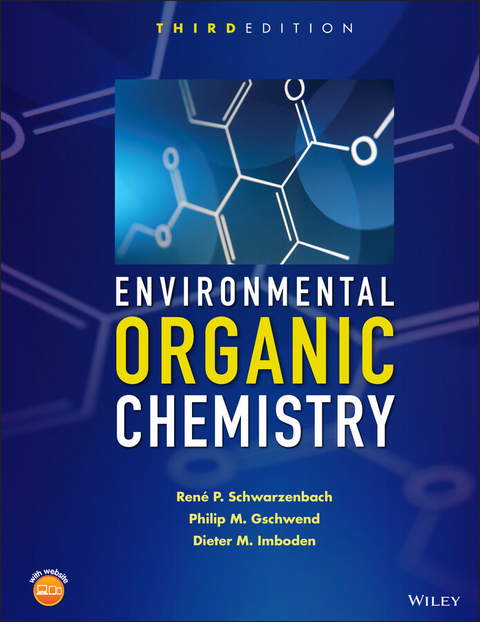
Environmental Organic Chemistry (eBook)
John Wiley & Sons (Verlag)
978-1-118-76704-7 (ISBN)
- Treats fundamental aspects of chemistry, physics, and mathematical modeling as applied to environmentally relevant problems, and gives a state of the art account of the field
- Teaches the reader how to relate the structure of a given chemical to its physical chemical properties and intrinsic reactivities
- Provides a holistic and teachable treatment of phase partitioning and transformation processes, as well as a more focused and tailor-made presentation of physical, mathematical, and modeling aspects that apply to environmental situations of concern
- Includes a large number of questions and problems allowing teachers to explore the depth of understanding of their students or allowing individuals who use the book for self-study to check their progress
- Provides a companion website, which includes solutions for all problems as well as a large compilation of physical constants and compound properties
René P. Schwarzenbach, PhD, is a Professor em. of Environmental Chemistry at the Swiss Federal Institute of Technology (ETH) in Zurich, Switzerland.
Philip M. Gschwend, PhD, is Full Professor of Civil and Environmental Engineering at the Massachusetts Institute of Technology in Cambridge, Massachusetts.
Dieter M. Imboden, PhD, is a Professor em. of Environmental Physics at the Swiss Federal Institute of Technology (ETH) in Zurich, Switzerland.
Examines in a pedagogical way all pertinent molecular and macroscopic processes that govern the distribution and fate of organic chemicals in the environment and provides simple modeling tools to quantitatively describe these processes and their interplay in a given environmental system Treats fundamental aspects of chemistry, physics, and mathematical modeling as applied to environmentally relevant problems, and gives a state of the art account of the field Teaches the reader how to relate the structure of a given chemical to its physical chemical properties and intrinsic reactivities Provides a holistic and teachable treatment of phase partitioning and transformation processes, as well as a more focused and tailor-made presentation of physical, mathematical, and modeling aspects that apply to environmental situations of concern Includes a large number of questions and problems allowing teachers to explore the depth of understanding of their students or allowing individuals who use the book for self-study to check their progress Provides a companion website, which includes solutions for all problems as well as a large compilation of physical constants and compound properties
René P. Schwarzenbach, PhD, is a Professor em. of Environmental Chemistry at the Swiss Federal Institute of Technology (ETH) in Zurich, Switzerland. Philip M. Gschwend, PhD, is Full Professor of Civil and Environmental Engineering at the Massachusetts Institute of Technology in Cambridge, Massachusetts. Dieter M. Imboden, PhD, is a Professor em. of Environmental Physics at the Swiss Federal Institute of Technology (ETH) in Zurich, Switzerland.
Preface
“Textbooks are outdated. Don't waste your time writing a textbook! Nowadays, teachers, students, and practitioners download whatever they need to know from the Internet. They don't depend on textbooks anymore.”
These and other similarly “encouraging” statements were made by some dear colleagues three years ago, ten years after the 2nd edition and twenty years after the 1st edition of our textbook appeared, when we announced our plan to write a 3rd edition. However, numerous others also motivated us to sit down and reflect again about the broad, interdisciplinary field of environmental organic chemistry, which has excited us during our whole scientific careers. And they won! Here it is, the 3rd edition. Also, here is why we feel that textbooks are needed more than ever: in a time in which the number of scientific publications continue to explode, there is, from time to time, a need to assess in a more holistic way the state-of-the-art in a given field, and to summarize this state-of-the-art in a didactic form, so it can be used for educational purposes. In other words, between two physical or imaginary book covers, an attempt to define a given field and to give an account where this field stands. Of course, such an attempt represents only the biased, personal view of the book's authors, but this may be better than having no view at all.
What distinguishes the 3rd edition from the previous two editions? The first important message is: our main goal and approach is still the same. We want to provide an understanding of how molecular interactions and macroscopic transport phenomena determine the distribution in space and time of organic compounds released into natural and engineered environments. We hope to do this by teaching the reader to utilize the structure of a given chemical to deduce that chemical's physical chemical properties and intrinsic reactivities. Emphasis is placed on quantification of phase transfer, transformation, and transport processes at each level. By first considering each of the processes that act on organic chemicals one at a time, we try to build bits of knowledge and understanding that, combined in mathematical models, should enable the reader to assess organic compound behavior in the environment.
The second important message is: as was the case when going from the 1st to the 2nd edition, the new edition has undergone significant changes. Old chapters have been deleted, the remaining chapters have been substantially revised, and new chapters have been added. Another important goal was to diminish the total volume of the book. Of course, for all topics, we have tried hard to give an account of the state-of-the-art and to provide access to the pertinent literature. The most drastic change made was our decision to position an introduction of mathematical modeling in Part I (Chapter 6) among other introductory chapters and, in turn, to condense the chapters on transport and mixing, and on modeling of environmental systems.
However, this does not mean that the most important physical and mathematical modeling aspects have been lost. They are now just more focused and tailor-made to the needs of environmental chemists and environmental engineers. In addition to this main change, we have added four completely new chapters, which were neither present in the 1st nor 2nd edition, and which, in our opinion, can hardly be found anywhere else: (i) A look into the vast world of anthropogenic chemicals, illustrating the great innovations made by the chemical industry in customizing chemicals that fulfill important tasks in our daily lives, but also illustrating why many of them are of environmental concern (Chapter 3); (ii) A summary of the most important physical and chemical “properties” of environmental compartments including the atmosphere, surface waters, soils, and groundwater (Chapter 5); (iii) A quantitative treatment of aerosol–air partitioning of organic pollutants and the role of aerosols in determining their residence time in the stratosphere (Chapter 15); and (iv) An introduction to compound specific isotope analysis (CSIA) and its application to assess organic pollutant transformations in laboratory and field systems (Chapter 27).
Who should read and use this book, or at least keep it on their bookshelf? From our experience with the previous editions, and maybe still with a bit of wishful thinking, we are inclined to answer this question with “Everybody who has to deal with organic chemicals in the environment.” More specifically,we believe that the theoretical explanations andmathematical relationships discussed are very useful for chemistry professors and students who want both fundamental explanations and concrete applications that students can use to remember those chemical principles. Likewise, we suggest that environmental and earth science professors as well as their students can utilize the chemical property information and quantitative descriptions of chemical cycling to think about how humans are playing an increasingly important role in changing the Earth system and how we may use specific chemicals as tracers of environmental processes. Further, we believe that civil and environmental engineering professors and students will benefit from detailed understanding of the fundamental phenomena supporting existing mitigation and remedial designs, and they should gain insights that allow them to invent the engineering approaches of the future. Environmental policy and management professors as well as students can also benefit by seeing our capabilities (and limitations) in estimating chemical exposures that result from our society's use of chemicals. Finally, chemists and chemical engineers in industry should be able to use this book's information to help make “green chemistry” decisions, whereas governmental regulators and environmental consultants can use the book in order to better assess the chemical uses they must permit and the problem sites theymust assess and manage.
To meet the needs of this very diverse audience, we have tried wherever possible to present the various topics in a way to make this book useful for beginners as well as for people with more expertise. We have also incorporated a large number of references throughout the text to help those who want to follow particular topics further. Finally, by including numerous problems, we want to motivate students as well as practitioners to attempt to arrive at quantitative answers for particular cases of interest to them. For all problems, solutions are made available electronically through a web site provided by the publisher—some of them to everybody but all of them to teachers, practitioners, and others with special permission. The possibility of making materials available electronically has allowed us to turn most of the illustrative examples of the 2nd edition into problems, thus making the main text more readable. It also allows us to provide the appendices, in particular the large Appendix Containing properties of numerous diverse chemicals, solely in electronic form.
In conclusion, this book is intended as a comprehensive text for introductory courses in environmental organic chemistry at the graduate level, as well as an important source of information for practical hazard and risk assessment of organic chemicals in the environment. We hope that with this 3rd edition, we can continue to make a useful contribution to the education of environmental scientists and engineers and, thus, to better protection of our environment.
Acknowledgments. Those who have ever written a textbook know that the authors are not the only ones who play an important role in the realization of the final product. In this particular case, one person made all the difference: Jeanne Tomaszewski, who we appointed as editor and general manager for this textbook. Jeanne has not only turned our “Swiss-English” into a language that can be understood by any Englishspeaking person, she has also been a relentless critic of how we present things, and she has helped us in literature searches and in the compilation of data. Last but not least, she has managed the entire process of readying the manuscript for the publisher. THANK YOU Jeanne; without you, there would most likely not be a 3rd edition of Environmental Organic Chemistry.
Many thanks to those who helped us with the numerous figures and structures in the book: above all,Werner Angst and Martin Hoffmann, but also Lauren McLean, Konstanze Schiessel, and Thierry Sollberger. Thanks as well to our professional colleagues who lent a keen eye to make sure some of our chapters are at their scientific best: Kathrin Fenner (Chapter 3), Kai-Uwe Goss (Chapter 7), Satoshi Endo (Chapters 7–10), Hans Peter Arp (Chapter 15), Beate Escher (Chapter 16), Kristopher McNeill (Chapters 24 and 25), Fatima Hussain and Allison Perrotta (Chapter 26), and Martin Elsner, Thomas Hofstetter, Elisabeth Janssen, and Michael Sander (Chapter 27).
We are also indebted to the Swiss Federal Institute of Technology in Zurich (ETH-Zurich) for significant financial support. Finally, we thank our wives Theres Schwarzenbach, Colleen Cavanaugh, and Sibyl Imboden for their continuous support during the many years of our professional lives.
René P. Schwarzenbach
Zürich, Switzerland
Philip M. Gschwend
Cambridge,...
| Erscheint lt. Verlag | 12.10.2016 |
|---|---|
| Sprache | englisch |
| Themenwelt | Naturwissenschaften ► Chemie ► Organische Chemie |
| Naturwissenschaften ► Chemie ► Technische Chemie | |
| Naturwissenschaften ► Geowissenschaften ► Hydrologie / Ozeanografie | |
| Technik ► Umwelttechnik / Biotechnologie | |
| Schlagworte | acid-base reactions • air-water exchange • Atmosphere • bioaccumulation • chemical fate modelling • Chemie • Chemistry • compound-specific isotope analysis (CSIA) • direct photolysis • earth sciences • Environmental Chemistry • exposure assessment • Freshwater • Geowissenschaften • groundwater • Hydrological Sciences • Hydrologie • Hydrolysis • indirect photolysis • linear free-energy relationships (LFERs) • mass transfer processes • Microbial Transformations • Natural solids • nucleophilic substitution and elimination • Organic Chemistry • Organic Pollutants • Organische Chemie • partition coefficients • Redox reactions • retardation • seawater • Sediment • Sedimentation • Soil • Sorption • structure-activity relationships (SARs) • Umweltchemie • wet and dry deposition |
| ISBN-10 | 1-118-76704-7 / 1118767047 |
| ISBN-13 | 978-1-118-76704-7 / 9781118767047 |
| Informationen gemäß Produktsicherheitsverordnung (GPSR) | |
| Haben Sie eine Frage zum Produkt? |
 EPUB (Adobe DRM)
Kopierschutz: Adobe-DRM
Adobe-DRM ist ein Kopierschutz, der das eBook vor Mißbrauch schützen soll. Dabei wird das eBook bereits beim Download auf Ihre persönliche Adobe-ID autorisiert. Lesen können Sie das eBook dann nur auf den Geräten, welche ebenfalls auf Ihre Adobe-ID registriert sind.
Details zum Adobe-DRM
Dateiformat: EPUB (Electronic Publication)
EPUB ist ein offener Standard für eBooks und eignet sich besonders zur Darstellung von Belletristik und Sachbüchern. Der Fließtext wird dynamisch an die Display- und Schriftgröße angepasst. Auch für mobile Lesegeräte ist EPUB daher gut geeignet.
Systemvoraussetzungen:
PC/Mac: Mit einem PC oder Mac können Sie dieses eBook lesen. Sie benötigen eine
eReader: Dieses eBook kann mit (fast) allen eBook-Readern gelesen werden. Mit dem amazon-Kindle ist es aber nicht kompatibel.
Smartphone/Tablet: Egal ob Apple oder Android, dieses eBook können Sie lesen. Sie benötigen eine
Geräteliste und zusätzliche Hinweise
Buying eBooks from abroad
For tax law reasons we can sell eBooks just within Germany and Switzerland. Regrettably we cannot fulfill eBook-orders from other countries.
aus dem Bereich