


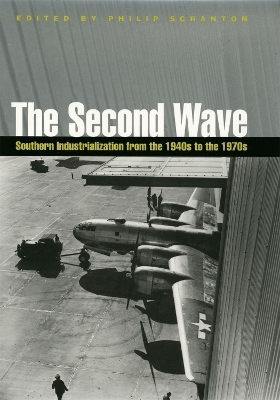
The Second Wave
Southern Industrialization from the 1940s to the 1970s
Seiten
2019
University of Georgia Press (Verlag)
978-0-8203-5714-0 (ISBN)
University of Georgia Press (Verlag)
978-0-8203-5714-0 (ISBN)
Though it had helped define the New South era, the first wave of regional industrialization had clearly lost momentum even before the Great Depression. These nine original case studies look at how World War II and its aftermath transformed the economy, culture, and politics of the South.
From perspectives grounded in geography, law, history, sociology, and economics, several contributors look at southern industrial sectors old and new: aircraft and defense, cotton textiles, timber and pulp, carpeting, oil refining and petrochemicals, and automobiles. One essay challenges the perception that southern industrial growth was spurred by a disproportionate share of federal investment during and after the war.
In covering the variety of technological, managerial, and spatial transitions brought about by the South's "second wave" of industrialization, the case studies also identify a set of themes crucial to understanding regional dynamics: investment and development; workforce training; planning, cost-containment, and environmental concerns; equal employment opportunities; rural-to-urban shifts and the decay of local economies entrepreneurism; and coordination of supply, service, and manufacturing processes. From boardroom to factory floor, the variety of perspectives in The Second Wave will significantly widen our understanding of the dramatic reshaping of the region in the decades after 1940.
From perspectives grounded in geography, law, history, sociology, and economics, several contributors look at southern industrial sectors old and new: aircraft and defense, cotton textiles, timber and pulp, carpeting, oil refining and petrochemicals, and automobiles. One essay challenges the perception that southern industrial growth was spurred by a disproportionate share of federal investment during and after the war.
In covering the variety of technological, managerial, and spatial transitions brought about by the South's "second wave" of industrialization, the case studies also identify a set of themes crucial to understanding regional dynamics: investment and development; workforce training; planning, cost-containment, and environmental concerns; equal employment opportunities; rural-to-urban shifts and the decay of local economies entrepreneurism; and coordination of supply, service, and manufacturing processes. From boardroom to factory floor, the variety of perspectives in The Second Wave will significantly widen our understanding of the dramatic reshaping of the region in the decades after 1940.
PHILIP SCRANTON is University Board of Governors Professor Emeritus of History of Industry and Technology at Rutgers University. His books include Endless Novelty: Specialty Production and American Industrialization, 1865-1925 and Beauty and Business: Commerce, Gender, and Culture in Modern America. Scranton is coeditor, with Douglas Flamming, of the series Economy and Society in the Modern South.
| Erscheinungsdatum | 09.09.2019 |
|---|---|
| Reihe/Serie | Economy and Society in the Modern South |
| Co-Autor | Arthur Krim, Gavin Wright, Gregory Hooks, Karen Ferguson, Karsten Hülsemann |
| Zusatzinfo | 4 photos, 5 figures |
| Verlagsort | Georgia |
| Sprache | englisch |
| Maße | 152 x 229 mm |
| Themenwelt | Geisteswissenschaften ► Geschichte ► Regional- / Ländergeschichte |
| Geschichte ► Teilgebiete der Geschichte ► Wirtschaftsgeschichte | |
| Technik | |
| Wirtschaft ► Volkswirtschaftslehre | |
| ISBN-10 | 0-8203-5714-6 / 0820357146 |
| ISBN-13 | 978-0-8203-5714-0 / 9780820357140 |
| Zustand | Neuware |
| Informationen gemäß Produktsicherheitsverordnung (GPSR) | |
| Haben Sie eine Frage zum Produkt? |
Mehr entdecken
aus dem Bereich



aus dem Bereich
wie Tech-Konzerne und Großmächte die Welt unter sich aufteilen
Buch | Hardcover (2025)
C.H.Beck (Verlag)
CHF 39,20


