Photoenergy and Thin Film Materials (eBook)
762 Seiten
John Wiley & Sons (Verlag)
978-1-119-58055-3 (ISBN)
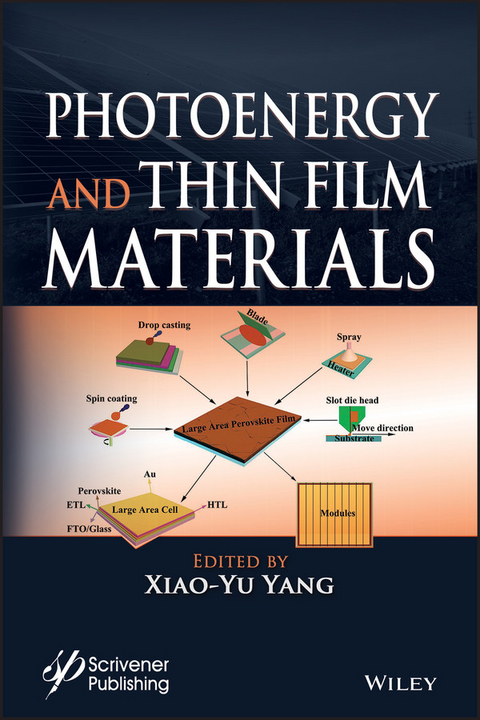
Photoenergy materials are expected to be a next generation class of materials to provide secure, safe, sustainable and affordable energy. Photoenergy devices are known to convert the sunlight into electricity. These types of devices are simple in design with a major advantage as they are stand-alone systems able to provide megawatts of power. They have been applied as a power source for solar home systems, remote buildings, water pumping, megawatt scale power plants, satellites, communications, and space vehicles. With such a list of enormous applications, the demand for photoenergy devices is growing every year.
On the other hand, thin films coating, which can be defined as the barriers of surface science, the fields of materials science and applied physics are progressing as a unified discipline of scientific industry. A thin film can be termed as a very fine, or thin layer of material coated on a particular surface, that can be in the range of a nanometer in thickness to several micrometers in size. Thin films are applied in numerous areas ranging from protection purposes to electronic semiconductor devices.
The 16 chapters in this volume, all written by subject matter experts, demonstrate the claim that both photoenergy and thin film materials have the potential to be the future of industry.
Xiao-Yu Yang earned his BS degree from Jilin University in 2000 and his joint PhD degree from Jilin University, China and FUNDP, Belgium (co-education) in 2007. He is currently working as a full professor at the State Key Laboratory of Advanced Technology for Material Synthesis and Processing, Wuhan University of Technology, China, and as a visiting professor at Harvard University. He is editor of the Journal of Nanostructures and Nano-Objects. His research is aimed at thin film, self-assembly technology, hierarchical materials, catalysis, and cell-surface-engineering. He has authored and co-authored more than 50 scientific publications and 10 patents.
| Erscheint lt. Verlag | 26.3.2019 |
|---|---|
| Sprache | englisch |
| Themenwelt | Naturwissenschaften ► Physik / Astronomie |
| Technik ► Elektrotechnik / Energietechnik | |
| Schlagworte | Dünne Schichten, Oberflächen u. Grenzflächen • Energie • Energy • Materials Science • Materialwissenschaften • Solarenergie u. Photovoltaik • Solar Energy & Photovoltaics • Thin Films, Surfaces & Interfaces |
| ISBN-10 | 1-119-58055-2 / 1119580552 |
| ISBN-13 | 978-1-119-58055-3 / 9781119580553 |
| Informationen gemäß Produktsicherheitsverordnung (GPSR) | |
| Haben Sie eine Frage zum Produkt? |
 PDF (Adobe DRM)
Kopierschutz: Adobe-DRM
Adobe-DRM ist ein Kopierschutz, der das eBook vor Mißbrauch schützen soll. Dabei wird das eBook bereits beim Download auf Ihre persönliche Adobe-ID autorisiert. Lesen können Sie das eBook dann nur auf den Geräten, welche ebenfalls auf Ihre Adobe-ID registriert sind.
Details zum Adobe-DRM
Dateiformat: PDF (Portable Document Format)
Mit einem festen Seitenlayout eignet sich die PDF besonders für Fachbücher mit Spalten, Tabellen und Abbildungen. Eine PDF kann auf fast allen Geräten angezeigt werden, ist aber für kleine Displays (Smartphone, eReader) nur eingeschränkt geeignet.
Systemvoraussetzungen:
PC/Mac: Mit einem PC oder Mac können Sie dieses eBook lesen. Sie benötigen eine
eReader: Dieses eBook kann mit (fast) allen eBook-Readern gelesen werden. Mit dem amazon-Kindle ist es aber nicht kompatibel.
Smartphone/Tablet: Egal ob Apple oder Android, dieses eBook können Sie lesen. Sie benötigen eine
Geräteliste und zusätzliche Hinweise
Buying eBooks from abroad
For tax law reasons we can sell eBooks just within Germany and Switzerland. Regrettably we cannot fulfill eBook-orders from other countries.
aus dem Bereich