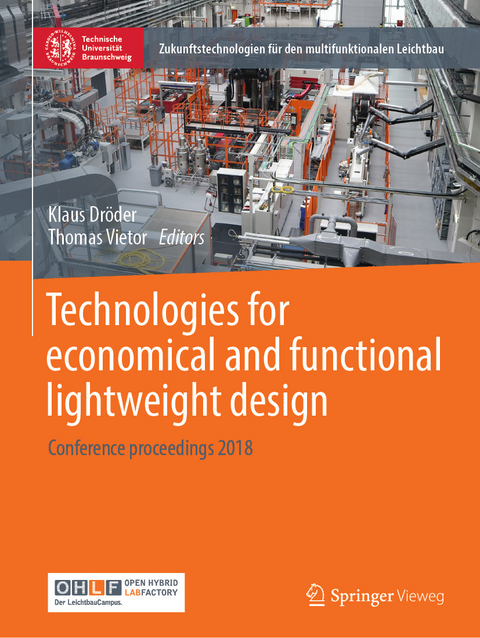
Technologies for economical and functional lightweight design (eBook)
233 Seiten
Springer Berlin Heidelberg (Verlag)
978-3-662-58206-0 (ISBN)
This book comprises the proceedings of the conference 'Faszination Hybrider Leichtbau 2018', which took place in Wolfsburg.
The conference focused on new methods and technologies for the development and production of multifunctional and hybrid lightweight solutions in large-scale vehicle manufacturing. Further, it promoted the exchange of insights and lessons learned between experts from industry and academia.
Lightweight design and construction are key technologies for the development of sustainable and resource-efficient mobility concepts. Material hybrid structures, which combine the advantages of different materials (e.g. fiber-reinforced plastics and metals), have a high potential for reducing weight, while simultaneously expanding component functionality. However, the efficient use of functional integrated hybrid structures in vehicle construction, requires innovations and constant developments in vehicle and production technology. There is a great demand for affordable lightweight construction in mass production that takes into account the increasing requirements in terms of variant diversity, safety and quality- particularly with regards to new methods and technologies.
Prof. Dr.-Ing. Klaus Dröder is Professor of Manufacturing Technologies and Process Automation, as well as, Head of the Institute for Machine Tools and Production Technology (IWF) at the Technische Universtität Braunschweig. He is also a member of the board of the Open Hybrid LabFactory. His research interests include technological and automation issues in current and future process chains, with a focus on the implementation of production strategies that enable the efficient and flexible manufacture of functionalized products.
Prof. Dr.-Ing. Thomas Vietor is Head of the Institute for Engineering Design (IK) at the Technische Universität Braunschweig and is a member of the board of the Open Hybrid LabFactory. His research focuses on the integration of product development and production technology, the integration of product development and industrial design, and the use and further improvement of CAx processes in product development.
Prof. Dr.-Ing. Klaus Dröder is Professor of Manufacturing Technologies and Process Automation, as well as, Head of the Institute for Machine Tools and Production Technology (IWF) at the Technische Universtität Braunschweig. He is also a member of the board of the Open Hybrid LabFactory. His research interests include technological and automation issues in current and future process chains, with a focus on the implementation of production strategies that enable the efficient and flexible manufacture of functionalized products.Prof. Dr.-Ing. Thomas Vietor is Head of the Institute for Engineering Design (IK) at the Technische Universität Braunschweig and is a member of the board of the Open Hybrid LabFactory. His research focuses on the integration of product development and production technology, the integration of product development and industrial design, and the use and further improvement of CAx processes in product development.
Preface 6
Table of Contents 7
I Projects within the Open Hybrid LabFactory 9
1 MULTI MATERIAL DESIGN. A CURRENT OVERVIEW OF THE USED POTENTIAL IN AUTOMOTIVE INDUSTRIES 10
1 INTRODUCTION 10
1.1 Definition of Multi Material Design 11
1.2 Challenges and focus of contribution 11
2 METHODOLOGY 12
2.1 Boundary conditions and format of the survey 12
2.2 Categorization and structure of the component database 12
3 MULTI MATERIAL DESIGN IN AUTOMOTIVE INDUSTRIES AN FURTHER RESEARCH 13
4 CHARACTERISTICS OF MULTI MATERIAL DESIGN 16
5 DISCUSSION 17
6 CONCLUSIONS AND FURTHER RESEACH 18
REFERENCES 19
2 DATA MINING APPLICATIONS IN MANUFACTURING OF LIGHTWEIGHT STRUCTURES 21
1 INTRODUCTION 21
2 ACQUISITION AND ANALYSIS OF MANUFACTURING DATA 22
2.1 Acquisition of Manufacturing Data 22
2.2 Analytics of Manufacturing Data 23
2.3 Application Fields of Data Mining in Manufacturing 24
3 FRAMEWORK – DATA MINING IN MANUFACTURING OF LIGHTWEIGHT STRUCTURES 25
3.1 Application Fields of Data Mining in Manufacturing of Lightweight Structures 25
3.2 Framework for the Design of a Data Acquisition Infrastructure 25
3.3 Framework for the Application of Data Mining in Manufacturing of Lightweight Structures 27
4 EXEMPLARY APPLICATION – MACHINE STATE RECOGNITION IN EXTRUSION OF GFRP RIB STRUCTURES 28
5 SUMMARY AND OUTLOOK 31
ACKNOWLEDGEMENTS 32
REFERENCES 32
3 DEVELOPMENT AND NUMERICAL VALIDATION OF COMBINED FORMING PROCESSES FOR PRODUCTION OF HYBRID PARTS 34
1 INTRODUCTION 34
1.1 Hybrid forming processes 35
1.2 Simulation and modelling of hybrid forming processes 35
2 PROCESS AND SIMULATION DEVELOPMENT 36
2.1 Stamping of sandwich structures 36
2.1.1 Conception of the heating-cooling strategy 36
2.1.2 Production of sample components 37
2.1.3 Investigations for the interface of sandwich structures 38
2.2 Development of a combined compression molding and draping process 39
2.2.1 Technological process design 39
2.2.2 Numerical process model 40
2.2.3 Experimental and numerical results 41
3 CONCLUSIONS 43
ACKNOWLEDGEMENTS 43
REFERENCES 43
II Functional Components 45
4 HYBRID COMPONENTS WITH FUNCTION INTEGRATION FOR CRASH RELATED APPLICATIONS IN ELECTROMOBILITY 46
1 INTRODUCTION 46
2 DESIGN OF COMPONENT 47
3 COMPUTATION AND SIMULATION 48
4 TESTING RESULTS 49
5 CONCLUSION 51
REFERENCES 52
5 COMPOSITE ENGINE BLOCK – CHALLENGES FOR DESIGN AND MATERIAL 53
1 INTRODUCTION 53
2 STATE OF THE ART 54
3 REQUIREMENTS FOR THE DESIGN 55
4 DESIGN CONCEPT 56
5 MATERIALS FOR DESIGN CONCEPT 56
6 EVALUATION 57
6.1 Surface analysis 57
6.2 Effect proof of the silanization 58
6.3 Pressure test 59
6.4 Leak tightness test 60
7 CONCLUSION AND OUTLOOK 61
6 DEVELOPMENT OF A LIGHT-WEIGHT SEAT STRUCTURE USING A HYBRID MATERIAL APPROACH 63
1 INTRODUCTION 63
2 SURFACE TREATMENT FOR ADHESIVE STRENGTH ENHANCEMENT 64
2.1 Propane flame treatment 64
2.2 Plasma treatment 64
3 MATERIALS AND CHARACTERISATION METHODS 65
3.1 Materials 65
3.2 Contact Angle Measurements 66
3.3 Lap Shear Test and Bonding of Front Seat Back (FSB) 66
4 RESULTS AND DISCUSSION 66
4.1 Effect of time after surface treatment on surface functionality 66
4.2 Mechanical performance of fibre reinforced PA66 and PP substrates 67
5 CONCLUSIONS 69
ACKNOWLEDGEMENTS 69
REFERENCES 69
III Smart Production/Smart Components 70
7 SMART SYSTEM INTEGRATION – POTENTIALS AND CHALLENGES IN THE INTEGRATED CONDITION MONITORING OF LIGHT-WEIGHT STRUCTURES 71
1 INTRODUCTION 71
2 CHALLENGES AND OBJECTIVES 72
3 EMBROIDERED SENSORS FOR THE INTEGRATION INTO LIGHTWEIGHT STRUCTURES 72
4 STRAIN GAUGE MEASUREMENT 73
4.1 Gauge factor (k-factor) 74
4.2 Transverse sensitivity 74
4.3 Fatigue behaviour 75
4.4 Interlaminar energy release rate 76
5 CONCLUSION 77
6 PROSPECTS 77
ACKNOWLEDGEMENTS 77
REFERENCES 77
8 POTENTIALS OF LOAD CARRYING CONDUCTOR TRACKS IN NEW VEHICLE STRUCTURES 79
1 INTRODUCTION 79
2 CONDUCTOR GEOMETRY 80
3 ELECTRIAL CHARACTERISTICS 81
4 MECHANICAL CHARACTERISTICS 82
4.1 Residual stresses in composite materials 83
4.2 Laminate under tensile load 83
4.3 Laminate under bending load 84
5 ELECTRICAL TESTS 85
6 SCALED DEMONSTRATOR 86
7 ELECTRICAL CONNECTION CONCEPT 88
8 CONCLUSIONS 89
REFERENCES 90
9 NUMERICAL AND EXPERIMENTAL INVESTIGATION OF FIBER REINFORCED BIOCOMPOSITES AS STRUCTURAL PARTS IN AUTOMOTIVE APPLICATIONS 91
1 NATURAL FIBER REINFORCED ORGANOSHEETS 91
1.1 Manufacturing process 92
2 THERMAL CHARACTERIZATION 92
3 MECHANICAL CHARACTERIZATION 93
3.1 Single fiber testing 93
3.2 Organosheet testing 93
3.3 Strain-rate dependent properties 94
4 IN PLANE SHEAR CHARACTERIZATION 95
4.1 Bias extension 96
5 FE DRAPING SIMULATION 98
5.1 Model description 98
5.2 Draping simulation of a seat shell 98
5.3 Optimization 99
6 CRASH SIMULATION 100
6.1 Modeling the NF-organosheet behavior 100
6.2 Frontal crash simulation of the seat shell 100
7 CONCLUSIONS 101
REFERENCES 101
IV Design and Simulation of Hybrid Structures 103
10 INNOVATIVE HYBRID MATERIAL CONCEPTS AND THEIR VIRTUAL SAFEGUARDING 104
1 INTRODUCTION 104
2 LEIKA, RELEI AND SAMPA 104
2.1 LEIKA 105
2.2 ReLei 106
2.3 SamPa 108
3 CONCLUSIONS 109
ACKNOWLEDGEMENTS 109
11 CARBON CARRIER – INTEGRATED CONCEPT FOR INNOVATIVE INTERIOR STRUCTURES 110
1 INTRODUCTION 111
2 THE ASSEMBLY 112
3 THE DEVELOPMENT PROCESS 113
4 PRODUCTION 115
5 CONCLUSION 116
12 TAILORED STACKED HYBRIDS – AN OPTIMIZATION-BASED APPROACH IN MATERIAL DESIGN FOR FURTHER IMPROVEMENT IN LIGHTWEIGHT CAR BODY STRUCTURES 117
1 INTRODUCTION 117
2 PROPOSED OPTIMIZATION METHOD FOR TAILORED HYBRID STACKS 118
2.1 LHybS Ordered Multi-Material Interpolation 118
2.2 Optimization methodology 120
3 REFERENCE STRUCTURE BENCHMARK 122
3.1 Global bending stiffness 122
3.2 Global torsion stiffness 123
3.3 Modal analysis 123
3.4 Lightweight Index 124
3.5 Component selection 124
4 BIW COMPONENT OPTIMIZATION 125
4.1 Hybrid material design 125
4.2 Geometry design 126
5 VALIDATION 127
6 CONCLUSIONS AND OUTLOOK 128
ACKNOWLEDGEMENTS 128
REFERENCES 129
13 A MANUFACTURE CONSTRAINED DESIGN METHODOLOGY APPLICATION FOR A TAILORED FORMING HYBRID COMPONENT 130
1 INTRODUCTION 130
2 METHODOLOGY 131
2.1 Tailored Forming 131
2.2 Topology Optimization 132
2.3 Parametric Analysis 134
3 APPLICATION FOR A TAILORED FORMING SHAFT 135
4 CONCLUSIONS 137
ACKNOWLEDGEMENTS 138
REFERENCES 138
V New Production Technologies 141
14 MATERIAL- AND PROCESS CHARACTERIZATION OF FIBRE-METAL-ELASTOMER LAMINATE COMPONENTS WITH HIGH FORMING DEGREES 142
1 INTRODUCTION 142
2 MATERIALS 143
2.1 CFRP 143
2.2 Aluminium 143
2.3 Elastomer 143
3 EXPERIMENTAL 144
3.1 Manufacturing process 144
3.2 Optical analysis 145
3.3 Modal analysis 145
4 RESULTS 145
4.1 Layer distribution of formed hybrid laminates 145
4.2 Modal analysis of FMEL 147
5 DISCUSSION 147
6 CONCLUSION 148
ACKNOWLEDGEMENTS 148
REFERENCES 149
VI Material Concepts 150
15 FILM-ADHESIVES FOR POLYMER-METAL HYBRID STRUCTURES FROM LABORATORY TO CLOSE-TO-PRODUCTION 151
1 INTRODUCTION 151
2 STATE OF THE ART 152
2.1 Investigations of the influence of flat steel metallic and organic coatings on bonding properties 153
3.2 Investigations on the process-integrated manufactured bonding 155
3.3 Development of a large-scale application process for the film-adhesive 156
3.4 Enhanced polymer-metal hybrid structures with coil coating 157
3 CONCLUSION AND OUTLOOK 159
ACKNOWLEDGEMENTS 159
REFERENCES 160
16 TESTING OF METAL CONNECTIONS USING ADHESIVE BONDING COMBINED WITH SELF-PIERCING RIVETING 161
1 INTRODUCTION 161
2 CHARACTERIZATION OF BONDED SPR CONNECTIONS 162
2.1 Experimental setup 162
2.2 Experimental results 163
3 COMPONENT TEST 164
3.1 Experimental setup 164
3.2 Experimental results 166
4 CONCLUSION 166
REFERENCES 167
17 APPLICATION OF INNOVATIVE MATERIAL CONCEPTS FOR SAFETY LIGHTWEIGHT INSIDE CARS USING ALTERNATIVE POWERTRAINS 168
1 INTRODUCTION 168
2 AUSTENITIC COLD-HARDENING STAINLESS STEELS 169
2.1 Integrated load-paths 170
2.2 Flexible rolling 171
3 PROFILED SHEETS 173
4 WELDABLE SANDWICH WITH 3D-PROFILED CORE 174
5 CONCEPT IDEAS FOR ELECTRIC MOBILITY 176
5.1 Individualized surfaces 176
5.2 Spring steels as safety protection 177
5.3 Integrated safety cell 178
6 CONCLUSIONS 179
REFERENCES 180
18 BIO-BASED MATERIALS FOR EXTERIOR APPLICATIONS – PROJECT BIOHYBRIDCAR 181
1 INTRODUCTION 181
2 STATE OF THE ART 183
3 MATERIAL AND METHODS 184
3.1 Material 184
3.2 Component and transaltion to 2D test specime 184
3.3 Stacking sequences for tested samples 185
3.4 Sample preparation 186
3.5 Experimental characterisation 186
3.6 Standardisation of fibre content 186
3.7 Relativisation of mechanical properties 186
3.8 Comparison of prices 187
4 RESULTS AND DISCUSSION 187
4.1 Directional flexural properties of fibre reinforced plastics 187
4.2 Flexural properties of fibre reinforced plastics 188
4.3 Tensile properties of fibre reinforced plastics 189
5 CONCLUSIONS 190
ACKNOWLEDGEMENTS 191
REFERENCES 192
19 IMPROVING THE DURABILITY OF BIO HYBRID FIBER REINFORCED PLASTICS BY PLASMA TREATMENT 193
1 INTRODUCTION 193
2 EXPERIMENTAL 194
2.1 Materials 194
2.2 Plasma treatment 194
2.3 Surface energy measurements 196
2.4 Composite fabrication 197
2.5 Environmental testing 197
2.6 Mechanical testing 197
2.7 CT measurements 197
3 RESULTS AND DISCUSSION 197
3.1 Plasma penetration depth 197
3.2 Effect of plasma treatment on textile surface properties 198
3.3 Composite morphology 199
3.4 Influence of plasma treatment on mechanical properties 200
3.5 Composite durability under accelerated environmental testing 202
4 CONCLUSIONS 203
ACKNOWLEDGEMENTS 204
REFERENCES 204
20 THE BEST PROPERTIES FROM THERMOPLASTIC AND THERMO-SETTING RESINS COMBINED IN FIBER REINFORCED PLASTICS FOR IMPROVED PRODUCTIVITY AND PROPERTIES 205
1 INTRODUCTION 205
2 EXPERIMENTAL 206
2.1 Materials 206
2.2 Preparation of Carbon Fiber Reinforced Plastics (CFRP) 207
2.3 Characterization of Thermal and Mechanical Behavior 207
3 RESULTS AND DISCUSSION 208
4 CONCLUSIONS 211
REFERENCES 211
21 FAUST: MATERIAL CHARACTERIZATION OF LOW-COST FOAM MATERIALS UNDER REAL BOUNDARY PROCESS CONDITIONS FOR RTM LARGE-SCALE PRODUCTION 212
1 INTRODUCTION 212
2 RESIN TRANSFER MOLDING 213
3 SANDWICH STRUCTURES 213
4 CORE MATERIALS 214
4.1 Foam core material 214
4.2 Foam core manufacturing 214
4.3 Low cost foam core 215
5 MATERIAL CHARACTERISATION 215
5.1 Preliminary tests 215
5.2 Measurement methods 216
6 REQUIREMENTS FOR THE MEASURING SYSTEM 216
7 MEASURING SYSTEM: FAUST 217
7.1 Measurement principle 217
7.2 Measuring system setup 218
7.3 Test specimen 219
7.4 Description of the test sequence 219
8 FOAM DEFORMATION MEASUREMENT BASED ON SOUND TRAVEL TIME 220
8.1 Calibration measurement 220
8.2 PET foam measurement 221
8.3 Results 222
9 CONCLUSIONS 222
ACKNOWLEDGEMENTS 222
REFERENCES 222
| Erscheint lt. Verlag | 25.3.2019 |
|---|---|
| Reihe/Serie | Zukunftstechnologien für den multifunktionalen Leichtbau | Zukunftstechnologien für den multifunktionalen Leichtbau |
| Zusatzinfo | VIII, 233 p. 1 illus. |
| Verlagsort | Berlin |
| Sprache | englisch |
| Themenwelt | Technik ► Bauwesen |
| Technik ► Maschinenbau | |
| Schlagworte | Automotive • hybrid materials • Material Science • Mobility • Multifunctional leightweigh design • Production techbnologies |
| ISBN-10 | 3-662-58206-6 / 3662582066 |
| ISBN-13 | 978-3-662-58206-0 / 9783662582060 |
| Informationen gemäß Produktsicherheitsverordnung (GPSR) | |
| Haben Sie eine Frage zum Produkt? |
 PDF (Wasserzeichen)
DRM: Digitales Wasserzeichen
Dieses eBook enthält ein digitales Wasserzeichen und ist damit für Sie personalisiert. Bei einer missbräuchlichen Weitergabe des eBooks an Dritte ist eine Rückverfolgung an die Quelle möglich.
Dateiformat: PDF (Portable Document Format)
Mit einem festen Seitenlayout eignet sich die PDF besonders für Fachbücher mit Spalten, Tabellen und Abbildungen. Eine PDF kann auf fast allen Geräten angezeigt werden, ist aber für kleine Displays (Smartphone, eReader) nur eingeschränkt geeignet.
Systemvoraussetzungen:
PC/Mac: Mit einem PC oder Mac können Sie dieses eBook lesen. Sie benötigen dafür einen PDF-Viewer - z.B. den Adobe Reader oder Adobe Digital Editions.
eReader: Dieses eBook kann mit (fast) allen eBook-Readern gelesen werden. Mit dem amazon-Kindle ist es aber nicht kompatibel.
Smartphone/Tablet: Egal ob Apple oder Android, dieses eBook können Sie lesen. Sie benötigen dafür einen PDF-Viewer - z.B. die kostenlose Adobe Digital Editions-App.
Buying eBooks from abroad
For tax law reasons we can sell eBooks just within Germany and Switzerland. Regrettably we cannot fulfill eBook-orders from other countries.
aus dem Bereich