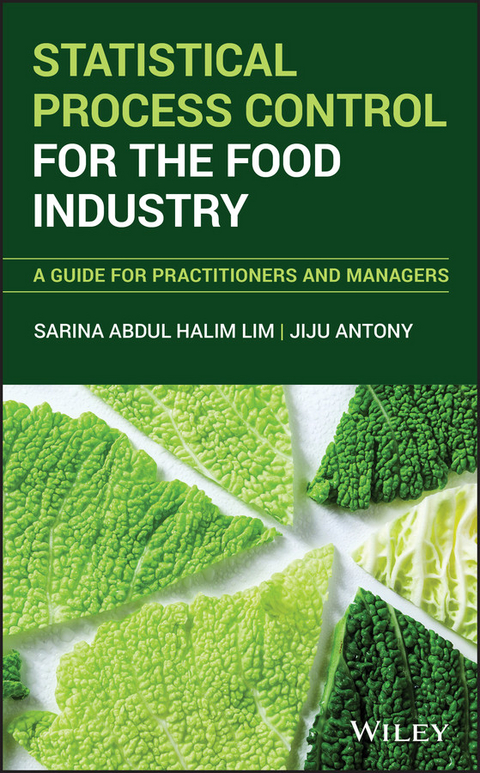
Statistical Process Control for the Food Industry (eBook)
John Wiley & Sons (Verlag)
978-1-119-15199-9 (ISBN)
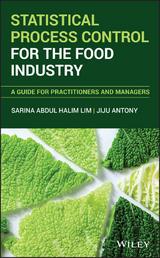
A comprehensive treatment for implementing Statistical Process Control (SPC) in the food industry
This book provides managers, engineers, and practitioners with an overview of necessary and relevant tools of Statistical Process Control, a roadmap for their implementation, the importance of engagement and teamwork, SPC leadership, success factors of the readiness and implementation, and some of the key lessons learned from a number of food companies. Illustrated with numerous examples from global real-world case studies, this book demonstrates the power of various SPC tools in a comprehensive manner. The final part of the book highlights the critical challenges encountered while implementing SPC in the food industry globally.
Statistical Process Control for the Food Industry: A Guide for Practitioners and Managers explores the opportunities to deliver customized SPC training programs for local food companies. It offers insightful chapter covering everything from the philosophy and fundamentals of quality control in the food industry all the way up to case studies of SPC application in the food industry on both the quality and safety aspect, making it an excellent 'cookbook' for the managers in the food industry to assess and initiating the SPC application in their respective companies.
- Covers concise and clear guidelines for the application of SPC tools in any food companies' environment
- Provides appropriate guidelines showing the organizational readiness level before the food companies adopt SPC
- Explicitly comments on success factors, motivations, and challenges in the food industry
- Addresses quality and safety issues in the food industry
- Presents numerous, global, real-world case studies of SPC in the food industry
Statistical Process Control for the Food Industry: A Guide for Practitioners and Managers can be used to train upper middle and senior managers in improving food quality and reducing food waste using SPC as one of the core techniques. It's also an excellent book for graduate students of food engineering, food quality management and/or food technology, and process management.
SARINA ABDUL HALIM LIM is part of the Faculty of Food Science and Technology, Universiti Putra Malaysia, Malaysia. Sarina is currently pursuing research on SPC implementation in the food industry. Sarina has also taught several modules on SPC and DOE for process analysis and optimization.
JIJU ANTONY works at the School of Social Sciences at Heriot-Watt University, Edinburgh, UK. He is recognized as a leader in Six Sigma methodology for achieving and sustaining process excellence, and delivers training courses on quality management, process management, and Lean Six Sigma topics to numerous companies world wide.
A comprehensive treatment for implementing Statistical Process Control (SPC) in the food industry This book provides managers, engineers, and practitioners with an overview of necessary and relevant tools of Statistical Process Control, a roadmap for their implementation, the importance of engagement and teamwork, SPC leadership, success factors of the readiness and implementation, and some of the key lessons learned from a number of food companies. Illustrated with numerous examples from global real-world case studies, this book demonstrates the power of various SPC tools in a comprehensive manner. The final part of the book highlights the critical challenges encountered while implementing SPC in the food industry globally. Statistical Process Control for the Food Industry: A Guide for Practitioners and Managers explores the opportunities to deliver customized SPC training programs for local food companies. It offers insightful chapter covering everything from the philosophy and fundamentals of quality control in the food industry all the way up to case studies of SPC application in the food industry on both the quality and safety aspect, making it an excellent "e;cookbook"e; for the managers in the food industry to assess and initiating the SPC application in their respective companies. Covers concise and clear guidelines for the application of SPC tools in any food companies' environment Provides appropriate guidelines showing the organizational readiness level before the food companies adopt SPC Explicitly comments on success factors, motivations, and challenges in the food industry Addresses quality and safety issues in the food industry Presents numerous, global, real-world case studies of SPC in the food industry Statistical Process Control for the Food Industry: A Guide for Practitioners and Managers can be used to train upper middle and senior managers in improving food quality and reducing food waste using SPC as one of the core techniques. It's also an excellent book for graduate students of food engineering, food quality management and/or food technology, and process management.
SARINA ABDUL HALIM LIM is part of the Faculty of Food Science and Technology, Universiti Putra Malaysia, Malaysia. Sarina is currently pursuing research on SPC implementation in the food industry. Sarina has also taught several modules on SPC and DOE for process analysis and optimization. JIJU ANTONY works at the School of Social Sciences at Heriot-Watt University, Edinburgh, UK. He is recognized as a leader in Six Sigma methodology for achieving and sustaining process excellence, and delivers training courses on quality management, process management, and Lean Six Sigma topics to numerous companies world wide.
| Erscheint lt. Verlag | 8.3.2019 |
|---|---|
| Sprache | englisch |
| Themenwelt | Mathematik / Informatik ► Mathematik ► Statistik |
| Mathematik / Informatik ► Mathematik ► Wahrscheinlichkeit / Kombinatorik | |
| Technik ► Maschinenbau | |
| Wirtschaft ► Betriebswirtschaft / Management | |
| Schlagworte | deploying SPC implementation • FDA regulations • food engineering • food industry • food process management • Food Quality • Food Quality Assurance • food quality control • Food Quality Management • Food Safety • Food Science & Technology • Food Technology • guide to SPC • guide to statistical process control • implementing SPC • implementing SPC in the food industry • implementing SPC practices • Industrial Engineering • Industrial Engineering / Project Management • Industrielle Verfahrenstechnik • Lebensmittel • Lebensmittelforschung u. -technologie • Lebensmittel / Qualitätskontrolle • Projektmanagement • Projektmanagement i. d. Industriellen Verfahrenstechnik • Qualität, Produktivität u. Zuverlässigkeit • quality control • Quality, Productivity & Reliability • SPC • SPC application in the food industry • SPC best practices • SPC challenges • SPC implementation • SPC tools • SPC training programs • Statistical Process Control • Statistics • Statistik • the Centre for Research in Six Sigma and Process Excellence (CRISSPE) • Verfahrenstechnik |
| ISBN-10 | 1-119-15199-6 / 1119151996 |
| ISBN-13 | 978-1-119-15199-9 / 9781119151999 |
| Informationen gemäß Produktsicherheitsverordnung (GPSR) | |
| Haben Sie eine Frage zum Produkt? |
 PDF (Adobe DRM)
Kopierschutz: Adobe-DRM
Adobe-DRM ist ein Kopierschutz, der das eBook vor Mißbrauch schützen soll. Dabei wird das eBook bereits beim Download auf Ihre persönliche Adobe-ID autorisiert. Lesen können Sie das eBook dann nur auf den Geräten, welche ebenfalls auf Ihre Adobe-ID registriert sind.
Details zum Adobe-DRM
Dateiformat: PDF (Portable Document Format)
Mit einem festen Seitenlayout eignet sich die PDF besonders für Fachbücher mit Spalten, Tabellen und Abbildungen. Eine PDF kann auf fast allen Geräten angezeigt werden, ist aber für kleine Displays (Smartphone, eReader) nur eingeschränkt geeignet.
Systemvoraussetzungen:
PC/Mac: Mit einem PC oder Mac können Sie dieses eBook lesen. Sie benötigen eine
eReader: Dieses eBook kann mit (fast) allen eBook-Readern gelesen werden. Mit dem amazon-Kindle ist es aber nicht kompatibel.
Smartphone/Tablet: Egal ob Apple oder Android, dieses eBook können Sie lesen. Sie benötigen eine
Geräteliste und zusätzliche Hinweise
Buying eBooks from abroad
For tax law reasons we can sell eBooks just within Germany and Switzerland. Regrettably we cannot fulfill eBook-orders from other countries.
aus dem Bereich