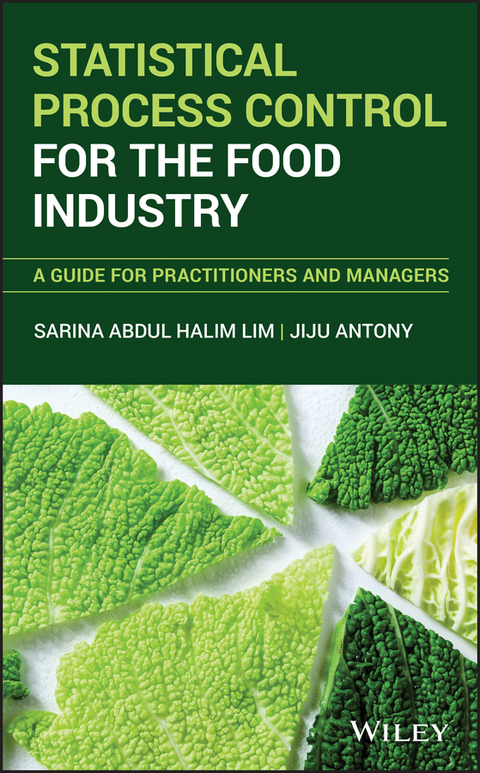
Statistical Process Control for the Food Industry (eBook)
John Wiley & Sons (Verlag)
978-1-119-15200-2 (ISBN)
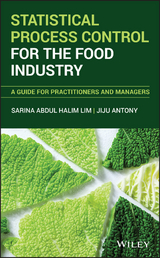
A comprehensive treatment for implementing Statistical Process Control (SPC) in the food industry
This book provides managers, engineers, and practitioners with an overview of necessary and relevant tools of Statistical Process Control, a roadmap for their implementation, the importance of engagement and teamwork, SPC leadership, success factors of the readiness and implementation, and some of the key lessons learned from a number of food companies. Illustrated with numerous examples from global real-world case studies, this book demonstrates the power of various SPC tools in a comprehensive manner. The final part of the book highlights the critical challenges encountered while implementing SPC in the food industry globally.
Statistical Process Control for the Food Industry: A Guide for Practitioners and Managers explores the opportunities to deliver customized SPC training programs for local food companies. It offers insightful chapter covering everything from the philosophy and fundamentals of quality control in the food industry all the way up to case studies of SPC application in the food industry on both the quality and safety aspect, making it an excellent 'cookbook' for the managers in the food industry to assess and initiating the SPC application in their respective companies.
- Covers concise and clear guidelines for the application of SPC tools in any food companies' environment
- Provides appropriate guidelines showing the organizational readiness level before the food companies adopt SPC
- Explicitly comments on success factors, motivations, and challenges in the food industry
- Addresses quality and safety issues in the food industry
- Presents numerous, global, real-world case studies of SPC in the food industry
Statistical Process Control for the Food Industry: A Guide for Practitioners and Managers can be used to train upper middle and senior managers in improving food quality and reducing food waste using SPC as one of the core techniques. It's also an excellent book for graduate students of food engineering, food quality management and/or food technology, and process management.
SARINA ABDUL HALIM LIM is part of the Faculty of Food Science and Technology, Universiti Putra Malaysia, Malaysia. Sarina is currently pursuing research on SPC implementation in the food industry. Sarina has also taught several modules on SPC and DOE for process analysis and optimization.
JIJU ANTONY works at the School of Social Sciences at Heriot-Watt University, Edinburgh, UK. He is recognized as a leader in Six Sigma methodology for achieving and sustaining process excellence, and delivers training courses on quality management, process management, and Lean Six Sigma topics to numerous companies world wide.
A comprehensive treatment for implementing Statistical Process Control (SPC) in the food industry This book provides managers, engineers, and practitioners with an overview of necessary and relevant tools of Statistical Process Control, a roadmap for their implementation, the importance of engagement and teamwork, SPC leadership, success factors of the readiness and implementation, and some of the key lessons learned from a number of food companies. Illustrated with numerous examples from global real-world case studies, this book demonstrates the power of various SPC tools in a comprehensive manner. The final part of the book highlights the critical challenges encountered while implementing SPC in the food industry globally. Statistical Process Control for the Food Industry: A Guide for Practitioners and Managers explores the opportunities to deliver customized SPC training programs for local food companies. It offers insightful chapter covering everything from the philosophy and fundamentals of quality control in the food industry all the way up to case studies of SPC application in the food industry on both the quality and safety aspect, making it an excellent "e;cookbook"e; for the managers in the food industry to assess and initiating the SPC application in their respective companies. Covers concise and clear guidelines for the application of SPC tools in any food companies' environment Provides appropriate guidelines showing the organizational readiness level before the food companies adopt SPC Explicitly comments on success factors, motivations, and challenges in the food industry Addresses quality and safety issues in the food industry Presents numerous, global, real-world case studies of SPC in the food industry Statistical Process Control for the Food Industry: A Guide for Practitioners and Managers can be used to train upper middle and senior managers in improving food quality and reducing food waste using SPC as one of the core techniques. It's also an excellent book for graduate students of food engineering, food quality management and/or food technology, and process management.
SARINA ABDUL HALIM LIM is part of the Faculty of Food Science and Technology, Universiti Putra Malaysia, Malaysia. Sarina is currently pursuing research on SPC implementation in the food industry. Sarina has also taught several modules on SPC and DOE for process analysis and optimization. JIJU ANTONY works at the School of Social Sciences at Heriot-Watt University, Edinburgh, UK. He is recognized as a leader in Six Sigma methodology for achieving and sustaining process excellence, and delivers training courses on quality management, process management, and Lean Six Sigma topics to numerous companies world wide.
Preface
1 Quality Management in The Food Industry
2 Food Industry and Its Contribution to The Global Economy
3 Quality and Safety in the Food Industry
4 An Introduction of SPC in the Food Industry: Past, Present and Future
5 Tools in SPC
6 Team Formation, Team Dynamics and Training
7 SPC Readiness Self-Assessment Tool
8 Critical Aspects in SPC Implementation Process
9 Roadmap for the Deployment of SPC
10 Case Studies
1
Quality Management in the Food Industry
1.1 Introduction
The importance of quality in the food industry has grown significantly over recent decades as consumers have become more critical. Apart from that, this is also attributed to the increasing expectations of consumers, stricter governmental regulations, changes in consumption patterns, continuous development of technologies and expanding market competition. Compared to other industry, food quality management is challenging due to the complex character of food products with the unpredictable and evolving behaviour of people involved in the food chain. Therefore, food companies are seeking more efficient and effective managerial approaches to improve or sustain the quality aspect of their processes and products. The key forces that drive the food companies to seek quality management practices may be dictated by internal or external circumstances or maybe both. The key purpose of effective quality management is to boost the competitiveness of the business and offer strategic advantages in the market (Anderson, Rungtusanatham, and Schroeder 1994). Similarly, food quality management is crucial to assure the quality of the process and subsequently the products in food businesses.
Although the food industry is aware of the negative public opinion, not all companies are committed to improving the industry's image
Mike Doyle, PhD, Director of the Center for Food Safety
1.2 Definition of Quality Control
The term ‘quality control’ () is initiated from the field of engineering where the quality of the product is constructing the quality of the product instead of inspecting the quality. Scoping down to the core of quality control, it is understood as a procedure designed to ensure that the product conforms to a designated set of criteria as set out by the consumers.
Quality control has been prioritised after the World War II where mass production manufacturing was developed despite the fact that quality is always being integrated into the businesses since the industrial revolution in Europe. Therefore, the quality control activities took a significant turn where the demand for more inspectors in ensuring the quality of the product increased. Another major advancement of quality control is when a physician, Dr. Walter Shewhart introduced a statistical approach to quality control in 1924. It started after World War II, when Statistical Quality Control has been widely applied to assist in quality control and production.
The key objectives of quality control are:
- to achieve a consistent quality of the product;
- to maintain the product at the quality at levels and tolerance limits acceptable to the consumers while minimising the cost for the vendors;
- to manage and continuously sustain the expected level of the product quality; and
- to ensure that produced items are fulfilling the highest possible quality.
Quality control can be categorised as off‐line quality control and on‐line quality control. The key purpose of the quality control is to satisfy the standard of quality in the product being produced as is compatible with the market for which the product is designed and at a price the product will be sold. Thus, the best approach of quality control is to initiate the efforts in the product design phase and continuously apply such efforts through the production operation phases.
1.3 Quality Control in the Food Industry
In modern food manufacturing settings, the quality control systems are the supporting programs that are outcrops of the Hazard Analysis Critical Control Point () program. A clear indication of the product conformance to their specification are based in the documentation required in the HACCP program.
Typically, any quality control program in this industry is documented in the program general overview and being verified on a monitoring form. The data gained through documentation, observation, measurement, data analysis and documentation from the programs provided a clear picture of the product conformance to a specification. The common approach to document the overall control system, a form for the quality control scheme should be completed. Thus, this document provided a concise indication of all the quality related programs established by the company (e.g. quality parameters, the specification limits, sampling plan, action plan, critical control point (), and correction action).
Quality control of food refers scientifically to the utilisation of technological, physical, chemical, microbiological, nutritional, and sensory parameters to achieve wholesome food. These quality factors depend on specific attributes, such as sensory properties (e.g. flavour, colour, aroma, taste, texture), quantitative properties (e.g. percentage of sugar, protein, fibre) and hidden attributes (e.g. peroxides, free fatty acids, and enzyme) (Edith and Ochubiojo 2012). Quality control is commonly in the raw material, process control, and finished product in the food industry.
Most large food businesses establish a quality control department in the organisation as they have a crucial role in driving quality efforts. A team of Quality Control (QC) staff promotes quality in the department, assists, and closely consults with the production. Typically, the production department is directly responsible for the quality of the products. Nevertheless, unlike most people's perception, quality assurance () is not directly responsible for the quality of the products the business delivered to its customers.
The professionals of the QC department:
- assist the production in quality‐related matters;
- report to the division director of QA;
- seek direction and assistance from the vice president of QA; and
- support for QA programs.
1.3.1 Quality Control (Raw Material)
In producing the products, the food manufacturers have to purchase other products in different forms and services to ensure the business maintains production. The products in the food industry are enormously diverse including raw materials from processed food ingredients, minor and major ingredients in food production.
In the chain of food production, especially in handling the production of the consumer foods, it requires the manufacturers who purchase the ingredients, raw materials and food packaging to ensure the materials are safe and fit for use. Apart from that, the food manufacturers have to identify the impact of supplies and services purchased on quality and subsequently confirm the supplier's capability to meet the requirements of the specification. Thus, many food companies categorised the quality control of these ingredients as being under supplier and purchasing control. Despite purchasing services are not as important as many of the ingredients, services such as pest control, calibration, laundry, plant cleaning and quality consultancy need to be considered. Therefore, the disruption of the food production commonly stemming from the supplier problems may impact the production, customers and the business bottom‐line. Food companies should have a systematic control plan in place. Such a systematic control plan is the key focus of the quality management system () in a company which prevents problems and ensures consistency within the manufacturing process.
Typically, the supplier provides the raw materials, which means the quality of the raw materials is not under the direct control of the manufacturer. Nevertheless, the manufacturers can overcome this through their purchasing power where the manufacturers have significant opportunity to select suppliers. The company takes the initiative to have a clear understanding of what is required. Thus, these demands have to be translated into criteria for selecting the suppliers and requirements for them to fulfil.
According to the ISO9001 requirement on the suppliers (i.e. external provider), the companies are only required to define the process, identify the authorised people, and ensure that the practice is implemented and adequately controlled. Nevertheless, the organisation needs to develop and establish procedures that work efficiently for them.
1.3.2 Quality Control in Production (Processes and End Product)
The actual processing approaches are critical in‐house factors that may adversely affect quality. The most common process control involved in the food manufacturing process is in the area of the production process despite some operators using the term ‘production’ and ‘processing’ interchangeably. The quality programmes in food industry increase the awareness relating to the values of quality of production and production control strategy as their fundamental elements. Quality control activities in the food industry mainly emphasise the production area of the business function.
Controls in production processes are critical in the food businesses as process variation contributes to the total variation of production. Such principles necessitate producer strategies in the manufacturing process in such a manner that the process can be run in controlled conditions at all steps of the food production. Furthermore, such an element of process control in a food quality programme is identified as being critical for the excellent capability of the process and consistent quality of the products. The food manufacturer should plan a process...
| Erscheint lt. Verlag | 25.2.2019 |
|---|---|
| Sprache | englisch |
| Themenwelt | Mathematik / Informatik ► Mathematik ► Statistik |
| Mathematik / Informatik ► Mathematik ► Wahrscheinlichkeit / Kombinatorik | |
| Technik ► Maschinenbau | |
| Wirtschaft ► Betriebswirtschaft / Management | |
| Schlagworte | deploying SPC implementation • FDA regulations • food engineering • food industry • food process management • Food Quality • Food Quality Assurance • food quality control • Food Quality Management • Food Safety • Food Science & Technology • Food Technology • guide to SPC • guide to statistical process control • implementing SPC • implementing SPC in the food industry • implementing SPC practices • Industrial Engineering • Industrial Engineering / Project Management • Industrielle Verfahrenstechnik • Lebensmittel • Lebensmittelforschung u. -technologie • Lebensmittel / Qualitätskontrolle • Projektmanagement • Projektmanagement i. d. Industriellen Verfahrenstechnik • Qualität, Produktivität u. Zuverlässigkeit • quality control • Quality, Productivity & Reliability • SPC • SPC application in the food industry • SPC best practices • SPC challenges • SPC implementation • SPC tools • SPC training programs • Statistical Process Control • Statistics • Statistik • the Centre for Research in Six Sigma and Process Excellence (CRISSPE) • Verfahrenstechnik |
| ISBN-10 | 1-119-15200-3 / 1119152003 |
| ISBN-13 | 978-1-119-15200-2 / 9781119152002 |
| Informationen gemäß Produktsicherheitsverordnung (GPSR) | |
| Haben Sie eine Frage zum Produkt? |
 EPUB (Adobe DRM)
Kopierschutz: Adobe-DRM
Adobe-DRM ist ein Kopierschutz, der das eBook vor Mißbrauch schützen soll. Dabei wird das eBook bereits beim Download auf Ihre persönliche Adobe-ID autorisiert. Lesen können Sie das eBook dann nur auf den Geräten, welche ebenfalls auf Ihre Adobe-ID registriert sind.
Details zum Adobe-DRM
Dateiformat: EPUB (Electronic Publication)
EPUB ist ein offener Standard für eBooks und eignet sich besonders zur Darstellung von Belletristik und Sachbüchern. Der Fließtext wird dynamisch an die Display- und Schriftgröße angepasst. Auch für mobile Lesegeräte ist EPUB daher gut geeignet.
Systemvoraussetzungen:
PC/Mac: Mit einem PC oder Mac können Sie dieses eBook lesen. Sie benötigen eine
eReader: Dieses eBook kann mit (fast) allen eBook-Readern gelesen werden. Mit dem amazon-Kindle ist es aber nicht kompatibel.
Smartphone/Tablet: Egal ob Apple oder Android, dieses eBook können Sie lesen. Sie benötigen eine
Geräteliste und zusätzliche Hinweise
Buying eBooks from abroad
For tax law reasons we can sell eBooks just within Germany and Switzerland. Regrettably we cannot fulfill eBook-orders from other countries.
aus dem Bereich