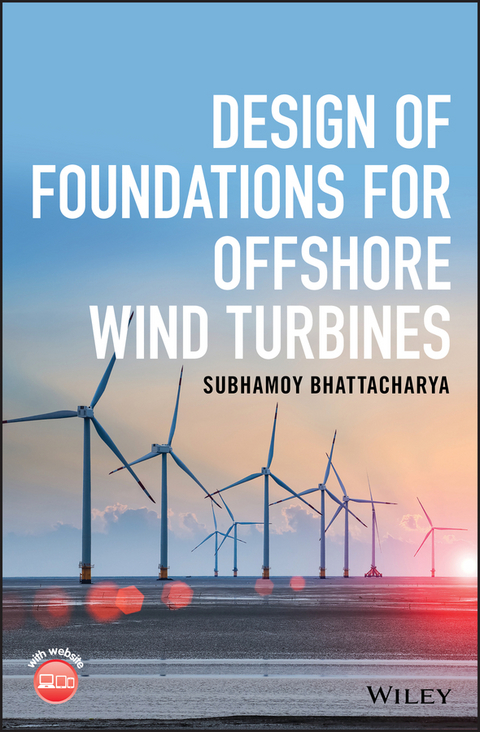
Design of Foundations for Offshore Wind Turbines (eBook)
John Wiley & Sons (Verlag)
978-1-119-12814-4 (ISBN)
Comprehensive reference covering the design of foundations for offshore wind turbines
As the demand for 'green' energy increases the offshore wind power industry is expanding at a rapid pace around the world.
Design of Foundations for Offshore Wind Turbines is a comprehensive reference which covers the design of foundations for offshore wind turbines, and includes examples and case studies. It provides an overview of a wind farm and a wind turbine structure, and examines the different types of loads on the offshore wind turbine structure. Foundation design considerations and the necessary calculations are also covered. The geotechnical site investigation and soil behavior/soil structure interaction are discussed, and the final chapter takes a case study of a wind turbine and demonstrates how to carry out step by step calculations.
Key features:
- New, important subject to the industry.
- Includes calculations and case studies.
- Accompanied by a website hosting software and data files.
Design of Foundations for Offshore Wind Turbines is a must have reference for engineers within the renewable energy industry and is also a useful guide for graduate students in this area.
SUBHAMOY BHATTACHARYA, PHD, is a Professor and Chair in Geomechanics at the University of Surrey. He is also a visiting fellow at the University of Bristol. His main research interest is the design for offshore wind turbines. He has also worked as a consultant in the in the civil and offshore engineering industry.
Comprehensive reference covering the design of foundations for offshore wind turbines As the demand for green energy increases the offshore wind power industry is expanding at a rapid pace around the world. Design of Foundations for Offshore Wind Turbines is a comprehensive reference which covers the design of foundations for offshore wind turbines, and includes examples and case studies. It provides an overview of a wind farm and a wind turbine structure, and examines the different types of loads on the offshore wind turbine structure. Foundation design considerations and the necessary calculations are also covered. The geotechnical site investigation and soil behavior/soil structure interaction are discussed, and the final chapter takes a case study of a wind turbine and demonstrates how to carry out step by step calculations. Key features: New, important subject to the industry. Includes calculations and case studies. Accompanied by a website hosting software and data files. Design of Foundations for Offshore Wind Turbines is a must have reference for engineers within the renewable energy industry and is also a useful guide for graduate students in this area.
SUBHAMOY BHATTACHARYA, PHD, is a Professor and Chair in Geomechanics at the University of Surrey. He is also a visiting fellow at the University of Bristol. His main research interest is the design for offshore wind turbines. He has also worked as a consultant in the in the civil and offshore engineering industry.
Chapter 1 Overview of a Wind Farm and Wind Turbine Structure
Chapter 2 Loads on the Foundations
Chapter 3 Consideration for Foundation Design and the Calculations Necessary
Chapter 4 Geotechnical Site Investigation and Soil Behaviour under Cyclic Loading
Chapter 5 Soil Structure Interaction (SSI)
Chapter 6 Simplified Hand Calculations
1
Overview of a Wind Farm and Wind Turbine Structure
Learning Objectives
The aim of this chapter is to provide an overview of the power generation from wind and features of a wind turbine structure. The overall layout of a wind farm is also discussed to appreciate the multidisciplinary nature of the subject. The fundamental concepts and understanding of other disciplines and fields not directly related to foundations but are necessary to carry out the foundation design are also described with references for further study. The chapter also provides description of different types of foundations that are being used and planned to be used.
After you read this chapter, you will be able to: (i) appreciate the complexity and multidisciplinary nature of the design; (ii) get an overview of the subject; (iii) differentiate between oil and gas (O&G) structure and offshore wind turbine structure.
The chapters of the book are arranged in the following way: It starts with a system‐level understanding (overall wind farm – Chapter 1) and then to component level (foundations design – Chapters 2 and 3) and finally to the element level (soil behaviour, provided in Chapter 4). Chapter 5 discusses the different methods of analyses and Chapter 6 provides some example applications.
1.1 Harvesting Wind Energy
Offshore wind power generation has established itself as a source of reliable energy rather than a symbolism of sustainability. It has been reported by National Grid of the United Kingdom (UK) that on 19 October 2014, 24% of the electricity supply in the United Kingdom was provided by offshore wind farms due to an unexpected fire in Didcot power station and when few of the nuclear power stations were offline due to maintenance and technical issues. Furthermore, National Grid also reported that on 21 October 2014, UK wind farms generated 14.2% of the electricity, which is more than the electricity generated by its nuclear power station (13.2%) for a 24‐hour period.
Before the details of engineering of these systems are discussed, it is considered useful to discuss the sustainability of wind resources as it is often noted that wind doesn't blow all the time. Wind, essentially atmospheric air in motion, is a secondary source of energy and is dependent on the sun. The electromagnetic radiation of the Sun unevenly heats the Earth's surface and creates a temperature gradient in the air, thereby also developing a density and pressure difference. The disparity in differential heating of the surface of the Earth is also a result of specific heat and absorption capacity of sand, clay, intermediate and mixed soils, rocks, water, and other materials. This also results in differential heating of air in different regions and at different rates. The physical process or mechanism that governs the air flow is convection. Common examples are land and sea breezes in coastal regions. The direction and velocity of wind are partly influenced by the rotation of the Earth and topography of the Earth's surface, and thus coastal areas are attractive locations for harvesting wind power. This above discussion shows the sustainability of the wind resource as it is related to the Sun and Earth's motion.
In 2017, Europe was the global leader for offshore wind energy, with the United Kingdom leading the field. This is partially due to the aspirations and policies of the European Union to reduce its greenhouse emissions from the 1990 levels by 20% by the year 2020 and then a further reduction of 80–95% by 2050. There is also an initiative in Europe to make its energy system clean, secure, and efficient.
Offshore wind farming is considered to be one of the most reliable ways to produce clean green energy for five reasons:
- The average wind speed over sea is generally higher and more consistent than onshore, making the offshore wind farming more efficient.
- The noise and vibrations from the wind turbines will have minimum impact on human beings due to their distance from land.
- Large capacity can be installed offshore in comparison to an equivalent onshore wind farm. The reasons are that heavier wind turbine generators (s) or towers can be easily transported and installed using sea routes. In contrast, transporting these large and heavy structures/components during construction will substantially disrupt the daily life for people who live in the vicinity of the wind farm due to blockage of roads.
- Wave and current loading can be harvested alongside wind through the use of hybrid systems.
- Wind turbine technology is relatively more mature than other forms of renewables.
1.2 Current Scenario
Currently, the United Kingdom is leading in offshore wind harvesting (currently generating around 3.6 GW). However, Denmark was the first country to build an offshore wind farm 2.5 km off the Danish coast at Vindeby. Figure 1.1a shows the cumulative offshore wind power capacity by country in 2013 and Figure 1.1 b displays the evolution of global offshore wind power capacity from 1993 to 2013. Construction of large‐scale offshore wind farms are on the rise – due to initiatives in many countries such as Germany, Spain, Portugal, South Korea, China, and Japan. The growth is further enhanced possibly due to diminishing public confidence following the 2011 Fukushima Dai‐ichi nuclear power plant (NPP) incident. Figure 1.2a shows the planned offshore wind farm development in the UK waters and Figure 1.2b shows some of the wind farms in Europe. Asian countries such as China, Taiwan, Japan, and South Korea are also fast progressing; see Figure 1.2c.
Figure 1.1 (a) Offshore wind power capacity (cumulative) by country in 2013 () and (b) evolution of cumulative global offshore wind power capacity for 1993–2013 ().
Source: E.W.E.A.
Source: E.W.E.A.
Figure 1.2 (a) Offshore wind farms around the United Kingdom; (b) wind farms in Europe; and (c) developments in China, Korea, Japan, Taiwan.
ASIDE
Energy challenge: With the discovery of shale natural gas (fracking) and lower oil prices, it is predicted that reliance of oil (often termed as Oil Age) may be ending. With the increasing use of electric cars and wind turbines, it may be argued that this move toward low‐carbon energy is irreversible and quite similar to the transition from the Stone Age to the Bronze Age.
1.2.1 Case Study: Fukushima Nuclear Plant and Near‐Shore Wind Farms during the 2011 Tohoku Earthquake
A devastating earthquake of moment magnitude Mw9.0 struck the Tohoku and Kanto regions of Japan on 11 March at 2 :46 p.m., which also triggered a tsunami (see Figure 1.3 for the location of the earthquake and the operating wind farms). The earthquake and the associated effects such as liquefaction and tsunami caused great economic loss, loss of life, and tremendous damage to structures and national infrastructures but very little damage to the wind farms. Extensive damage was also caused by the massive tsunami in many cities and towns along the coast. Figure 1.4a shows photographs of a wind farm at Kamisu (Hasaki) after the earthquake and Figure 1.4b shows the collapse of pile‐supported building at Onagawa. At many locations (e.g. Natori, Oofunato, and Onagawa), tsunami heights exceeded 10 m, and sea walls and other coastal defence systems failed to prevent the disaster.
Figure 1.3 Details of the 2011 Tohoku earthquake and locations of the wind farms.
Figure 1.4 (a) Photograph of the Kamisu (Hasaki) wind farm following the 2011 Tohoku earthquake; and (b) collapse of the pile‐supported building following the same earthquake.
The earthquake and its associated effects (i.e. tsunami) also initiated the crisis of the Fukushima Dai‐ichi nuclear power plant. The tsunami, which arrived around 50 minutes following the initial earthquake, was 14 m high, which overwhelmed the 10 m high plant sea walls, flooding the emergency generator rooms and causing power failure to the active cooling system. Limited emergency battery power ran out on 12 March and subsequently led to the reactor heating up and melting down, which released harmful radioactive materials into the atmosphere. Power failure also meant that many of the safety control systems were not operational. The release of radioactive materials caused a large‐scale evacuation of over 300 000 people, and the clean‐up costs are expected to be in the tens of billions of dollars. On the other hand, following/during the earthquake, the wind turbines were automatically shut down (like all escalators or lifts), and following an inspection they were restarted.
1.2.2 Why Did the Wind Farms Survive?
Recorded ground acceleration time‐series data in two directions (north−south [NS] and east−west [EW]) at the Kamisu and Hiyama wind farms (FKSH 19 and IBRH20) are presented in Figure 1.5 in frequency domain. The dominant period ranges of the recorded ground motions at the wind farm sites were around 0.07–1.0 seconds and the period of offshore wind turbine systems are in the range of 3.0 seconds. Due to nonoverlapping, these structures will not get tuned and as a result, they are relatively insensitive to earthquake shaking. However,...
| Erscheint lt. Verlag | 20.2.2019 |
|---|---|
| Sprache | englisch |
| Themenwelt | Technik ► Bauwesen |
| Technik ► Elektrotechnik / Energietechnik | |
| Technik ► Maschinenbau | |
| Schlagworte | Bauingenieur- u. Bauwesen • calculations • case study of engineers • Civil Engineering & Construction • Comprehensive • Design • Energie • Energy • foundation design • Foundations • geotechnical site investigation • loads • Maschinenbau • Maschinenbau - Entwurf • mechanical engineering • Mechanical Engineering - Design • Offshore • renewable energy • soil behavior • Soil Structure Interaction • Structure • Structures • Tragwerke • Turbines • Wind • Windenergie • Wind Energy • wind farm • Wind Turbines |
| ISBN-10 | 1-119-12814-5 / 1119128145 |
| ISBN-13 | 978-1-119-12814-4 / 9781119128144 |
| Informationen gemäß Produktsicherheitsverordnung (GPSR) | |
| Haben Sie eine Frage zum Produkt? |
 EPUB (Adobe DRM)
Kopierschutz: Adobe-DRM
Adobe-DRM ist ein Kopierschutz, der das eBook vor Mißbrauch schützen soll. Dabei wird das eBook bereits beim Download auf Ihre persönliche Adobe-ID autorisiert. Lesen können Sie das eBook dann nur auf den Geräten, welche ebenfalls auf Ihre Adobe-ID registriert sind.
Details zum Adobe-DRM
Dateiformat: EPUB (Electronic Publication)
EPUB ist ein offener Standard für eBooks und eignet sich besonders zur Darstellung von Belletristik und Sachbüchern. Der Fließtext wird dynamisch an die Display- und Schriftgröße angepasst. Auch für mobile Lesegeräte ist EPUB daher gut geeignet.
Systemvoraussetzungen:
PC/Mac: Mit einem PC oder Mac können Sie dieses eBook lesen. Sie benötigen eine
eReader: Dieses eBook kann mit (fast) allen eBook-Readern gelesen werden. Mit dem amazon-Kindle ist es aber nicht kompatibel.
Smartphone/Tablet: Egal ob Apple oder Android, dieses eBook können Sie lesen. Sie benötigen eine
Geräteliste und zusätzliche Hinweise
Buying eBooks from abroad
For tax law reasons we can sell eBooks just within Germany and Switzerland. Regrettably we cannot fulfill eBook-orders from other countries.
aus dem Bereich