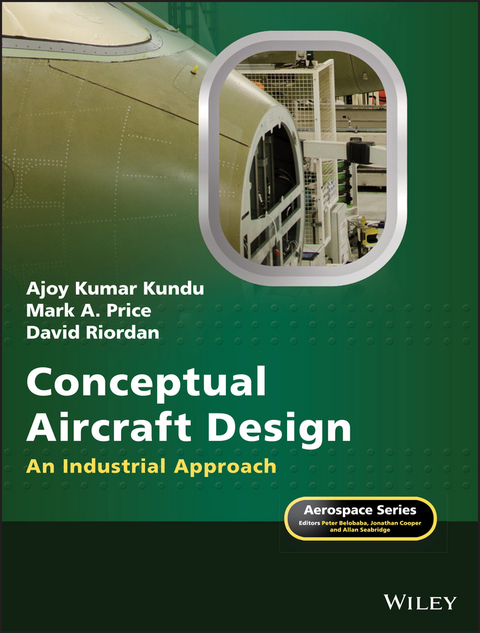
Conceptual Aircraft Design (eBook)
John Wiley & Sons (Verlag)
978-1-119-50026-1 (ISBN)
Provides a Comprehensive Introduction to Aircraft Design with an Industrial Approach
This book introduces readers to aircraft design, placing great emphasis on industrial practice. It includes worked out design examples for several different classes of aircraft, including Learjet 45, Tucano Turboprop Trainer, BAe Hawk and Airbus A320. It considers performance substantiation and compliance to certification requirements and market specifications of take-off/landing field lengths, initial climb/high speed cruise, turning capability and payload/range. Military requirements are discussed, covering some aspects of combat, as is operating cost estimation methodology, safety considerations, environmental issues, flight deck layout, avionics and more general aircraft systems. The book also includes a chapter on electric aircraft design along with a full range of industry standard aircraft sizing analyses.
Split into two parts, Conceptual Aircraft Design: An Industrial Approach spends the first part dealing with the pre-requisite information for configuring aircraft so that readers can make informed decisions when designing vessels. The second part devotes itself to new aircraft concept definition. It also offers additional analyses and design information (e.g., on cost, manufacture, systems, role of CFD, etc.) integral to conceptual design study. The book finishes with an introduction to electric aircraft and futuristic design concepts currently under study.
- Presents an informative, industrial approach to aircraft design
- Features design examples for aircraft such as the Learjet 45, Tucano Turboprop Trainer, BAe Hawk, Airbus A320
- Includes a full range of industry standard aircraft sizing analyses
- Looks at several performance substantiation and compliance to certification requirements
- Discusses the military requirements covering some combat aspects
- Accompanied by a website hosting supporting material
Conceptual Aircraft Design: An Industrial Approach is an excellent resource for those designing and building modern aircraft for commercial, military, and private use.
Dr. Ajoy Kumar Kundu, PhD, FRAeS, FIMechE, CEng, is a former Professor (IIT, Kharagpur), Chief Aircraft Designer (HAL) and retired from Bombardier, Belfast. He is current honorary visiting faculty member in the School of Mechanical and Aerospace Engineering (QUB). He held private pilot licence.
Professor Mark A. Price, PhD, CEng, FRAeS, FIMechE, is Pro-Vice-Chancellor for the Faculty of Engineering and Physical Sciences at Queen's University Belfast (QUB).
David Riordan, MSc, CEng, is Engineering Fellow, Nacelle Design and Powerplant Integration at Bombardier, Belfast, having previously been Chief Technical Engineer.
Provides a Comprehensive Introduction to Aircraft Design with an Industrial Approach This book introduces readers to aircraft design, placing great emphasis on industrial practice. It includes worked out design examples for several different classes of aircraft, including Learjet 45, Tucano Turboprop Trainer, BAe Hawk and Airbus A320. It considers performance substantiation and compliance to certification requirements and market specifications of take-off/landing field lengths, initial climb/high speed cruise, turning capability and payload/range. Military requirements are discussed, covering some aspects of combat, as is operating cost estimation methodology, safety considerations, environmental issues, flight deck layout, avionics and more general aircraft systems. The book also includes a chapter on electric aircraft design along with a full range of industry standard aircraft sizing analyses. Split into two parts, Conceptual Aircraft Design: An Industrial Approach spends the first part dealing with the pre-requisite information for configuring aircraft so that readers can make informed decisions when designing vessels. The second part devotes itself to new aircraft concept definition. It also offers additional analyses and design information (e.g., on cost, manufacture, systems, role of CFD, etc.) integral to conceptual design study. The book finishes with an introduction to electric aircraft and futuristic design concepts currently under study. Presents an informative, industrial approach to aircraft design Features design examples for aircraft such as the Learjet 45, Tucano Turboprop Trainer, BAe Hawk, Airbus A320 Includes a full range of industry standard aircraft sizing analyses Looks at several performance substantiation and compliance to certification requirements Discusses the military requirements covering some combat aspects Accompanied by a website hosting supporting material Conceptual Aircraft Design: An Industrial Approach is an excellent resource for those designing and building modern aircraft for commercial, military, and private use.
Dr. Ajoy Kumar Kundu, PhD, FRAeS, FIMechE, CEng, is a former Professor (IIT, Kharagpur), Chief Aircraft Designer (HAL) and retired from Bombardier, Belfast. He is current honorary visiting faculty member in the School of Mechanical and Aerospace Engineering (QUB). He held private pilot licence. Professor Mark A. Price, PhD, CEng, FRAeS, FIMechE, is Pro-Vice-Chancellor for the Faculty of Engineering and Physical Sciences at Queen's University Belfast (QUB). David Riordan, MSc, CEng, is Engineering Fellow, Nacelle Design and Powerplant Integration at Bombardier, Belfast, having previously been Chief Technical Engineer.
List of Symbols and Abbreviations
Symbols
- A
- area
- A1
- intake high light area
- APR
- Augmented power rating
- Ath
- throat area
- AW
- wetted area
- AR
- aspect ratio
- a
- speed of sound, acceleration
- ā
- average acceleration at 0.7 V2
- ac
- aerodynamic centre
- a0_w
- wing zero lift line relative to fuselage reference line
- αht
- angle of attack at the H‐tail
- b
- span
- CR, CB
- root chord
- CD
- drag coefficient
- CDi
- induced drag coefficient
- CDp
- parasite drag coefficient
- CDpmin
- minimum parasite drag coefficient
- CDw
- wave drag coefficient
- Cv
- specific heat at constant volume
- CF
- overall skin friction coefficient, force coefficient
- Cf
- local skin friction coefficient, coefficient of friction
- CL
- lift coefficient
- Cl
- sectional lift coefficient, rolling moment coefficient
- CLi
- integrated design lift coefficient
- CLα
- lift curve slope
- CLβ
- side slip curve slope
- Cm
- pitching moment coefficient
- Cn
- yawing moment coefficient
- Cp
- pressure coefficient, power coefficient, specific heat at constant pressure
- CT
- thrust coefficient
- CHT
- horizontal tail volume coefficient
- CVT
- vertical tail volume coefficient
- Cxxxx
- cost with subscript identifying parts assembly
- C′xxxx
- cost heading for the type
- CC
- combustion chamber
- CG
- centre of gravity
- c
- chord
- croot
- root chord
- ctip
- tip chord
- cp
- centre of pressure
- D
- drag, diameter
- Dskin
- skin friction drag
- Dpress
- pressure drag
- d
- diameter
- E
- modulus of elasticity, stored energy
- E*
- mass (gravimetric) specific energy,
- EV*
- volumetric specific energy density
- e
- Oswald's factor
- εu
- deflected upwash angle
- εd
- deflected downwash angle
- F
- force
- f
- flat plate equivalent of drag, wing span
- fc
- ratio of speed of sound (altitude to sea level)
- Fca
- aft fuselage closure angle
- Fcf
- front fuselage closure angle
- FB
- body axis
- FI
- inertia axis
- FW
- wind axis
- Fxxx
- component mass fraction, subscript identifies the item (Section 8.8)
- F/ma
- specific thrust
- FR
- fineness ratio
- G
- gearing ratio
- g
- acceleration due to gravity
- H
- height
- h
- vertical distance, height
- if
- incidence of the fuselage camber line relative to fuselage reference line
- it
- angle between H‐tail MACHT and fuselage reference line
- iw
- wing and fuselage setting angle.
- J
- advance ratio
- k
- constant, sometimes with subscript for each application
- L
- length, lift
- LFB
- nacelle fore‐body length
- LN
- nacelle length
- LVT, lVT
- vertical tail arm
- LHT, lHT
- horizontal tail arm
- L
- length
- M
- mass, moment
- Mf
- fuel mass
- Mi
- component group mass, subscript identifies the item (Section 8.6)
- Mxxx
- component item mass, subscript identifies the item (Section 8.6)
- m
- mass
- air mass flow rate
- fuel mass flow rate
- primary (hot) air mass flow rate (turbofan)
- secondary (cold) air mass flow rate (turbofan)
- N
- revolution per minute, number of blades, normal force
- Ne
- number of engine
- n
- load factor
- ng
- load factor times acceleration due to gravity
- P, p
- static pressure, power
- P*
- mass (gravimetric) specific power
- Pbat
- electric power of the battery
- Pt, pt
- total pressure
- p′
- angular velocity about Y‐axis
- pe
- exit plane static pressure
- p∞
- atmospheric (ambient) pressure
- Q
- heat energy per of the system
- q
- dynamic head, heat energy per unit mass
- q′
- angular velocity about z‐axis
- R
- gas constant, reaction
- Re
- Reynolds number
- Recrit
- critical Reynolds number
- r
- radius, angular velocity
- r′
- angular velocity about the x‐axis
- S
- area, most of the time, with a subscript identifying the component
- SBs
- project side area of the fuselage
- SH, SHT
- horizontal tail reference area
- Sn
- maximum cross sectional area
- SW
- wing reference area
- SV, SVT
- vertical tail reference area
- sfc
- specific fuel consumption
- T
- temperature, thrust, time
- TC
- non dimensional thrust
- TF
- non dimensional force (for torque)
- TSLS
- sea level static thrust at takeoff rating
- T/W
- thrust loading
- t/c
- thickness to chord ratio
- tf
- turbofan
- Ug
- vertical gust velocity
- U∞
- free stream velocity
- u
- local velocity along the x‐axis
- V
- free stream velocity
- VA
- aircraft stall speed at limit load
- VB
- aircraft speed at upward gust
- VC
- aircraft maximum design speed
- VD
- aircraft maximum dive speed
- VS
- aircraft stall speed
- Ve
- exit plane velocity (turbofan)
- Vep
- primary (hot) exit plane velocity (turbofan)
- Ves
- secondary (cold) exit plane velocity (turbofan)
- W
- weight, width, rate of energy usage (per hour).
- WA
- useful work done on aircraft
- WE
- mechanical work produced by engine
- W/Sw
- wing loading
- wu
- upwash deflected velocity
- wd
- downwash deflected velocity
- x
- distance along the x‐axis
- y
- distance along the y‐axis
- z
- vertical distance
Greek Symbols
- α
- angle of attack
- αeff
- effective angle of incidence
- β
- CG angle with vertical at main wheel, blade pitch angle, side slip angle
- Γ
- dihedral angle, circulation
- γ
- ratio of specific heat, fuselage clearance angle
- Δ
- increment measure
- δ
- boundary layer thickness
- ε
- downwash angle
- ηt
- thermal efficiency
- ηp
- propulsive efficiency
- ηo
- overall efficiency
- Λ
- wing sweep, subscript indicates the chord line.
- λ
- taper ratio
- μ
- friction coefficient, wing mass
- ρ
- density
- θ
- elevation angle, flight path angle, fuselage upsweep angle
- π
- constant = 3.14
- σ
- atmospheric density ratio
- τ
- thickness parameter, torque
- υ
- velocity
- ϕ
- roll angle, bank angle
- ψ
- azimuth angle, yaw angle
- ω
- angular velocity
Subscripts (in many cases the subscripts are spelled out and not listed here)
- a
- aft
- ave
- average
- ep
- primary exit plane
- es
- secondary exit plane
- f
- front, fuselage
- fb
- blockage factor for drag
- fh
- drag factor for nacelle profile drag (propeller driven)
- fus
- fuselage
- HT
- horizontal tail
- M
- middle
- N, nac
- nacelle
- o
- free stream condition
- p
- primary (hot) flow
- s
- stall, secondary (cold)...
| Erscheint lt. Verlag | 14.12.2018 |
|---|---|
| Reihe/Serie | Aerospace Series |
| Aerospace Series (PEP) | Aerospace Series (PEP) |
| Mitarbeit |
Herausgeber (Serie): Peter Belobaba, Jonathan Cooper, Allan Seabridge |
| Sprache | englisch |
| Themenwelt | Technik ► Bauwesen |
| Technik ► Maschinenbau | |
| Schlagworte | advanced aircraft design • aerodynamics • Aeronautic & Aerospace Engineering • aeroplane design • Aircraft Aerodynamics • aircraft design concepts • aircraft design performance • aircraft design process • Aircraft Electrical Systems • aircraft engineering • aircraft life cycle costing • aircraft mechanical systems • Aircraft performance • aircraft reliability and safety • aircraft safety design • Aircraft Structural Design • aircraft thermodynamics designing for aircraft nose • airframe design methods • airplane design • Applied Mathematics in Engineering • Bombardier • combat plane design • Conceptual Aircraft Design: An Industrial Approach</p> • design for air combat • guide to aircraft design • Institute of Mechanical Engineers • jet plane design • <p>aircraft design • Luft- u. Raumfahrttechnik • Maschinenbau • Maschinenbau - Entwurf • Mathematics • Mathematik • Mathematik in den Ingenieurwissenschaften • mechanical engineering • Mechanical Engineering - Design • Royal Aeronautical Society • structural design of composite airframes • structural design of metallic airframes • value driven design for aircrafts |
| ISBN-10 | 1-119-50026-5 / 1119500265 |
| ISBN-13 | 978-1-119-50026-1 / 9781119500261 |
| Informationen gemäß Produktsicherheitsverordnung (GPSR) | |
| Haben Sie eine Frage zum Produkt? |
 EPUB (Adobe DRM)
Kopierschutz: Adobe-DRM
Adobe-DRM ist ein Kopierschutz, der das eBook vor Mißbrauch schützen soll. Dabei wird das eBook bereits beim Download auf Ihre persönliche Adobe-ID autorisiert. Lesen können Sie das eBook dann nur auf den Geräten, welche ebenfalls auf Ihre Adobe-ID registriert sind.
Details zum Adobe-DRM
Dateiformat: EPUB (Electronic Publication)
EPUB ist ein offener Standard für eBooks und eignet sich besonders zur Darstellung von Belletristik und Sachbüchern. Der Fließtext wird dynamisch an die Display- und Schriftgröße angepasst. Auch für mobile Lesegeräte ist EPUB daher gut geeignet.
Systemvoraussetzungen:
PC/Mac: Mit einem PC oder Mac können Sie dieses eBook lesen. Sie benötigen eine
eReader: Dieses eBook kann mit (fast) allen eBook-Readern gelesen werden. Mit dem amazon-Kindle ist es aber nicht kompatibel.
Smartphone/Tablet: Egal ob Apple oder Android, dieses eBook können Sie lesen. Sie benötigen eine
Geräteliste und zusätzliche Hinweise
Buying eBooks from abroad
For tax law reasons we can sell eBooks just within Germany and Switzerland. Regrettably we cannot fulfill eBook-orders from other countries.
aus dem Bereich