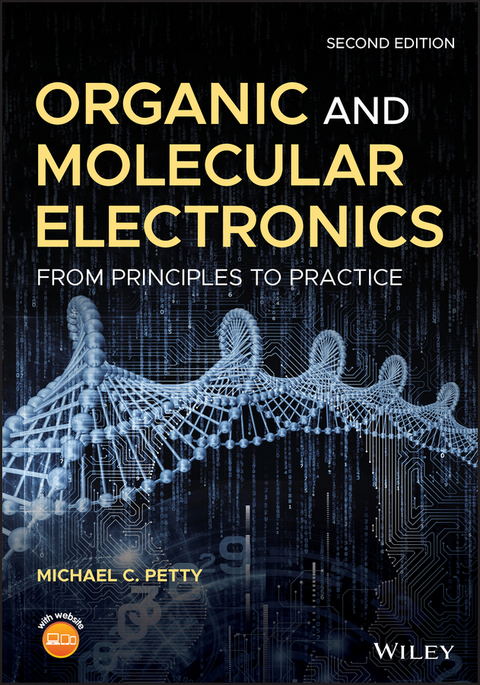
Organic and Molecular Electronics (eBook)
John Wiley & Sons (Verlag)
978-1-118-87925-2 (ISBN)
An introduction to the interdisciplinary subject of molecular electronics, revised and updated
The revised second edition of Organic and Molecular Electronics offers a guide to the fabrication and application of a wide range of electronic devices based around organic materials and low-cost technologies. Since the publication of the first edition, organic electronics has greatly progressed, as evidenced by the myriad companies that have been established to explore the new possibilities.
The text contains an introduction into the physics and chemistry of organic materials, and includes a discussion of the means to process the materials into a form (in most cases, a thin film) where they can be exploited in electronic and optoelectronic devices. The text covers the areas of application and potential application that range from chemical and biochemical sensors to plastic light emitting displays. The updated second edition reflects the recent progress in both organic and molecular electronics and:
- Offers an accessible resource for a wide range of readers
- Contains a comprehensive text that covers topics including electrical conductivity, optical phenomena, electroactive organic compounds, tools for molecular electronics and much more
- Includes illustrative examples based on the most recent research
- Presents problems at the end of each chapter to help reinforce key points
Written mainly for engineering students, Organic and Molecular Electronics: From Principles to Practice provides an updated introduction to the interdisciplinary subjects of organic electronics and molecular electronics with detailed examples of applications.
MICHAEL C. PETTY, Emeritus Professor of Engineering, University of Durham, UK. Professor Petty has published extensively in the areas of organic electronics and molecular electronics and has lectured worldwide in these subjects. He was formerly President of the International Society for Molecular Electronics and BioComputing, and was a previous Chairman of the School of Engineering at Durham University.
MICHAEL C. PETTY, Emeritus Professor of Engineering, University of Durham, UK. Professor Petty has published extensively in the areas of organic electronics and molecular electronics and has lectured worldwide in these subjects. He was formerly President of the International Society for Molecular Electronics and BioComputing, and was a previous Chairman of the School of Engineering at Durham University.
Symbols and Abbreviations
| A | Hamaker constant |
| A | acceptor |
| AC | alternating current |
| AES | Auger electron spectroscopy |
| AFLC | antiferroelectric liquid crystal |
| AFM | atomic force microscopy |
| ALD | atomic layer deposition |
| AmI | ambient intelligence |
| amu | atomic mass unit |
| ANN | artificial neural network |
| ATP | adenosine triphosphate |
| ATR | attenuated total reflection |
| au | arbitrary units |
| B, B | magnetic field (T) |
| BEDT‐TTF or ET | bis(ethylenedithio)tetrathiafulvalene |
| BHJ | bulk heterojunction |
| BCS | Bardeen, Cooper and Schrieffer |
| c | molecular concentration (mol m−3) |
| C | capacitance (F) |
| CAD | computer‐aided drawing |
| CB | conduction band |
| CCD | charge‐coupled device |
| cd | candela |
| CFM | chemical force microscope |
| CGS | centimetre gram second |
| CIE | Commission International de l'Eclairage |
| CMOS | complementary metal‐oxide‐semiconductor |
| CRI | colour‐rendering index |
| CRN | continuous random network |
| CT | charge transfer |
| CVD | chemical vapour deposition |
| dhkl | interplanar spacing (m) |
| D | donor |
| D | diffusion coefficient (m2 s−1) |
| D, D | electric displacement (C m−2) |
| DC | direct current |
| DMeFc | decamethyl‐ferrocene |
| DMSO | dimethyl sulfoxide |
| DNA | dioxyribonucleic acid |
| DOBAMBC | p‐decyloxybenzylidene‐p′−amino‐2‐methylbutylcinnamate |
| DPN | dip‐pen nanolithography |
| DRAM | Dynamic Random Access Memory |
| DVD | Digital Video (or Versatile) Disc |
| E | energy (J) |
| E, E | electric field (V m−1) |
| E c | conduction band edge (J or eV) |
| E F | Fermi energy (J or eV) |
| EIL | electron injection layer |
| EL | electroluminescent (or electroluminescence) |
| EM | electromagnetic |
| EML | emissive layer |
| ENFET | enzyme field effect transistor |
| ENIAC | Electronic Numerical Integrator and Computer |
| ESR | electron spin resonance |
| ETL | electron transport layer |
| E v | valence band edge (J or eV) |
| EXAFS | extended X‐ray absorption fine structure |
| FET | Field Effect Transistor |
| FLC | ferroelectric liquid crystal |
| FLOPS | FLoating‐point Operations Per Second |
| FMM | force modulation microscope |
| FPGA | field‐programmable gate array |
| G | conductance (S or Ω−1) |
| GMR | giant magnetoresistance |
| GPS | Global Positioning System |
| GSM | Global System for Mobile communications |
| H, H | magnetizing field (A m−1) |
| H c | coercive field |
| HCl | hydrochloric acid |
| HDTTF | hexadecanolyl tetrathiafulvalene |
| HIL | hole injection layer |
| HOMO | highest occupied molecular orbital |
| HTL | hole transport layer |
| I | electric current (A) |
| IC | integrated circuit |
| IDT | indacenodithiophene |
| IID | isoindigo |
| IMFET | immuno field effect transistor |
| IoT | Internet of Things |
| IR | infrared |
| ISFET | ion‐sensitive field effect transistor |
| ITO | indium–tin‐oxide |
| ITRS | International Technology Roadmap for Semiconductors |
| J | joule |
| j |
| J | electric current density (A m−2) |
| k | wavevector (m−1) |
| k B | Boltzmann’s constant |
| LASER | light amplification by stimulated emission of radiation |
| LB | Langmuir–Blodgett |
| LbL | Layer‐by‐Layer |
| LCD | liquid crystal display |
| LEC | light‐emitting electrochemical cell |
| LED | light‐emitting diode |
| LFM | lateral force microscope |
| lm | lumen |
| LSI | large‐scale integrated circuit |
| LUMO | lowest unoccupied molecular orbital |
| M | molecular weight |
| M, M | magnetization (A m−1) |
| MBE | molecular beam epitaxy |
| MEH‐PPV | poly[2‐methoxy‐5‐(2‐ethylhexyloxy)‐1,4‐phenylenevinylene] |
| MEMS | Micro‐Electro‐Mechanical System |
| MFM | magnetic force microscope |
| MIM | metal‐insulator‐metal |
| MIS | metal–insulator–semiconductor |
| MISFET | metal–insulator–semiconductor field effect transistor |
| MLD | molecular layer deposition |
| mm | magnetic dipole moment (A m−2) |
| MOCVD | metalorganic chemical vapour deposition |
| MOS | metal–oxide–semiconductor |
| MOSFET | metal–oxide–semiconductor field effect transistor |
| MPP | maximum power point (for a PV device) |
| MPU | microprocessor unit |
| M r | remanent magnetization (A m−1) |
| MRAM | magnetic random access memory |
| mRNA | messenger RNA |
| MTDATA | 4,4′,4″‐tris[phenyl(m‐tolyl)amino]triphenylamine |
| MWNT | multiwall (carbon) nanotube |
| n | refractive index |
| n | number per unit volume or concentration (m−3) |
| n′ | real part of refractive index |
| n″ | imaginary part of refractive index |
| NAD | nicotinamide adenine... |
| Erscheint lt. Verlag | 29.10.2018 |
|---|---|
| Sprache | englisch |
| Themenwelt | Naturwissenschaften ► Chemie |
| Technik ► Elektrotechnik / Energietechnik | |
| Technik ► Maschinenbau | |
| Schlagworte | applications of organic and molecular electronics • beyond Moore’s laws • Carbon Based Materials • Electrical & Electronics Engineering • electronic devices based around organic materials and low-cost technologies • Electronic materials • Elektronische Materialien • Elektrotechnik u. Elektronik • evolution of microelectronics • guide to organic and molecular electronics • Halbleiterphysik • Materials Science • Materialwissenschaften • Moore’s laws • new possibilities of organic and molecular electronics • Organic electronics • organic materials and electronics • Organische Elektronik • Physics • Physik • Practices of organic and molecular electronics • Principles of Organic and Molecular Electronics • progress in organic and molecular electronics • recent research on organic and molecular electronics • resource to organic and molecular electronics • scope of organic and molecular electronics • Semiconductor physics • solutions to organic and molecular electronics • text on organic and molecular electronics • the physics and chemistry of organic materials |
| ISBN-10 | 1-118-87925-2 / 1118879252 |
| ISBN-13 | 978-1-118-87925-2 / 9781118879252 |
| Informationen gemäß Produktsicherheitsverordnung (GPSR) | |
| Haben Sie eine Frage zum Produkt? |
 EPUB (Adobe DRM)
Kopierschutz: Adobe-DRM
Adobe-DRM ist ein Kopierschutz, der das eBook vor Mißbrauch schützen soll. Dabei wird das eBook bereits beim Download auf Ihre persönliche Adobe-ID autorisiert. Lesen können Sie das eBook dann nur auf den Geräten, welche ebenfalls auf Ihre Adobe-ID registriert sind.
Details zum Adobe-DRM
Dateiformat: EPUB (Electronic Publication)
EPUB ist ein offener Standard für eBooks und eignet sich besonders zur Darstellung von Belletristik und Sachbüchern. Der Fließtext wird dynamisch an die Display- und Schriftgröße angepasst. Auch für mobile Lesegeräte ist EPUB daher gut geeignet.
Systemvoraussetzungen:
PC/Mac: Mit einem PC oder Mac können Sie dieses eBook lesen. Sie benötigen eine
eReader: Dieses eBook kann mit (fast) allen eBook-Readern gelesen werden. Mit dem amazon-Kindle ist es aber nicht kompatibel.
Smartphone/Tablet: Egal ob Apple oder Android, dieses eBook können Sie lesen. Sie benötigen eine
Geräteliste und zusätzliche Hinweise
Buying eBooks from abroad
For tax law reasons we can sell eBooks just within Germany and Switzerland. Regrettably we cannot fulfill eBook-orders from other countries.
aus dem Bereich