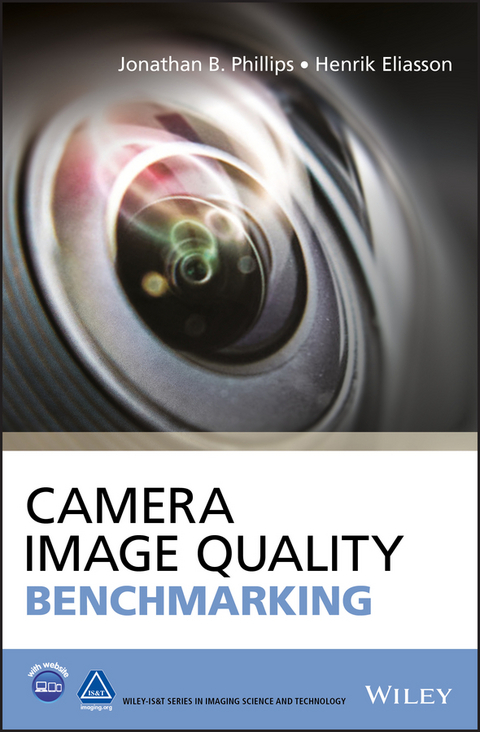
Camera Image Quality Benchmarking, Enhanced Edition (eBook)
John Wiley & Sons (Verlag)
978-1-119-05467-2 (ISBN)
Camera Image Quality Benchmarking contains the basic information and approaches for the use of subjectively correlated image quality metrics and outlines a framework for camera benchmarking. The authors show how to quantitatively compare image quality of cameras used for consumer photography. This book helps to fill a void in the literature by detailing the types of objective and subjective metrics that are fundamental to benchmarking still and video imaging devices. Specifically, the book provides an explanation of individual image quality attributes and how they manifest themselves to camera components and explores the key photographic still and video image quality metrics. The text also includes illustrative examples of benchmarking methods so that the practitioner can design a methodology appropriate to the photographic usage in consideration.
The authors outline the various techniques used to correlate the measurement results from the objective methods with subjective results. The text also contains a detailed description on how to set up an image quality characterization lab, with examples where the methodological benchmarking approach described has been implemented successfully. This vital resource:
* Explains in detail the entire process behind performing a complete characterization and benchmarking of cameras through image quality analysis
* Provides best practice measurement protocols and methodologies, so readers can develop and define their own camera benchmarking system to industry standards
* Includes many photographic images and diagrammatical illustrations to clearly convey image quality concepts
* Champions benchmarking approaches that value the importance of perceptually correlated image quality metrics
Written for image scientists, engineers, or managers involved in image quality and evaluating camera performance, Camera Image Quality Benchmarking combines knowledge from many different engineering fields, correlating objective (perception-independent) image quality with subjective (perception-dependent) image quality metrics.
JONATHAN B. PHILLIPS, is a Staff Image Scientist at Google, USA. He is a United States delegate to the technical committee ISO/TC 42 Photography and a major contributor to the IEEE Camera Phone Image Quality (CPIQ) initiative. HENRIK ELIASSON, PHD, is an image sensor and image analysis specialist at Eclipse Optics, Sweden. He is a senior member of SPIE.
| Erscheint lt. Verlag | 7.12.2017 |
|---|---|
| Reihe/Serie | The Wiley-IS&T Series in Imaging Science and Technology | Wiley-IS&T Series in Imaging Science and Technology |
| Sprache | englisch |
| Themenwelt | Technik ► Elektrotechnik / Energietechnik |
| Schlagworte | best practices for camera benchmarking • best practices for camera benchmarking methodologies • best practices for camera measurement protocols • Bildgebendes Verfahren • Bildgebende Systeme u. Verfahren • camera benchmarking system to industry standards • camera color quality • camera image processor • camera image quality attributes subcomponents of a camera • Camera Image Quality Benchmarking • camera lens • camera noise quality • camera sensor • camera sharpness quality • correlate the camera measurement results from the objective methods • Electrical & Electronics Engineering • Elektrotechnik u. Elektronik • Henrik Eliasson • Imaging Systems & Technology • implementing camera quality measurement methods • Jonathan B. Phillips • methodological camera benchmarking approach • quantitatively compare image quality of cameras used for consumers • set up an image quality characterization lab • Still camera image quality • subjective camera image quality assessment • video camera image quality • video image quality metrics |
| ISBN-10 | 1-119-05467-2 / 1119054672 |
| ISBN-13 | 978-1-119-05467-2 / 9781119054672 |
| Informationen gemäß Produktsicherheitsverordnung (GPSR) | |
| Haben Sie eine Frage zum Produkt? |
 EPUB (Adobe DRM)
Kopierschutz: Adobe-DRM
Adobe-DRM ist ein Kopierschutz, der das eBook vor Mißbrauch schützen soll. Dabei wird das eBook bereits beim Download auf Ihre persönliche Adobe-ID autorisiert. Lesen können Sie das eBook dann nur auf den Geräten, welche ebenfalls auf Ihre Adobe-ID registriert sind.
Details zum Adobe-DRM
Dateiformat: EPUB (Electronic Publication)
EPUB ist ein offener Standard für eBooks und eignet sich besonders zur Darstellung von Belletristik und Sachbüchern. Der Fließtext wird dynamisch an die Display- und Schriftgröße angepasst. Auch für mobile Lesegeräte ist EPUB daher gut geeignet.
Systemvoraussetzungen:
PC/Mac: Mit einem PC oder Mac können Sie dieses eBook lesen. Sie benötigen eine
eReader: Dieses eBook kann mit (fast) allen eBook-Readern gelesen werden. Mit dem amazon-Kindle ist es aber nicht kompatibel.
Smartphone/Tablet: Egal ob Apple oder Android, dieses eBook können Sie lesen. Sie benötigen eine
Geräteliste und zusätzliche Hinweise
Buying eBooks from abroad
For tax law reasons we can sell eBooks just within Germany and Switzerland. Regrettably we cannot fulfill eBook-orders from other countries.
aus dem Bereich