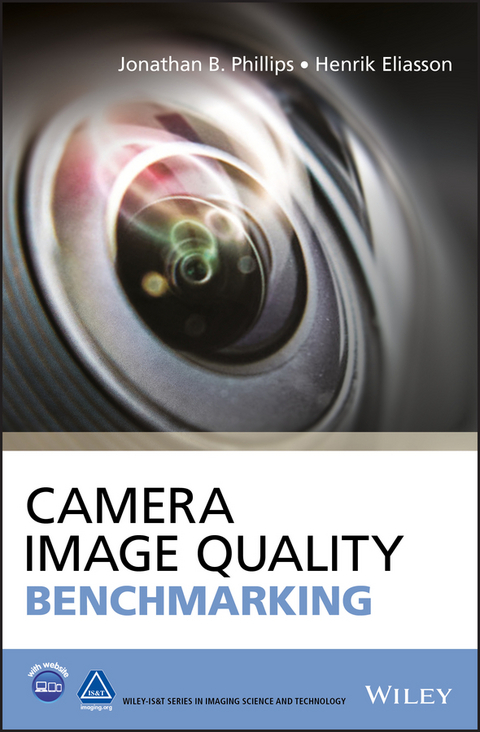
Camera Image Quality Benchmarking (eBook)
John Wiley & Sons (Verlag)
978-1-119-05451-1 (ISBN)
The essential guide to the entire process behind performing a complete characterization and benchmarking of cameras through image quality analysis
Camera Image Quality Benchmarking contains the basic information and approaches for the use of subjectively correlated image quality metrics and outlines a framework for camera benchmarking. The authors show how to quantitatively compare image quality of cameras used for consumer photography. This book helps to fill a void in the literature by detailing the types of objective and subjective metrics that are fundamental to benchmarking still and video imaging devices. Specifically, the book provides an explanation of individual image quality attributes and how they manifest themselves to camera components and explores the key photographic still and video image quality metrics. The text also includes illustrative examples of benchmarking methods so that the practitioner can design a methodology appropriate to the photographic usage in consideration.
The authors outline the various techniques used to correlate the measurement results from the objective methods with subjective results. The text also contains a detailed description on how to set up an image quality characterization lab, with examples where the methodological benchmarking approach described has been implemented successfully. This vital resource:
- Explains in detail the entire process behind performing a complete characterization and benchmarking of cameras through image quality analysis
- Provides best practice measurement protocols and methodologies, so readers can develop and define their own camera benchmarking system to industry standards
- Includes many photographic images and diagrammatical illustrations to clearly convey image quality concepts
- Champions benchmarking approaches that value the importance of perceptually correlated image quality metrics
Written for image scientists, engineers, or managers involved in image quality and evaluating camera performance, Camera Image Quality Benchmarking combines knowledge from many different engineering fields, correlating objective (perception-independent) image quality with subjective (perception-dependent) image quality metrics.
JONATHAN B. PHILLIPS, is a Staff Image Scientist at Google, USA. He is a United States delegate to the technical committee ISO/TC 42 Photography and a major contributor to the IEEE Camera Phone Image Quality (CPIQ) initiative.
HENRIK ELIASSON, PHD, is an image sensor and image analysis specialist at Eclipse Optics, Sweden. He is a senior member of SPIE.
The essential guide to the entire process behind performing a complete characterization and benchmarking of cameras through image quality analysis Camera Image Quality Benchmarking contains the basic information and approaches for the use of subjectively correlated image quality metrics and outlines a framework for camera benchmarking. The authors show how to quantitatively compare image quality of cameras used for consumer photography. This book helps to fill a void in the literature by detailing the types of objective and subjective metrics that are fundamental to benchmarking still and video imaging devices. Specifically, the book provides an explanation of individual image quality attributes and how they manifest themselves to camera components and explores the key photographic still and video image quality metrics. The text also includes illustrative examples of benchmarking methods so that the practitioner can design a methodology appropriate to the photographic usage in consideration. The authors outline the various techniques used to correlate the measurement results from the objective methods with subjective results. The text also contains a detailed description on how to set up an image quality characterization lab, with examples where the methodological benchmarking approach described has been implemented successfully. This vital resource: Explains in detail the entire process behind performing a complete characterization and benchmarking of cameras through image quality analysis Provides best practice measurement protocols and methodologies, so readers can develop and define their own camera benchmarking system to industry standards Includes many photographic images and diagrammatical illustrations to clearly convey image quality concepts Champions benchmarking approaches that value the importance of perceptually correlated image quality metrics Written for image scientists, engineers, or managers involved in image quality and evaluating camera performance, Camera Image Quality Benchmarking combines knowledge from many different engineering fields, correlating objective (perception-independent) image quality with subjective (perception-dependent) image quality metrics.
JONATHAN B. PHILLIPS, is a Staff Image Scientist at Google, USA. He is a United States delegate to the technical committee ISO/TC 42 Photography and a major contributor to the IEEE Camera Phone Image Quality (CPIQ) initiative. HENRIK ELIASSON, PHD, is an image sensor and image analysis specialist at Eclipse Optics, Sweden. He is a senior member of SPIE.
Preface
The seed for the content of this book started in 2011 when Nicolas Touchard of DxO Labs in France, being a participant in the Camera Phone Image Quality (CPIQ) initiative just like us, contacted us about a short course they wanted to teach on objective and subjective camera image quality benchmarking at the then SPIE/IS&T Electronic Imaging conference (now IS&T International Symposium on Electronic Imaging). Nicolas proposed to have us join some of his colleagues, Harvey (Hervé) Hornung, Frédéric Cao and Frédéric Guichard, to plan this new course. In 2012, we launched our short course on camera image quality benchmarking with a set of nearly 400 slides, with the DxO team being the major contributor. Over a period of several years, the course was supplemented and revised, with particular attention to adding video image quality to our initial focus of still imaging. Five individuals were involved with the class instruction over time: apart from Hervé and the two of us (Henrik and Jonathan), also Nicolas Touchard and Hugh Denman. When John Wiley & Sons Ltd asked Jonathan in 2014 about converting our course slides to a book, he contacted each of the course contributors with the same inquiry. Finally, the two of us decided we were up to the challenge. As we began the writing, we realized we needed to convince Hugh, who was at YouTube at the time, to join our efforts as a contributing author on the topic of video image quality.
We have been involved in image quality measurements for many years, in the mobile industry as well as more generally. Our backgrounds are slightly different: while Jonathan has mainly been focusing his efforts on the subjective and pragmatic side of image quality assessment, Henrik has been looking more at objective image quality metrics and the theory of such. Thus, the book has been naturally divided between us, with Jonathan responsible for Chapters 1, 5, 8, and 9, and Henrik for Chapters 2, 3, 4, 6, and 7. We need to mention here also the contribution from Hugh Denman, who has been responsible for the video-related content in Chapters 1 and 3 through 8.
We have met regularly, nearly every weekend via webcam, for the past several years as we have been collaborating on the book. To increase our productivity, we have even had “Writers Workshops” in our respective countries, with Henrik having spent time in San Jose with Jonathan, and Jonathan traveling to spend time in both Sweden with Henrik and Ireland with Hugh. Those workshops as well as weekly meetings have enabled us to assemble this book in a cohesive fashion, including both still and video image quality benchmarking material. Our photography in the following chapters includes images of scenes from our respective countries among others, which we have captured throughout the writing process and are excited to share with the readers of the book.
It has been very interesting to follow the evolution of the camera from a specialized piece of equipment that one carried mostly during vacations and other important events to a ubiquitous component in a mobile communications device one always has in one's pocket or carryall. 15 years ago, it would have been hard to believe that the image quality provided by an average mobile phone camera today would actually be better in most cases compared with the compact cameras then available. Still, there are areas in which the mobile phone camera is lacking, like low-light photography and zooming capabilities. At the same time, the basic principle of photography and video capture has not changed significantly: you point the camera toward the subject you wish to capture and press the shutter button. The camera then records the image or video and one can view it, for example, directly on screen or as a printout at a later time. What has changed tremendously is in the way we use the photos and videos taken, as well as the subjects captured. From being “frozen memories” helping us to recall important moments in our lives and brought out to be viewed at specific occasions, photos are now to a large extent consumed immediately and used to augment social interactions. This has led to an enormous increase in the quantity of pictures taken.
Even with this exponentially increasing volume of new photos taken every day, which inevitably leads to a shorter attention span with regard to viewing the images, the quality of the images is still important. This is not least evident from the advertising made by the large mobile phone companies, where camera image quality has a prominent place. Therefore, the quantification of image quality has not become less important, but rather more so.
One often hears the claim that image quality cannot be measured due to reasons such as its subjective nature, or the complexities involved. What we have realized over the years is that image quality measurements are indeed hard to perform, but not prohibitively so. This book will demonstrate this point through theoretical reasoning but also through examples. Furthermore, even with the development of new technologies, many of the traditional concepts and techniques remain valid today. They do need continuous development, but the effort spent on learning the important theories and methods is not wasted, and will instead help substantially in understanding many of the new technologies and how to develop metrics to cope with their particular quirks and intricacies. It is therefore our hope that this book will give the reader and benchmarking practitioner a good start in tackling the challenges that lie ahead in image quality camera benchmarking and characterization.
In order to provide even more useful and accurate content, we sought out notable authorities and peers in the field to both review and provide dialog on chapters related to their respective expertise. Of note, we appreciate and thank the following: Kjell Brunnström, Mark D. Fairchild, Harvey (Hervé) Hornung, Paul Hubel, Elaine W. Jin, Kenneth A. Parulski, Andreas von Sneidern, Nicolas Touchard, and Mats Wernersson.
We want to give a very special thanks to our contributing author, Hugh Denman, for providing invaluable knowledge and insights to the video-related sections spread throughout the book.
We have been given very valuable help by the Wiley staff, Ashmita Thomas Rajaprathapan and Teresa Netzler. We would also like to thank our commissioning editor, Alexandra Jackson, who helped us through the initial stages of the book proposal process and launch of writing.
We also want to thank DxO Labs for providing images as well as video examples for the electronic version of the book. Nicolas Touchard of DxO has been invaluable in supporting us, and also for providing so much extremely valuable feedback at the beginning of this project. We are grateful to the team at Imatest for allowing us to use images of their test charts and equipment, and to Dietmar Wüller at Image Engineering for many fruitful discussions and helpful comments as well as graciously letting us use images of their equipment.
Jonathan B. Phillips
Henrik Eliasson
Of course there are many others to thank along the way. For me, I first want to thank the outstanding colleagues from Kodak who have been my inspiration in so many ways. Starting out my professional career in Kodak's Image Science Career Development Program was a superb introduction to the world of imaging science. When contemplating this book project, I sought out the advice from instructors in that program who have been excellent advisors over the years: Brian W. Keelan and Edward J. Giorgianni. I thank my former Kodak managers, Kenneth A. Parulski and Brian E. Mittelstaedt, who provided the opportunities for me to branch into mobile imaging and the image quality standards efforts in ISO Technical Committee 42/Working Group 18 on photography and the IEEE CPIQ (Camera Phone Image Quality) initiative. I also thank NVIDIA and Google for continuing the sponsorship of my participation in ISO and CPIQ with support from Margaret Belska, Boyd A. Fowler, and Vint Cerf. In many ways, much of the content of this book is built on the dedicated expert efforts of the members and delegates of these image quality standards bodies. Additionally, fundamental to the writing of this book are the faculty and staff of the Munsell Color Science Lab and Center for Imaging Science at Rochester Institute of Technology, who were my instructors and guides as I spent over eight years there for my graduate work. Finally, I thank the many observers who have participated in countless subjective studies, without which we would not have the understanding of camera image quality benchmarking presented in this book.
Jonathan B. Phillips
San Jose, California
Writing this book would never have been possible if I hadn't started to become involved in imaging standards activities some ten years ago through the CPIQ initiative. For me, this has been a great learning experience, and I have enjoyed tremendously being a part of this community where I have met so many outstanding and great personalities over the years. I am thankful to my former employer and my managers there, Martin Ek, Pontus Nelderup, Fredrik Lönn, Per Hiselius, and Thomas Nilsson, for giving me the opportunity to participate in these activities. I would also like to thank my father, Lars Eliasson, for reviewing parts of the book and giving valuable feedback. Last, but in no way least, my wife, Monica, has played a big role in making this possible, not only by putting up with all the evenings I have spent by the computer, but also for giving...
| Erscheint lt. Verlag | 17.11.2017 |
|---|---|
| Reihe/Serie | The Wiley-IS&T Series in Imaging Science and Technology |
| Wiley-IS&T Series in Imaging Science and Technology | Wiley-IS&T Series in Imaging Science and Technology |
| Sprache | englisch |
| Themenwelt | Kunst / Musik / Theater ► Fotokunst |
| Sachbuch/Ratgeber ► Freizeit / Hobby ► Fotografieren / Filmen | |
| Technik ► Elektrotechnik / Energietechnik | |
| Schlagworte | best practices for camera benchmarking • best practices for camera benchmarking methodologies • best practices for camera measurement protocols • Bildgebendes Verfahren • Bildgebende Systeme u. Verfahren • camera benchmarking system to industry standards • camera color quality • camera image processor • camera image quality attributes subcomponents of a camera • Camera Image Quality Benchmarking • camera lens • camera noise quality • camera sensor • camera sharpness quality • correlate the camera measurement results from the objective methods • Electrical & Electronics Engineering • Elektrotechnik u. Elektronik • Henrik Eliasson • Imaging Systems & Technology • implementing camera quality measurement methods • Jonathan B. Phillips • methodological camera benchmarking approach • quantitatively compare image quality of cameras used for consumers • set up an image quality characterization lab • Still camera image quality • subjective camera image quality assessment • video camera image quality • video image quality metrics |
| ISBN-10 | 1-119-05451-6 / 1119054516 |
| ISBN-13 | 978-1-119-05451-1 / 9781119054511 |
| Informationen gemäß Produktsicherheitsverordnung (GPSR) | |
| Haben Sie eine Frage zum Produkt? |
 EPUB (Adobe DRM)
Kopierschutz: Adobe-DRM
Adobe-DRM ist ein Kopierschutz, der das eBook vor Mißbrauch schützen soll. Dabei wird das eBook bereits beim Download auf Ihre persönliche Adobe-ID autorisiert. Lesen können Sie das eBook dann nur auf den Geräten, welche ebenfalls auf Ihre Adobe-ID registriert sind.
Details zum Adobe-DRM
Dateiformat: EPUB (Electronic Publication)
EPUB ist ein offener Standard für eBooks und eignet sich besonders zur Darstellung von Belletristik und Sachbüchern. Der Fließtext wird dynamisch an die Display- und Schriftgröße angepasst. Auch für mobile Lesegeräte ist EPUB daher gut geeignet.
Systemvoraussetzungen:
PC/Mac: Mit einem PC oder Mac können Sie dieses eBook lesen. Sie benötigen eine
eReader: Dieses eBook kann mit (fast) allen eBook-Readern gelesen werden. Mit dem amazon-Kindle ist es aber nicht kompatibel.
Smartphone/Tablet: Egal ob Apple oder Android, dieses eBook können Sie lesen. Sie benötigen eine
Geräteliste und zusätzliche Hinweise
Buying eBooks from abroad
For tax law reasons we can sell eBooks just within Germany and Switzerland. Regrettably we cannot fulfill eBook-orders from other countries.
aus dem Bereich