Spectroscopy (eBook)
John Wiley & Sons (Verlag)
978-1-119-43663-8 (ISBN)
Provides students and practitioners with a comprehensive understanding of the theory of spectroscopy and the design and use of spectrophotometers
In this book, you will learn the fundamental principles underpinning molecular spectroscopy and the connections between those principles and the design of spectrophotometers.
Spectroscopy, along with chromatography, mass spectrometry, and electrochemistry, is an important and widely-used analytical technique. Applications of spectroscopy include air quality monitoring, compound identification, and the analysis of paintings and culturally important artifacts. This book introduces students to the fundamentals of molecular spectroscopy - including UV-visible, infrared, fluorescence, and Raman spectroscopy - in an approachable and comprehensive way. It goes beyond the basics of the subject and provides a detailed look at the interplay between theory and practice, making it ideal for courses in quantitative analysis, instrumental analysis, and biochemistry, as well as courses focused solely on spectroscopy. It is also a valuable resource for practitioners working in laboratories who regularly perform spectroscopic analyses.
Spectroscopy: Principles and Instrumentation:
- Provides extensive coverage of principles, instrumentation, and applications of molecular spectroscopy
- Facilitates a modular approach to teaching and learning about chemical instrumentation
- Helps students visualize the effects that electromagnetic radiation in different regions of the spectrum has on matter
- Connects the fundamental theory of the effects of electromagnetic radiation on matter to the design and use of spectrophotometers
- Features numerous figures and diagrams to facilitate learning
- Includes several worked examples and companion exercises throughout each chapter so that readers can check their understanding
- Offers numerous problems at the end of each chapter to allow readers to apply what they have learned
- Includes case studies that illustrate how spectroscopy is used in practice, including analyzing works of art, studying the kinetics of enzymatic reactions, detecting explosives, and determining the DNA sequence of the human genome
- Complements Chromatography: Principles and Instrumentation
The book is divided into five chapters that cover the Fundamentals of Spectroscopy, UV-visible Spectroscopy, Fluorescence/Luminescence Spectroscopy, Infrared Spectroscopy, and Raman Spectroscopy. Each chapter details the theory upon which the specific techniques are based, provides ways for readers to visualize the molecular-level effects of electromagnetic radiation on matter, describes the design and components of spectrophotometers, discusses applications of each type of spectroscopy, and includes case studies that illustrate specific applications of spectroscopy.
Each chapter is divided into multiple sections using headings and subheadings, making it easy for readers to work through the book and to find specific information relevant to their interests. Numerous figures, exercises, worked examples, and end-of-chapter problems reinforce important concepts and facilitate learning.
Spectroscopy: Principles and Instrumentation is an excellent text that prepares undergraduate students and practitioners to operate in modern laboratories.
MARK F. VITHA is a Windsor Professor of Chemistry at Drake University. He received his Ph.D. from the University of Minnesota. He is the editor of the Chemical Analysis Series (Wiley), the author of Chromatography: Principles and Instrumentation (Wiley 2017), and a co-editor of the books High Throughput Analysis for Food Safety (Wiley, 2014) and Interfaces and Interphases in Analytical Chemistry (ACS, 2011). He has received three teaching awards, including the Levitt Teacher of the Year Award, and has been named a Ronald D. Troyer Research Fellow at Drake University.
Provides students and practitioners with a comprehensive understanding of the theory of spectroscopy and the design and use of spectrophotometers In this book, you will learn the fundamental principles underpinning molecular spectroscopy and the connections between those principles and the design of spectrophotometers. Spectroscopy, along with chromatography, mass spectrometry, and electrochemistry, is an important and widely-used analytical technique. Applications of spectroscopy include air quality monitoring, compound identification, and the analysis of paintings and culturally important artifacts. This book introduces students to the fundamentals of molecular spectroscopy including UV-visible, infrared, fluorescence, and Raman spectroscopy in an approachable and comprehensive way. It goes beyond the basics of the subject and provides a detailed look at the interplay between theory and practice, making it ideal for courses in quantitative analysis, instrumental analysis, and biochemistry, as well as courses focused solely on spectroscopy. It is also a valuable resource for practitioners working in laboratories who regularly perform spectroscopic analyses. Spectroscopy: Principles and Instrumentation: Provides extensive coverage of principles, instrumentation, and applications of molecular spectroscopy Facilitates a modular approach to teaching and learning about chemical instrumentation Helps students visualize the effects that electromagnetic radiation in different regions of the spectrum has on matter Connects the fundamental theory of the effects of electromagnetic radiation on matter to the design and use of spectrophotometers Features numerous figures and diagrams to facilitate learning Includes several worked examples and companion exercises throughout each chapter so that readers can check their understanding Offers numerous problems at the end of each chapter to allow readers to apply what they have learned Includes case studies that illustrate how spectroscopy is used in practice, including analyzing works of art, studying the kinetics of enzymatic reactions, detecting explosives, and determining the DNA sequence of the human genome Complements Chromatography: Principles and Instrumentation The book is divided into five chapters that cover the Fundamentals of Spectroscopy, UV-visible Spectroscopy, Fluorescence/Luminescence Spectroscopy, Infrared Spectroscopy, and Raman Spectroscopy. Each chapter details the theory upon which the specific techniques are based, provides ways for readers to visualize the molecular-level effects of electromagnetic radiation on matter, describes the design and components of spectrophotometers, discusses applications of each type of spectroscopy, and includes case studies that illustrate specific applications of spectroscopy. Each chapter is divided into multiple sections using headings and subheadings, making it easy for readers to work through the book and to find specific information relevant to their interests. Numerous figures, exercises, worked examples, and end-of-chapter problems reinforce important concepts and facilitate learning. Spectroscopy: Principles and Instrumentation is an excellent text that prepares undergraduate students and practitioners to operate in modern laboratories.
MARK F. VITHA is a Windsor Professor of Chemistry at Drake University. He received his Ph.D. from the University of Minnesota. He is the editor of the Chemical Analysis Series (Wiley), the author of Chromatography: Principles and Instrumentation (Wiley 2017), and a co-editor of the books High Throughput Analysis for Food Safety (Wiley, 2014) and Interfaces and Interphases in Analytical Chemistry (ACS, 2011). He has received three teaching awards, including the Levitt Teacher of the Year Award, and has been named a Ronald D. Troyer Research Fellow at Drake University.
Title Page 5
Copyright Page 6
Contents 7
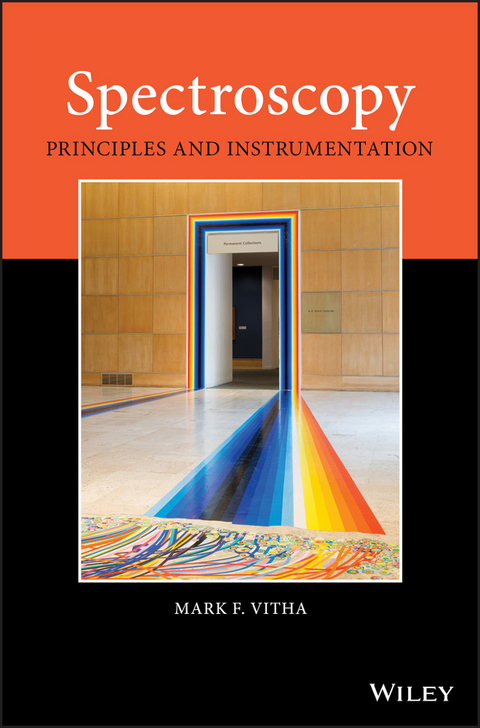
About the Cover 11
Preface 13
Chapter 1 Fundamentals of Spectroscopy 17
1.1. Properties of Electromagnetic Radiation 17
1.1.1. Speed, c 18
1.1.2. Amplitude, A 18
1.1.3. Frequency, ? 19
1.1.4. Wavelength, ? 19
1.1.5. Energy, E 19
1.1.6. Wavenumber, ? 22
1.2. The Electromagnetic Spectrum 23
1.2.1. Radio-Frequency Radiation (10?27 to 10?21 J/photon) 24
1.2.2. Microwave Radiation (10?23 to 10?22 J/photon) 26
1.2.3. Infrared Radiation (10?22 to 10?19 J/photon) 27
1.2.4. Ultraviolet and Visible Radiation (10?19 to 10?18 J/photon) 28
1.2.5. X-Ray Radiation (10?15 to 10?13 J/photon) 29
1.2.6. Alpha, Beta, and Gamma Radiation (10?13 to 10?11 J/photon and Higher) 29
1.3. The Perrin–Jablonski Diagram 31
1.3.1. Timescales of Events 34
1.3.2. Summary of Radiative and Nonradiative Processes 35
1.4. Temperature Effects on Ground and Excited State Populations 35
1.5. More Wave Characteristics 37
1.5.1. Adding Waves Together 37
1.5.2. Diffraction 37
1.5.3. Reflection 41
1.5.4. Refraction 44
1.5.5. Scattering 45
1.5.6. Polarized Radiation 47
1.6. Spectroscopy Applications 50
1.7. Summary 50
Problems 50
References 52
Further Reading 54
Chapter 2 UV?Visible Spectrophotometry 55
2.1. Theory 56
2.1.1. The Absorption Process 56
2.1.2. The Beer–Lambert Law 59
2.1.3. Solvent Effects on Molar Absorptivity and Spectra 65
2.2. UV?Visible Instrumentation 68
2.2.1. Sources of Visible and Ultraviolet Light 70
2.2.2. Wavelength Selection: Filters 74
2.2.3. Wavelength Selection: Monochromators 77
2.2.4. Monochromator Designs: Putting It All Together 91
2.2.5. Detectors 95
2.3. Spectrophotometer Designs 101
2.3.1. Single-Beam Spectrophotometers 101
2.3.2. Scanning Double-Beam Instruments 105
2.3.3. Photodiode Array Instruments 109
2.4. The Practice of Spectrophotometry 114
2.4.1. Types of Samples That Can Be Analyzed 115
2.4.2. Preparation of Calibration Curves 116
2.4.3. Deviations from Beer’s Law 119
2.4.4. Precision: Relative Concentration Error 127
2.4.5. The Desirable Absorbance Range 130
2.5. Applications and Techniques 132
2.5.1. Simultaneous Determinations of Multicomponent Systems 132
2.5.2. Difference Spectroscopy 133
2.5.3. Derivative Spectroscopy 134
2.5.4. Titration Curves 135
2.5.5. Turbidimetry and Nephelometry 137
2.6. A Specific Application of UV?Visible Spectroscopy: Enzyme Kinetics 138
2.6.1. Myeloperoxidase, Immune Responses, Heart Attacks, and Enzyme Kinetics 138
2.6.2. Possible Mechanism for Myeloperoxidase Oxidation of LDL via Tyrosyl Radical Intermediates 139
2.7. Summary 143
Problems 143
References 148
Further Reading 150
Chapter 3 Molecular Luminescence: Fluorescence, Phosphorescence, and Chemiluminescence 151
3.1. Theory 151
3.1.1. Absorbance Compared to Fluorescence 152
3.1.2. Factors That Affect Fluorescence Intensity 157
3.1.3. Quenching 162
3.1.4. Quantum Yield and Fluorescence Intensity 163
3.1.5. Linearity and Nonlinearity of Fluorescence: Quenching and Self-Absorption 165
3.2. Instrumentation 169
3.2.1. Instrument Design 170
3.2.2. Sources 170
3.2.3. Filters and Monochromators 173
3.2.4. Component Arrangement 174
3.2.5. Fluorometers 174
3.2.6. Spectrofluorometers 175
3.2.7. Cells and Slit Widths 180
3.2.8. Detectors 182
3.3. Practice of Luminescence Spectroscopy 183
3.3.1. Considerations and Options 183
3.3.2. Fluorescence Polarization 184
3.3.3. Time?Resolved Fluorescence Spectroscopy 188
3.4. Fluorescence Microscopy 189
3.4.1. Fluorescence Microscopy Resolution 191
3.4.2. Confocal Fluorescence Microscopy 191
3.5. Phosphorescence and Chemiluminescence 193
3.5.1. Phosphorescence 193
3.5.2. Chemiluminescence 193
3.6. Applications of Fluorescence: Biological Systems and DNA Sequencing 195
3.7. Summary 202
Problems 202
References 206
Further Reading 208
Chapter 4 Infrared Spectroscopy 209
4.1. Theory 209
4.1.1. Bond Vibrations 212
4.1.2. Other Types of Vibrations 214
4.1.3. Modeling Vibrations: Harmonic and Nonharmonic Oscillators 216
4.1.4. The 3N?6 Rule 223
4.2. FTIR Instruments 225
4.2.1. The Michelson Interferometer and Fourier Transform 226
4.2.2. Components of FTIR Instruments: Sources 240
4.2.3. Components of FTIR Instruments: DTGS and MCT Detectors 242
4.2.4. Sample Handling 243
4.2.5. Reflectance Techniques 247
4.3. Applications of IR Spectroscopy, Including Near?IR and Far?IR 250
4.3.1. Structure Determination with Mid-IR Spectroscopy 251
4.3.2. Gas Analysis 251
4.3.3. Near-Infrared Spectroscopy (NIR) 252
4.3.4 Far-Infrared Spectroscopy (FIR) 261
4.4. Summary 264
Problems 264
References 267
Further Reading 270
Chapter 5 Raman Spectroscopy 271
5.1. Energy-Level Description 271
5.2. Visualization of Raman Data 274
5.3. Molecular Polarizability 275
5.4. Brief Review of Molecular Vibrations 277
5.5. Classical Theory of Raman Scattering 278
5.6. Polarization of Raman Scattering 281
5.6.1. Depolarization Ratio 282
5.7. Instrumentation and Analysis Methods 282
5.7.1. Filter Instruments 283
5.7.2. Dispersive Spectrometers 286
5.7.3. Fourier Transform Raman Spectrometers 287
5.7.4. Confocal Raman Instruments 287
5.7.5. Light Sources 289
5.8. Quantitative Analysis Methods 290
5.8.1. Calibration Curves 290
5.8.2. Curve Fitting 290
5.8.3. Ordinary Least Squares 291
5.8.4. Classical Least Squares 293
5.8.5. Implicit Analytical Methods 293
5.9. Applications 293
5.9.1. Art and Archeology 293
5.9.2. Pharmaceuticals 294
5.9.3. Forensics 295
5.9.4. Medicine and Biology 295
5.10. Signal Enhancement Techniques 298
5.10.1. Resonance Raman Spectroscopy 299
5.10.2. Surface-Enhanced Raman Spectroscopy 299
5.10.3. Nonlinear Raman Spectroscopy 300
5.11. Summary 302
Problems 302
References 304
Further Reading 305
Solutions 307
Index 331
EULA 339
| Erscheint lt. Verlag | 17.9.2018 |
|---|---|
| Sprache | englisch |
| Themenwelt | Naturwissenschaften ► Biologie |
| Naturwissenschaften ► Chemie ► Analytische Chemie | |
| Naturwissenschaften ► Chemie ► Technische Chemie | |
| Technik | |
| Schlagworte | Absorbance • Analytical Chemistry • analytical techniques for chemistry • Beer-Lambert Law • Beer’s Law • Biowissenschaften • Cell & Molecular Biology • Chemical Analysis • chemical analysis methods • chemical engineering • Chemie • Chemische Verfahrenstechnik • Chemistry • Chromatography • Electromagnetic radiation • Electromagnetic Spectrum • electromagnetic wave • fluorescence • Fluorescence spectroscopy • fluorometer • Frequency • fundamentals of spectroscopy • Grating • Harmonic oscillator • Hooke’s law • infrared spectroscopy • instrumental analysis • Interferometer • Jablonski diagram • Life Sciences • <p>spectroscopy • Mass Spectrometry • Michelson Interferometer • modern chemical analysis techniques • molar absorptivity • molecular spectroscopy • monochromator • Perrin-Jablonski diagram • photomultiplier tube • Planck’s equation • Quantitative Analysis • Raman • Raman spectroscopy • Rayleigh scattering • reflection • refraction • Spectra • spectrofluorometer • Spectrometer • spectrophotometer • Spectrophotometry • spectroscopy • Spectroscopy: Principles and Instrumentation</p> • spectrum • Spektroskopie • transmittance • Ultraviolet • Ultraviolet-Visible Spectroscopy • UV-Visible spectrophotometry • UV-visible spectroscopy • vibrational spectroscopy • Wavelength • wavenumber • Zell- u. Molekularbiologie |
| ISBN-10 | 1-119-43663-X / 111943663X |
| ISBN-13 | 978-1-119-43663-8 / 9781119436638 |
| Informationen gemäß Produktsicherheitsverordnung (GPSR) | |
| Haben Sie eine Frage zum Produkt? |
 PDF (Adobe DRM)
Kopierschutz: Adobe-DRM
Adobe-DRM ist ein Kopierschutz, der das eBook vor Mißbrauch schützen soll. Dabei wird das eBook bereits beim Download auf Ihre persönliche Adobe-ID autorisiert. Lesen können Sie das eBook dann nur auf den Geräten, welche ebenfalls auf Ihre Adobe-ID registriert sind.
Details zum Adobe-DRM
Dateiformat: PDF (Portable Document Format)
Mit einem festen Seitenlayout eignet sich die PDF besonders für Fachbücher mit Spalten, Tabellen und Abbildungen. Eine PDF kann auf fast allen Geräten angezeigt werden, ist aber für kleine Displays (Smartphone, eReader) nur eingeschränkt geeignet.
Systemvoraussetzungen:
PC/Mac: Mit einem PC oder Mac können Sie dieses eBook lesen. Sie benötigen eine
eReader: Dieses eBook kann mit (fast) allen eBook-Readern gelesen werden. Mit dem amazon-Kindle ist es aber nicht kompatibel.
Smartphone/Tablet: Egal ob Apple oder Android, dieses eBook können Sie lesen. Sie benötigen eine
Geräteliste und zusätzliche Hinweise
Buying eBooks from abroad
For tax law reasons we can sell eBooks just within Germany and Switzerland. Regrettably we cannot fulfill eBook-orders from other countries.
aus dem Bereich