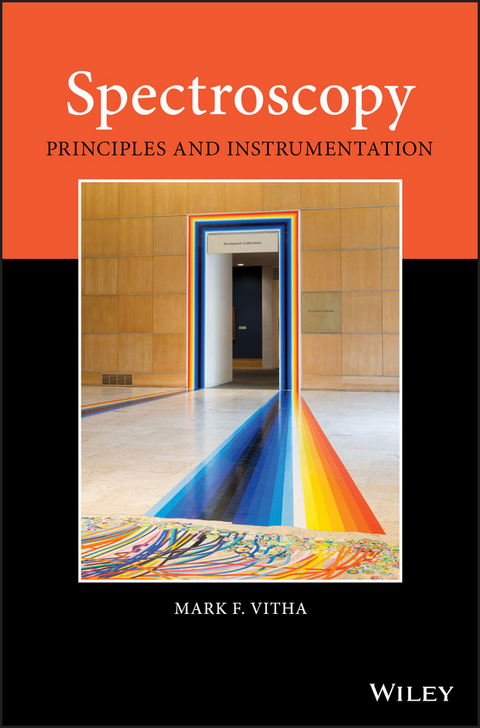
Spectroscopy (eBook)
336 Seiten
Wiley (Verlag)
978-1-119-43660-7 (ISBN)
Provides students and practitioners with a comprehensive understanding of the theory of spectroscopy and the design and use of spectrophotometers
In this book, you will learn the fundamental principles underpinning molecular spectroscopy and the connections between those principles and the design of spectrophotometers.
Spectroscopy, along with chromatography, mass spectrometry, and electrochemistry, is an important and widely-used analytical technique. Applications of spectroscopy include air quality monitoring, compound identification, and the analysis of paintings and culturally important artifacts. This book introduces students to the fundamentals of molecular spectroscopy - including UV-visible, infrared, fluorescence, and Raman spectroscopy - in an approachable and comprehensive way. It goes beyond the basics of the subject and provides a detailed look at the interplay between theory and practice, making it ideal for courses in quantitative analysis, instrumental analysis, and biochemistry, as well as courses focused solely on spectroscopy. It is also a valuable resource for practitioners working in laboratories who regularly perform spectroscopic analyses.
Spectroscopy: Principles and Instrumentation:
- Provides extensive coverage of principles, instrumentation, and applications of molecular spectroscopy
- Facilitates a modular approach to teaching and learning about chemical instrumentation
- Helps students visualize the effects that electromagnetic radiation in different regions of the spectrum has on matter
- Connects the fundamental theory of the effects of electromagnetic radiation on matter to the design and use of spectrophotometers
- Features numerous figures and diagrams to facilitate learning
- Includes several worked examples and companion exercises throughout each chapter so that readers can check their understanding
- Offers numerous problems at the end of each chapter to allow readers to apply what they have learned
- Includes case studies that illustrate how spectroscopy is used in practice, including analyzing works of art, studying the kinetics of enzymatic reactions, detecting explosives, and determining the DNA sequence of the human genome
- Complements Chromatography: Principles and Instrumentation
The book is divided into five chapters that cover the Fundamentals of Spectroscopy, UV-visible Spectroscopy, Fluorescence/Luminescence Spectroscopy, Infrared Spectroscopy, and Raman Spectroscopy. Each chapter details the theory upon which the specific techniques are based, provides ways for readers to visualize the molecular-level effects of electromagnetic radiation on matter, describes the design and components of spectrophotometers, discusses applications of each type of spectroscopy, and includes case studies that illustrate specific applications of spectroscopy.
Each chapter is divided into multiple sections using headings and subheadings, making it easy for readers to work through the book and to find specific information relevant to their interests. Numerous figures, exercises, worked examples, and end-of-chapter problems reinforce important concepts and facilitate learning.
Spectroscopy: Principles and Instrumentation is an excellent text that prepares undergraduate students and practitioners to operate in modern laboratories.
MARK F. VITHA is a Windsor Professor of Chemistry at Drake University. He received his Ph.D. from the University of Minnesota. He is the editor of the Chemical Analysis Series (Wiley), the author of Chromatography: Principles and Instrumentation (Wiley 2017), and a co-editor of the books High Throughput Analysis for Food Safety (Wiley, 2014) and Interfaces and Interphases in Analytical Chemistry (ACS, 2011). He has received three teaching awards, including the Levitt Teacher of the Year Award, and has been named a Ronald D. Troyer Research Fellow at Drake University.
MARK F. VITHA is a Windsor Professor of Chemistry at Drake University. He received his Ph.D. from the University of Minnesota. He is the editor of the Chemical Analysis Series (Wiley), the author of Chromatography: Principles and Instrumentation (Wiley 2017), and a co-editor of the books High Throughput Analysis for Food Safety (Wiley, 2014) and Interfaces and Interphases in Analytical Chemistry (ACS, 2011). He has received three teaching awards, including the Levitt Teacher of the Year Award, and has been named a Ronald D. Troyer Research Fellow at Drake University.
1
FUNDAMENTALS OF SPECTROSCOPY
All instruments are designed to take advantage of some molecular property or behavior. For example, chromatography is based on the different strength of intermolecular interactions that molecules have with mobile and stationary phases. Electrochemistry is based on the ability of molecules to gain or lose electrons. In this book, we focus on the fact that atoms and molecules absorb and emit electromagnetic radiation (EMR). By measuring the amount and the characteristics of the EMR absorbed and emitted, we can measure the concentration of particular molecules present in a sample or gain structural information about them. You may already be familiar with several of the instrumental methods used to measure the absorption and emission of electromagnetic radiation, such as UV‐visible, infrared (IR), and fluorescence spectroscopy.
In order to better understand the fundamental basis of these techniques, in this chapter we examine the properties of electromagnetic radiation and its effects on atoms and molecules. In subsequent chapters, we examine specific spectroscopic techniques. While all the techniques share common features, the specific instruments required and the information we gain from each are quite different and therefore require individual examination.
1.1. PROPERTIES OF ELECTROMAGNETIC RADIATION
Spectroscopic methods ultimately rely on measuring characteristics of electromagnetic radiation, which travels through space as a wave, as shown in Figure 1.1. As the name implies, it has two components, an electric field and a magnetic field, which are at right angles to one another. Figure 1.1 shows only a single wave with its electric field oriented along the x‐axis, but in reality, most sources of electromagnetic radiation, like light bulbs and car headlights, emit radiation in which the electric field of the waves are randomly distributed around the x‐axis. For now, however, we take a simplified view by focusing on only a single electromagnetic wave.
FIGURE 1.1 Diagram of a single electromagnetic wave propagating through space. The diagram indicates that an electromagnetic wave has both an electric field (E) and magnetic field (B) associated with it and that they are oriented at right angles to each other. It also indicates that the wavelength (λ) is the distance the wave travels during one oscillation of the electric and magnetic fields.
Source: Reproduced with permission of Eric Clarke.
All electromagnetic waves have the properties of:
- Speed
- Amplitude
- Frequency
- Wavelength
- Energy
Each of these characteristics is described below.
1.1.1. Speed, c
Electromagnetic radiation in a vacuum travels at 2.998 × 10⁸ m/s, commonly referred to as the speed of light, c. This speed only pertains to light traveling in a vacuum, though, because EMR slows down when it travels through matter such as air and water. We discuss the speed of light when it travels through matter in a later section.
1.1.2. Amplitude, A
The amplitude, A, of a wave is the maximum length of the electric field vector, as shown in Figure 1.2. We seldom consider the amplitude of the wave because detectors are not fast enough to measure the magnitude of the electric field vector. Instead, we measure the radiant power, P, of a beam, which is proportional to the square of the amplitude. Radiant power is the amount of energy transmitted per unit time and is given by Eq. (1.1), where E is the energy of a photon and φ is the flux (i.e., the number of photons per unit time) [1]:
FIGURE 1.2 A side view of the electric field component of an electromagnetic wave as it propagates from left to right across the page. The amplitude is the displacement along the y‐axis and the wavelength is the peak‐to‐peak distance between a single oscillation of the wave.
Although radiant power is commonly referred to as intensity, I, intensity is strictly defined as the radiant power from a point source per unit solid angle, usually measured in watts per steradian [1, 2].
1.1.3. Frequency, υ
Frequency, υ, is the number of oscillations a wave makes per unit time and is typically measured in hertz, Hz, with units of reciprocal seconds, 1/s or s−1. To visualize the physical meaning of frequency, imagine sitting on a rock out in the ocean with a stopwatch and counting waves that pass the rock. If you count, say, 120 waves in a minute, the frequency is
In other words, two waves pass the rock every second. If more waves pass every second, the frequency is higher, and fewer waves per second are associated with a lower frequency.
The speed and wavelength of electromagnetic radiation change as it passes through different media, but the frequency remains the same. As described below, the frequency of EMR is closely related to the energy of the EMR. Therefore, the frequency is the characteristic that truly differentiates one wave from another.
1.1.4. Wavelength, λ
The wavelength, λ, is the peak‐to‐peak distance of the wave, as shown in Figure 1.2. Because it is a distance, wavelengths are typically measured in meters. For example, EMR in the visible portion of the electromagnetic spectrum has wavelengths between 380 and 760 nanometers (nm).
1.1.5. Energy, E
As we will see in all of the subsequent chapters, energy is really the fundamental wave characteristic that matters most in terms of the impact electromagnetic radiation has on matter. We often talk about EMR in terms of wavelengths, frequencies, and wavenumbers, but these ultimately relate to energy. In order to understand the energy of radiation, we must consider the wave/particle duality of light. When EMR propagates through space, it is convenient to focus on its wave properties (frequency, wavelength, amplitude). However, when it interacts with matter, it is useful to think of EMR as a discrete particle that contains a fixed amount of energy that can be transferred to an atom or molecule. That discrete particle is called a photon.
The energy that a photon contains is directly related to its frequency and wavelength, as shown in the two relationships in Eqs. (1.2) and (1.3):
where h is Planck’s constant (6.626 × 10⁻³⁴ Js) and c is the speed of light (2.998 × 10⁸ m/s). These equations are fundamental to the study of spectroscopy. They also clearly show that photons with higher frequencies (i.e., faster oscillations) and shorter wavelengths are higher in energy than those with slower oscillations and longer wavelengths (see Figure 1.3). To help make a mental association between these relationships, consider the two waves shown in Figure 1.3. Imagine trying to draw a wave of each frequency across the entire length of a chalkboard or white board, and that you only have 15 seconds to go from one end of the board to the other. You have the same amount of time in each case because light propagates through space at the same velocity regardless of wavelength. Clearly, the higher frequency wave – the one with little space between peaks and therefore shorter wavelength – will require you to expend a greater amount of energy to fill the board, whereas you can take a leisurely stroll (i.e., exert low energy) along the board when drawing the low‐frequency, long‐wavelength wave.
FIGURE 1.3 Depiction of the reciprocal relationships between wavelength and frequency. Longer wavelengths are associated with lower frequencies and lower energies, while shorter wavelengths are associated with higher frequencies and higher energies.
From the fact that Eqs. (1.2) and (1.3) are equal to each other, we can see that
This relationship has implications for the speed and wavelength of EMR as it travels through different media such as air, water, benzene, etc. As radiation passes through matter, its electric field interacts with the electrons in the matter, slowing its propagation, meaning that the speed of light is different in different media. In a vacuum, the speed is 2.998 × 10⁸ m/s, but in everything else, including air, it is slower. However, as the EMR propagates through matter, its frequency is unaffected, so υ remains the same. In order to maintain the equality in Eq. (1.4), when the speed, c, decreases, then the wavelength must also decrease in order to maintain a constant frequency, υ.
The change in the speed of EMR in matter is measured by the refractive index of a substance, η, where
in which cv is the speed in a vacuum and ci is the speed in the substance of interest. Because EMR is slower in matter than it is in a vacuum, such that ci < cv, refractive indices are greater than 1.00. The velocity of radiation in air is within 1% of the velocity in a vacuum such that using...
| Erscheint lt. Verlag | 17.9.2018 |
|---|---|
| Sprache | englisch |
| Themenwelt | Naturwissenschaften ► Biologie |
| Naturwissenschaften ► Chemie ► Analytische Chemie | |
| Naturwissenschaften ► Chemie ► Technische Chemie | |
| Technik | |
| Schlagworte | Absorbance • Analytical Chemistry • analytical techniques for chemistry • Beer-Lambert Law • Beer’s Law • Biowissenschaften • Cell & Molecular Biology • Chemical Analysis • chemical analysis methods • chemical engineering • Chemie • Chemische Verfahrenstechnik • Chemistry • Chromatography • Electromagnetic radiation • Electromagnetic Spectrum • electromagnetic wave • fluorescence • Fluorescence spectroscopy • fluorometer • Frequency • fundamentals of spectroscopy • Grating • Harmonic oscillator • Hooke’s law • infrared spectroscopy • instrumental analysis • Interferometer • Jablonski diagram • Life Sciences • <p>spectroscopy • Mass Spectrometry • Michelson Interferometer • modern chemical analysis techniques • molar absorptivity • molecular spectroscopy • monochromator • Perrin-Jablonski diagram • photomultiplier tube • Planck’s equation • Quantitative Analysis • Raman • Raman spectroscopy • Rayleigh scattering • reflection • refraction • Spectra • spectrofluorometer • Spectrometer • spectrophotometer • Spectrophotometry • spectroscopy • Spectroscopy: Principles and Instrumentation</p> • spectrum • Spektroskopie • transmittance • Ultraviolet • Ultraviolet-Visible Spectroscopy • UV-Visible spectrophotometry • UV-visible spectroscopy • vibrational spectroscopy • Wavelength • wavenumber • Zell- u. Molekularbiologie |
| ISBN-10 | 1-119-43660-5 / 1119436605 |
| ISBN-13 | 978-1-119-43660-7 / 9781119436607 |
| Informationen gemäß Produktsicherheitsverordnung (GPSR) | |
| Haben Sie eine Frage zum Produkt? |
 EPUB (Adobe DRM)
Kopierschutz: Adobe-DRM
Adobe-DRM ist ein Kopierschutz, der das eBook vor Mißbrauch schützen soll. Dabei wird das eBook bereits beim Download auf Ihre persönliche Adobe-ID autorisiert. Lesen können Sie das eBook dann nur auf den Geräten, welche ebenfalls auf Ihre Adobe-ID registriert sind.
Details zum Adobe-DRM
Dateiformat: EPUB (Electronic Publication)
EPUB ist ein offener Standard für eBooks und eignet sich besonders zur Darstellung von Belletristik und Sachbüchern. Der Fließtext wird dynamisch an die Display- und Schriftgröße angepasst. Auch für mobile Lesegeräte ist EPUB daher gut geeignet.
Systemvoraussetzungen:
PC/Mac: Mit einem PC oder Mac können Sie dieses eBook lesen. Sie benötigen eine
eReader: Dieses eBook kann mit (fast) allen eBook-Readern gelesen werden. Mit dem amazon-Kindle ist es aber nicht kompatibel.
Smartphone/Tablet: Egal ob Apple oder Android, dieses eBook können Sie lesen. Sie benötigen eine
Geräteliste und zusätzliche Hinweise
Buying eBooks from abroad
For tax law reasons we can sell eBooks just within Germany and Switzerland. Regrettably we cannot fulfill eBook-orders from other countries.
aus dem Bereich