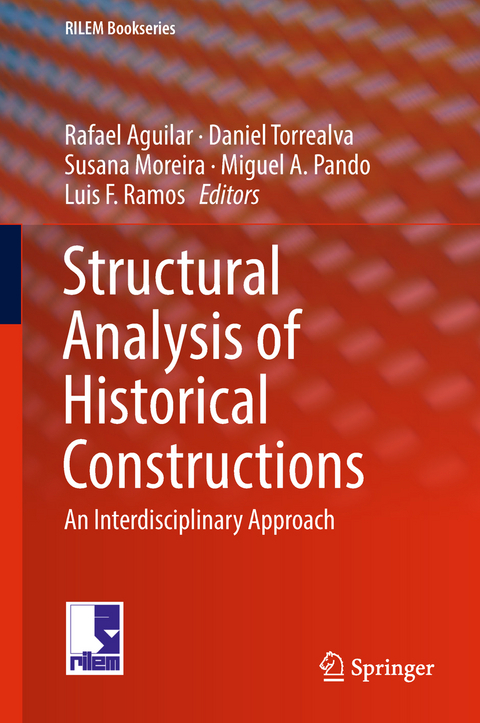
Structural Analysis of Historical Constructions (eBook)
XXXVI, 2518 Seiten
Springer International Publishing (Verlag)
978-3-319-99441-3 (ISBN)
This volume contains the proceedings of the 11th International Conference on Structural Analysis of Historical Constructions (SAHC) that was held in Cusco, Peru in 2018. It disseminates recent advances in the areas related to the structural analysis of historical and archaeological constructions. The challenges faced in this field show that accuracy and robustness of results rely heavily on an interdisciplinary approach, where different areas of expertise from managers, practitioners, and scientists work together.
Bearing this in mind, SAHC 2018 stimulated discussion on the new knowledge developed in the different disciplines involved in analysis, conservation, retrofit, and management of existing constructions. This book is organized according to the following topics: assessment and intervention of archaeological heritage, history of construction and building technology, advances in inspection and NDT, innovations in field and laboratory testing applied to historical construction and heritage, new technologies and techniques, risk and vulnerability assessments of heritage for multiple types of hazards, repair, strengthening, and retrofit of historical structures, numerical modeling and structural analysis, structural health monitoring, durability and sustainability, management and conservation strategies for heritage structures, and interdisciplinary projects and case studies.
This volume holds particular interest for all the community interested in the challenging task of preserving existing constructions, enable great opportunities, and also uncover new challenges in the field of structural analysis of historical and archeological constructions.
Preface 6
Organization 8
Organizing Committee 8
Advisory Committee 8
Scientific Committee (Reviewers Panel) 8
Conference Secretariat 10
Program Committee 10
Contents 12
Keynotes 38
An Interdisciplinary Approach to the Seismic Assessment of Built Cultural Heritage: Case Studies in Lisbon and Outskirts 39
Abstract 39
1 Introduction 39
2 Masonry Residential Buildings in Lisbon 41
2.1 Buildings Description 41
2.2 Seismic Fragility Functions 44
3 Sintra National Palace 47
3.1 The Palace and Its History 47
3.2 Structural Survey and Experimental Campaign 48
3.3 Structural Analyses 50
3.3.1 Ambient Vibration Tests 50
3.3.2 Nonlinear Static Analyses 52
4 Final Comments 52
Acknowledgments 53
References 53
Vulnerability Evaluation of Historical Masonry Structures: Italian Churches and Towers 55
Abstract 55
1 Introduction 55
2 Churches: Application in Real Case Studies 58
3 Towers: An Effective Approach to Estimate Vulnerability 63
4 Conclusions 66
References 66
Understanding Fire Safety of Historical Buildings 69
Abstract 69
1 Introduction 69
2 The Fire Safety Strategy 70
2.1 Current Approach 70
2.2 Historic Buildings 72
3 Example – Smoke Management for the Bastions Building University of Geneva 76
3.1 Brief Description of the Building 76
3.2 Proposed Compliant Solution 76
3.3 Alternative Approach to Smoke Management 78
4 Conclusions 79
Acknowledgments 79
References 79
It Always Takes a Village: Preserving Earthen Sites 80
Abstract 80
1 Earthen Architecture – A Universal Way of Construction 80
1.1 A Community Based Adaptable Construction and Maintenance System 82
2 The Work of the Getty Conservation Institute 85
3 Research on Earthen Conservation at the GCI 86
3.1 Professional Exchange 87
4 Projects for the Conservation of Earthen Sites 88
4.1 The Seismic Retrofitting Project 88
4.2 The Conservation and Rehabilitation of Kasbah Taourirt 89
5 Training on the Conservation of Earthen Sites 90
5.1 The International Course on the Conservation of Earthen Architecture 90
5.2 The SRP Workshops 91
6 Conclusions 91
Acknowledgments 91
References 92
History of Construction and Building Technology 93
House on a Bunker by Architect R. Romke de Vries: From Military Accommodation to Residential Refinement 94
Abstract 94
1 Introduction 94
1.1 Architect R. Romke de Vries (1908–1997) 94
1.2 Traces of the Atlantic Wall in the Hague 95
1.3 House on the Bunker 95
2 Methodology 96
3 Post-war Heritage Issues 97
3.1 Historical Layout, Construction Principles, Materials and Colours 97
3.2 Vision and Ambition 98
4 Restoration and Conservation Options 100
4.1 Phased Approach 100
4.2 Technical Upgrade 101
4.2.1 Piping System 101
4.2.2 Concrete Restoration 101
4.2.3 Steel and Metalwork 101
4.2.4 Thermal Insulation 102
4.3 Interior Restoration 102
5 Conclusions 103
References 103
The Structural Function of Cross Beams During Vault Construction in the Maya Palace of the Governor at Uxmal, Yucatan 104
Abstract 104
1 Introduction and Objectives 104
2 Methodology 107
2.1 Finite Element Model 107
2.2 Rigid Block Equilibrium 108
3 Results 109
3.1 Construction Stage 1 – Half Vaults Completed but not Joined 109
3.2 Construction Stage 2 – Half Vaults Joined at the Top 110
3.3 Construction Stage 3 – External Façade Inserted 110
4 Discussion and Conclusions 111
References 112
Deformation Process of Romanesque Masonry Constructions: The Case of Vall d’Aran Churches 113
Abstract 113
1 Introduction 113
2 Aim of the Research 114
3 Selected Churches 114
4 Method 117
5 Results 117
6 Conclusion 119
References 119
A Double Dome Through the Ages 122
Abstract 122
1 Introduction 122
2 History of Planning for Shah Mosque 123
3 Geometry and Morphology of the Dome 124
3.1 Hybrid Double Dome (HDD) 124
3.2 Building Components 124
3.2.1 Domes 124
3.2.2 Walls 125
3.2.3 Wooden Elements 125
4 Building Techniques and Construction Process 126
5 Conservation History of Shah Mosque’s Dome 127
6 Discussion and Analysis of Crack Pattern 129
7 Conclusion 129
References 130
Construction and Building Technology in Sanctuary of Roman Settlement Aquae Iasae with the Review of Conservation Works on the Site 131
Abstract 131
1 Introduction 131
2 Sanctuary Area 132
2.1 Building Phases in Aquae Iasae Sanctuary 132
2.2 Sacred Spring 134
3 Management of Heritage Structures and Conservation Strategies 137
4 Conclusions 138
References 138
Early Iron Roofs in Belgian Churches (1845–60) 140
Abstract 140
1 Introduction 140
2 Intellectual Interest in the Use of Iron in Young Belgium 141
3 Early Iron Roofs in Churches: Three Belgian Case Studies 142
3.1 Transition to Iron Trusses: St. Joseph’s Church in Brussels (1842–49) 142
3.2 Improvement of Iron Trusses: St. George’s Church in Antwerp (1847–53) 144
3.3 Optimisation of Iron Trusses: St. Anne’s Church in Ghent (1853–62) 146
4 International Network 148
5 Conclusions 148
Acknowledgments 149
References 149
Lightweight Structures and Conservation - Engineering and Architectural Perspective 151
Abstract 151
1 Introduction 151
2 Conservation in the Modern Era and Lightweight Structures 152
2.1 Light Structures in the Modern Era - General 152
3 Lightweight Structures - General Background 152
3.1 Lightweight Structures - General 152
3.2 Lightweight Structures and Nature 153
4 Historical Background – Lightweight Structures 154
4.1 General 154
4.2 Lightweight Structures Along History 154
4.3 Lightweight Structures Nowadays 155
5 Lightweight Structures and Conservation – Engineering and Architecture 156
5.1 Lightweight Structures and Conservation – General 156
5.2 Lightweight Structures as Heritage Buildings – Old Lightweight Structures 156
5.3 New Lightweight Structures Integrated in Historical and Old-Heavyweight Buildings 156
5.4 Lightweight Strengthening Intervention in Old-Heavyweight Historic Buildings 157
5.5 Light Structures Theory as a Vital Knowledge for Understanding Heavyweight Traditional Structures 157
5.6 Light Structures Philosophy as a Didactic Tool in Conservation Studies and Other Aspects 158
6 Conclusions 158
References 158
Mid-20th Century Colombian Vaults. A Contemporary Tradition 160
Abstract 160
1 Introduction 160
2 Masonry Vaults 162
2.1 Tile Vaults in Colombia 162
2.2 The Casa Pizano 162
3 Concrete Shells 163
3.1 Precast Concrete. The Patents of Vacuum Concrete 163
3.2 The Quiroga Neighbourhood 164
4 Variants on Reinforced Ceramics 165
4.1 From Reinforced Ceramics to the Hat Brick 165
4.2 The Casa Gaitán Cortés 165
5 Antecedents and Consequents of the Colombian Vaults of the 50’s 166
6 Conclusions 168
References 169
Building Techniques and Structural Damage of Historical Constructions Detected Through the Point Cloud Survey 170
Abstract 170
1 Introduction 170
2 Methodology: Advantages and Criticalities of the Laser Scanning Technique 171
3 The Laser Scanning Technique Applied to a Medieval Building 172
3.1 Unsolved Historiographical and Conservation Issues 173
3.2 Focusing onto the Building Techniques 173
3.3 Detection of the Structural Problems 176
4 Concluding Remarks 177
Acknowledgments 177
References 177
Analysis and Proposal to Retrofit the Traditional Construction Systems (Earth) of the Former San José School, Cuenca, Ecuador 179
Abstract 179
1 Introduction 180
1.1 Main Traditional Materials and Construction Systems Used in the City of Cuenca 180
1.1.1 Bahareque 180
1.1.2 Adobe 180
1.1.3 Clay Brick 181
1.1.4 Wooden Elements for Roofs, Portals and Mezzanines 181
1.2 The Influence of the Builder Johannes Stiehle on the Construction Systems Used in the Architecture of Cuenca and the Former San José School 181
2 Methodology 183
2.1 Application of the Assessment and Diagnosis Card 183
2.2 Prospecting 183
3 Results 183
3.1 Emerging Actions Plan and Proposal to Reinforce the Traditional Construction Systems 183
3.1.1 Adobe Walls 183
3.1.2 Clay Brick Walls 184
3.1.3 Bahareque Walls 185
4 Conclusion 186
Acknowledgments 186
References 187
Iron Ties Originally Anchored into Masonry as a Historical Construction Technology – Case Study: A Church in Cyprus 188
Abstract 188
1 Introduction 188
2 Historical Review 189
3 Use of Tie-Rods in Cyprus 190
3.1 Social and Historical Background 190
3.2 Buildings with Embedded Iron Tie-Rods 190
4 Function of the Tie-Rods 192
4.1 Seismic Response of ‘Panagia Faneromeni’, A Case Study from Cyprus 192
4.2 Anchorage 193
5 Conclusions 195
Acknowledgments 195
References 195
Learning from Regional Architecture: Sustainable Solutions in Traditional Portuguese Houses 197
Abstract 197
1 Introduction 197
2 The Influence of the Atlantic Climate as Unifying Factor of the Popular Architecture of the North Region of Portugal 198
2.1 Fundamental Type of Villages and Vernacular Houses 200
3 Conclusion 202
References 203
Innovative Stone Vaults in Dalmatia in Antiquity and Renaissance 204
Abstract 204
1 Introduction: Tradition of Constructing in Stone in Dalmatia 204
2 The Vaults of the Emperor Diocletian’s Palace 205
2.1 Vault of the Temple of Jupiter: Assembling of Stone Elements 205
2.2 Influence of the Vault of the Temple of Jupiter: Two Coffered Barrel Vaults in Trogir 207
3 The Vaults of the Šibenik Cathedral 207
3.1 Specific Structural Behavior 208
3.2 Details of the Vaults of the Šibenik Cathedral 209
4 New Hypothesis on the Origin of the Details of the Vault of the Šibenik Cathedral 209
Acknowledgments 211
References 212
The Structure of Gothic Architecture in Evolving Contexts – The Case of “Bombay Gothic”, India 213
Abstract 213
1 Introduction 213
2 Methodology 214
3 The Context 214
3.1 Climate and Socio Economic 214
3.2 Socio-Cultural/Stylistic/Colonial 214
4 Incorporation of Indian Elements and Corresponding Stylistic Modifications 215
4.1 Structural Modifications 215
4.1.1 The Dome 216
4.1.2 The Arch 218
4.1.3 Wood and Lime Concrete Roofing 219
4.2 Materiality of Structure and Adaptation to Context 219
4.2.1 Massiveness as a Function of Psychological Perception of Size 219
5 Conclusions 221
References 221
Comparison of Erudite and Popular Timber Historical Buildings in the Former Erechim Colony, Rio Grande do Sul, Brazil 222
Abstract 222
1 The Erechim Colony 222
2 Methodological Procedures 223
3 Two Construction Models – On Erudite and Popular Architecture – A Literature Review 224
4 The Popular House of the Immigrants and the Official Architecture 224
4.1 Houses Built by the Immigrants 224
4.2 The Official Architecture 225
5 Analysis of Stylistic Influences 228
6 Conclusions 229
Acknowledgments 229
References 229
The Structural Technology and Architecture of Timber Bridges in Song Dynasty Paintings 231
Abstract 231
1 Introduction 231
2 The Structural Classification of Timber Bridges in Song Dynasty 232
2.1 Timber Beam Bridge 232
2.1.1 Simply Supported Beam Bridge 232
2.1.2 Continuous Simply Supported Beam Bridge 232
2.1.3 Stretch Beam Bridge 235
2.2 Timber Arch Bridge 236
3 The Architectural Artistry of Timber Covered Bridges 238
3.1 Artistry of Surrounding Landscapes 238
3.2 Ornamentation 238
4 Conclusion 238
References 239
The Imperial Record Office in Delhi: An Architectural Paradox 240
Abstract 240
1 Introduction 240
2 Beyond Representation of ‘Style’ 241
2.1 Existing Views on Architecture of Imperial Delhi 241
2.2 The Building as a Source of ‘Knowledge’ 242
3 ‘Systems’ of Design and Construction 242
3.1 Visual-Spatial Organization Synthesizing Classical and Modern 242
3.1.1 Architectural Composition – The ‘Taxis’, Tripartition and Ratios 243
3.1.2 Elements and Arrangement – The ‘Genera’ and ‘Symmetry’ 244
3.1.3 Spatial Organization According to Function 245
3.2 Structure and Construction Systems 246
3.2.1 Structural Composite of Load Bearing and Framed Systems 246
3.2.2 Materials and Elements of Construction 247
3.3 Understanding the Paradox 248
4 Concluding Remarks 249
Acknowledgments 249
References 250
Concrete Thin Shells in the Sixties. Construction and Long-Term Behaviour 251
Abstract 251
1 Introduction 251
2 Capturing the Incalculable 252
2.1 Heinz Isler and “Form Finding” 252
2.2 Deitingen Süd Service Station (1968–1969) 253
2.3 Long Term Behavior and Preservation 254
3 Building with Air 256
3.1 Dante Bini and Bini Shells System 256
3.2 Thin Concrete Shells in Sardinia (Italy) 257
3.3 Long Term Behavior and Preservation 257
4 Concluding Remarks 258
References 258
Chechen Medieval Towers-Obelisks to the Issue of Architectural Form Interpretation 260
Abstract 260
1 Background 260
2 Towers with a Pyramidal-Stepped Roof 261
2.1 Description 261
2.2 Structure and Functional Features 262
3 The Main Hypothesis 265
4 Conclusion 267
Acknowledgement 267
References 268
The First Industrial Period: A Forgotten Period in Brazilian Construction History 269
Abstract 269
1 Introduction – Context 269
2 The Influence of Brazilian Modern Architecture Movement 270
3 The 19th Century: The Influence of the First Industrial Revolution on Brazilian Construction 271
3.1 Belo Horizonte: The Capital of a New Way to Construct 271
4 The 20th Century: The Influence of the 2nd Industrial Revolution on Brazilian Construction 274
5 Conclusion 275
Acknowledgments 275
References 275
Conservation and Restoration on Cement-Based Renders of Built Heritage in Shanghai, PR China 276
Abstract 276
1 Introduction 276
2 Cement-Based Renders in Shanghai 277
2.1 History of Cement in Shanghai in Brief 277
2.2 Main Types of Cement-Based Renders in Shanghai 277
3 Conservation and Restoration 279
3.1 Guidelines and Codes of Practices 279
3.2 Defects 279
3.3 Specific Techniques for Restoration 280
4 Case Study 280
5 Conclusions 284
Acknowledgments 284
References 284
Traditional Wall Construction Technology of the Ottoman Empire in Relation to the Seismic Resistance of Bath Structures in the Marmara Region 285
Abstract 285
1 Seismicity of the Marmara Region 285
2 Types of Masonry Wall Construction in the Ottoman Empire 286
2.1 Cut Stone Wall Construction 287
2.2 Rough Cut Stone Construction 288
2.3 Rubble Stone Wall Construction 289
2.4 Brick and Stone ‘alma??k’ Wall Construction 289
3 Case Studies: Bath Structures Masonry Wall Construction in the Marmara Region in Relation to Seismic Resistance 290
4 Conclusion 292
References 293
Back to the Past – The History and Current Modernisations of Kleinische Decke Ceiling 294
Abstract 294
1 Introduction 295
2 Case Study 296
3 Static and Strength Calculations 298
4 Conclusions 300
References 301
Historic Evolution of the Temple of San Pedro and San Pablo de Zepita, and the Origins of the Structural Faults 302
Abstract 302
1 Location of the Temple 302
2 Structural Layout of the Temple 303
3 Characteristics of the Construction 304
4 Historical Evolution of the Construction 305
4.1 Historical Chronology 305
4.2 Evidence of the Evolution of Construction [3] 305
4.3 Hypothesis of the Evolution of Construction (Figs. 10, 11, 12 and 13) 306
5 Structural Faults 308
6 Summary of Structural Faults from the Evolution of the Construction 309
7 Conclusions 309
References 309
Stone Masonry with Brick Stripe Courses: Study on a Historical Building Technique Diffused in Brianza District 310
Abstract 310
1 Introduction 310
2 Local Resources and Buildings Techniques 311
2.1 Main Building Techniques Diffused in Subalpine Region 311
2.2 Overview of the Building Techniques Observed in Vimercate Context 311
2.3 Structural Performances Issues 312
3 The Investigated Sample 314
4 Discussion 315
5 Conclusions 317
References 318
Megalithic Shelters in Vale de Poldros, Portugal. The Cardenhas 320
Abstract 320
1 Introduction 320
2 Origins, Typologies and Evolution of the Cardenhas 321
3 From Cardenhas to the Traditional Rural House 326
4 Conclusion 327
References 328
New Technologies and Techniques 329
Connected Semantic Concepts as a Base for Optimal Recording and Computer-Based Modelling of Cultural Heritage Objects 330
Abstract 330
1 Introduction 331
2 State of the Art 331
3 Approach 332
3.1 Methodology 332
3.2 Data Set and Its Semantic Description 333
3.3 Application Case 334
4 Outcomes 335
5 Conclusions 336
Acknowledgments 336
References 336
Semi-automated Creation of Accurate FE Meshes of Heritage Masonry Walls from Point Cloud Data 338
Abstract 338
1 Introduction 339
2 Background 339
3 Related Work 340
4 Methodology 341
4.1 FE Mesh 341
4.2 Crack Extraction 341
5 Experiments 343
6 Conclusions 344
Acknowledgments 345
References 346
Numerical Modeling of Single Tube-Jack and Flat-Jack Tests in an Unreinforced Masonry Wall with a Regular Typology 348
Abstract 348
1 Introduction 348
2 Model Preparation, Analysis, and Processing 349
2.1 Geometry, Material and Element Properties, and Meshing 349
2.2 Boundary Conditions and Loading 350
2.3 Phased Analysis 350
2.4 Post-processing 351
3 Single Tube-Jack Test 351
4 Single Flat-Jack Test 353
5 Conclusions 354
Acknowledgments 355
References 355
The Strength of Wooden (Timber)-Glass Beams Combined with the Polyurethane Adhesive - DIC and Finite Element Analysis 356
Abstract 356
1 Introduction 356
2 Small-Scale Shear Tests on the Timber-Glass Joint Made of Polyurethane PS 358
3 Research on Composite Timber-Glass Beams with Polyurethane PS Adhesive 359
3.1 Set up of Tests 359
3.2 Results and Discussion 360
4 Composite Timber-Glass Beams Numerical Tests 362
5 Conclusions 364
References 364
On the Use of Sound Spectral Analysis for the In Situ Assessment of Structural Timber 365
Abstract 365
1 Introduction 365
2 Materials and Methods 367
2.1 Timber Specimens 367
2.2 Microphones 367
2.3 Sound Analysis Software 367
2.4 Testing Procedure 367
2.4.1 Static Testing, MC and Density Determination 367
2.4.2 Dynamic Testing 368
3 Results and Discussion 369
3.1 Static Testing 369
3.2 Investigated Parameters 369
3.2.1 Impact Tool 369
3.2.2 Microphone Distance 370
3.2.3 Boundary Conditions 371
3.3 Comparison Between Sound Specimens and Decayed Specimens 371
4 Conclusions 372
Acknowledgements 373
References 373
Application of Digital Close-Range Photogrammetry to the Modeling of Heritage Structural Elements for Its Analysis by FEM 375
Abstract 375
1 Introduction 376
2 Methodology 377
2.1 Survey 377
2.2 Photogrammetric Models 377
2.2.1 Creation of Models 378
2.2.2 Scale and Correction 379
2.3 Finite Element Method Models 379
3 Results 380
4 Conclusions 382
Acknowledgments 383
References 383
Parameterization of Structural Faults in Large Historical Constructions for Further Structural Modelling Thanks to Laser Scanning Technology and Computer Vision Algorithms 384
Abstract 384
1 Introduction 385
2 The Medieval Wall of Guimarães 385
3 Laser Scanning Survey 386
3.1 Laser Scanning Technology 386
3.2 Survey of the Medieval Wall of Guimarães 386
3.3 Point Cloud Pre-processing 387
4 Results: Dimensional Analysis 388
4.1 Automated Processing 388
4.1.1 Ground Extraction 388
4.1.2 Point Cloud Rotation 389
4.1.3 Damage Detection: Transverse Opening of the Walls 389
4.2 Structural Diagnosis 390
5 Conclusions 391
Acknowledgments 392
References 392
Stop-Splayed Scarf-Joint Reinforcement with Timber Pegs Behaviour 393
Abstract 393
1 Introduction 393
2 Experimental Program on Fir Stop-Splayed Scarf Joint Samples 394
2.1 Tensile Test Settings 394
2.2 Experimental Results 395
2.3 Results: Analysis and Discussion 397
3 Comparison with Analytical Results 400
4 Conclusions 400
Acknowledgments 401
References 401
Characterization of the Mechanical Properties of Ancient Masonry from a Non-destructive Method In Situ 403
Abstract 403
1 Introduction 404
2 Theory 405
3 Methodology 405
4 The Case Study: Temple of San Antonio de Padua 406
5 Application of the Obtained Results in a Numerical Model 408
6 Conclusion 409
Acknowledgments 410
References 410
Developing Solutions Based on Shape Memory Alloys for Historical Constructions 412
Abstract 412
1 Introduction 412
2 Device Concept 413
3 Thermal Tests 413
3.1 Material Properties 413
3.2 Testing Program and Sensor Set up 414
3.3 Results 415
4 Shaking Table Tests 415
4.1 Testing Model 416
4.2 Test Apparatus and Sensor Set up 417
4.3 Experimental Program 417
4.4 Results 417
5 Case Study 418
5.1 Aim of Intervention 418
5.2 Dimensioning and Installation 418
6 Conclusions 419
References 420
Historic Digital Survey: Reality Capture and Automatic Data Processing for the Interpretation and Analysis of Historic Architectural Rubble Masonry 421
Abstract 421
1 Introduction 421
2 Stone Segmentation and Labelling 423
3 Parameters Extraction 423
3.1 Stone Face Contour 424
3.2 Stone Face Profile 425
3.3 Stone Face Colour 425
4 Experimental Results 425
5 Conclusions 428
Acknowledgments 429
References 429
Study of Early Age Stiffness Development in Lime–Cement Blended Mortars 430
Abstract 430
1 Introduction 430
2 Research Program 431
2.1 Materials 431
2.2 Mortar Compositions 431
2.3 EMM-ARM 432
2.4 Unconfined Cyclic Compression Test [Static Modulus of Elasticity] 433
3 Results 434
3.1 Stiffness Evolution of Blended Mortars 434
3.2 Examining the Feasibility of EMM-ARM for Blended Mortars 435
4 Conclusions 436
Acknowledgments 436
References 436
Evaluation of a Rope Mesh Reinforcement System for Adobe Dwellings in Seismic Areas 438
Abstract 438
1 Introduction 438
2 Rope Mesh Reinforcement System for One-Storey Earthen Houses 439
3 Calculation of Maximum Forces at the Reinforcement Systems 440
4 Proposed Design Procedure 442
5 Experimental Validation 444
6 Conclusions 445
References 445
Comparison of the Degree of Consolidation of Historic Plaster Layers by Means of Lime Hydrate Nanosuspensions 446
Abstract 446
1 Introduction 447
2 Materials and Methods 447
2.1 Verification of the Deposition Rate of Consolidating Agents Using Scanning Microscopy 447
2.2 Results on the Degree of Plaster Consolidation with Nanosuspensions 449
2.3 “Scotch Tape” Peeling Test 450
2.4 Results on Subsurface Adhesion Measurement Using “Scotch Tape” Peeling Test 452
3 Conclusions 453
Acknowledgments 453
References 453
Study on Carbonation Initiated by Organics in Traditional Lime Mortar 454
Abstract 454
1 Introduction 454
2 Experiment 455
3 Results and Discussion 456
3.1 Phenolphthalein Test 456
3.2 Xrd 457
3.3 TGA and DTA 458
4 Conclusions 460
References 460
Virtual Reality for the Enhancement of Structural Health Monitoring Experiences in Historical Constructions 462
Abstract 462
1 Introduction 463
2 Case Study and Description of the Experimental Program 464
2.1 Fieldwork 464
2.1.1 Photogrammetry 464
2.1.2 Research Project Information 465
2.2 Laboratory Work 465
2.2.1 Development of 3D Models 465
2.2.2 Development of the Virtual Environment 466
2.2.3 Development of the Virtual Reality Program 467
3 Tests and Results 468
4 Conclusions 469
References 469
Classification of Hardened Cement and Lime Mortar Using Short-Wave Infrared Spectrometry Data 470
Abstract 470
1 Introduction 470
2 Background 471
3 Materials and Methods 472
3.1 Sample preparation 472
3.2 Equipment (SWIR Spectrometry) 472
3.3 Data Analysis 474
4 Results 474
5 Discussion 475
6 Conclusions 477
Acknowledgements 478
References 478
Improvements of the Ultrasonic Tomography for Applications to Historical Masonry Constructions 480
Abstract 480
1 Introduction 480
2 Acoustic Tomography: Theoretical Background 482
2.1 Amplitude Tomography 482
2.2 Inversion Algorithms 483
3 Proposed Improvements 483
3.1 Standardized Amplitude Tomography 483
3.1.1 The Experimental Tool 483
3.1.2 The Amplitude Propagation Model 483
3.2 Inversion Algorithm 485
4 Experimental Validation 485
5 Application of the Amplitude Tomography to a Masonry Pillar 487
6 Conclusions 487
References 488
Correlation Between Sonic and Mechanical Test Results on Stone Masonry Walls 489
Abstract 489
1 Introduction 489
2 Methodology 490
2.1 Uniaxial Compression Test 491
2.2 Sonic Test 492
3 Results 493
3.1 Uniaxial Compression Tests 493
3.2 Sonic Tests 494
3.3 Correlation Between Sonic and Mechanical Test Results 495
4 Conclusions 496
Acknowledgments 497
References 497
Geometric and Radiometric Analysis of TLS Point Clouds to Diagnose the Conservation State of Historical Constructions. Case of Study in the Master Gate of San Francisco, Almeida, Portugal 498
Abstract 498
1 Introduction 498
2 Case Study 499
3 Materials and Methods 500
3.1 Equipment 500
3.2 Pre-processing 500
3.3 Radiometric Strategy 501
3.3.1 TLS Radiometric Calibration 501
3.3.2 Incidence Angle Affectation 501
3.3.3 Point Cloud Classification 502
3.4 Geometric Strategy 502
4 Experimental Results 502
4.1 Radiometric Results 502
4.1.1 TLS Intensity in Reflectance Values 502
4.1.2 Classified Point Cloud 503
4.1.3 Classification, Validation and Damages Detection 503
4.2 Geometric Results 504
5 Conclusions 505
Acknowledgments 505
References 505
Diagonal Compression Behaviour of Masonry Walls Reinforced with FRM Coatings 507
Abstract 507
1 Description of the Work 507
1.1 Characterization of the Materials 508
1.2 Execution of the Diagonal Compression Tests 510
2 Interpretation of the Observed Behaviour 512
3 Conclusions 515
Acknowledgments 515
References 515
Preliminary Methodology for the Integration of Lean Construction, BIM and Virtual Reality in the Planning Phase of Structural Intervention in Heritage Structures 517
Abstract 517
1 Introduction 518
2 Lean Construction and New Project Management Technologies 518
2.1 The Role of Lean on Project Management 518
2.2 The New Technologies for Historical Buildings 519
2.3 Choosing by Advantages (CBA) 519
3 Methodology Structural Intervention of a Heritage Building 520
4 Validation Case Study 520
4.1 Description 520
4.2 Results 521
5 Conclusions and Recommendations for Future Research 523
Acknowledgements 524
References 524
Inspection, Non-destructive and Laboratory Testing 526
Enhancement of the Identification of Historical Timber Element’s Local Stiffness Based on Resistance Drilling Measurements 527
Abstract 527
1 Introduction 527
2 Test Program 528
2.1 Materials 528
2.2 Test Setup 528
2.3 Experimental Results 529
3 Identification of Local Young’s Moduli 530
3.1 Identification of the Local Density: Resistance Drilling Measurements 530
3.2 Influence of the Slope of the Grain 532
3.3 Identification of the Local Young’s Moduli Along the Orthotropic Axes 533
4 Conclusions 534
Acknowledgments 535
References 535
Inspection of Seismic Damage and Conservation Conditions in Modern School Buildings in Chile 536
Abstract 536
1 Introduction 536
2 Methodology of Inspection and Research 538
3 Inspection Results 540
3.1 Structural and Constructive Characterization 540
3.2 Structural Damages and Faults 540
3.3 Observation of Physicochemical Damages 542
4 Conclusions 543
Acknowledgments 543
References 544
Laboratory and In Situ Calibrations of New Flat Jack Method for Assessing Masonry Shear Characteristics 545
Abstract 545
1 Introduction 545
2 Testing Technique 546
3 Laboratory and In Situ Calibrations 547
3.1 Calibration Techniques 547
3.2 Results of Laboratory Tests 548
4 Finite Elements Modelling 548
5 Data Processing 550
6 Practical Application and Recommendations 552
7 Conclusions 553
References 553
Investigation of the Shear-Sliding Behavior of Masonry Through Shove Test: Experimental and Numerical Studies 555
Abstract 555
1 Introduction 555
2 Materials and Methods 556
3 Experimental Results 557
4 Numerical Model 559
4.1 Modeling Strategy 559
4.2 Calibration of the Model 560
4.3 Numerical Results 560
5 Conclusions 562
Acknowledgements 563
References 563
A Proposed Test to Evaluate Efflorescence Potential of Ceramic Blocks 564
Abstract 564
1 Introduction 564
2 The Proposed Test Procedure 566
3 Procedure Assessment 566
4 Results 568
4.1 Results from Proposed Test 568
4.2 Results from ASTM C 67 Test 568
5 Observations and Recommendations 569
Acknowledgments 571
References 571
Structural Behaviour of Dry Stack Stone Corbelled Vaults Under Lateral Support Movement 572
Abstract 572
1 Introduction 572
1.1 Occurrence and Examples 572
1.2 Behaviour 573
1.3 Research on Corbelled Domes 574
2 Experimental Study 575
2.1 Test Setup and Instrumentation 575
2.2 Results 576
3 Static Analysis of the Arch 577
4 Key Observations and Concluding Remarks 579
Acknowledgments 579
References 580
Influence of Geometry of Cylindrical Samples in the Mechanical Characterization of Existing Brickwork 581
Abstract 581
1 Introduction 581
2 Experimental Program 582
2.1 Materials 582
2.2 Masonry Specimens 583
2.3 Testing Setup 584
3 Results and Discussion 585
3.1 Failure Modes and Crack Patterns 585
3.2 Estimation of Compressive Strength and Young’s Modulus 586
4 Conclusions 588
Acknowledgements 588
References 589
Estimation of Churches Frequencies Based on Simplified Geometry Parameters 590
Abstract 590
1 Introduction 591
2 Geometrical Survey and Analysis of the Data 592
2.1 Typological Classification of the Churches 592
2.2 Relationship Between Geometrical Parameters 593
3 Numerical Simulation and Parametric Analysis 594
4 Proposed Formulations and Validation with Real Cases Studies 595
5 Conclusions 597
Acknowledgment 598
References 598
Experimental Characterization of Mechanical Behaviour of Existing Tabique Walls Under Compressive and Shear Loading 600
Abstract 600
1 Introduction 600
2 Context 601
3 Testing Specimens and Set-up 602
4 Experimental Results 604
4.1 Compression Tests 604
4.2 Shear-Compression Tests 606
5 Conclusions 607
Acknowledgments 607
References 607
Estimation of Mortar Compressive Strength Based on Specimens Extracted from Masonry Bed Joints 609
Abstract 609
1 Introduction 609
2 Methodology of Research 610
3 Tests Results 611
4 Numerical Analysis 612
4.1 Finite Element Model 612
4.2 Physical Models for Materials 613
4.3 Solution Procedure 615
5 Discussion of Results 615
6 Conclusions 616
References 617
A XVth Century Diamond Ashlar Façade: The Case Study of Palazzo Raimondi in Cremona 619
Abstract 619
1 Marble Diamond Ashlar Facings 619
2 Construction Phases and Building Restorations in Palazzo Raimondi 620
3 Conclusions 626
Acknowledgements 626
References 627
From Brick to Element: Investigating the Mechanical Properties of Calcium Silicate Masonry 628
Abstract 628
1 Introduction 628
2 Materials and Methods 629
3 Compression Behavior of Masonry in Two Orthogonal Directions 631
4 Shear-Sliding Behavior of Unit-Joint Interface 633
5 Characterization of Masonry in Tension 635
6 Conclusions 635
Acknowledgment 635
References 636
Seismic Behavior of Timber-Laced Masonry Structures in the Himalayan Belt 637
Abstract 637
1 Introduction 637
2 Local Seismic Cultures and Their Forgotten Fates 638
2.1 Local Seismic Culture in the Indian Context 639
3 Studies on Timber-Framed and Timber-Laced Constructions 639
4 Taq Construction System 640
5 Multi-story Isolation Systems 642
5.1 Interpreting Taq Construction as a Multiple Isolation System 643
6 Conclusions 644
Acknowledgments 644
References 644
Structural Characterization of Quarry Stone in Experimental Testing Using Digital Image Correlation as a Non-destructive Technique 646
Abstract 646
1 Introduction 646
2 Basic Principles of Digital Image Correlation 647
3 Experimental Setup 648
3.1 Specimens and Materials Description 648
3.2 Compression Tests 648
4 Digital Image Correlation Setup 650
5 Results 651
5.1 Compression Tests Results 651
5.2 Digital Image Correlation Analysis 652
5.2.1 Load-Displacement Behavior of Pink Quarry Stone Samples 652
5.2.2 Graphic Results of DIC Analysis 654
6 Conclusions 655
Acknowledgments 655
References 655
Mechanical Characterization of Masonry Typologies in Israel via Flat Jack Tests 657
Abstract 657
1 Foreword 658
2 History of Stone Masonry Construction in Israel 658
2.1 Typical Features Related to the Structural Type 658
2.2 Types of the Stones Used in Ancient Israeli Buildings 660
3 On-Site Investigations 661
4 Data Interpretation and Mechanical Feature Extraction 662
5 Conclusions 664
References 664
Experimental Characterization of Solid Clay Bricks: Correlations Among Mechanical Properties 666
Abstract 666
1 Introduction 666
2 Materials and Methods 667
3 Results and Discussion 670
3.1 Compressive Strength and Apparent Density 670
3.2 Bending and Compressive Strength 672
3.3 Bending and Splitting Strength 672
3.4 Pull-off and Compressive Strength 672
3.5 Pull-off and Bending Strength 673
3.6 Pull-off and Splitting Strength 673
4 Conclusions 673
Acknowledgments 674
References 674
Internal Geometrical Characterization of Stone Masonry Walls Using Electrical Resistivity Tomography 676
Abstract 676
1 Introduction 676
2 Materials and Methods 678
3 Results and Discussion 679
4 Conclusions 681
Acknowledgments 682
References 682
Study on Stone Cultural Heritage’s Structural Stability Management – with a Focus on Cheomseongdae 684
Abstract 684
1 Prologue 684
2 Historical Background 685
3 Scientific Analysis 687
3.1 Research on the Characteristics of Stone and Deterioration 687
3.2 Structural Stability Analysis 688
3.2.1 Ground Survey 688
3.2.2 Analysis of Ground Response to a Scenario Earthquake 689
3.2.3 Evaluation of Seismic Behavior Characteristics by Dynamic Centrifuge Test 689
4 9.12 (Gyeongju) Earthquake and Its Characteristics of Damage 690
5 Conclusions 692
References 692
The Application of Sonic Testing on Double-Leaf Historical Portuguese Masonry to Obtain Morphology and Mechanical Properties 693
Abstract 693
1 Problem Statement 694
2 Analysis Procedures 694
2.1 The Masonry Quality Index MQI 694
2.2 Sonic Testing 695
3 Testing Scheme on Portuguese Historical Wallets 696
3.1 The Wallets 696
3.2 Application of MQI Method 697
3.3 Application of Sonic Testing 697
3.3.1 Methodology 697
3.3.2 Sonic Apparatus 698
3.3.3 Results and Discussions 699
4 Conclusions 700
References 700
Inspection and Analysis of Ancient Monastery of “São Romão de Neiva”, Portugal 701
Abstract 701
1 Introduction 701
2 The Ancient Monastery of São Romão de Neiva 702
2.1 Architectonical and Structural Description 702
3 Inspection and Diagnosis 703
3.1 Masonry Quality Index (MQI) 704
4 In Situ ND and MDT Test 705
4.1 Schmidt Hammer Tests 705
4.2 Ground Penetrating Radar (GPR) 706
4.3 Sonic Tests 706
5 Laboratory Test 707
6 Conclusions 708
Acknowledgements 709
References 709
Connections of Roof-Diaphragm to Perimeter Walls in Historic Masonry Buildings 710
Abstract 710
1 Introduction 710
2 Stud Connection Securing Roof Diaphragms to the Masonry Walls 712
2.1 Technical Solution Improving the Stud Connection Capacity 712
2.2 Experimental Assessment of the Effectiveness of the Technical Improvement of the Connection 713
2.3 Assessment of the Connection Capacity 715
3 In-Situ Assessment of the Connection Capacity 715
4 Concluding Remarks 717
Acknowledgements 717
References 717
Experimental Characterization of the Deterioration of Masonry Materials Due to Wet and Dry and Salt Crystallization Cycles 719
Abstract 719
1 Introduction 719
2 Materials and Testing Methods 721
2.1 Introduction 721
2.2 Wet and Dry and Salt Crystallization Tests 722
3 Results and Discussion 723
3.1 Visual Assessment: Efflorescence Formation 723
3.1.1 Efflorescence in Prisms of Lime Mortar of 40 × 40 × 160 mm 723
3.1.2 Efflorescence in Masonry Specimens 724
3.2 Effects of Cycles: Mechanical Properties 725
3.2.1 Mortar 725
3.2.2 Stone 725
3.2.3 Masonry 726
4 Conclusions 726
Acknowledgments 727
References 727
Façades of an Iconic Building in Sao Paulo, Brazil: Assessment for Restoration Design 728
Abstract 728
1 Introduction 728
2 Objective 729
3 Case Study 730
4 Materials and Methods 730
5 Survey, Characterization, Test and Projects 731
5.1 Survey of the Pathological Manifestations – Damage Map 731
5.2 Reconstitution of Coating Mortar Mix Proportion 732
5.3 Determination of the Bond Tensile Strength 733
5.4 Surface Hardness Test or Sclerometry 734
5.5 Steel 735
6 Conclusion 735
References 736
Mechanical Characterization of Adobe Constructions Using Flat Jack Tests: Case Study of the Virgen de la Asunción de Sacsamarca Church 738
Abstract 738
1 Introduction 738
2 Flat Jack Tests 739
3 The Church Virgen de la Asunción de Sacsamarca 740
3.1 Location of Tests 740
3.2 Single Flat Jack Test Procedure 741
3.3 Double Flat Jack Test Procedure 741
4 Results and Discussion 743
4.1 Single Flat Jack Test 743
4.2 Double Flat Jack Test 744
5 Conclusions 746
Acknowledgments 746
References 746
An Automatic Algorithm for the Execution and Elaboration of Sonic Pulse Velocity Tests in Direct and Tomographic Arrangements 748
Abstract 748
1 Introduction 749
2 Test Procedure and Validation Specimens 750
3 Evaluation of the Human Factor 751
4 Structure and Definition of the Automatic Algorithm 752
4.1 Issues on Signals and Detection Methods 752
4.2 New Software Structure and Interface 753
4.3 New Implemented Approach 753
5 Procedure Validation 755
6 Conclusions 755
Acknowledgments 755
References 756
Flexural Tests on Consolidation Effects on Stone 757
Abstract 757
1 Introduction 757
2 Experimental Programme 758
2.1 Test Specimens and Arrangement 758
2.2 Treatment of Test Specimens 759
3 Test Results 759
3.1 Mechanical Characteristics 759
3.2 Consolidant Characteristics 762
4 Numerical Model and Results 763
5 Conclusions 764
Acknowledgments 764
References 764
Timber Roof Structure Rehabilitation of Municipal Council and Jail Building 766
Abstract 766
1 Introduction 767
2 Material Assessment Method 767
2.1 Pathological Survey 767
2.2 Timber Anatomical Identification 768
3 Structural Assessment 769
3.1 Pathological Survey 769
3.2 Timber Anatomical Identification 769
3.3 Restore Project of the Roof 770
4 Conclusions 772
References 772
A Novel Approach to the in situ Compression Testing of Stone Masonry Walls 773
Abstract 773
1 Introduction 773
2 Test Set-Up 774
3 Test Campaign 775
3.1 Test Site 775
3.2 Instrumentation and Load Cycles 775
4 Results 777
5 Conclusions 781
Acknowledgments 782
References 782
Quantitative Estimation Method for Rebar Corrosion Degree of RC Structures 783
Abstract 783
1 Introduction 783
2 Outline of Proposed Technique 784
2.1 General of Proposed System 784
2.2 Electromagnetic Induction Heating 785
3 Thermal Characteristic at Concrete Surface Related with Rate of Corrosion 785
3.1 Experimental Outline 785
3.2 Thermal Characteristics 786
4 Prediction Model for Rate of Corrosion Rebar 787
4.1 General 787
4.2 Prediction Model 787
4.2.1 Temperature at Concrete Surface 787
4.2.2 Rate of Corrosion of Rebar 788
5 Applicability of Proposed Model 791
5.1 Laboratory Measurement 791
5.2 On-Site Measurement 791
6 Conclusions 792
References 793
Static and Dynamic Testing on a Brick Masonry Pavilion Vault of the San Francesco di Paola Convent, in Roccabernarda (KR), Italy 794
Abstract 794
1 Introduction 795
2 The Case Study 796
3 Description of the Experimental Campaign 797
3.1 Phase 1 – Reconstruction of the Vault 797
3.2 Phase 2 – Static Load Tests 798
3.3 Phase 3 – Dynamic Tests 799
4 Conclusions 801
Acknowledgments 801
References 801
Analysis and Monitoring Methodology of the Wooden Structure - Historic Military Architecture 803
Abstract 803
1 Introduction 803
2 Case Study 804
3 Static and Strength Calculations 805
4 SHM Methodology 808
5 Conclusions 809
References 809
Restoration of Reinforced Lime Concrete Sunshades of a Century Old Heritage Building in New Delhi, India 810
Abstract 810
1 Introduction 811
2 Methodology 811
2.1 Concrete Evaluation 811
2.2 Corrosion/Deterioration Assessment 812
2.3 Calibration and Classification 813
2.4 Load-Deflection Behaviour 813
3 Results and Discussion 814
3.1 Concrete Evaluation 814
3.2 Corrosion/Deterioration Assessment 814
3.3 Service Level Load Test 815
3.3.1 Case A: No Delamination 816
3.3.2 Case B: With Delamination 817
4 Recommendations 818
5 Conclusions 818
Acknowledgements 818
References 819
Mechanical Behaviour of Metal Anchors in Historic Brick Masonry: An Experimental Approach 820
Abstract 820
1 Introduction 820
2 Theoretical Aspects of Resistance of Metal Connections to Tension Loads 822
2.1 Characteristic Strength for Adhesive Anchors 822
2.2 Characteristic Strength for Mechanical Anchors 824
3 Experimental Campaign 824
3.1 Material Characterization 825
3.2 Masonry Construction and Mechanical Characterization 825
3.3 Pull-Out Tests Applied to Walls 825
4 Results, Analyses and Conclusions 826
Acknowledgments 829
References 829
Analyzing the Historical Earth Construction for Achieving Earthquake Safety 831
Abstract 831
1 Introduction 831
2 Material and Production Technique Used in the Studies 832
2.1 Durability of the Material 832
2.2 Block Production 832
2.3 Ramming Technique 833
2.4 Shotcrete Technique 834
3 Earthquake Safety 834
4 Historical Earthen Architecture with Horizontal Layer 835
5 Earthen Architecture Revival 836
6 Conclusion 836
References 837
Numerical Modeling and Structural Analysis 838
Structural Assessment of Old Masonry Dams 839
Abstract 839
1 Introduction 839
2 Typical Causes of Failure 841
2.1 Overturning Failure 841
2.2 Sliding Failure 841
2.3 Failure of Mexican Dams 842
3 Assessment Based on the Traditional Method 842
4 The Rigid Body Spring Model 843
5 Structural Assessment Using a RBSM 844
6 Conclusions 846
References 846
Finite Element Modeling of Cross-Wall Ties in Multi-wythe Walls 847
Abstract 847
1 Introduction 847
2 Finite Element Analysis 849
2.1 The Model 849
2.2 Load and Material Cases 850
3 Results 851
3.1 Load Case (a) - Uniform Vertical Pressure of 2 MPa on the Loading Beam 851
3.2 Load Case (B) – Uniform Lateral Pressure of 2 MPa on One End of the Loading Beam 851
3.3 Load Case (C) – Uniform Out-of-Plane Displacement at the Mid-Height of the Masonry 851
3.4 Load Case (D) – Vertical Pressure on the Top of the Loading Beam, Increasing Linearly from 1.5 to 2.5 MPa Across the Masonry Width 851
3.5 Load Case (E) – Uniform Vertical Pressure on Masonry Where the Wythes Had Different Properties 851
4 Discussion 853
5 Conclusions 854
Acknowledgments 854
References 854
Numerical Modeling of Crack Propagation in Masonry Structures 856
Abstract 856
1 Introduction 856
2 Literature Review 857
2.1 Baptistery di San Giovanni 857
2.2 Brief Background on Numerical Methods 857
3 Methodology 859
4 Results and Discussion 860
5 Conclusions 862
Acknowledgements 862
References 863
Numerical Modelling of Hypothetical Quincha Walls on Samaipata Rock 865
Abstract 865
1 Introduction 865
1.1 The Site and the Scope of Work 865
2 Interpretation of the Function of Vertical Wooden Poles 867
2.1 Basic Information on Precolonial Quincha Walls 867
2.2 Hypothesis Discussion 868
2.3 Primary Conclusions and the Scope of Subsequent Analyses 869
3 Numerical Modeling 869
3.1 Available Input Data, Material Characteristics and the Simulation Model 869
3.2 Discussion of the Results 870
4 Conclusions 872
Acknowledgments 872
References 872
Simulation of Distinct Element Joint Stiffness of the Historical Masonry Structure Model by Micro-tremor Measurement 874
Abstract 874
1 Introduction 874
2 Dynamic Properties of the Corbel Arch Model 875
2.1 Micro-tremor Measurements and Data Processing 875
2.2 Transfer Functions and a Mode Shape 876
3 DEM Analysis 877
3.1 Parameters of the Previous Static Simulation 877
3.2 Simulation of Transfer Functions with the Stiffness for Static Experiments 878
3.3 Joint Simulation of Stiffness by Static and Dynamic Experiments 879
4 Conclusions 881
Acknowledgments 881
References 882
Numerical Analysis of Settlement-Induced Damage to a Masonry Church Nave Wall 883
Abstract 883
1 Introduction 883
2 Site Investigation 885
3 Numerical Modeling 887
3.1 Pre-processing 887
3.2 Influence of the Settlement Application Mode 888
3.3 Influence of Settlement Profile Type 888
4 Remarks and Conclusions 890
Acknowledgments 890
References 890
Influence of the Thickness of Vaults and Buttresses in the Structural Response of Mexican Colonial Temples 892
Abstract 892
1 Introduction 892
2 Description of the Models 894
3 Numerical Modal Analyses 895
4 Inelastic Analysis Under Self-weight 896
5 Conclusions 899
Acknowledgments 899
References 900
Simulation of Masonry Arch Bridges Using 3D Discrete Element Modeling 901
Abstract 901
1 Introduction 901
2 Background 902
3 Discrete Element Modeling of Masonry Arch Structures 903
3.1 Bolton Institute Bridge 903
3.2 Donim Bridge 905
4 Conclusions 909
Acknowledgments 909
References 909
Finite Element Modelling and Limit Analysis of Fastnet Lighthouse Under Impulsive Ocean Waves 911
Abstract 911
1 Introduction 912
2 Fastnet Lighthouse 912
3 Limit Analysis 913
4 Numerical Analysis 915
4.1 Wave Impact 915
4.2 FE Models Description 916
4.3 FEM Results 918
5 Conclusions 919
Acknowledgments 920
References 920
19th Century Iron Dome Structures in the Vienna Hofburg. An Insight into the Simplified Structural Assessment of that Period and Its Evaluation Using Modern Engineering Software 921
Abstract 921
1 Introduction 922
2 Historical Context 922
2.1 Project Conception 922
2.2 Project Realization 922
3 Aspects of Simplified Structural Modelling and Assessment 925
3.1 Basic Domains of Structural Modeling 925
3.2 2D-Approach According to Schwedler and Consequences 926
3.3 3D-Extensions by Föppl and Their Limitations for Hand Calculation 927
3.4 Verification Against Failure 928
4 Evaluation Using Modern Engineering Software 928
5 Conclusions 929
References 929
Finite Element Thrust Line Analysis (FETLA) Based Sensitivity Analysis of the Thrust Line of a Masonry Dome with Tension Rings 931
Abstract 931
1 Tension Rings in Masonry Domes 931
2 Motivation and Objective 933
3 FETLA for a Hemispherical Masonry Dome with Tension Strips 934
4 Case Study Structure and Its Modelling 935
5 FETLA-Based Sensitivity Analysis of the Strengthened Masonry Dome 935
6 Results and Discussion 936
7 Conclusions 938
References 939
Experimental and Numerical Analysis of Historical Aseismic Construction System 940
Abstract 940
1 Introduction 940
2 Casa Baraccata: Conception, Implementation and Frezza’s Modifications 941
3 Experimental Campaign 942
3.1 Preparation of the Specimen 943
3.2 Diagonal Compressive Test 943
4 Numerical Model 945
5 Conclusions 947
References 948
Tracking of Localized Cracks in the Finite Element Analysis of Masonry Walls 949
Abstract 949
1 Introduction 949
2 Constitutive Model 950
3 Multi-directional Tracking Algorithm 952
4 Structural Application 954
5 Conclusions 956
Acknowledgments 957
References 957
Structural Behaviour of Gopurams in South Indian Temples 959
Abstract 959
1 Introduction 959
2 Purpose and Motivation 960
3 Structural Morphology and Material Characterization 961
3.1 Structural Morphology 961
3.2 Material Characterisation 962
4 Structural Analysis and Safety Assessment 963
4.1 Material Properties 963
4.2 Safety Assessment 964
4.2.1 Vertical Loads 964
4.2.2 Lateral Loads 965
5 Conclusions 966
Acknowledgments 966
References 967
Assessment of the Structural Damage on the Former San Agustin Temple Using Numerical Modelling 968
Abstract 968
1 Introduction 968
2 Description of the Structure 969
2.1 Architectural Aspects 969
2.2 Structural Configuration 969
3 Survey of the Structure 970
3.1 Visual Survey 970
3.2 Topographical Survey 971
3.3 Ambient Vibration Survey 972
4 Numerical Modelling 972
4.1 Finite Element Model 972
4.2 Results 973
5 Conclusions 975
Acknowledgments 976
References 976
Three-Dimensional Numerical Modelling of Historical Masonry Structures Affected by Tunnelling-Induced Settlements 977
Abstract 977
1 Introduction 977
2 Jointed Masonry Model 978
3 Soil-Structure Interaction Analysis 980
3.1 Modelling of Excavation 980
3.2 Masonry Wall Without Openings 981
3.3 Masonry Wall with Openings 982
3.3.1 Analysis Without Eccentricity 983
3.3.2 Analysis with Eccentricity 983
4 Conclusions 984
References 984
Analysis of the Dome of India’s Presidential Residence 987
Abstract 987
1 Introduction 987
2 Procedure of Structural Assessment 988
2.1 Establishment of Actual Geometry of the Structure 989
2.2 Analysis of Constituent Materials 990
2.3 Development of a 3D Finite Element (FE) Model 991
3 Conclusions 994
References 995
Dynamic Behaviour Analysis of an English-Bond Masonry Prototype Using a Homogenized-Based Discrete FE Model 996
Abstract 996
1 Introduction 997
2 Numerical Framework 997
3 Case Study 998
4 Macro-scale: The RBSM Model 999
5 Results: Dynamic Analysis 1000
6 Conclusions 1003
Acknowledgments 1003
References 1003
On the Stability Analysis of a Geometrically Complex Leaning Historic Structure 1005
Abstract 1005
1 Introduction 1005
2 Modelling of Geometrically Complex Historic Structures 1006
2.1 Southwest Tower of the Caerphilly Castle 1006
2.2 Automated Generation of the Finite Element Model 1007
3 Stability Analysis Approach and Results 1008
3.1 Constitutive Model for Masonry 1008
3.2 Analyses Performed and Results 1009
4 Conclusions 1011
Acknowledgments 1011
References 1011
Seismic Vulnerability Assessment of Sri Kedarnath Temple in India 1013
Abstract 1013
1 Introduction 1013
2 Architecture of the Temple Structure 1014
3 Methodology 1014
4 Numerical Modeling 1015
5 Analysis and Results 1015
5.1 Modal Analysis 1015
5.2 Mass-Based Pushover Analysis 1017
5.3 Non-linear Dynamic Analysis 1017
6 Conclusions 1020
References 1021
Simple Homogenized Numerical Model for the Analysis of Multi-leaf Masonry Walls 1022
Abstract 1022
1 Introduction 1022
2 Mesh Generating Tool 1023
2.1 Description of the Mesh Generator 1023
3 Homogenized Model 1024
3.1 Founding Hypothesis 1024
3.2 Upper Bound Limit Analysis Problem 1025
3.3 Applications 1025
4 Conclusions 1029
References 1029
Diagonal Compressive Tests on Double Wythe Brick Ancient Masonry Panels Unreinforced and Reinforced with Innovative Cement Based Materials: Advanced FE Simulations 1030
Abstract 1030
1 Introduction 1030
2 Experimental Campaign 1031
3 Numerical Simulations 1032
3.1 Material Properties 1032
3.2 Numerical Analyses and Results 1033
4 Conclusions 1038
Acknowledgments 1038
References 1038
Nonlinear Analysis of Masonry Walls Based on a Damage-Plastic Formulation 1039
Abstract 1039
1 Introduction 1039
2 Bouc-Wen Model with Damage 1040
3 Force-Based Macroelement Formulation 1043
4 Experimental Comparisons 1044
5 Conclusions 1046
References 1046
Nonlinear Parametric Static Analysis of Rubble Stone Masonry Walls in Lisbon 1048
Abstract 1048
1 Introduction 1048
2 Brief Description of Experimental Tests 1049
3 Numerical Modelling 1050
4 Calibration of the Finite Element Model 1050
5 Parametric Analysis 1051
6 Conclusions 1054
Acknowledgments 1055
References 1055
Case Study: Assessment of the Load-Carrying Capacity of Multi-span Masonry Ancient Roman Arch Bridge Situated in “Campana”, Near L’Aquila City (IT) 1057
Abstract 1057
1 Introduction 1058
2 Geometric Features and Material Property 1058
3 Assessment Methods 1059
3.1 Limit Analysis Method 1059
3.2 Finite Elements Method 1060
3.3 Seismic Assessment 1061
3.4 Load Cases 1061
4 Results and Discussion 1062
5 Conclusions 1065
Acknowledgments 1065
References 1065
Bearing Capacity of Masonry Walls in Churches by Means of a Probabilistic Assessment 1066
Abstract 1066
1 Introduction 1066
2 Deterministic “Conservative” Approach 1067
2.1 Material and Geometric Description of the Wall Composition 1067
2.2 Several Comments on Constitutive Nonlinear Modeling and FEM Strategy 1067
2.3 Results of Conservative Estimation of Enclosure Wall Bearing Capacity 1069
3 Probabilistic Approach 1070
3.1 Motivation for the Stochastic Analysis 1070
3.2 Modification of Characteristic Parameters for Stochastic Purpose 1071
3.3 Results of Stochastic Estimation of Enclosure Wall Bearing Capacity 1071
4 Conclusions 1073
Acknowledgments 1074
References 1074
Square Cross Vaults on Spreading Supports 1075
Abstract 1075
1 Introduction 1075
2 Elliptical Arch on Spreading Supports 1076
2.1 Methodology 1076
2.2 Minimum Thrust of Elliptical Arch 1077
2.3 Displacement Capacity of Elliptical Arch 1077
3 Square Cross Vault Undergoing Diagonal Settlement 1079
3.1 Static and Kinematic Analyses of Square Cross Vault on Spreading Supports 1079
3.2 Minimum Thrust of Square Cross Vault 1080
3.3 Displacement Capacity of Square Cross Vault 1080
4 Conclusions 1082
References 1082
Effects of Degrading Mechanisms on Masonry Dynamic Response 1084
Abstract 1084
1 Introduction 1084
2 Nonlocal Damage-Plastic Model for Masonry 1085
3 Nonlinear Static Response 1086
4 Experimental and Numerical Dynamic Response 1088
4.1 Response to Harmonic Excitations 1088
4.2 Response to Earthquake Excitations 1089
5 Conclusive Remarks 1091
Acknowledgments 1091
References 1092
Structural Evaluation and Preliminary Analysis of the St. Jerome Hall of the Church of the Nativity in Bethlehem 1093
Abstract 1093
1 Introduction 1093
2 Geometrical Survey and 3D Reconstruction 1095
3 Structural and Foundation Assessment 1095
3.1 Damage Visual Inspection 1096
3.2 Nondestructive Testing and Material Properties Assessment 1096
3.3 Operation Modal Analysis (OMA) 1097
4 Numerical Modelling 1098
4.1 Calibration of the FEM Using OMA Results 1099
4.2 Preliminary Structural Static Analysis 1099
5 Summary and Conclusions 1101
Acknowledgments 1101
References 1101
Structural Assessment of Masonry Arches Using Admissible Geometrical Domains 1103
Abstract 1103
1 Introduction 1103
2 Assessing Geometrically the Structural Safety 1104
2.1 Admissible Geometrical Domains 1104
2.2 Safety Requirements 1105
2.2.1 Stability 1106
2.2.2 Robustness 1106
3 Impact of Shape and Resistance on Safety Assessment 1107
3.1 Influence of Stereotomy 1107
3.2 Influence of Masonry Compressive Strength 1107
3.3 Stability Assessment 1109
4 Conclusion 1110
References 1110
Rotational Stiffness of Connections in a Historical Steel Railway Bridge 1112
Abstract 1112
1 Introduction 1112
1.1 Classification of a Joint According to Eurocode 1113
2 Case Study 1115
2.1 Groups of Connections 1116
2.2 Software Specifications 1116
2.3 Materials and Loads 1117
3 Results 1117
4 Conclusions 1119
Acknowledgments 1119
References 1119
Lower Bound Limit Analysis of Masonry Vaults Under General Load Conditions 1120
Abstract 1120
1 Introduction 1120
2 Equilibrium Analysis of Masonry Vaults 1121
3 Search of Statically Admissible Stress Field as an Optimization Problem 1124
4 The Case of the Barrel Vault 1125
5 Conclusions 1127
References 1128
Seismic Modelling of a Masonry Monument Including the Interaction of the Vaults, Longitudinal Walls and Soil 1129
Abstract 1129
1 Introduction 1129
2 The Cathedral of Modena 1130
2.1 The Actual State of Conservation and the Main Vulnerabilities 1131
3 The Global Structural Behaviour 1132
4 DEM Analyses of a Transversal Cross Section 1133
4.1 Defining Modelling Parameters 1134
4.2 Analyses Results 1135
5 Conclusions 1136
References 1137
Non-linear Modelling of a Geomesh-Reinforced Earthen Wall Subjected to Dynamic Loading 1138
Abstract 1138
1 Introduction 1138
2 Seismic Strengthening of Adobe Dwellings with Biaxial Geogrid (Project DAI 113.0225) 1139
3 Calibration of Finite Element Model Parameters 1140
3.1 Adobe 1140
3.2 Geogrid Reinforcement 1140
4 Finite Element Modelling of Geomesh-Reinforced Adobe Wall (GRAW) and Calibration 1142
5 Seismic Response of Calibrated FE Model of GRAW 1143
5.1 Seismic Performance of FE Model Subjected to Scaled Earthquake Signals 1144
6 Conclusions 1145
Acknowledgements 1145
References 1145
Structural Analysis and Damage Assessment of a Historical Masonry Palace – A Case Study 1147
Abstract 1147
1 Introduction 1147
2 Banat Museum Timisoara 1148
3 Numerical Analysis of the Historical Building 1150
4 Conclusions 1153
References 1154
Vulnerability and Risk Analysis Regarding Natural and Man-made 1155
Seismic Vulnerability and Risk Assessment of Historic Constructions: The Case of Masonry and Adobe Churches in Italy and Chile 1156
Abstract 1156
1 Introduction 1156
2 LV0. Qualitative Tools for the Seismic Vulnerability and Hazard Assessment as Causes of Decay 1157
3 LV1. Simplified Assessment for the Church Typology 1159
4 Application to the Churches in Italy and Chile 1160
4.1 Church of Sant’Agostino, Matera, Italy 1161
4.2 Church of San Francisco Barón, Valparaíso, Chile (Condition Before the 2010 Earthquake) 1162
4.3 Church of San Francisco de Chiu Chiu, Calama, Chile (Condition Before the 2005 Earthquake) 1162
5 Conclusions 1163
Acknowledgments 1164
References 1164
Investigating Exposure in Historical Scenarios: How People Behave in Fires, Earthquakes and Floods 1167
Abstract 1167
1 General Instructions 1167
2 Methods for Behavioral Analysis Organization 1169
3 Results and Discussion 1169
3.1 Common Emergency Evacuation Behaviors 1169
3.2 “Peculiar” Emergency Evacuation Behaviors 1173
4 Conclusions 1178
References 1178
Flooding Pedestrians’ Evacuation in Historical Urban Scenario: A Tool for Risk Assessment Including Human Behaviors 1181
Abstract 1181
1 Introduction 1182
2 Phases and Methods 1183
2.1 Simulation Model Structure 1183
2.2 Case-Study Application for Tool Capability Demonstration 1183
3 Results 1185
3.1 Simulation Model 1185
3.2 Application to the Case Study 1187
4 Conclusions 1189
Acknowledgment 1189
References 1190
Sacral Buildings in Slovenia – Seismic Risk Assessment Through Simplified Methodologies 1191
Abstract 1191
1 General Instructions 1191
2 Simplified Methodologies for the Seismic Risk Assessment 1192
2.1 Simplified Indexes for Sacral Buildings 1192
2.2 Macroseismic Method RISK-UE, 1st Level 1193
2.3 Macroseismic Method RISK-UE, 2nd Level 1195
3 Results of Analysis 1196
4 Conclusions 1199
Acknowledgments 1199
References 1199
Seismic Vulnerability Assessment of Unreinforced Masonry Churches in Central Chile 1201
Abstract 1201
1 Introduction 1202
2 The Religious Architectural Heritage in the Central Region of Chile 1202
2.1 The European Influences 1202
2.2 Geometrical, Constructive, and Structural Features 1203
3 Geometrical Indexes 1206
4 Probabilistic Analysis of the Seismic Vulnerability 1208
5 Conclusions 1208
References 1209
Seismic Assessment of the Palace of Priors in Perugia 1211
Abstract 1211
1 Introduction 1211
2 Assessment Method 1212
2.1 LV1 (Territorial Level Analysis) 1212
2.2 LV2 (Local Level Analysis) 1214
2.3 LV3 (Global Level Analysis) 1216
3 Conclusions 1217
Acknowledgments 1218
References 1218
Seismic Vulnerability Scenarios for Timisoara, Romania 1220
Abstract 1220
1 Seismicity of Romania 1221
2 The Case Study Site 1221
2.1 Timisoara City 1221
2.2 Fabric Zone 1222
3 Seismic Vulnerability of Selected Buildings 1222
3.1 Short Description of the Buildings 1222
3.2 Seismic Vulnerability Index by Empirical Method 1224
3.3 Seismic Vulnerability Index by Mechanical Method 1225
3.4 Comparison Between Seismic Vulnerability Methodologies Results 1226
4 Conclusions 1227
Acknowledgments 1228
References 1228
Bartolomeo Ammannati’s Fountain: Comparisons Between Different Numerical Models 1230
Abstract 1230
1 Introduction 1230
2 Cerere (Venus), the Protagonist of Juno Fountain 1231
2.1 Geometric Characteristics and Mechanical Properties of Venus 1232
3 Dynamic Analyses 1233
3.1 Modal Analysis 1234
3.2 The Seismic Input 1234
3.3 Results from Time-History Analyses 1234
4 Conclusions 1237
Acknowledgments 1237
References 1237
Assessment of the Seismic Vulnerability of an Unreinforced Masonry Structure Based on Discrete-Macro Dynamic Analyses 1239
Abstract 1239
1 Introduction 1239
2 Discrete-Macro Modelling Approach 1240
2.1 Calibration Procedure of the Nonlinear Links 1241
3 Brick Masonry Prototype 1243
4 Seismic Vulnerability 1244
4.1 Capacity Dominium 1244
4.2 Fragility Curves 1245
5 Final Considerations 1246
Acknowledgments 1246
References 1246
Vulnerability Assessment of Monumental Masonry Structures Including Uncertainty 1248
Abstract 1248
1 Introduction 1248
2 Methodology for the Seismic Assessment of Monumental Structures 1249
2.1 Numerical Model 1249
2.2 Uncertainty of the Material Parameters 1250
2.3 Methodology for Uncertainty Analysis 1251
2.3.1 Uncertainty Analysis 1251
2.3.2 Seismic Demand 1252
3 Results 1253
3.1 Capacity Curves 1253
3.2 Seismic Fragility 1254
4 Conclusions 1255
Acknowledgments 1256
References 1256
Seismic Vulnerability of Old Italian Railway Stations 1258
Abstract 1258
1 Introduction 1258
2 Typological Classification of “Standard” Railway Stations 1260
3 Logic Tree for the Assessment of Seismic Vulnerability of the Prototype Stations 1261
4 Derivation of Fragility Curves for the Selected Stations’ Typologies 1263
4.1 Assessment of the Global Response 1263
4.2 Assessment of Out-of-Plane Local Failure Mechanisms 1264
4.3 Fragility Curves 1264
5 Conclusions 1265
Acknowledgments 1266
References 1266
Defining Behavioral Pattern for Historical Buildings in Izmir, Turkey 1267
Abstract 1267
1 Introduction 1267
2 Seismic Setting and Characteristic of the City 1269
3 Historical Building Profile in Izmir 1270
4 Rapid Visual Inspection for Historical Buildings in Izmir 1271
4.1 Base Score Investigation 1272
4.2 Critical Benchmark Score 1272
5 Conclusions 1274
References 1275
An Interdisciplinary Approach for the Seismic Vulnerability Assessment of Historic Masonry Buildings: The Case Study of the Ex Jesuits College in Amantea (Italy) 1276
Abstract 1276
1 Introduction 1276
2 Structural Instabilities and Masonry Characterization 1277
3 The Vertical Flexural Mechanism 1278
3.1 Triggering Factors and Theoretical Hypotheses of the Methodology Used 1278
3.2 Search for the Position of the Hinge Inside the Out-of-Plane Mechanism 1280
4 Kinematic Linear Analysis on the Unreinforced System 1281
5 The Influence of the Strengthening on the Displacement Capacity 1281
5.1 Kinematic Analysis on the Reinforced System Through Classical and Innovative Techniques 1282
5.2 Comparison Between Analytical Results and Numerical Treatment by 3Muri ML 1283
6 Conclusions 1284
References 1284
An Extensive Survey of the Historic Center of Cusco for Its Seismic Vulnerability Assessment 1286
Abstract 1286
1 Introduction 1286
2 Seismic Vulnerability Assessment at Urban Scale 1287
3 Historical Evolution of the Historic Center 1288
4 Historic Center Survey 1289
5 Conclusions 1295
Acknowledgments 1295
References 1296
Preliminary Analysis on the Effects of 2016 Central Italy Earthquake on One-Nave Churches 1297
Abstract 1297
1 Introduction 1297
2 The Investigated Churches 1298
2.1 General 1298
2.2 Geographical Distribution 1299
2.3 Historical and Typological Characterization of the Stock 1299
3 The Observed Damage Scenario 1299
4 Observed Damage Probability Matrices 1305
5 Comparison with Predictive Models 1306
6 Conclusions 1308
Acknowledgments 1308
References 1308
Simplified Assessment of the Seismic Vulnerability of Churches After the 2009 L’Aquila Earthquake 1309
Abstract 1309
1 Introduction 1309
2 The Investigated Churches Belonging to Sulmona-Valva and L’Aquila Dioceses 1310
2.1 Damage Assessment 1310
2.2 Vulnerability Assessment 1310
3 Fragility Curves 1314
4 Conclusions 1317
References 1317
Seismic Analysis and RetroFIt 1319
Numerical Seismic Response and Failure Modes of Old URM Walls Under Lateral Loading 1320
Abstract 1320
1 Introduction 1320
2 Used Material Model 1322
3 Numerical Seismic Assessment of Old URM Walls 1323
4 Conclusions 1325
References 1326
Nonlinear FE Analysis of the Response to Lateral Accelerations of the Triumphal Arch of the Church of Andahuaylillas, Peru 1328
Abstract 1328
1 Introduction and Objectives 1328
2 Analysis Procedure 1330
3 Material Characterization 1331
4 Models 1332
5 Results 1333
6 Discussion and Conclusions 1335
Acknowledgments 1335
References 1336
Seismic Retrofit of a Historical Building Using Cored and Internal Grouted Reinforcing 1337
Abstract 1337
1 Introduction 1337
2 Structural System 1338
3 Available As-Built Information 1339
4 Design Criteria 1339
5 Conceptual Retrofit Schemes 1340
6 Analysis and Design of the Retrofit 1340
7 Coring and Compatible Injection Fill 1342
8 Quality Control 1343
9 Conclusions 1344
References 1344
A Methodology to Account for Crushing Effects During Out-of-Plane Collapse of Masonry 1345
Abstract 1345
1 Introduction 1345
2 Methodology 1346
2.1 Determination of Geometric Parameters 1346
2.2 Generation of the Equation of Motion 1347
2.3 Derivation of af(?) for the 3 Hinges 1348
3 Evaluation of the Effects of Interface Properties and Overburden Force on Stability 1349
3.1 Moment-Rotation Curves 1349
3.2 Free-Rocking Response 1350
3.3 Full Time-History Analyses 1351
4 Conclusions 1353
Acknowledgments 1353
References 1353
Macro-modeling of Adobe Piers for Seismic Analysis of Adobe Dwellings in Cuenca, Ecuador 1355
Abstract 1355
1 Introduction 1355
2 Case Study 1356
3 Pushover Analyses 1357
3.1 Simplified Model Using an Equivalent Frame Method 1357
3.2 Experimental Campaign 1359
3.3 First Mode and Vibration Period of the Building 1360
3.4 Non-linear Static Analysis 1360
4 Conclusions 1361
Acknowledgements 1362
References 1362
Seismic Behaviour of a Historic Five-Tiered Pagoda in Nepal 1364
Abstract 1364
1 Introduction 1364
2 Description of the Kumbeshwar Temple 1365
2.1 Description of the Structure 1365
2.2 Collapse Mechanisms and Damage Observed After the Earthquakes in 2015 1366
3 Previously Conducted Experiments 1367
3.1 Dynamic Identification Test 1367
3.2 Material Tests 1367
4 Limit Analysis 1367
5 Numerical Simulations 1368
5.1 Description of the FEM Model 1368
5.2 Eigenvalue Comparison 1369
5.3 Pushover Analysis 1370
5.4 Nonlinear Dynamic Analysis 1370
6 Conclusions 1371
Acknowledgments 1371
References 1371
Seismic Assessment of the Matera Cathedral 1373
Abstract 1373
1 Introduction 1373
2 Cathedral of Matera 1374
3 Operational Modal Analysis 1375
4 Numerical Model and Calibration 1376
4.1 Model Definition 1376
4.2 Calibration of the Model 1376
4.3 Updated Model 1377
5 Seismic Assessment 1378
5.1 Definition of Nonlinear Properties 1378
5.2 Variables Considered 1378
5.3 Results of the Analysis 1379
6 Conclusions 1380
Acknowledgements 1381
References 1381
Seismic Demand on Historical Constructions During the 2016–2017 Central Italy Earthquake Sequence 1382
Abstract 1382
1 Introduction 1382
2 Conventional Linear-Elastic Damped Spectra of Horizontal Components 1384
3 Absolute Input Energy Spectra 1386
4 Two-Sided Rocking Spectra 1386
5 Conclusions 1388
References 1389
Distinct Element Modelling of the Out-of-Plane Seismic Behaviour of Masonry Walls 1391
Abstract 1391
1 Introduction 1391
2 Shake Table Test 1392
3 Numerical Modeling 1393
3.1 Geometry 1393
3.2 Mechanical Characterization 1394
3.3 Boundary Conditions, Dynamic Input and Damping 1394
4 Results and Comparisons 1395
4.1 Time Histories of Relative Displacement 1396
4.2 Deflection Profiles 1396
5 Conclusions 1397
Acknowledgments 1397
References 1397
Experimental Seismic Response of a Half-Scale Stone Masonry Building Aggregate: Effects of Retrofit Strategies 1399
Abstract 1399
1 Introduction 1400
2 Description of the Prototype 1400
2.1 Geometry of the Prototype and Characteristics of the Double-Leaf Stone Masonry 1400
2.2 Timber Floors and Roofs 1401
2.3 Retrofit Interventions 1402
3 Shaking Table Tests 1403
3.1 Dynamic Testing Protocol and Instrumentation 1403
4 Test Results 1404
5 Conclusions 1407
Acknowledgments 1407
References 1408
Evaluation of the Seismic Performance of a Dwelling of Confined Masonry Walls 1409
Abstract 1409
1 Introduction 1409
2 Engineering Based on Performance: State of the Art 1410
3 Housing of Confined Masonry Walls 1410
4 Structural Modeling and Design Verification to the Shear 1411
5 Evaluation of Seismic Performance 1414
5.1 Non-linear Static Analysis 1414
5.2 Incremental Dynamic Analysis (IDA) 1415
5.3 Fragility Curves of Collapse 1416
6 Conclusions 1418
References 1418
Structural Characterization for the Seismic Protection of Heritage Churches 1419
Abstract 1419
1 Introduction 1419
2 Case Studies 1420
2.1 Dealing with Irregularities 1420
2.2 Assessing Structural Modifications 1423
2.3 Managing Complexity 1424
3 Conclusions 1426
Acknowledgments 1426
References 1426
Survey, Assessment and Conservation of Post-industrial Cultural Heritage: The Case of the Thin Concrete Vault in Casale, Italy 1428
Abstract 1428
1 Introduction 1428
2 The “Paraboloide” of Casale (Italy) 1429
2.1 Constructive Typology and Material Analysis 1430
3 The Laser Survey 1431
3.1 The Model 3d Texturing and Surface Deterioration Analysis 1432
4 Numerical Modeling 1432
5 Criteria for Interventions 1434
6 Conclusions 1435
Acknowledgments 1435
References 1435
Structural Analysis and Evaluation of the Historic Haydarpasa Railway Station 1437
Abstract 1437
1 A Brief History of Haydarpasa Railway Station 1437
2 Site Investigations 1439
2.1 Description of the Structural System 1439
2.2 3D GPR Investigations 1439
2.3 Deteriorations and Weaknesses in the Structural System 1440
3 Preliminary Structural Analysis of the Station Building 1441
3.1 Modelling of the Structure 1441
3.2 Material Parameters 1442
3.3 Analysis of the Structure Under Vertical and Earthquake Loads 1442
4 Suggested Repair Methods 1444
5 Conclusions 1444
References 1445
Seismic Stability Analysis of Historical Construction: A Case Study - Wazirpur Tomb 1446
Abstract 1446
1 Introduction 1446
2 Geometry of Structure 1447
3 Mechanical Properties of Material 1449
4 Finite Element Model 1449
5 Concluding Remark 1453
Acknowledgments 1453
References 1453
The Washington Monument - Post-earthquake Damage Inventory, Repair, and Seismic Vulnerability Assessment 1454
Abstract 1454
1 Abbreviated History 1454
2 Construction 1455
2.1 Foundation and Shaft 1455
2.2 Pyramidion 1456
2.3 Earthquake Damage Assessment and Damage Inventory 1457
3 Shaking Intensity During Mineral 1457
4 Analytical Model Development 1458
5 Nonlinear Modal Time History 1460
6 Seismological Studies 1460
7 Seismic Vulnerability Results, Recommendations and Conclusions 1461
References 1462
On Site Surveying of a Historical Structure for Numerical Models Development and Seismic Retrofitting Design 1463
Abstract 1463
1 Introduction 1464
2 General Considerations 1465
3 The Case Study - Aggregate “Mastro Giulio” 1466
4 Conclusions 1470
Seismic Retrofit and Historic Preservation of a San Francisco Banking Temple 1472
Abstract 1472
1 Background 1472
2 Building Description 1473
3 Investigation 1474
4 Analyses 1475
4.1 Overview 1475
4.2 Walls and Rocking Piers 1476
4.3 Diaphragm Strengthening 1477
5 Conclusions 1479
References 1479
La Sagrada Familia: Approaches to Seismic Analysis 1481
Abstract 1481
1 Introduction 1481
2 The Sagrada Familia 1482
2.1 Project History 1482
2.2 Building Structure 1482
3 Seismic Analysis and Design 1483
3.1 Design Basis 1483
3.2 Measurement of Dynamic Properties 1483
3.3 Analysis 1484
3.3.1 Input 1485
3.3.2 Output 1486
4 Conclusions and Future Applications 1487
References 1488
Seismic Assessment of the Church of San Sebastian in Cusco, Peru by Means of Pushover Nonlinear Analysis 1489
Abstract 1489
1 Introduction 1489
2 Description of the Case Study 1490
2.1 Architectural and Structural Description 1490
2.2 Structural Diagnosis 1491
2.2.1 Visual Inspection 1491
2.2.2 NDT Inspection Using IR Thermography 1492
3 Seismic Vulnerability Assessment 1493
3.1 Model Description 1493
3.2 Pushover Analysis 1494
4 Conclusion 1496
Acknowledgments 1496
References 1497
The Response of Masonry Barrel Vaults to Repetitive Static and Dynamic Loads and Example of Rehabilitation of Historic Barrel Vaults 1498
Abstract 1498
1 Introduction 1498
2 Experimental Research into the Effect of Dynamic Response on Segmental Barrel Vault Stiffness 1499
3 Discussion of Experimental Results 1502
4 Rehabilitation of Historic Vaults of the Premonstrate Monastery in Seismic Area 1503
4.1 Reinforcement of Damaged Cloister Vaults 1504
5 Conclusions 1505
Acknowledgments 1505
References 1506
Seismic Pounding Analysis of Palazzotto Borbonico “Vecchio” and “Nuovo” in Naples 1507
Abstract 1507
1 Introduction 1507
2 Architectural Survey and Material Testing 1508
2.1 Historical Analysis and Architectural Representation 1508
2.2 Mechanical Properties for Masonry and Reinforced Concrete 1508
3 Numerical Models and Analysis 1509
3.1 Definition of the Seismic Action 1509
3.2 Numerical Model of the Structural System 1510
3.3 Dynamic Analysis 1510
4 Non-linear Dynamic Analyses 1511
4.1 The “Fast Non-linear Analysis” Method 1511
4.2 Main Results 1512
5 Conclusions 1514
Acknowledgements 1515
References 1515
Seismic Behavior of Historical Conical Masonry Vaults 1516
Abstract 1516
1 Introduction 1516
2 Gunbad-I ‘Ala Ad-Din Tomb Tower 1517
2.1 Description 1517
2.2 Description of the Idealized Structure of the Tomb Tower 1517
3 Finte Element Analysis (FEA) Model 1519
4 Results 1519
4.1 Roof Cone – Dead Load (DL) 1520
4.2 Roof Cone – Seismic Load 1522
4.3 Ceiling Cone – Dead Load DL Plus Seismic Load 1522
4.4 Cylindrical Shell Wall Base – Seismic Loading – Table 3 and Figs. 4 and 5 1522
4.5 Cylindrical Shell Wall Base – Dead Load DL 1522
5 Conclusions 1523
Acknowledgments 1524
References 1524
Bell Towers of Lima’s Cathedral: An Architectural-Engineering Combined Seismic Study 1525
Abstract 1525
1 Introduction 1525
2 Case Study 1527
2.1 Geometrical Configuration 1527
2.2 Material Properties 1528
2.3 Study of Mechanisms 1528
2.4 Numerical Model 1530
3 Result Discussion 1530
4 Conclusions 1531
Acknowledgements 1532
References 1532
Experimental Earthquake Response of Two-Storey Scaled URM Buildings 1534
Abstract 1534
1 Introduction 1534
2 Experimental Programme 1535
2.1 Models Construction 1536
2.1.1 As-built Model with w-to-d Anchorages 1536
2.1.2 Retrofitted Model 1536
2.2 Testing Procedure and Instrumentation 1537
3 Results: As-built Model with w-to-d Anchorages 1538
3.1 Crack-Pattern 1538
3.2 Damage Progression 1539
4 Results: Retrofitted Model 1540
4.1 Crack-Pattern 1540
4.2 Damage Progression 1540
5 Data Analysis 1541
6 Retrofit Performance 1542
7 Conclusions 1543
Acknowledgments 1543
References 1544
Numerical Interpretation of Structural Behavior of Stone Arches of Historical Storehouses Building 1546
Abstract 1546
1 Introduction 1546
2 Description of Building and Experimental Campaign 1547
3 Numerical Modelling and Interpretation of Experimental Tests 1548
3.1 The Finite Element Models 1548
3.2 Interpretation of Tests on Stone Arches 1550
3.3 Tests on Foundation Elements 1551
4 Inelastic Behavior of the Structure Subject to Horizontal Forces 1552
5 Conclusions 1554
References 1554
Stone Bags Seismic Isolation for Vernacular Earth and Stone Construction 1555
Abstract 1555
1 Introduction 1555
2 The Great Innovation of the Caral Builders 1557
3 Adaptation of the Old Caral Seismic Dissipation System to a Case of a Contemporary Earthen Construction 1559
4 Explanation of the Three Layers of the Isolation System 1560
5 Comparison of Acceleration Seismic Signals Between the Earthquake Command and the Response of the Earthen Model 1561
6 Conclusions 1563
Reference 1563
Repair and Strengthening Techniques 1564
Strengthening of Masonry Vaults with Textile Reinforced Mortars 1565
Abstract 1565
1 Introduction 1565
2 Experimental Setup 1566
3 Test Results 1567
4 Conclusions 1572
Acknowledgments 1572
References 1572
Experimental Investigation of the Structural Response of Adobe Buildings to Lateral Loading Before and After the Implementation of Compatible Grout Repairs 1574
Abstract 1574
1 Introduction 1574
2 Model Building Construction and Experimental Set-up 1575
3 Static Tests to Induce Cracking Damage 1576
4 Testing of Repaired Building 1578
4.1 Repair Procedure 1578
4.2 Lateral Loading of Grout Injected Building 1579
5 Conclusions 1581
Acknowledgments 1581
References 1582
Full–Scale Pull–Down Tests on a Two–Storied Rammed Earth Building with Possible Strengthening Interventions 1583
Abstract 1583
1 Introduction 1583
2 Experimental Program 1584
2.1 Material 1584
2.2 Specimen 1584
2.2.1 Specimen Preparation 1584
2.2.2 Strengthening Interventions 1585
2.3 Test Set–Up 1587
3 Test Results and Discussions 1587
3.1 Micro–tremor Measurements 1587
3.2 Pull–Down–1 1588
3.3 Pull–Down–2 1589
4 Conclusions 1591
Acknowledgments 1591
References 1591
External Post-tensioning System for the Strengthening of Historical Stone Masonry Bridges 1592
Abstract 1592
1 Introduction 1592
2 State of the Art 1593
2.1 RAM (Reinforced Arch Method) 1593
2.2 Borri and Castori’s System 1594
3 Modelling and Strengthening Proposal Assessment 1594
3.1 Geometry and Material Properties 1594
3.2 Strengthening Proposal 1594
4 Results and Discussion 1595
4.1 Non-reinforced Model 1595
4.2 Reinforced Model 1597
5 Comparison with Other Available Strengthening Techniques 1598
6 Conclusions 1600
Acknowledgments 1600
References 1600
Proposal of a CLT Reinforcement of Old Timber Floors 1601
Abstract 1601
1 Introduction 1601
2 Design Method 1603
2.1 Gamma Method 1603
2.2 Connector Characteristics 1605
3 Application 1606
3.1 Strengthening of an Existing Timber Floor 1606
3.2 Impact of the Slip Modulus Value 1607
4 Conclusion 1609
References 1609
Mix Proportion and Engineering Behavior of San-Ho-Tu Building Material for Temples and Ancestral Clan Houses 1611
Abstract 1611
1 Introduction 1611
2 Experimental Program and Specimens 1612
2.1 Materials 1612
2.2 Conversion Process of Sintered Oyster Shell Ash into Cultivated Paste 1613
2.3 Mix Proportion 1614
2.4 Specimen Preparations and Experimental Parameters 1615
3 Results and Discussion 1616
3.1 Compressive Strength 1616
3.2 Splitting Tensile Strengths 1617
4 Conclusions 1618
References 1619
A TRM-Based Compatible Strengthening Solution for Rammed Earth Heritage: Investigation of the Bond Behavior 1620
Abstract 1620
1 Introduction 1620
2 Experimental Program 1622
2.1 Characterization of the Mortar 1622
2.2 Characterization of the Meshes 1622
2.3 Characterization of the Interaction Mortar-Mesh (Pull-Out Tests) 1623
3 Conclusions 1626
Acknowledgments 1627
References 1627
Mechanical Behavior of Polyurethane Adhesives Applied to Timber Joints in Repair of Historical Timber Structures 1629
Abstract 1629
1 Introduction 1629
2 Properties of Investigated Materials 1630
2.1 Properties of Timber 1630
2.2 Properties of Flexible Polyurethane Adhesives 1631
3 Pull-Off Test of Flexible Adhesives to Timber Surface 1632
3.1 Set Up of Tests 1633
3.2 Results and Discussion 1634
4 Shear Investigation Test of the Timber-Glass Joint 1635
4.1 Set Up of Tests 1635
4.2 Results and Discussion 1636
5 Remarks on Adhesives Application in Heritage Timber Structures 1636
6 Conclusions 1637
Acknowledgments 1637
References 1637
In-Plane Behavior of Timber Diaphragms Retrofitted with CLT Panels 1639
Abstract 1639
1 Introduction 1639
2 Finite Element Modeling 1640
2.1 M1 Modeling Approach 1640
2.2 M2 Modeling Approach 1640
3 Finite Element Model Validation 1641
4 Parametric Analyses 1643
4.1 General 1643
4.2 Non-linear Static Analyses 1645
4.3 Dynamic Analyses 1646
5 Conclusions 1647
Acknowledgements 1647
References 1647
Influence of Masonry Texture on the Shear Strength of FRCM Reinforced Panels 1649
Abstract 1649
1 Introduction 1649
2 Materials and Methods 1650
2.1 Masonry Typologies 1650
2.1.1 Bricks 1650
2.1.2 Mortar 1651
2.2 Reinforcements 1651
2.2.1 Fiber Grid and Mechanical Anchorages 1651
2.2.2 Mortar Matrix 1651
2.3 Diagonal Compression Test 1652
3 Results 1653
4 Theoretical Formulation 1655
5 Conclusions 1656
Acknowledgements 1657
References 1657
Repair of an Arched Masonry Construction for a Historic Bridge Intervention 1658
Abstract 1658
1 Introduction 1658
2 Structural Analysis 1660
2.1 Construction of the Vault 1660
2.2 Properties of the Vault Masonry 1661
2.3 Limit Displacements of the Vault 1663
2.4 Scientific Adaption of Strengthening Techniques 1663
3 Repair and Strengthening 1665
3.1 Vault 1665
3.2 Buttresses and Wing Walls 1665
4 Conclusions 1666
References 1667
Patterns of Earthquake Damage to Korean Stone Pagoda and Seismic Hazard Mitigation Techniques 1668
Abstract 1668
1 Introduction 1668
1.1 Overview of Earthquake Damage to the Cultural Heritages 1669
1.2 Damage Patterns of the Cultural Heritages in and Around Gyeongju 1670
2 Repair Techniques Applied to the Gyeongju Bulguksa Samcheung Seoktap 1671
2.1 Stone Pagoda Repair History and Causes 1671
2.2 Repair Technique (Method) of Bulguksa Samcheung Seoktap 1672
2.2.1 Retention of Vertical Central Axis 1673
2.2.2 Method of Stacking the Filling Stones of Stylobate 1673
2.2.3 Filling Gaps Between the Upper and Lower Facing Surfaces (Reducing Vibration Transfer) 1673
2.3 Analysis of the Performance of Fillers for the Gaps Between the Upper and Lower Members [7] 1673
2.3.1 Structural Performance According to Filler Types 1674
2.3.2 Structural Performance According to Thickness of Mineral Filler 1674
2.3.3 Structural Performance According to Surface Roughness 1674
3 Conclusions 1675
Acknowledgments 1676
References 1676
Possibilities of Using Fiber Reinforced Mortar and Textile Reinforced Mortar for Strengthening Masonry Columns in Rehabilitation Projects 1677
Abstract 1677
1 Introduction 1678
2 Proposals 1679
2.1 First Step 1680
2.2 Second Step 1681
2.3 Third Step 1681
2.4 Fourth Step 1682
3 Results and Discussions 1682
4 Conclusions 1685
Acknowledgments 1685
References 1685
Safeguarding and Retrofitting of the Western Eivan of the Takht-e Soleyman, Iran 1687
Abstract 1687
1 Introduction 1687
2 The Site and Its History in Brief 1688
3 Brief Description of the Northern Wall 1689
4 Preliminary Documentation and Studies on the Historical Construction Techniques 1689
5 The Safeguarding and Retrofitting 1690
5.1 Structural and Constructive Implications 1690
5.2 Preliminary Tests and Studies 1691
5.3 Safeguarding Proposal 1693
5.4 Implementation 1693
Acknowledgments 1695
References 1695
Numerical Study of NSM FRP Strengthened Masonry Walls 1696
Abstract 1696
1 Introduction 1696
2 Finite Element Model 1697
3 Parametric Study 1699
3.1 Effect of Elasticity Modulus 1699
3.2 Effect of Thickness 1700
3.3 Effect of Stiffness 1700
4 Case Study 1701
5 Conclusions 1703
Acknowledgments 1703
References 1703
Characteristics and Preservation of Civilian Conservation Corps Construction in the United States 1705
Abstract 1705
1 Introduction 1705
2 Typical Forms of Construction 1706
3 Structural Challenges and Solutions 1707
3.1 Variable Construction Quality 1707
3.2 Site-Sourced Materials 1708
3.3 Cement-Based Materials 1708
3.4 Atypical Design and Construction 1709
3.5 Landscape Integration 1711
4 Maintenance Requirements 1712
5 Summary and Conclusions 1712
Acknowledgments 1713
References 1713
Structural Upgrade of Steel Stub Girders 1714
Abstract 1714
1 Introduction 1714
1.1 Stub Girder System Description 1714
2 Stub Girder Analysis and Modeling Approaches 1717
2.1 Preliminary Analysis 1717
2.2 Choosing Stub Girder Component Sizes 1717
2.3 Modeling Stub Girders 1718
3 Case Study – Strengthening a Stub Girder System 1718
3.1 Motivation 1718
3.2 Description of the Structure 1719
3.3 Preliminary Works 1719
3.4 Structural Analysis 1720
3.5 Results 1720
3.6 Structural Strengthening 1721
4 Conclusions 1721
Acknowledgments 1722
References 1722
Experimental Study of the Seismic Behavior of Two-Leaf Masonry Wall with and Without Confinement 1723
Abstract 1723
1 Introduction 1723
2 Experimental Study 1724
2.1 Samples and Its Characteristics 1725
2.2 Properties of the Material 1725
2.3 Procedure for the Test 1726
3 Experimental Results 1727
3.1 Non-reinforced Sandwich Masonry Walls 1727
3.2 Reinforced Masonry Wall 1728
3.3 Comparison of Unreinforced and Reinforced Wall 1729
4 Conclusions 1730
Acknowledgments 1730
References 1731
Revaluation of Historical Buildings with Timber-Concrete Composite in Compliance with Fire Resistance Demands 1732
Abstract 1732
1 Requirements of Fire Protection 1732
1.1 Objectives of Fire Protection 1732
1.2 Historical Development and Current Requirements in Germany 1733
1.3 Differences Between New, Existing and Protected Historical Structures 1735
1.3.1 General Remarks 1735
1.3.2 Building Authority’s Order 1736
1.3.3 Alteration Intensions of the Owner 1736
2 Revaluation with Timber-Concrete Composite (TCC) 1737
2.1 General Remarks 1737
2.2 Fire Resistance of TCC 1738
3 Summary/Conclusions 1739
References 1739
SRG Composite Systems for Strengthening Masonry Structures: From Laboratory to Field Applications 1741
Abstract 1741
1 Introduction 1741
2 Material Properties 1742
2.1 Galvanized Steel Fiber Sheet 1742
2.2 Hydraulic Lime and Cement Based Matrices 1744
3 Structural Behaviour and Research Studies on SRG 1745
3.1 Small Scale Specimens 1745
3.2 Masonry Medium-Large Scale Specimens 1745
4 Case Studies 1745
4.1 Ciolina-Ciampella Palace - L’Aquila 1746
4.2 Historic Building - L’Aquila 1747
4.3 Caserta’s Royal Palace, Bagni della Regina Vault - Caserta 1748
5 Conclusions 1748
References 1749
Structural Rehabilitation of Santa Maria de Los Reyes Convent. Seville (Spain) 1751
Abstract 1751
1 Introduction 1751
1.1 Historical Complex 1751
1.2 Incidents and Pathologies 1752
1.3 Rehabilitation Project 1753
1.3.1 Foundations 1753
1.3.2 Cloister’s Arcade 1754
1.3.3 Walls 1754
1.3.4 Ceilings and Covers 1754
2 Execution of the Works 1754
2.1 Historical Complex 1754
2.2 Stitching/Connection, Sealing and Injection of Cracks in Walls 1755
2.3 Wooden Ceilings Reinforcement 1755
2.4 New Metal Cover in Work Room 1756
2.5 “Casa del Cura” Building 1757
2.6 Sewing of the Fracture Plane of the Columns in the Cloister 1758
3 Conclusions 1759
References 1759
Correction of Pattern of Subsidence and Structural Rehabilitation of the Old San Agustín Temple in Mexico City 1760
Abstract 1760
1 Subsidence of the Monumental Colonial Buildings in Mexico City 1760
2 Short Notes on the History on the Temple of San Agustín 1761
3 State of Damage and Structural Studies of the Two Buildings 1762
4 The Rehabilitation Program for San Agustín 1764
5 Structural Rehabilitation 1765
6 Behavior of the Buildings After Its Rehabilitation 1767
7 Conclusions 1768
Acknowledgments 1768
References 1768
A Comparison Between the Bond Behavior of SRP and SRG Strengthening Systems Applied to a Masonry Substrate 1769
Abstract 1769
1 Introduction 1769
2 Methods 1770
2.1 Materials 1770
2.2 Test Procedure 1771
3 Results and Failure Modes 1773
4 Conclusions 1775
Acknowledgments 1776
References 1776
Mortar Plaster and Reinforcement Use to Repair and Stiff Brazil Historical Constructions 1777
Abstract 1777
1 Introduction 1777
2 Experimental Procedure – Materials and Methods 1779
2.1 Reinforcement with Mortar Plaster 1779
2.2 Reinforcement with Mortar Plaster with Steel Mesh 1780
2.3 Methodology 1780
3 Experimental Results 1781
3.1 Mortar 1781
3.2 Clay Bricks 1781
3.3 Prisms 1782
3.4 Walls and Small Walls 1782
4 Conclusions 1783
References 1784
Assessment and Intervention of Archaeological Heritage 1785
Conservation Efforts on the Middle Phrygian Gate Complex at Gordion, Turkey 1786
Abstract 1786
1 Introduction 1786
2 Site Description and Background 1788
3 The Stabilization Project 1790
4 Conclusions 1793
Acknowledgments 1794
References 1794
The Adaptation of Medieval Castle Ruins in Zabkowice Slaskie (Poland) for Touristic Services 1795
Abstract 1795
1 Introduction 1795
1.1 Concepts of Full Revitalization of Historic Palace-Castle Buildings 1796
1.1.1 Refurbishment of the Classicist Palace from the 18th Century in Wiechlice 1796
1.1.2 Revitalization of the 19th Century Ballestrem Palace in Wroclaw 1796
1.2 Examples of Partial Revitalization of the Ruins of Historic Castle Buildings 1797
1.2.1 The Self-supporting Roofing Construction in the 11th Century Koldinghus Castle in Denmark 1797
1.2.2 New Museum Buildings in the 11th Century Castle of Firmiano in Bolzano 1798
1.3 The Architectural and Functional Concept of the Adaptation of Castle Ruins in Zabkowice Slaskie 1798
2 The Castle in Zabkowice Slaskie Over the Course of History 1800
3 Characteristics of the Castle and Its Structural Condition 1800
4 The Proposition of a New Construction in the Castle Ruins 1801
5 The Calculation Model of a New Construction 1802
6 Summary 1803
References 1803
Seismic Analysis of the Stylite Tower at Umm ar-Rasas 1805
Abstract 1805
1 Introduction 1805
2 On-Site Investigations 1806
3 Push Over Analyses 1808
3.1 Present Configuration 1808
3.2 Rigid Model 1809
3.3 Elastic-Plastic Model 1810
4 Conclusions 1812
Acknowledgements 1812
References 1812
Damage Assessment of Livas and Kastels in Gaziantep, Turkey 1814
Abstract 1814
1 Introduction 1814
2 Gaziantep’s Rock-Cut Water Structures Livas and Kastel
2.1 Livas 1815
2.2 Kastel 1816
3 Damage Assessment of Existing Kastels 1816
3.1 Pisirici Kastel and Masjid 1816
3.2 Ihsanbey Kastel and Masjid 1817
3.3 Seyh Fethullah Kastel 1818
3.4 Kozluca Kastel 1818
3.5 Ahmet Celebi Kastel 1819
3.6 Imam-? Gazali Kastel 1820
4 Conclusions 1821
References 1822
Understanding the Function of Roman Bonding Courses: A Numerical Approach 1823
Abstract 1823
1 Introduction 1823
2 Literature Review 1824
3 Methodology 1825
4 Results and Discussion 1826
4.1 Preliminary Simulation of Lateral in-Plane Loading 1829
5 Conclusions 1829
Acknowledgements 1830
References 1830
Integration of Finite Element and Graphic Methods in the Study of the Government Complex in Caesarea Maritima (IL) 1832
Abstract 1832
1 Introduction 1833
2 The Site of Caesarea Maritima 1833
3 The Procuratoris Praetorium 1834
4 The Western Vaults 1834
5 The Current Deformation of Western Vaults 1836
6 The Finite Element Method 1837
6.1 The Numerical Model 1837
6.2 The Linear Static Analysis 1837
7 The Graphic Method 1838
8 Conclusions 1839
Acknowledgments 1839
References 1840
Protecting the Value of Archaeological Heritage: Frame of Reference in Value Assessments 1841
Abstract 1841
1 Value of Archaeological Heritage 1841
2 Frame of Reference and Evaluation of Archaeological Heritage 1842
3 Setting a Frame of Reference 1845
3.1 Spatial Boundaries and Features of the Area 1846
3.2 General Features of the Regional Late Bronze Age Archaeological Record 1846
3.3 Interpretative Features of Regional Late Bronze Age Archaeological Record 1847
4 Value Assessment of Late Bronze Age Settlements 1847
5 Conclusions 1851
Acknowledgments 1852
References 1852
The Bahrain Pearling Path: Urban Planning, Structural Investigation and Design of the Strengthening Interventions 1855
Abstract 1855
1 The Bahrain Pearling Path 1856
1.1 History of the Site 1856
1.2 The Cultural Value and UNESCO Inscription 1857
2 The Structural Conditions of the Southern Complex Buildings 1857
3 The Investigation Campaign: Definition of the Materials Characteristics 1859
4 Preliminary Evaluations for the Structural Upgrading 1861
5 Conclusions 1862
Acknowledgements 1862
References 1862
Ruins and Archaeological Artifacts: Vulnerabilities Analysis for Their Conservation Through the Original Computer Program BrickWORK 1864
Abstract 1864
1 Introduction and State of the Art 1865
2 The Computer Program BrickWORK 1865
2.1 The Numerical Model 1865
2.2 The Algorithm 1867
3 Case Studies 1870
3.1 Colonnade in the Civil Forum of Pompeii 1870
3.2 The Entrance Arched Gate to the Acropolis of Arpino 1871
4 Conclusions 1872
References 1872
Structural Investigations and Modelling of Seismic Behaviour on Ruins in the Monumental Area of Hierapolis of Phrygia 1874
Abstract 1874
1 Introduction 1875
1.1 Hierapolis of Phrygia 1875
1.2 Survey and On-Site Inspections 1876
2 Seismic Characterization of Soil 1876
3 Qualification of Structural Materials 1878
3.1 Sonic Tomography Tests 1878
3.2 GPR Acquisitions 1878
4 Seismic Vulnerability Assessment 1879
4.1 Kinematic Limit Analysis 1880
4.2 Numerical Analysis (FEM) 1880
5 Conclusions 1881
Acknowledgements 1882
References 1882
Durability and Sustainability 1883
Extensive Renovation, Modernization and Redevelopment of the Helsinki Olympic Stadium in Finland 1884
Abstract 1884
1 Introduction 1884
1.1 Olympic Stadium Renovation Background 1885
2 Process and Phases of Renovation, Modernization and Redevelopment 1886
2.1 Renovation and Modernization Overview 1886
3 Project Overview, Scope of Work, Site Work Specifications 1886
3.1 Key Contractors’ and KAREG Consulting Engineers’ Mandate 1886
3.2 Complex Excavation 1887
3.3 Modernization and Redevelopment 1888
3.4 Expansion 1888
3.4.1 Helsinki Multipurpose Arena Near the Olympic Stadium 1888
3.4.2 Building Services Design, Update and Renovation 1889
4 Conclusions 1889
References 1889
Thermal Compatibility of Rigid and Flexible Adhesives to Substrates of Historical Structures 1891
Abstract 1891
1 Introduction 1891
2 Differences in Thermal Behavior of Stiff Epoxy Resins and Flexible Polyurethanes 1892
3 Thermal Stress Factor E? 1893
4 Thermal Shear Stress in Composite-to-Brick Bond Caused by Sun Radiation 1895
5 Adhesives and Substrates Stiffness vs. Strain Distribution in Elevated Temperature 1897
6 Conclusions 1899
References 1899
Sustainable Buildings: The Rehabilitation Project 1901
Abstract 1901
1 Introduction 1901
2 Case Study: Apartament in Baixa de Lisboa, Portugal 1902
2.1 Building Registration 1902
2.2 Identified Pathologies 1903
2.3 Solutions 1903
3 Economic Return Analyses 1906
4 Conclusions 1907
References 1908
Comfort Assessment of Heritage Buildings in Cuenca-Ecuador 1909
Abstract 1909
1 Introduction 1909
2 Research Methodology 1910
2.1 Heritage Value Assessment 1910
2.2 Occupants Enquiries 1911
2.3 Climatic Measures and Discussion 1911
2.4 Proposed Strategies 1911
3 Validation 1912
3.1 Heritage Values 1913
3.2 Indoor Climatic Measures 1913
3.3 Results and Discussion 1914
3.4 Proposed Strategies 1915
3.5 Conclusions and Recommendations 1916
References 1917
Evaluation of Compressed Lime Plaster tadelakt as a Protective Covering for Earth Structures 1918
Abstract 1918
1 Basic Concepts of tadelakt 1918
2 Tadelakt as a Protective Coating for Earth Structures 1919
3 Sustainable Properties of the tadelakt 1921
4 Adaptation of Moroccan tadelakt to Mexico 1921
5 Experimental Process 1922
6 Results 1924
7 Discussion of Results 1925
8 Conclusions 1925
Acknowledgments 1926
References 1926
Durability Modeling to Determine Long Term Performance of Historic Concrete Structures 1927
Abstract 1927
1 Introduction 1927
2 Historic Concrete and Deterioration 1928
2.1 Preserving Concrete 1928
2.2 Establishing Condition States 1928
2.3 Corrosion Deterioration 1928
3 Establishing the Parameters 1929
3.1 Establishing a Carbonation Protocol 1929
3.2 Temperature and Relative Humidity 1930
3.3 Site Specific Corrosion Data 1930
4 Case Study 1931
4.1 Concrete Building Case Study 1931
4.2 Verification of Conditions 1931
4.3 The Condition Survey 1932
4.4 Monitoring System 1932
5 Conclusions 1934
Acknowledgments 1935
References 1935
Salt-Induced Deterioration on FRP-Brick Masonry Bond 1937
Abstract 1937
1 Introduction 1937
2 Materials and Methods 1938
2.1 Materials and Masonry Specimens 1938
2.2 Weathering Protocol 1938
2.3 Direct Shear Test and Materials Characterization 1940
3 Results and Discussion 1941
3.1 Direct Shear Test 1941
3.2 Materials Characterization 1941
4 Conclusions 1942
Acknowledgments 1942
References 1943
Historic Surfaces Consolidation - Multiple Treatments. Captured History of Changes and Advancement in the Field of Conservation via Microstructural Consolidation 1945
Abstract 1945
1 The Frames of the Problem 1945
2 Duomo di Milano – One Façade of Many Faces 1946
2.1 Stratigraphical Analysis 1946
2.2 Overall Summary 1951
3 Conclusions and Reflections 1952
Acknowledgments 1952
References 1952
Utilize Shape Memory Alloys for the Structural Intervention of Historical Structures 1954
Abstract 1954
1 Introduction 1954
2 Literature Review 1955
2.1 Fabrication of SMA 1955
2.2 Effect of Temperature Changes 1955
2.3 Material Properties of SMA 1956
2.3.1 Compression-Tension Behaviour 1956
2.3.2 Shape Memory Effect 1956
2.3.3 Pseudoelasticity 1956
2.3.4 Cyclic Loading Behaviour 1957
2.4 Use of SMA in Structural Restoration of Historical Structures 1958
2.4.1 Restoration of the Basilica of San Francesco in Assisi, Italy 1958
2.4.2 Seismic Retrofitting of the Bell Tower of the Church of San Giorgio in Trignano, Italy 1959
2.4.3 RC Beam Strengthening 1960
3 Conclusions and Recommendations 1960
Acknowledgments 1961
References 1961
The Effects of Bird Excrements on Copper and Bronze 1963
Abstract 1963
1 Introduction 1963
1.1 Objectives 1963
1.2 Background 1964
2 Methods and Materials 1965
2.1 Materials and Aging Procedures 1965
2.2 Methods of Analysis 1967
2.2.1 Bird Excrement Composition 1967
2.2.2 Surface Corrosion Products 1967
3 Results and Discussion 1968
3.1 Testing Results 1968
3.2 Analysis Results 1968
3.2.1 Bird Excrement Composition Results 1968
3.2.2 Surface Corrosion Product Results 1969
4 Conclusions 1971
Acknowledgments 1971
References 1971
Towards a More Realistic and Effective Use of Sodium Sulfate in Accelerated Ageing of Natural Stone 1972
Abstract 1972
1 Introduction 1973
2 Methodology 1973
2.1 Materials 1973
2.2 Salt Ageing Protocol 1974
2.3 Monitoring and Testing Methods 1975
3 Results and Discussion 1975
3.1 Visual Observations 1975
3.2 Mass Variation and Mass Loss 1975
3.3 Salt Distribution 1977
3.4 Ultrasonic Pulse Velocity (UPV) 1978
3.5 Microstructural Analysis Using the Scanning Electron Microscope 1978
4 Conclusions 1979
Acknowledgements 1980
References 1980
The Impact of Humidity on the Resistance of Historic Adobe Monuments 1982
Abstract 1982
1 Introduction 1982
2 Background 1982
3 Objective 1983
4 Method 1983
4.1 Research Design 1983
4.2 Hypothesis Testing Strategy 1983
4.3 Sample 1983
5 Results 1984
6 Discussion 1984
7 Conclusions 1989
Acknowledgements 1990
References 1990
Graphics of Rigidity Compatibility of Composing Members of Isostatic and Hyperstatic Structures 1991
Abstract 1991
1 Introduction 1991
1.1 Structure Criteria 1992
1.2 Critical Capacity of Support of Members and Subsystems 1993
2 Construction of Compatibility Graphics 1993
3 Conclusion 1998
Acknowledgments 1998
References 1998
Management of Heritage Structures and Conservation Strategies 1999
Archival Documents as Sources of Historic Structures’ Construction Materials and Technique: Three Case Studies from Ottoman Architecture 2000
Abstract 2000
1 Introduction 2000
2 A Brief History of the Analyzed Buildings 2001
3 Materials in Use: Ottoman Construction at the Turn of the Eighteenth Century 2004
3.1 Galata New Mosque 2004
3.2 Fountains Around Galata New Mosque and Their Waterways 2005
3.3 Yalakabad Bridge 2006
3.4 Comparison with Previous and Later Ottoman Buildings 2006
4 Conclusions 2007
References 2008
Preparation for Stabilizing the Early Phrygian Gate Complex at Gordion, Turkey 2009
Abstract 2009
1 Introduction 2010
2 Background 2011
3 Temporary Foundation and Scaffolding System 2014
3.1 Temporary Foundation System 2014
3.2 Scaffolding Selection 2015
4 Effectiveness of the Temporary Foundation and Scaffolding System 2017
5 Conclusions 2017
Acknowledgments 2017
References 2017
An Exploratory Study on Project Delivery Frameworks for Heritage Conservation in India 2019
Abstract 2019
1 Introduction 2020
2 Methodology 2020
3 Categorization of Heritage Conservation Projects in India 2021
4 Factors Affecting Mode of Execution 2024
5 Conclusions 2027
Acknowledgments 2027
References 2027
Natural and Synthetic Consolidants for Earth Heritage: A Review 2028
Abstract 2028
1 Introduction 2028
2 Earth Heritage Degradation 2029
3 Consolidants in Earth Heritage Conservation 2031
3.1 Natural Consolidants: Traditional and Ancient Techniques 2031
3.2 Synthetic Consolidants: Commercial Products 2033
4 Conclusions 2033
Acknowledgments 2034
References 2034
The Collapse and Restoration of the Church of Saint Mary of Itria in Piazza Armerina (Sicily, Italy) 2037
Abstract 2037
1 Introduction 2037
2 The Consolidation Works of the 1980s 2039
3 The Collapse and Its Causes 2040
4 The Interventions 2043
5 Conclusions 2044
References 2045
From Preventive Conservation of Heritage to Preventive Conservation of Society: Three Case Studies in the South of Ecuador 2046
Abstract 2046
1 Introduction 2047
2 The Built Heritage Maintenance Campaigns 2048
2.1 The “Susudel Model” 2048
2.2 The San Roque – Cuenca Campaign 2049
2.3 Maintenance and Structural Reinforcement of Elements 2049
3 Evaluation of the Maintenance Campaigns 2050
3.1 The Impact of the Maintenance Campaigns on Its Communities 2052
4 Conclusions 2053
Acknowledgments 2054
References 2054
Sustainability, Disaster Risk and Conservation Problems of Industrial Heritages Between Yedikule and Küçükçekmece, Istanbul 2056
Abstract 2056
1 Introduction 2056
2 Methodology 2057
3 Materials 2058
3.1 19th Century Factories on the Marmara Shore Line from Yedikule to Küçükçekmece Lake 2058
3.1.1 Yedikule Gashouse 2058
3.1.2 Zeytinburnu Iron Factory 2059
3.1.3 Küçükçekmece Match Factory 2061
3.2 Disaster Risk on the Marmara Shore Line 2062
4 Results 2062
5 Conclusions 2063
References 2063
Traditional Residential Architecture in Albania and Kosovo – Mason-Carpenter Structures and Their Future Restoration 2065
Abstract 2065
1 Traditional Residential Houses of Albania and Kosovo 2066
1.1 Albanian Residential House Types and Life-Style 2066
1.2 Material and Construction 2066
2 Current Condition, Restoration and Rehabilitation of the Structures 2068
2.1 The Kullas of the Mazrekaj Neighborhood in Dranoc 2068
2.2 The Adobe Brick Banesa of the Kryeziu Family in Gjakova 2069
2.3 Regional Restoration Camps and the Revival of the Conservation Ateliers in Gjirokastra 2070
3 Conclusions 2072
References 2072
Cultural Significance: Linking Actors and Methods 2074
Abstract 2074
1 Cultural Significance 2074
2 Methodology: Actors, Methods and Tools 2076
2.1 Reading the Territory 2077
2.2 From the Diagnostic to the Self-diagnostic 2078
2.3 Integration and Devolution 2080
3 Conclusions 2080
Acknowledgments 2081
References 2081
Academy, Cultural Heritage and Innovation in the Province of Azuay, Ecuador 2083
Abstract 2083
1 Introduction 2083
1.1 Case-of-Study 2084
2 Current Situation of the Chain of Production for “Adobe” 2085
2.1 The Current Role of the Academic Actor in the Chain of Production for “Adobe” 2086
3 Towards an “Adobe” Value Chain 2087
4 Conclusions 2089
Acknowledgments 2089
References 2090
Building Information Modeling and Structural Analysis in the Knowledge Path of a Historical Construction 2092
Abstract 2092
1 Introduction 2092
2 Scientific Review 2093
2.1 Heritage Buildings 2093
2.2 Masonry and Wooden Historical Building: Structure and Acting Forces 2094
2.3 Building Information Modeling (BIM) Applied to Building Heritage 2094
3 Methodology 2095
4 Results 2096
4.1 Study Case: “Quartel Da Tropa” 2096
4.2 Qualitative Interpretation of the Structural Performance 2097
4.3 Structural Analysis for a Quantitative Evaluation of the Construction 2098
5 Conclusions 2099
Acknowledgment 2099
References 2100
Re-modeling of the Monumental Building According to Existing Standards on Cultural Heritage Protection 2101
Abstract 2101
1 Identification of the Problem 2101
2 Influence of Economical and Sociological Background on Changes of Way of Thinking About Monumental Building’s Preservation 2102
3 Changes in Education of Engineers and His Influence on Monumental Building’s Conservation 2104
4 Influence of Engineer’s Modern Way of Education on Monumental Building’s Preservation 2105
5 Proposition of the Solution 2106
6 Conclusions 2108
References 2108
Management and Restauration of Two National Historical Monuments of Earthen in Salta, Argentina 2110
Abstract 2110
1 Leguizamón House 2110
1.1 Description 2111
1.2 Architectural Characteristics 2111
1.3 Heritage Management 2111
1.4 Detailed Study of Pathologies 2112
1.5 Use of Geogrid as Structural Reinforcement 2113
1.6 Values 2113
2 Güemes House 2114
2.1 Use of the Rope as Structural Reinforcement 2116
2.2 Additional Works and Contingencies: The Hidden Problems of the Restoration Works: The Need to Raise These Contingencies in the Initial Budget of the Work 2116
3 Conclusions 2117
References 2117
Re-tolling the Bells – Preservation of an Historic Bell Tower 2118
Abstract 2118
1 Australia’s Railway Heritage and Site Background 2118
1.1 The Eveleigh Railway Workshops 2119
1.2 The Works Managers’ Office 2119
2 Site Analysis and Survey 2120
2.1 The Conservation Works 2122
2.2 The Bell 2124
2.3 Reinstatement of the Belfry 2124
3 Conclusions 2125
Acknowledgments 2125
References 2125
Structural and Conservation Analysis of an Industrial Masonry Chimney in Monza, Italy 2126
Abstract 2126
1 Introduction 2126
2 Evaluation of the Chimney and Masonry Geometry 2127
2.1 Chimney Section 2127
3 Crack Pattern Survey 2129
4 Visual Survey of the Chimney Decay 2130
5 Structural Modeling and Analysis 2131
6 Conclusions 2133
Acknowledgments 2133
References 2134
Preservation of Heritage Buildings Against Natural Processes: The Case of the Saint George Church (Old Cairo, Egypt) 2135
Abstract 2135
1 Introduction 2135
2 History and Pathology of the Monument 2138
3 Geotechnical Conditions 2139
4 Groundwater Lowering 2140
5 Estimation and Monitoring of Settlements 2142
6 Conclusions 2143
References 2143
Restoration of the Municipal Theatre of Ouro Preto, MG, Brazil 2144
Abstract 2144
1 A Brief Historic Background 2144
2 Architectural Analysis 2146
3 State of Conservation and Transformation Through Time 2148
4 Interventions 2150
5 Conclusions 2151
References 2153
Protection of Historical Structures and Interventions for Repair and Strengthening with Emphasis on Antiseismic Conservation 2154
Abstract 2154
1 Introduction 2155
2 Existing Legal Status for Protection and Preservation of Historical and Monumental Structures in Greece 2156
3 Basic Principles of Interventions on Historical and Monumental Buildings 2157
4 Damage to Historical and Monumental Structures 2158
5 Performance Levels 2158
6 Techniques for Seismic Retrofitting 2159
6.1 Strengthening Techniques 2159
6.2 Maintenance 2159
6.3 Basic and Traditional Measures 2160
6.4 Rehabilitation 2160
6.5 New Technologies 2161
7 Conclusions 2161
References 2161
Synergies Between Lean Construction and Management of Heritage Structures and Conservation Strategies - A General Overview 2163
Abstract 2163
1 Introduction 2163
2 Lean Construction 2164
2.1 Lean Project Delivery System 2165
2.2 Modern Tools and Technologies for MHS& CS
3 Management of Heritage Structures and Conservation Strategies (MHS& CS)
4 Synergies Between Lean and MHS& CS
5 Conclusions 2169
Acknowledgements 2169
References 2169
Reconsidering the Vaulted Forms of Cuba’s National School of Ballet 2171
Abstract 2171
1 Introduction 2172
1.1 Motivation and Objective 2172
1.2 Methodology 2172
2 Context 2172
2.1 Social, Political, and Economic Background 2172
2.2 Modern Interest 2173
2.3 Engineering 2173
3 Data Collection (Initial Findings From Fieldwork) 2174
3.1 Structural Discoveries 2174
3.2 Plausible Construction Process 2174
3.3 Preliminary FEM Results 2176
4 Preservation of Structure 2177
4.1 Physical Preservation 2177
4.2 Digital Preservation 2177
5 Conclusions 2178
Acknowledgments 2179
References 2179
Structural Health Monitoring 2180
Protection and Monitoring of Three Temples Close to the Excavation of a Tunnel in Guadalajara, Mexico 2181
Abstract 2181
1 Introduction 2181
2 Characteristics of the Three Temples, and Their State of Damage 2182
3 Preventive Retrofitting: Scope and Descriptions 2184
4 Behavior of the Three Temples During the Preventive Works and at the TBM Passage 2185
5 Studies on the Seismic Response of the Temple of San Francisco 2186
6 Conclusions 2187
Acknowledgments 2189
References 2189
The Influence of Bell’s Swaying on Neo-Gothic Cathedral 2190
Abstract 2190
1 Introduction 2190
2 Neo-Gothic Cathedral in Prague-Vysehrad 2191
2.1 Measurement of the Vibrations 2192
3 Effect of Bell’s Swaying on the Construction 2193
4 Limitation of Dynamic Response 2195
5 Behaviour of the Structure During the Ringing of Bells 2196
6 Conclusions 2197
Acknowledgments 2198
References 2198
Health Monitoring with Acceleration Measurement for Maintenance and Management in World Heritage Angkor Wat 2199
Abstract 2199
1 Introduction 2200
2 Angkor Wat 2200
3 Measurement of Vibration 2201
3.1 Location Points and Measurement Device 2201
3.2 Measurement at the Third Story Corridor 2202
3.3 Measurement at the First Story Corridor 2203
4 Future Direction on World Heritage Monitoring and the Need for Development of Smart Sensing Technology 2205
5 Conclusions 2207
Acknowledgments 2207
References 2207
Monitoring, Assessment and Diagnosis of Fraeylemaborg in Groningen, Netherlands 2208
Abstract 2208
1 Introduction 2208
2 Fraeylemaborg and Its Damage History 2209
3 Damage Scenario, Field Measurements and Numerical Model 2209
4 Numerical Analyses 2213
5 Conclusions 2215
Acknowledgments 2215
References 2216
Detachment Monitoring of Repair Mortar Applied to Historical Masonry Stone by Acoustic Emission Technique 2217
Abstract 2217
1 Introduction 2217
2 Laboratory Tests 2218
3 Monitoring by AE Technique 2220
4 Numerical Simulation Through the Cohesive Crack Model 2221
5 Experimental and Numerical Results 2223
6 Conclusions 2224
References 2224
Strategy of Structural Monitoring of Heritage Structures for Phase 1B for Jaipur Metro – An Overview 2226
Abstract 2226
1 Introduction 2227
2 Methodology 2228
3 Implementation of SHM Tool for JMRC Phase 1B 2229
4 Mitigation Scheme 2233
5 Archaeological Exploration, Analstylosis and Reconstruction of the Chaupads 2233
6 Conclusion 2234
Acknowledgement 2234
References 2234
Environmental and Dynamic Remote Monitoring of Historical Adobe Buildings: The Case Study of the Andahuaylillas Church in Cusco, Peru 2236
Abstract 2236
1 Introduction 2237
2 Description of the Monitoring System 2237
2.1 Data Acquisition 2237
2.2 Data Transmission 2238
2.3 Data Processing 2239
2.4 Real Time Visualization 2239
3 Case Study: San Pedro Apostol Church of Andahuaylillas 2240
4 Conclusions 2243
Acknowledgments 2243
References 2244
Example Applications of Satellite Monitoring for Post-tunnelling Settlement Damage Assessment for the Crossrail Project in London 2245
Abstract 2245
1 Introduction 2246
2 MT-InSAR Monitoring 2246
3 Step-by-Step Damage Assessment Procedure 2248
4 Results 2250
5 Conclusions 2253
Acknowledgments 2253
References 2253
Long-Term Vibration Measurements to Enhance the Knowledge of a Historic Bell-Tower 2256
Abstract 2256
1 Introduction 2256
2 Dynamic Characteristics of the Bell-Tower 2258
3 Continuous Dynamic Monitoring and Results 2259
4 Removal of Environmental Effects 2261
5 Conclusions 2263
References 2264
Implementation of a Web Platform to Present Real Time Dynamic Monitoring Data from Heritage Structures 2265
Abstract 2265
1 Introduction 2266
2 Literature Review 2266
3 Problematic 2268
4 Implementation of a Real Time Dynamic Monitoring System 2268
5 Results and Discussion 2269
5.1 Data Transmission and Reception 2269
5.2 Structural Health Monitoring Web Site 2270
6 Conclusions 2272
Acknowledgments 2272
References 2272
Structural Health Monitoring and Assessment of Seismic Vulnerability of Historic Monuments on the Great Silk Road Based on Laser Scanning 2274
Abstract 2274
1 Introduction 2275
2 Structural Health Monitoring 2276
2.1 Minaret in Ulugh Beg Madrasah 2276
2.2 Dorus-Saodat Mausoleum Complex (Shakhrisyabz) 2278
3 Structural Assessment with Numerical Simulation of Calibrated Models 2279
3.1 Structural Assessment of Kok-Gumboz Mosque (Shakhrisyabz) 2279
3.2 Numerical Simulation of Calibrated Models 2281
4 Conclusions 2282
Acknowledgments 2282
References 2282
Static and Dynamic Investigation of the Taro Masonry Bridge in Parma, Italy 2284
Abstract 2284
1 Introduction 2284
1.1 Geometry and Conservation of the Bridge 2285
2 Bridge Testing 2286
2.1 Dynamic Investigation 2287
2.2 Static Loading 2287
3 Model Identification 2288
3.1 Evaluation of the Static Tests 2290
4 Dynamic Comparison of the 19 Bridge Spans 2290
5 Conclusions 2291
Acknowledgements 2291
References 2292
Structural Analysis and Monitoring Suggestions for an 11th Century Shipwreck 2293
Abstract 2293
1 Introduction 2293
2 Field Study: Structural Properties of the Shipwreck Structure 2295
3 Finite Element Modeling (FEM) of the Shipwreck 2298
4 Modal Analysis and Monitoring Requirements 2300
5 Conclusions 2302
References 2302
Interdisciplinary Projects and Case Studies 2303
The Sobrado Vallim Rehabilitation Project 2304
Abstract 2304
1 History 2304
2 Piecewise Structural Interventions 2306
3 General Retrofitting Scheme 2307
4 Proposed Roof and Floor Retrofitting 2308
4.1 New Roof Trusses 2308
4.2 Longitudinal Steel Truss-Frame 2308
4.3 A New Wood Floor and Supporting Beams 2308
5 Exterior Walls Testing 2309
5.1 In-Situ Flatjack Testing 2309
5.2 Results of Flatjack Test 2310
5.3 Laboratory Compressive Strength Testing 2310
5.4 Results of Compressive Tests 2312
5.5 Value of Test Results 2312
6 Conclusions 2312
Acknowledgments 2312
References 2313
Framework for a Maintenance-Focused Conservation System 2314
Abstract 2314
1 Introduction 2314
2 Developing a Maintenance-Focus Conservation Framework 2315
3 Who Will Do It? 2316
4 Emerging Tools and Technology 2316
4.1 Facility Management in Building Information Modelling (FM/BIM) 2317
4.2 Structural Health Monitoring (SHM) Technology 2318
5 Government Support 2319
6 Conclusions 2320
7 Recommendations 2320
Acknowledgments 2321
References 2321
Historical and Structural Analysis of a Deteriorated Reinforced Concrete Structure: Student Residence Camilo Torres in Leuven (Belgium) 2323
Abstract 2323
1 Introduction 2323
2 Case Study: Camilo Torres 2324
2.1 Building History and Materiality 2324
3 Damage Evaluation: Methodology 2325
3.1 Analysis of Existing Information 2325
3.2 On-Site Investigations 2327
4 Results and Discussion 2328
4.1 Results and Comparison with Previous Investigations 2328
4.2 Renovation Plans 2331
5 Conclusions 2331
Acknowledgments 2331
References 2331
Reshaping the Villa – Complex Intervention in a 1930’s Structure 2333
Abstract 2333
1 The Location 2333
2 The Villa 2334
3 The Project 2335
4 The Structural Retrofitting 2336
5 The Evolving Project 1: Continuous Adjustments 2337
6 The Architectural Project 2: The Dual Image 2339
References 2341
The Lossetti Tower in Beura-Cardezza (Italy): Structural Assessment and Rehabilitation of a Historical Dry Stone Masonry Building 2342
Abstract 2342
1 Introduction 2342
2 The Strengthening Technique of Continuous Basalt Fibre Stitchings 2344
3 The Knowledge Activities for the Design of the Intervention 2345
3.1 The Geometric Survey 2345
3.2 The Masonry Technological Analysis 2345
3.3 Mechanical Characterization 2346
4 Intervention 2348
5 Conclusions 2349
Acknowledgments 2349
References 2349
Evaluation of Primitive Extraction Methods from Point Clouds of Cultural Heritage Buildings 2351
Abstract 2351
1 Introduction 2351
2 Segmentation Methods 2352
2.1 Related Works 2352
2.2 Tested Methods 2353
3 Methodology 2353
3.1 Dataset and Ground Truth 2354
3.2 Parameter Setting 2354
3.3 Evaluation Metrics of the Segmentation Methods 2356
4 Segmentation Pipeline 2358
4.1 Phase I: Subsampling?+?Region Growing?+?SAC 2358
4.2 Phase II: Refinement 2358
5 Discussion and Conclusions 2359
Acknowledgments 2359
References 2360
The Unique Baroque Carousel in Hanau, Germany – Renovation, Restauration and Rebuilding of Movement 2361
Abstract 2361
1 History 2361
2 Construction 2362
2.1 Roof Construction 2362
2.2 Columns 2363
2.3 Inner Floor 2364
2.4 Drive System 2364
3 Defects and Damages 2364
3.1 Structural Problems 2364
3.2 Static Defects 2365
4 Restoration Concept 2366
4.1 Roof Construction 2366
4.2 Inner Floor 2367
5 Analysis 2367
6 Drive System 2367
7 Conclusions 2368
Acknowledgement 2368
Reference 2368
The Medieval Grange of Cuna – Siena (Italy)- Interdisciplinary Studies on Masonry Structures 2369
Abstract 2369
1 Working Group and Work Method 2370
2 Structural Surveys 2371
3 Multi-disciplinary Interactive Study Development 2371
4 Diagnostic on Masonry Structures 2372
4.1 Double Flat Jack on Adobe Wall (Tapial) 2372
4.2 Data from Instrumental Analysis and Interpretation 2373
5 Conclusions 2377
References 2377
Compressive Strength of Fired-Clay Brick with Variations in Composition of Rice Husk Ash Compared with Ancient Bricks in Dv?ravat? Peroid, Northeast Thailand 2378
Abstract 2378
1 Introduction 2379
1.1 Clay Brick Production from Lower Phong Sediments 2379
1.2 Study Areas 2379
2 Methodology 2380
2.1 Raw Material Collection and Preparation 2380
2.2 Firing 2381
2.3 Imaging Characteristics 2381
2.4 Mineral Compositions 2381
2.5 Uniaxial Compressive Strength Test 2381
3 Results and Discussion 2382
3.1 Imaging Characteristics 2382
3.2 Mineral Compositions 2382
3.3 Mechanical Property 2383
4 Conclusions 2384
References 2386
Using Earthquake-Induced Damage on Historical Constructions for the Detection of the Basic Seismological Parameters of Historical Earthquakes 2387
Abstract 2387
1 Introduction 2388
2 Building Damage from Earthquakes Induced by the Prevailing Vertical Component of the Earthquake Ground Motion 2390
3 Back Analysis of Building Damage for Detecting the Basic Parameters of Recent Earthquakes – The 2016 August 24 Amatrice (Italy) Earthquake 2392
4 Back Analysis of Building Damage for Detecting the Basic Parameters of Historical Earthquakes – The 1755 Great Lisbon Earthquake 2392
5 Conclusions 2394
References 2394
In Favour of Collaborative Research Methodologies. The Case of the Architectural Design for the Renewal of São Francisco de Real Convent, in Braga, Portugal 2396
Abstract 2396
1 Context, Fundamentals and Methodological Approach to the Architectural Design 2397
2 Building Metamorphosis Over the Centuries 2398
3 Analysis of the Architectural Space Composition 2400
4 Fundamentals of the Architectural Design 2401
5 Tectonic Options 2402
6 Conclusions 2403
Acknowledgments 2404
Diagnosis and Structural Assessment of the Fortress and Convent of Ínsua de São Isidro 2405
Abstract 2405
1 Introduction 2406
2 Historical Context 2406
3 Inspection and In-Situ Testing 2407
3.1 Visual Inspection 2407
3.2 Photogrammetry 2408
3.3 Sonic and Impact-Echo Tests 2408
3.4 Ground Penetrating Radar 2409
3.5 Dynamic Identification Tests 2409
4 Structural Analysis 2410
4.1 Model Properties 2410
4.2 Analysis of Gravity Loads 2411
4.3 Analysis of Seismic Action 2412
5 Conclusions 2413
Acknowledgments 2413
References 2413
Importance of Environmental Monitoring After Rehabilitation of Heritage Masonry Buildings in Seismic Zone: Case Study 2414
Abstract 2414
1 Introduction 2414
2 Studied Building 2415
2.1 Background and Behavior of the Building 2415
2.2 Criteria Applied in the Value Enhancement 2416
2.3 Condition of the Masonry After Restoration 2417
2.4 Results of Environmental Monitoring 2418
3 Conclusions 2421
Acknowledgments 2422
References 2422
Restoration of the Ottoman Bath on Kastellorizo 2423
Abstract 2423
1 Introduction 2424
2 The Monument 2424
2.1 Location-Historical Context 2424
2.2 Layout 2425
2.3 Construction 2425
2.4 Functional Elements 2426
2.5 Pathology 2426
3 Restoration and Conservation 2426
3.1 Deontology-Philosophy of the Intervention 2426
3.2 Non-destructive Methods for Network Inspection 2427
3.3 Building Interventions 2427
3.4 Conservation Issues of Coatings 2428
3.5 Functional Restoration 2428
3.6 Introduction of New Features 2429
3.7 Mechanical Analysis for Effective Reuse 2429
4 Conclusions 2430
Acknowledgments 2430
References 2430
Sensitivity and Preliminary Analyses for the Seismic Assessment of Ardinghelli Palace 2431
Abstract 2431
1 Introduction 2431
2 Sensitivity and Preliminary Analysis to Set the Investigation Plan 2432
3 Application of the Procedure to Ardinghelli Palace 2433
3.1 Description of the Case Study 2433
3.2 List of Uncertainties Involved in the Assessment 2434
3.3 Application of the Sensitivity Analysis 2436
3.4 Application of the Preliminary Analysis 2437
4 Conclusions 2439
Acknowledgments 2439
References 2439
Safety of the Architectural Heritage: Structural Assessment of the Zuccaro’s Tower in Mantua 2441
Abstract 2441
1 Introduction 2441
2 The Zuccaro’s Tower 2442
2.1 Description of the Building and Its Evolution 2442
2.2 On Site Inspections 2444
3 Ambient Vibration Tests 2445
3.1 Testing Procedures and Modal Identification 2447
4 Conclusions 2448
References 2449
Preliminary Structural Diagnosis of the Sacsamarca Church in Peru Using Photogrammetry and IR Thermography 2450
Abstract 2450
1 Introduction 2450
2 The Case Study 2451
3 In-Situ Damage Survey 2452
3.1 Aerial and Terrestrial Photogrammetry and Visual Inspection of the Exterior of the Church 2452
3.2 Visual Inspection of the Interior of the Church 2454
3.3 Infrared Thermography 2454
4 Results and Discussion 2455
5 Conclusions 2456
Acknowledgments 2456
References 2456
Production of Organic Lime Mortar to Adapt CO2 for Construction of Scared Groves @ Auroville, Puducherry, India 2458
Abstract 2458
1 Introduction 2458
2 Experimental Activity 2460
2.1 Materials Used 2460
2.2 Preparation of Herbal Extract 2460
2.3 Mortar Preparation 2460
2.4 Mechanical Properties 2461
2.5 Analytical Analysis 2461
3 Results and Discussions 2462
3.1 Characterization of Lime Powder 2462
3.2 Characterization of Herbs 2463
3.3 Spectral Analysis 2463
3.4 Strength vs XRD 2464
3.5 FESEM vs XRD 2464
3.6 Conclusions 2465
Acknowledgement 2465
References 2465
Structural Balance of Historical Aggregates 2467
Abstract 2467
1 Introduction 2467
2 Case Study - St. George Aggregate 2468
2.1 The Initial Buildings 2469
2.2 Structural Decay 2470
2.3 The Original Architectural Project 2471
2.4 The Current Architectural Project 2472
3 Conclusions 2474
Acknowledgments 2474
References 2475
Promoting Vernacular Architecture, A Basis for Building Back Safer? A Case Study from Nepal 2476
Abstract 2476
1 Introduction 2477
2 The Identification of Local DRR Practices in Magapauwa and Katunje 2478
3 The Seismic Bands: Academic Research and Recommendations 2479
4 The Reincorporation of These Results in the Reconstruction Projects 2481
5 Conclusions 2483
Acknowledgments 2483
References 2484
Enhancing Livability Through Universal Usability: A Case of City Palace Museum of Udaipur 2485
Abstract 2485
1 Introduction 2485
1.1 Background 2485
1.2 Universal Design 2486
1.3 Universal Access at Udaipur 2487
2 Universal Design at City Palace Complex in Udaipur 2487
2.1 Preparation of Universal Access Plan 2488
3 Universal Accessibility of Zenana Mahal-Zone: UD 2490
3.1 Identification of Location Points of the Various Places of Zenana Mahal 2490
3.2 UD Documentation 2490
3.3 UD Assessment 2490
3.4 The Accessibility Legend 2491
3.5 UD Solutions 2491
4 Conclusions 2492
Acknowledgments 2493
References 2493
Durability, Sustainability and Restorability of the Saudi Desert Village of Historic Al-Ghat 2494
Abstract 2494
1 Introduction 2494
2 Evolution and Nature 2494
3 Urban Aspects 2495
4 Architectural Aspects 2496
5 Structure, Materials and Techniques 2498
6 Current Preservation Efforts 2500
7 Summary and Conclusions 2501
References 2501
Restoration of the Masonry Arch Bridge Over Jamor River in the National Palace of Queluz 2502
Abstract 2502
1 Historic Overview 2502
1.1 The Palace 2502
1.2 Botanical Garden, Water Courses and Arch Bridge 2503
2 Architectural Description 2504
3 Conservation Status 2505
4 Intervention 2505
4.1 Structural Design Methodology 2506
4.2 Conservation Methods 2508
5 Discussion and Conclusion 2510
References 2510
The Restoration of the Skokloster Castle Roof Structure 2511
Abstract 2511
1 Introduction 2511
1.1 The Roof Structure of Skokloster Castle 2512
2 Methods and Limitations 2514
3 Results 2514
3.1 The Structural Behaviour of the Corner Structure Before Restoration and Without Impregnated Wood Reinforcements 2515
3.2 Structural Behaviour of the Corner Structure with the Impregnated Wood Reinforcements 2515
3.3 The Search for Structural Solutions and the Design of Restoration Measures 2516
4 Conclusions 2518
References 2519
Experimental Dynamic Behavior of Historical Buildings at Scale Model: San Raymundo Church, Guatemala 2520
Abstract 2520
1 Importance of Patrimony Preservation 2520
2 Background San Raymundo Church 2521
2.1 Earthquake Background, San Marcos 2012 2521
2.2 Scaled Record for Simulation on Shaking Table 2522
3 Criterion of Scale Model 2522
3.1 Mathematic Model 2524
3.2 Scaled Mathematical Model 2524
4 Analysis of Results 2525
4.1 Efforts in the Structure 2526
4.2 Observed Damage 2526
5 Conclusions 2527
Acknowledgements 2527
References 2527
Author Index 2529
| Erscheint lt. Verlag | 18.8.2018 |
|---|---|
| Reihe/Serie | RILEM Bookseries | RILEM Bookseries |
| Zusatzinfo | XXXVI, 2518 p. 1775 illus. |
| Verlagsort | Cham |
| Sprache | englisch |
| Themenwelt | Technik ► Bauwesen |
| Technik ► Maschinenbau | |
| Schlagworte | History of construction and building technology • numerical modeling • RILEM • SAHC • Structural Analysis • Structural Health Monitoring |
| ISBN-10 | 3-319-99441-7 / 3319994417 |
| ISBN-13 | 978-3-319-99441-3 / 9783319994413 |
| Informationen gemäß Produktsicherheitsverordnung (GPSR) | |
| Haben Sie eine Frage zum Produkt? |
 PDF (Wasserzeichen)
DRM: Digitales Wasserzeichen
Dieses eBook enthält ein digitales Wasserzeichen und ist damit für Sie personalisiert. Bei einer missbräuchlichen Weitergabe des eBooks an Dritte ist eine Rückverfolgung an die Quelle möglich.
Dateiformat: PDF (Portable Document Format)
Mit einem festen Seitenlayout eignet sich die PDF besonders für Fachbücher mit Spalten, Tabellen und Abbildungen. Eine PDF kann auf fast allen Geräten angezeigt werden, ist aber für kleine Displays (Smartphone, eReader) nur eingeschränkt geeignet.
Systemvoraussetzungen:
PC/Mac: Mit einem PC oder Mac können Sie dieses eBook lesen. Sie benötigen dafür einen PDF-Viewer - z.B. den Adobe Reader oder Adobe Digital Editions.
eReader: Dieses eBook kann mit (fast) allen eBook-Readern gelesen werden. Mit dem amazon-Kindle ist es aber nicht kompatibel.
Smartphone/Tablet: Egal ob Apple oder Android, dieses eBook können Sie lesen. Sie benötigen dafür einen PDF-Viewer - z.B. die kostenlose Adobe Digital Editions-App.
Buying eBooks from abroad
For tax law reasons we can sell eBooks just within Germany and Switzerland. Regrettably we cannot fulfill eBook-orders from other countries.
aus dem Bereich