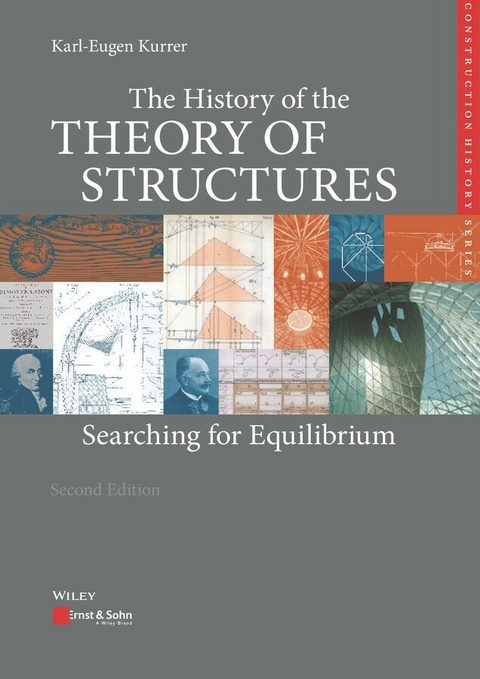
The History of the Theory of Structures (eBook)
Wiley-VCH (Verlag)
978-3-433-60913-2 (ISBN)
Brief insights into customary methods of calculation backed up by historical facts help the reader to understand the history of structural mechanics and earth pressure theory from the point of view of modern engineering practice. This approach also makes a vital contribution to the teaching of engineers.
Dr. Kurrer manages to give us a real feel for the different approaches of the players involved through their engineering science profiles and personalities, thus creating awareness for the social context. The 260 brief biographies convey the subjective aspect of theory of structures and structural mechanics from the early years of the modern era to the present day. Civil and structural engineers and architects are well represented, but there are also biographies of mathematicians, physicists, mechanical engineers and aircraft and ship designers. The main works of these protagonists of theory of structures are reviewed and listed at the end of each biography. Besides the acknowledged figures in theory of structures such as Coulomb, Culmann, Maxwell, Mohr, Müller-Breslau, Navier, Rankine, Saint-Venant, Timoshenko and Westergaard, the reader is also introduced to G. Green, A. N. Krylov, G. Li, A. J. S. Pippard, W. Prager, H. A. Schade, A. W. Skempton, C. A. Truesdell, J. A. L. Waddell and H. Wagner. The pioneers of the modern movement in theory of structures, J. H. Argyris, R. W. Clough, T. v. Kármán, M. J. Turner and O. C. Zienkiewicz, are also given extensive biographical treatment. A huge bibliography of about 4,500 works rounds off the book.
New content in the second edition deals with earth pressure theory, ultimate load method, an analysis of historical textbooks, steel bridges, lightweight construction, theory of plates and shells, Green's function, computational statics, FEM, computer-assisted graphical analysis and historical engineering science. The number of pages now exceeds 1,200 - an increase of 50% over the first English edition.
This book is the first all-embracing historical account of theory of structures from the 16th century to the present day.
Karl-Eugen Kurrer was born in Heilbronn, Germany, in 1952. After graduating from Stuttgart University of Applied Sciences with a general civil engineering degree in 1973, he worked as a structural timber engineer for Losberger GmbH in Heilbronn.
He then returned to university to study civil engineering and physical engineering sciences at TU Berlin, the city's science and technology university. As a tutor in the Theory of Structures Department at TU Berlin between 1977 and 1981, one of Karl-Eugen Kurrer's most important teaching and learning experiences was grasping the basic principles of structural analysis from the historical point of view. The intention of his handwritten introductory lecture notes on the history of each method of structural analysis was to help students understand that theory of structures, too, is the outcome of a socio-historical everyday process in which they themselves play a part and, in the end, help to shape. Another goal was to create a deeper sense of the motivation for and enjoyment of the learning of structural analysis. It was crucial to overcome the formula-type acquisition of the subject matter by introducing a didactic approach to the fundamentals of theory of structures through their historical appreciation. By 1998 this had evolved into a plea for a historico-genetic approach to the teaching of theory of structures.
His dissertation 'Entwicklung der Gewölbetheorie vom 19. Jahrhundert bis zum heutigen Stand der Wissenschaft am Beispiel der Berechnung einer Bogenbrücke' (the development of vault theory from the 19th century to today using the example of structural calculations for an arch bridge) was completed in 1981. Since 1980, his many articles on the history of science and technology in general and construction history in particular have appeared in journals, newspapers, books and exhibition publications.
Karl-Eugen Kurrer completed his PhD - on the internal kinematic and kinetic of tube vibratory mills (advisers: Eberhard Gock, Wolfgang Simonis, Gerd Brunk) - with the highest level of distinction, summa cum laude, at TU Berlin in 1986 and went on to carry out externally funded research on energy efficiency in industry. He contributed to the development of a new eccentric vibratory mill that uses 50% less energy than comparable models. After 1995 the design successfully established itself on the international machine market (US and EU patents). The head of the 'Eccentric vibratory mill' team at Clausthal University of Technology, Prof. Dr. Eberhard Gock (1937-2016), received an innovation award ('Technologietransferpreis der Industrie- und Handelskammer Braunschweig') for this work in 1998.
Summaries of the research results from Dr. Kurrer's work at the interface between mechanical process engineering, machine dynamics and raw materials engineering appeared in issues 124 and 282 of series 3 (process engineering) of the progress reports published by the VDI (Association of German Engineers), and also in numerous presentations and journal publications at home and abroad.
Between 1989 and 1995, Dr. Kurrer was employed at the Department of Antenna Design of Telefunken Sendertechnik GmbH (head of department: Dr.-Ing. Peter Bruger) in Berlin as a developer of structural systems for large long-, medium- and short-wave antenna systems. He worked on the further development of Telefunken's own program suite for the calculation, dimensioning and design of cable networks for short-wave antennas according to third-order theory. He also contributed to the design of a rotating steel short-wave curtain antenna.
For nearly 40 years, Karl-Eugen Kurrer has carried out research on the subject of construction history with a special emphasis on theory of structures. Since 1992, he has been involved in the conference series entitled 'Between Mechanics and Architecture', which was established by Patricia Radelet-de Grave and Edoardo Benvenuto.
Since 1996, Dr. Kurrer has been Chair of the VDI's Working Group on the History of Technology in Berlin. Between 1996 and February 2018, he was chief editor of Stahlbau and (from 2008) Steel Construction - Design and Research, journals published by Ernst & Sohn (now a Wiley brand). In his capacity as Chair of the History of Technology Working Group, Dr. Kurrer organises, together with Prof. Werner Lorenz (Brandenburg University of Technology Cottbus-Senftenberg), eight lectures on construction history every year for the Deutsches Technikmuseum Berlin. In this capacity, Dr. Kurrer has also organised more than 330 events at the Deutsches Technikmuseum Berlin between 1996 and 2017 - some 140 of them on the history of construction.
For his commitment to the field of the history of technology, Dr. Kurrer was awarded the VDI's 'Medal of Honour' in 2016.
Dr. Kurrer was chairman of the scientific committee of the 3rd International Congress on Construction History (20-24 May 2009, Brandenburg University of Technology Cottbus-Senftenberg, Germany).
He has published more than 180 papers and several monographs, e.g. Geschichte der Baustatik (2002, 540pp.), The History of the Theory of Structures. From Arch Analysis to Computational Mechanics (2008, 848pp.) and Geschichte der Baustatik. Auf der Suche nach dem Gleichgewicht (2016, 1184pp.). The first edition of The History of the Theory of Structures was reviewed in 50 international journals.
In recognition of his outstanding scientific achievements in the field of the history of construction, Brandenburg University of Technology Cottbus-Senftenberg awarded him an honorary doctorate on 18 October 2017.
Karl-Eugen Kurrer was born in Heilbronn, Germany, in 1952. After graduating from Stuttgart University of Applied Sciences with a general civil engineering degree in 1973, he worked as a structural timber engineer for Losberger GmbH in Heilbronn. He then returned to university to study civil engineering and physical engineering sciences at TU Berlin, the city's science and technology university. As a tutor in the Theory of Structures Department at TU Berlin between 1977 and 1981, one of Karl-Eugen Kurrer's most important teaching and learning experiences was grasping the basic principles of structural analysis from the historical point of view. The intention of his handwritten introductory lecture notes on the history of each method of structural analysis was to help students understand that theory of structures, too, is the outcome of a socio-historical everyday process in which they themselves play a part and, in the end, help to shape. Another goal was to create a deeper sense of the motivation for and enjoyment of the learning of structural analysis. It was crucial to overcome the formula-type acquisition of the subject matter by introducing a didactic approach to the fundamentals of theory of structures through their historical appreciation. By 1998 this had evolved into a plea for a historico-genetic approach to the teaching of theory of structures. His dissertation "Entwicklung der Gewölbetheorie vom 19. Jahrhundert bis zum heutigen Stand der Wissenschaft am Beispiel der Berechnung einer Bogenbrücke" (the development of vault theory from the 19th century to today using the example of structural calculations for an arch bridge) was completed in 1981. Since 1980, his many articles on the history of science and technology in general and construction history in particular have appeared in journals, newspapers, books and exhibition publications. Karl-Eugen Kurrer completed his PhD - on the internal kinematic and kinetic of tube vibratory mills (advisers: Eberhard Gock, Wolfgang Simonis, Gerd Brunk) - with the highest level of distinction, summa cum laude, at TU Berlin in 1986 and went on to carry out externally funded research on energy efficiency in industry. He contributed to the development of a new eccentric vibratory mill that uses 50% less energy than comparable models. After 1995 the design successfully established itself on the international machine market (US and EU patents). The head of the "Eccentric vibratory mill" team at Clausthal University of Technology, Prof. Dr. Eberhard Gock (1937-2016), received an innovation award ("Technologietransferpreis der Industrie- und Handelskammer Braunschweig") for this work in 1998. Summaries of the research results from Dr. Kurrer's work at the interface between mechanical process engineering, machine dynamics and raw materials engineering appeared in issues 124 and 282 of series 3 (process engineering) of the progress reports published by the VDI (Association of German Engineers), and also in numerous presentations and journal publications at home and abroad. Between 1989 and 1995, Dr. Kurrer was employed at the Department of Antenna Design of Telefunken Sendertechnik GmbH (head of department: Dr.-Ing. Peter Bruger) in Berlin as a developer of structural systems for large long-, medium- and short-wave antenna systems. He worked on the further development of Telefunken's own program suite for the calculation, dimensioning and design of cable networks for short-wave antennas according to third-order theory. He also contributed to the design of a rotating steel short-wave curtain antenna. For nearly 40 years, Karl-Eugen Kurrer has carried out research on the subject of construction history with a special emphasis on theory of structures. Since 1992, he has been involved in the conference series entitled "Between Mechanics and Architecture", which was established by Patricia Radelet-de Grave and Edoardo Benvenuto. Since 1996, Dr. Kurrer has been Chair of the VDI's Working Group o
Dr.-Ing. Dr.-Ing. E.h. Karl-Eugen Kurrer, geboren am 10.8.1952 in Heilbronn. Nach Realschule und Maurerlehre Studium des Allgemeinen Ingenieurbaus an der Staatsbauschule Stuttgart (heute Hochschule für Technik). Anschließend Bauingenieur im Ingenieurholzbau. Studium des Bauingenieurwesens und der Physikalischen Ingenieurwissenschaften an der TU Berlin; 1982 Diplomarbeit über die Entwicklungsgeschichte der Gewölbetheorie. Danach Promotion an der TU Berlin mit der Dissertation "Zur inneren Kinematik und Kinetik von Rohrschwingmühlen" (1986) und daselbst Fortsetzung der Forschungen zur rationellen Energieverwendung in der Industrie. Entwicklungsingenieur für Antennensysteme bei Telefunken Sendertechnik GmbH in Berlin (1989-1995). Ab Mitte der 1980er-Jahre Entwicklung des wissenschaftshistorisch akzentuierten Ansatzes der Bautechnikgeschichte für die Baustatik, der später zum Konzept einer Historischen Technikwissenschaft verallgemeinert wurde. Von 1993 bis 2010 Mitarbeit an dem von Edoardo Benvenuto (Genua) und Patricia Radelet-de Grave (Louvain-la-Neuve) begründeten Netzwerk "Between Mechanics and Architecture". Seit 1996 Leiter des VDI-Arbeitskreises "Technikgeschichte" in Berlin und Begründer einer Vortragsreihe am Deutschen Technikmuseum Berlin. Chefredakteur "Stahlbau" (seit 1996) und "Steel Construction - Design and Research" (seit 2008) bei Ernst & Sohn. Chairperson des International Scientific Committee des IIIrd International Congress on Construction History (2009) an der BTU Cottbus-Senftenberg. Gründungsmitglied der deutschsprachigen Gesellschaft für Bautechnikgeschichte (2013). Für seine hervorragenden wissenschaftlichen Leistungen auf dem Gebiet der Bautechnikgeschichte wurde er am 18. Oktober 2017 von der BTU Cottbus-Senftenberg zum Dr.-Ing. E.h. promoviert. Kurrer veröffentlichte über 180 Zeitschriftenaufsätze und Buchbeiträge sowie hunderte Rezensionen und Zeitungsartikel. Im Jahr 2002 erschien erstmals seine "Geschichte der Baustatik", der 2008 die wesentlich erweiterte "The History of the Theory of Structures" folgte. In der Tradition legendärer Arbeiten zur Geschichte der Mechanik gelten diese "opera magna" heute weltweit als moderne Standardwerke des wissenschaftsgeschichtlichen Zweiges der Bautechnikgeschichte.
Foreword of the series editors
Foreword by Prof. Ekkehard Ramm
Preface to the second English edition
About this series
About the series editors
About the author
1 The tasks and aims of a historical study of the theory of structures
2 Learning from history: 12 introductory essays
3 The first fundamental engineering science disciplines: theory of structures and applied mechanics
4 From masonry arch to elastic arch
5 The history of earth pressure theory
6 The beginnings of a theory of structures
7 The discipline-formation period of theory of structures
8 From construction with iron to modern structural steelwork
9 Member analysis conquers the third dimension: the spatial framework
10 Reinforced concrete's influence on theory of structures
11 The consolidation period of theory of structures
12 The development and establishment of computational statics
13 Thirteen scientific controversies in mechanics and theory of structures
14 Perspectives for a historical theory of structures
15 Brief biographiesof 260 protagonists of theory of structures
Bibliography
Name index
Subject index
Vorwort der Reihenherausgeber
Zum Geleit von Prof. Ekkehard Ramm
Vorwort zur zweiten englischen Edition
Über die Reihe
Über die Reihenherausgeber
Über den Autor
1 Aufgaben und Ziele der Historiographie der Baustatik
2 Lernen aus der Geschichte: Zwölf Einführungsvorträge in die Baustatik
3 Die ersten technikwissenschaftlichen Grundlagendisziplinen: Baustatik und Technische Mechanik
4 Vom Gewölbe zum Bogen
5 Geschichte der Erddrucktheorie
6 Die Anfänge der Baustatik
7 Die Disziplinbildungsperiode der Baustatik
8 Vom Eisenbau zum modernen Stahlbau
9 Die Stabstatik erobert die dritte Dimension: Das Raumfachwerk
10 Der Einfluss des Stahlbetonbaus auf die Baustatik
11 Die Konsolidierungsperiode der Baustatik
12 Herausbildung und Etablierung der Computerstatik
13 Dreizehn wissenschaftliche Kontroversen in der Mechanik und Baustatik
14 Perspektiven der Historischen Baustatik
15 Kurzbiographien von 260 Protagonisten der Baustatik
Bibliographie
Personenregister
Sachregister
About this Edition
"[...] K.-E. Kurrer's book is a compreshensive treatise on the theories that are used for analysis and design of structures from the earliest days (Archimedes' lever principle) to the present (finite element method). Those who have read the first edition of the book will be surprised by the huge amount of history and knowledge which has been added in the second edition. One can still read the individual chapters in isolation without losing the broad view on the total. The book is well illustrated with pictures, graphs, historical drawings and sketches, which makes for entertaining reading. It contains a wealth of information and is therefore a source for historians, especially interested in the history of technology, but also for professional engineers and graduate students of engineering and art history. The book is a necessary element of libraries and engineering departments."
em. Prof. Dr.-Ing. Dr. h.c. Dr. E.h. Hans-Wolf Reinhardt, University of Stuttgart, Germany (RILEM's website: www.rilem.net, July 2018)
"(...) Der Rezensent empfiehlt vorliegendes Buch wärmstens - auch den Lesern in Polen.
Bauingenieure, Architekten und Umweltingenieure und Studierende der genannten Disziplinen
finden dort zahlreiche Anregungen zum Nachdenken."
Prof. dr hab. inz. Zbigniew Cywinski in "Inzynieria Morska i Geotechnika", 4/2018, S. 313:
About the First English edition 2008
"[...] Ultimately, this is an extraordinary book that should be in every engineering library and on the bookshelf of every structural engineer who aspires to make a difference in the design, development, and preservation of civil infrastructure."
Prof. Sashi K. Kunnath, University of California, Davis, USA (Journal of Structural Engineering, March 2009, pp. 330-331)
"[...] Kurrer's achievement in compiling this book is colossal, and I commend it to anyone interested in the subject. It will, for a long time, stand well along side the other classics of the field - Timoshenko's "History of Strength of Materials", and Eduardo Benvenuto's "Introduction to the History of Structural Mechanics". [...]"
Dr. Bill Addis, Buro Happold, London, UK (International Journal of Space Structures, Vol. 23, No. 3, July 2008, p. 194)
"[...] As you can tell from my enthusiasm, I recommend this highly original study, first as a pleasure to read and a thoughtful examination of new avenues to explain the development of human understanding, and also as an aid and inspiration for further research."
Prof. Dr. Tom F. Peters, Lehigh University, USA (Technology and Culture, July 2009, Vol. 50, pp. 669-674)
"[...] Kurrer's book is truly a masterpiece. In the 800-plus pages, one finds no end of new and interesting pieces of information that contribute to the history of the theory of structures. [...]"
Prof. Dr. Harry H. West, The Pennsylvania State University, USA (Journal of Architectural Engineering, Vol. 14, Issue 4, December 2008, p. 130)
"[...] Whenever you want to learn about the subject or just want to browse through history - this is the book! It is certainly a must for every historically interested engineer as well as for historians of science. "The Kurrer" will become the standard reference book and will stay in that position for many years to come."
Prof. Dr. Thomas Sonar, Institute of Computational Mathematics, Technische Universität Braunschweig, Germany (ZAMP The Journal of Applied Mathematics and Physics, Vol. 60 (2009), p. 581)
"[...] German publisher Ernst & Sohn has brought to the English-speaking public this substantial monograph by Karl-Eugen Kurrer, which is a revised and considerably extended version of the highly successful 2002 German edition Geschichte der Baustatik. The additional content, especially the inclusion of more international developments, makes this book of truly worldwide significance."
Prof. Dr. Andreas Kahlow, Berlin, Germany (Proceedings of the Institution of Civil Engineers - Engineering History and Heritage, Vol. 164, February 20
Foreword
Ten years after the first English edition of Dr. Kurrer’s The History of the Theory of Structures, he now presents us with a much enlarged edition, and with a new subtitle: Searching for Equilibrium – an addition that reminds us of that most important of all mechanical principles: no equilibrium, no loadbearing system! But the subtitle also expresses the constant search for a balance between theory of structures as a scientific discipline and its prime task in practical applications – totally in keeping with Leibniz’ Theoria cum Praxi. This interaction has proved beneficial for both sides at all times in history, and runs like a thread through the entire book.
New content in this second edition includes: earth pressure theory, ultimate load method, an analysis of historical textbooks, steel bridges, lightweight construction, plate and shell theory, computational statics, Green’s functions, computer-assisted graphical analysis and historical engineering science. Furthermore, the number of brief biographies has been increased from 175 to 260! Compared with the first English edition, the number of printed pages has increased by 50 % to a little over 1,200.
Right at the start we learn that the first conference on the history of theory of structures took place in Madrid in 2005. This theme, its parts dealt with many times, is simply crying out for a comprehensive treatment. However, this book is not a history book in which the contributions of our predecessors to this theme are listed chronologically and described systematically. No, this is ‘Kurrer’s History of Theory of Structures’ with his interpretations and classifications; luckily – because that makes it an exciting journey through time, with highly subjective impressions, more thematic and only roughly chronological, and with a liking for scientific theory. Indeed, a description of the evolution of an important fundamental engineering science discipline with its many facets in teaching, research and, first and foremost, practice.
And what is “theory of structures” anyway? … Gerstner’s first book dating from 1789 talks about the “statics of architecture” and Emil Winkler used the term “statics of structures” around 1880. Winkler’s term also included earth pressure theory, the evolution of which from 1700 to the present day is now the topic of a new chapter 5 in this second edition.
The history of theory of structures is in the first place the history of mechanics and mathematics, which in earlier centuries were most definitely understood to be applied sciences. Dr. Kurrer calls this period from 1575 to 1825 the “preparatory period” – times in which structural design was still very much dominated by empirical methods. Nevertheless, it is worth noting that the foundations of many structural theories were laid in this period. It is generally accepted that the structural report for the repairs to the dome of St. Peter’s in Rome (1742/1743) by the tre mattematici represents the first structural calculations as we understand them today. In other words, dealing with a constructional task by the application of scientific methods – accompanied, characteristically, by the eternal dispute between theory and practice (see section 13.2.5). These days, the centuries-old process of the theoretical abstraction of natural and technical processes in almost all scientific disciplines is called ‘modelling and simulation’ – as though it had first been introduced with the invention of the computer and the world of IT, whereas, in truth, it has long since been the driving force behind humankind’s ideas and actions. Mapping the loadbearing properties of building structures in a theoretical model is a typical case. Classic examples are the development of masonry and elastic arch theories (see chapter 4) and the continuum mechanics models of earth pressure of Rankine and Boussinesq (see sections 5.4 and 5.5). It has become customary to add the term ‘computational’ to these computer-oriented fields in the individual sciences, in this case ‘computational mechanics’.
The year 1825 has been fittingly chosen as the starting point of the discipline-formation period in theory of structures (see chapter 7). Theory of structures is not just the solving of an equilibrium problem, not just a computational process. Navier, whose importance as a mechanics theorist we still acknowledge today in the names of numerous theories (Navier stress distribution, Navier-Lamé and Navier-Stokes equations, etc.), was very definitely a practitioner. In his position as professor for applied mechanics at the École des Ponts et Chaussées, it was he who combined the subjects of applied mechanics and strength of materials in order to apply them to the practical tasks of building. For example, in his Mechanik der Baukunst of 1826, he describes the work of engineers thus: “… after the works have been designed and drawn, [they] investigate them to see if all conditions have been satisfied and improve their design until this is the case. Economy is one of the most important conditions here; stability and durability are no less important …” (see section 2.1.2.1). Navier was the first to establish theory of structures as an independent scientific discipline. Important structural theories and methods of calculation would be devised in the following years, linked with names such as Clapeyron, Lamé, Saint-Venant, Rankine, Maxwell, Cremona, Castigliano, Mohr and Winkler, to name but a few. The graphical statics of Culmann and its gradual development into graphical analysis are milestones in the history of theory of structures.
Already at this juncture, it is worth pointing out that the development did not always proceed smoothly – controversies concerning the content of theories, or competition between disciplines, or priority disputes raised their heads along the way. This exciting theme is explored in detail in chapter 13 by way of 13 examples.
In the following decades, the evolution of methods in theory of structures became strongly associated with specific structural systems and hence, quite naturally, with the building materials employed, such as iron (steel) and later reinforced concrete (see chapters 8, 9 and 10). Independent materials-specific systems and methods were devised. Expressed in simple terms, structural steelwork, owing to its modularity and the fabrication methods, initially concentrated on assemblies of linear members, not embracing plate and shell structures until the 1950s. On the other hand, reinforced concrete preferred its own two-dimensional design language, which manifested itself in slabs, plates and shells. Therefore, chapters 8 and 10 in this second English edition have been considerably enlarged by the addition of plate and shell structures. The space frames dealt with in chapter 9 represent a link to some extent. This materials-based split was also reflected in the teaching of theory of structures in the form of separate studies. It was not until many years later that the parts were brought together in a homogeneous theory of structures, albeit frequently ‘neutralised’, i. e. no longer related to the specific properties of the particular building material – an approach that must be criticised in retrospect. Of course, the methods of structural analysis can encompass any material in principle, but in a specific case they must take account of the particular characteristics of the material.
Dr. Kurrer places the transition from the discipline-formation period – with its great successes in the shape of graphical statics and the systematic approach to methods of calculation in member analysis in the form of the force method – to the consolidation period around 1900. This latter period, which lasted until 1950, is characterised by refinements and extensions, e. g. a growing interest in plate and shell structures and the consideration of non-linear effects. Only after this does the ‘modern’ age of theory of structures begin – designated the integration period in this instance and typified by the use of modern computers and powerful numerical methods. Theory of structures is integrated into the structural planning process of draft design – analysis – detailed design – construction in this period. Have we reached the end of the evolutionary road? Does this development mean that theory of structures, as an independent engineering science, is losing its profile and its justification? The tendencies of recent years indicate the opposite.
The story of yesterday and today is also the story of tomorrow. In the world of data processing and information technology, theory of structures has undergone rapid progress in conjunction with numerous paradigm changes. It is no longer the calculation process and method issues, but rather principles, modelling, realism, quality assurance and many other aspects that form the focus of our attention. The remit includes dynamics alongside statics; in terms of the role they play, plate and shell structures are almost equal to trusses, and taking account of true material behaviour is obligatory these days. During its history so far, theory of structures was always the trademark of structural engineering; it was never the discipline of ‘number crunchers’, even if this was and still is occasionally proclaimed as such when launching relevant computer programs. Theory of structures continues to play an...
| Erscheint lt. Verlag | 19.6.2018 |
|---|---|
| Reihe/Serie | Edition Bautechnikgeschichte / Construction History |
| edition Bautechnikgeschichte / Construction History series | edition Bautechnikgeschichte / Construction History series |
| Übersetzer | Philip Thrift |
| Vorwort | Ekkehard Ramm |
| Sprache | englisch |
| Themenwelt | Technik ► Bauwesen |
| Schlagworte | Aeronautic & Aerospace Engineering • Applied Mathematics in Engineering • Applied Mathmatics in Engineering • Architecture • Architektur • author • Bauentwurf • Bauingenieur- u. Bauwesen • Baustatik • Baustatik u. Baumechanik • Baustoffe • Building Design • Civil Engineering & Construction • Civil Engineering & Construction Special Topics • construction materials • Da Vinci • Denkmalpflege • Edition • Editors • Ekkehard • Emergence • English • Equilibrium • Erd- u. Grundbau • Foreword • Geschichte • Geschichte der Medizin u. Naturwissenschaften • Grundbau / Geotechnik • historic preservation • History • History of Science & Medicine • Industrial Engineering • Industrial Engineering Special Topics • Industrielle Verfahrenstechnik • journey • kurrer • Luft- u. Raumfahrttechnik • Maschinenbau • Mathematics • Mathematik • Mathematik in den Ingenieurwissenschaften • mechanical engineering • Mechanical Engineering Special Topics • Mech Engineering Special Topics • Militärgeschichte • military history • New • Part • Prof • Ramm • Reader • Searching • Second • series • series editors • Soil (Civil Engineering) • Soil Constructions & Geotechnics • Spezialthemen Bauingenieur- u. Bauwesen • Spezialthemen Industrielle Verfahrenstechnik • Spezialthemen Maschinenbau • starts • Structural Theory & Structural Mechanics • Structures • subtitle • Tasks • Time |
| ISBN-10 | 3-433-60913-6 / 3433609136 |
| ISBN-13 | 978-3-433-60913-2 / 9783433609132 |
| Informationen gemäß Produktsicherheitsverordnung (GPSR) | |
| Haben Sie eine Frage zum Produkt? |
 EPUB (Adobe DRM)
Kopierschutz: Adobe-DRM
Adobe-DRM ist ein Kopierschutz, der das eBook vor Mißbrauch schützen soll. Dabei wird das eBook bereits beim Download auf Ihre persönliche Adobe-ID autorisiert. Lesen können Sie das eBook dann nur auf den Geräten, welche ebenfalls auf Ihre Adobe-ID registriert sind.
Details zum Adobe-DRM
Dateiformat: EPUB (Electronic Publication)
EPUB ist ein offener Standard für eBooks und eignet sich besonders zur Darstellung von Belletristik und Sachbüchern. Der Fließtext wird dynamisch an die Display- und Schriftgröße angepasst. Auch für mobile Lesegeräte ist EPUB daher gut geeignet.
Systemvoraussetzungen:
PC/Mac: Mit einem PC oder Mac können Sie dieses eBook lesen. Sie benötigen eine
eReader: Dieses eBook kann mit (fast) allen eBook-Readern gelesen werden. Mit dem amazon-Kindle ist es aber nicht kompatibel.
Smartphone/Tablet: Egal ob Apple oder Android, dieses eBook können Sie lesen. Sie benötigen eine
Geräteliste und zusätzliche Hinweise
Buying eBooks from abroad
For tax law reasons we can sell eBooks just within Germany and Switzerland. Regrettably we cannot fulfill eBook-orders from other countries.
aus dem Bereich