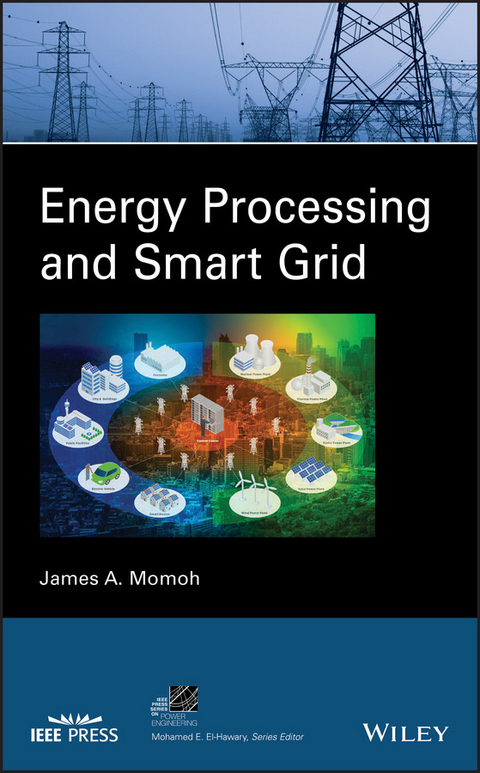
Energy Processing and Smart Grid (eBook)
John Wiley & Sons (Verlag)
978-1-119-37623-1 (ISBN)
The first book in the field to incorporate fundamentals of energy systems and their applications to smart grid, along with advanced topics in modeling and control
This book provides an overview of how multiple sources and loads are connected via power electronic devices. Issues of storage technologies are discussed, and a comparison summary is given to facilitate the design and selection of storage types. The need for real-time measurement and controls are pertinent in future grid, and this book dedicates several chapters to real-time measurements such as PMU, smart meters, communication scheme, and protocol and standards for processing and controls of energy options.
Organized into nine sections, Energy Processing for the Smart Grid gives an introduction to the energy processing concepts/topics needed by students in electrical engineering or non-electrical engineering who need to work in areas of future grid development. It covers such modern topics as renewable energy, storage technologies, inverter and converter, power electronics, and metering and control for microgrid systems. In addition, this text:
- Provides the interface between the classical machines courses with current trends in energy processing and smart grid
- Details an understanding of three-phase networks, which is needed to determine voltages, currents, and power from source to sink under different load models and network configurations
- Introduces different energy sources including renewable and non-renewable energy resources with appropriate modeling characteristics and performance measures
- Covers the conversion and processing of these resources to meet different DC and AC load requirements
- Provides an overview and a case study of how multiple sources and loads are connected via power electronic devices
- Benefits most policy makers, students and manufacturing and practicing engineers, given the new trends in energy revolution and the desire to reduce carbon output
Energy Processing for the Smart Grid is a helpful text for undergraduates and first year graduate students in a typical engineering program who have already taken network analysis and electromagnetic courses.
JAMES A. MOMOH, PHD, is a Fellow at the Institute of Electronics and Electrical Engineering (IEEE) and a Distinguished Fellow at the Nigerian Society of Engineers (NSE). His current research activities for utility firms and government agencies span several areas in systems engineering, optimization, and energy systems control of terrestrial, space and naval complex and dynamic networks. Momoh was Chair of the Electrical Engineering Department at Howard University and Director of the Center for Energy Systems and Control.
The first book in the field to incorporate fundamentals of energy systems and their applications to smart grid, along with advanced topics in modeling and control This book provides an overview of how multiple sources and loads are connected via power electronic devices. Issues of storage technologies are discussed, and a comparison summary is given to facilitate the design and selection of storage types. The need for real-time measurement and controls are pertinent in future grid, and this book dedicates several chapters to real-time measurements such as PMU, smart meters, communication scheme, and protocol and standards for processing and controls of energy options. Organized into nine sections, Energy Processing for the Smart Grid gives an introduction to the energy processing concepts/topics needed by students in electrical engineering or non-electrical engineering who need to work in areas of future grid development. It covers such modern topics as renewable energy, storage technologies, inverter and converter, power electronics, and metering and control for microgrid systems. In addition, this text: Provides the interface between the classical machines courses with current trends in energy processing and smart grid Details an understanding of three-phase networks, which is needed to determine voltages, currents, and power from source to sink under different load models and network configurations Introduces different energy sources including renewable and non-renewable energy resources with appropriate modeling characteristics and performance measures Covers the conversion and processing of these resources to meet different DC and AC load requirements Provides an overview and a case study of how multiple sources and loads are connected via power electronic devices Benefits most policy makers, students and manufacturing and practicing engineers, given the new trends in energy revolution and the desire to reduce carbon output Energy Processing for the Smart Grid is a helpful text for undergraduates and first year graduate students in a typical engineering program who have already taken network analysis and electromagnetic courses.
JAMES A. MOMOH, PHD, is a Fellow at the Institute of Electronics and Electrical Engineering (IEEE) and a Distinguished Fellow at the Nigerian Society of Engineers (NSE). His current research activities for utility firms and government agencies span several areas in systems engineering, optimization, and energy systems control of terrestrial, space and naval complex and dynamic networks. Momoh was Chair of the Electrical Engineering Department at Howard University and Director of the Center for Energy Systems and Control.
CHAPTER 2
ELECTRIC NETWORK ANALYSIS IN ENERGY PROCESSING AND SMART GRID
2.1 INTRODUCTION
In modern AC electric power systems (Figure 2.1), power is generated, transmitted, and distributed as balanced, three-phase AC. The three-phase system was independently invented by Galileo Ferraris, Mikhail Dolivo-Dobrovolsky, Jonas Wenström, and Nikola Tesla in the 1880s and is the most widely used means of transferring power through power grids. The three-phase system has the advantage of economy over the single-phase system because more power can be transmitted with significant cost savings in conductors per unit line length. The three-phase system may be configured as three-wire star, four-wire star, or three-wire delta system.
Figure 2.1 Simplified single-line diagram schematics of a modern electric power system.
Because of advances in electronics, the future electric power system is headed in the direction of microgrids and smart grids. In anticipation of demands, researchers and students need to be equipped with relevant knowledge on the emerging trends in this area. This chapter introduces the fundamentals of electric power systems and the basic computational tools needed for the design and analysis of the future-generation power system.
2.2 COMPLEX POWER CONCEPTS
In electrical power systems, we are mainly concerned with flow in the electrical circuit, such as Voltage (V), Frequency (f), Current (I), and Power (P). To treat sinusoidal, steady-state behavior of an electric current, some further definitions are necessary.
Let
and
and
where
In polar form,
or
It is important to recall the following trigonometric identities:
For a voltage signal represented in terms of root mean square (rms) value:
For impedance, if the circuit is purely resistive, inductive, or capacitive, there will be difference in current and angle phase shift.
2.2.1 Purely Resistive Circuit
In a purely resistive circuit, Figure 2.2, the current is in phase with voltage:
Figure 2.2 Phasor diagram of a purely resistive circuit.
2.2.2 Purely Inductive Circuit
Current lags behind V by 90° as seen in Figure 2.3:
Figure 2.3 Phasor diagram of purely inductive circuit.
2.2.3 Purely Capacitive Circuit
In a purely capacitive circuit Figure 2.4, current leads voltage by 90°:
Figure 2.4 Phasor diagram of a purely capacitive circuit.
2.2.4 Instantaneous Power
The instantaneous power is given by:
where Cosϕ is the power factor.
2.2.5 Power Factor
The power factor of a system is defined as:
where P = VICosϕ and Q = VISinϕ.
Q is the reactive power measured in kilo-var (kvar).
2.2.6 Complex Power
The apparent power S is then:
and
If the load impedance is Z, then,
In terms of load admittance,
2.3 REVIEW OF AC-CIRCUIT ANALYSIS USING PHASOR DIAGRAMS
Consider the AC circuit of Figure 2.5. The load, operating at a voltage VL, draws a current IL from the source whose voltage is Vs, through resistance R and inductive reactance jX.
Figure 2.5 AC circuit analysis with phasor diagram.
By Kirchhoff's voltage rule:
where
If the load is operated at power factor Cosϕ and voltage VL then
Then Equation 2.29 may be rewritten as:
A phasor diagram Figure 2.6 may be constructed based on Equation 2.35 from which the source voltage Vs may be determined.
Figure 2.6 Phasor relationships of power system quantities.
2.4 POLYPHASE SYSTEMS
One of the methods of transmitting and distributing AC electric power is by means of polyphase systems. This is a system with three or more energized AC currents carrying conductors with a phase deviation between them. For a balanced n-phase system, the phase difference is given by:
For two-, three- … six-phase systems, voltages will be out of phase by 90°, 120°, …60°, respectively.
Polyphase systems are particularly useful for transmitting power as more power can be transmitted than when a single phase is used.
2.4.1 Three-Phase Circuits
Power generation, transmission, and distribution are usually connected in a type of polyphase system for heavy utilization of AC electric power. These types of connections provide economic advantages as well as system stability and capacity control. Both voltage and currents are sinusoidal waveforms equal in magnitude, but are displaced from one another by 120° in time phase. Stator windings are connected in three-phase through a ground wire, leading to four wires. The center of the four wires (Figure 2.7) leads to a Y-connected system, where each is referred to as a phase and the fourth conductor is called the neutral wire, which has four-wire balanced connection.
Figure 2.7 Equivalent Y diagram.
2.4.2 Balanced Y-Connected Three-Phase Source
In vector (phasor) form
Similarly, for Δ-connected system
2.4.3 Phase and Line Voltages: Delta Connected
The line-neutral and line–line voltages with proper relations are shown in Figure 2.8.
Figure 2.8 Phase and line voltage representation.
Line-Neutral, VBA leads VNA by 30°, VCB leads VNB by 30°.
2.4.4 Equivalent Y-Connected Voltage Phasor Representation
Taking VNA as a reference from Figure 2.9,
Figure 2.9 Equivalent Y-connected voltage phasor representation.
2.4.5 Mesh or Delta Connection
These connections are not properly balanced to maintain balanced voltage across each load. A delta-connected generator Figure 2.10 is possible but not desirable for two main reasons:
- Grounding is not possible with a delta-connected generator. For safety, a generator-neutral point typical of Y is the logical point of connection to ground.
- A delta connection of the coils of the generator provides a short-circuited path in which current can flow. Third harmonics in the coil voltages cause a disturbance, which produces power loss and lowers the efficiency of the generator.
Figure 2.10 Mesh or delta connection.
2.5 THREE-PHASE IMPEDENCE LOADS
A delta-connected load or Y-connected load (Figure 2.11) uses the same configuration as discussed in Section 2.8.
Figure 2.11 Delta-connected three-phase loads.
From which the individual phase currents may be computed as
The line currents...
| Erscheint lt. Verlag | 19.6.2018 |
|---|---|
| Reihe/Serie | IEEE Press Series on Power and Energy Systems |
| IEEE Press Series on Power Engineering | IEEE Press Series on Power Engineering |
| Sprache | englisch |
| Themenwelt | Technik ► Elektrotechnik / Energietechnik |
| Technik ► Nachrichtentechnik | |
| Schlagworte | communication for processing energy • controlling energy • Department of Energy (DOE) • Electrical Engineering • Electrical Power Systems • electric energy processing • Electric machinery • Electric Machines • electric power systems • Elektrische Energietechnik • Energie • Energy • Energy Processing for Smart Grid • energy storage technology • future grid initiative • Industry University Collaboration Research Center IUCRC • Microgrid • Microgrid systems • National Science Foundation (NSF) • Non-renewable energy • PMU • Power Electronics • Power System Engineering Research Center (PSERC) • protocol and standards for processing energy • reducing carbon footprint • renewable energy • Smart Grid • smart grid design • Smart Grids • smart meters |
| ISBN-10 | 1-119-37623-8 / 1119376238 |
| ISBN-13 | 978-1-119-37623-1 / 9781119376231 |
| Informationen gemäß Produktsicherheitsverordnung (GPSR) | |
| Haben Sie eine Frage zum Produkt? |
 EPUB (Adobe DRM)
Kopierschutz: Adobe-DRM
Adobe-DRM ist ein Kopierschutz, der das eBook vor Mißbrauch schützen soll. Dabei wird das eBook bereits beim Download auf Ihre persönliche Adobe-ID autorisiert. Lesen können Sie das eBook dann nur auf den Geräten, welche ebenfalls auf Ihre Adobe-ID registriert sind.
Details zum Adobe-DRM
Dateiformat: EPUB (Electronic Publication)
EPUB ist ein offener Standard für eBooks und eignet sich besonders zur Darstellung von Belletristik und Sachbüchern. Der Fließtext wird dynamisch an die Display- und Schriftgröße angepasst. Auch für mobile Lesegeräte ist EPUB daher gut geeignet.
Systemvoraussetzungen:
PC/Mac: Mit einem PC oder Mac können Sie dieses eBook lesen. Sie benötigen eine
eReader: Dieses eBook kann mit (fast) allen eBook-Readern gelesen werden. Mit dem amazon-Kindle ist es aber nicht kompatibel.
Smartphone/Tablet: Egal ob Apple oder Android, dieses eBook können Sie lesen. Sie benötigen eine
Geräteliste und zusätzliche Hinweise
Buying eBooks from abroad
For tax law reasons we can sell eBooks just within Germany and Switzerland. Regrettably we cannot fulfill eBook-orders from other countries.
aus dem Bereich