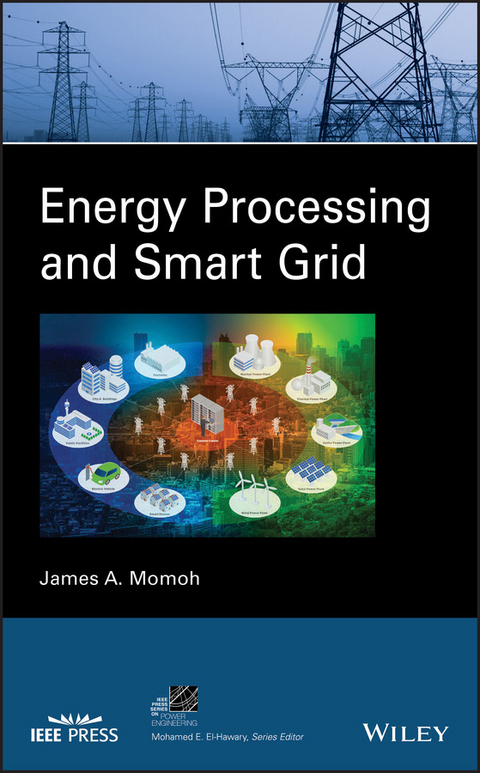
Energy Processing and Smart Grid (eBook)
John Wiley & Sons (Verlag)
978-1-119-37616-3 (ISBN)
The first book in the field to incorporate fundamentals of energy systems and their applications to smart grid, along with advanced topics in modeling and control
This book provides an overview of how multiple sources and loads are connected via power electronic devices. Issues of storage technologies are discussed, and a comparison summary is given to facilitate the design and selection of storage types. The need for real-time measurement and controls are pertinent in future grid, and this book dedicates several chapters to real-time measurements such as PMU, smart meters, communication scheme, and protocol and standards for processing and controls of energy options.
Organized into nine sections, Energy Processing for the Smart Grid gives an introduction to the energy processing concepts/topics needed by students in electrical engineering or non-electrical engineering who need to work in areas of future grid development. It covers such modern topics as renewable energy, storage technologies, inverter and converter, power electronics, and metering and control for microgrid systems. In addition, this text:
- Provides the interface between the classical machines courses with current trends in energy processing and smart grid
- Details an understanding of three-phase networks, which is needed to determine voltages, currents, and power from source to sink under different load models and network configurations
- Introduces different energy sources including renewable and non-renewable energy resources with appropriate modeling characteristics and performance measures
- Covers the conversion and processing of these resources to meet different DC and AC load requirements
- Provides an overview and a case study of how multiple sources and loads are connected via power electronic devices
- Benefits most policy makers, students and manufacturing and practicing engineers, given the new trends in energy revolution and the desire to reduce carbon output
Energy Processing for the Smart Grid is a helpful text for undergraduates and first year graduate students in a typical engineering program who have already taken network analysis and electromagnetic courses.
JAMES A. MOMOH, PHD, is a Fellow at the Institute of Electronics and Electrical Engineering (IEEE) and a Distinguished Fellow at the Nigerian Society of Engineers (NSE). His current research activities for utility firms and government agencies span several areas in systems engineering, optimization, and energy systems control of terrestrial, space and naval complex and dynamic networks. Momoh was Chair of the Electrical Engineering Department at Howard University and Director of the Center for Energy Systems and Control.
The first book in the field to incorporate fundamentals of energy systems and their applications to smart grid, along with advanced topics in modeling and control This book provides an overview of how multiple sources and loads are connected via power electronic devices. Issues of storage technologies are discussed, and a comparison summary is given to facilitate the design and selection of storage types. The need for real-time measurement and controls are pertinent in future grid, and this book dedicates several chapters to real-time measurements such as PMU, smart meters, communication scheme, and protocol and standards for processing and controls of energy options. Organized into nine sections, Energy Processing for the Smart Grid gives an introduction to the energy processing concepts/topics needed by students in electrical engineering or non-electrical engineering who need to work in areas of future grid development. It covers such modern topics as renewable energy, storage technologies, inverter and converter, power electronics, and metering and control for microgrid systems. In addition, this text: Provides the interface between the classical machines courses with current trends in energy processing and smart grid Details an understanding of three-phase networks, which is needed to determine voltages, currents, and power from source to sink under different load models and network configurations Introduces different energy sources including renewable and non-renewable energy resources with appropriate modeling characteristics and performance measures Covers the conversion and processing of these resources to meet different DC and AC load requirements Provides an overview and a case study of how multiple sources and loads are connected via power electronic devices Benefits most policy makers, students and manufacturing and practicing engineers, given the new trends in energy revolution and the desire to reduce carbon output Energy Processing for the Smart Grid is a helpful text for undergraduates and first year graduate students in a typical engineering program who have already taken network analysis and electromagnetic courses.
JAMES A. MOMOH, PHD, is a Fellow at the Institute of Electronics and Electrical Engineering (IEEE) and a Distinguished Fellow at the Nigerian Society of Engineers (NSE). His current research activities for utility firms and government agencies span several areas in systems engineering, optimization, and energy systems control of terrestrial, space and naval complex and dynamic networks. Momoh was Chair of the Electrical Engineering Department at Howard University and Director of the Center for Energy Systems and Control.
| Erscheint lt. Verlag | 13.6.2018 |
|---|---|
| Reihe/Serie | IEEE Press Series on Power and Energy Systems |
| IEEE Press Series on Power Engineering | IEEE Press Series on Power Engineering |
| Sprache | englisch |
| Themenwelt | Technik ► Elektrotechnik / Energietechnik |
| Technik ► Nachrichtentechnik | |
| Schlagworte | communication for processing energy • controlling energy • Department of Energy (DOE) • Electrical Engineering • Electrical Power Systems • electric energy processing • Electric machinery • Electric Machines • electric power systems • Elektrische Energietechnik • Energie • Energy • Energy Processing for Smart Grid • energy storage technology • future grid initiative • Industry University Collaboration Research Center IUCRC • Microgrid • Microgrid systems • National Science Foundation (NSF) • Non-renewable energy • PMU • Power Electronics • Power System Engineering Research Center (PSERC) • protocol and standards for processing energy • reducing carbon footprint • renewable energy • Smart Grid • smart grid design • Smart Grids • smart meters |
| ISBN-10 | 1-119-37616-5 / 1119376165 |
| ISBN-13 | 978-1-119-37616-3 / 9781119376163 |
| Informationen gemäß Produktsicherheitsverordnung (GPSR) | |
| Haben Sie eine Frage zum Produkt? |
 PDF (Adobe DRM)
Kopierschutz: Adobe-DRM
Adobe-DRM ist ein Kopierschutz, der das eBook vor Mißbrauch schützen soll. Dabei wird das eBook bereits beim Download auf Ihre persönliche Adobe-ID autorisiert. Lesen können Sie das eBook dann nur auf den Geräten, welche ebenfalls auf Ihre Adobe-ID registriert sind.
Details zum Adobe-DRM
Dateiformat: PDF (Portable Document Format)
Mit einem festen Seitenlayout eignet sich die PDF besonders für Fachbücher mit Spalten, Tabellen und Abbildungen. Eine PDF kann auf fast allen Geräten angezeigt werden, ist aber für kleine Displays (Smartphone, eReader) nur eingeschränkt geeignet.
Systemvoraussetzungen:
PC/Mac: Mit einem PC oder Mac können Sie dieses eBook lesen. Sie benötigen eine
eReader: Dieses eBook kann mit (fast) allen eBook-Readern gelesen werden. Mit dem amazon-Kindle ist es aber nicht kompatibel.
Smartphone/Tablet: Egal ob Apple oder Android, dieses eBook können Sie lesen. Sie benötigen eine
Geräteliste und zusätzliche Hinweise
Buying eBooks from abroad
For tax law reasons we can sell eBooks just within Germany and Switzerland. Regrettably we cannot fulfill eBook-orders from other countries.
aus dem Bereich