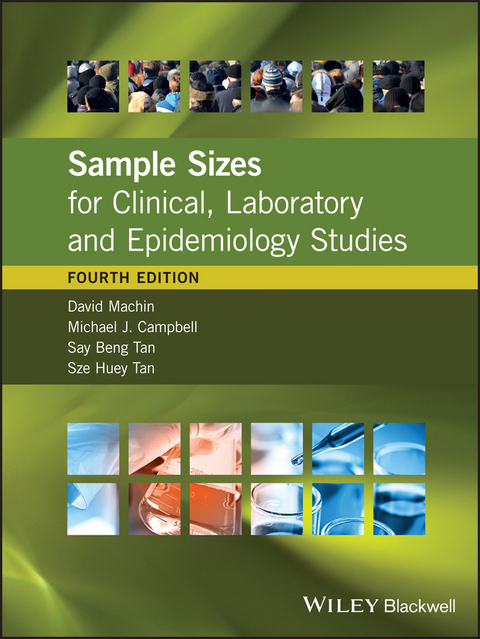
Sample Sizes for Clinical, Laboratory and Epidemiology Studies (eBook)
John Wiley & Sons (Verlag)
978-1-118-87493-6 (ISBN)
An authoritative resource that offers the statistical tools and software needed to design and plan valid clinical studies
Now in its fourth and extended edition, Sample Sizes for Clinical, Laboratory and Epidemiology Studiesincludes the sample size software (SSS) and formulae and numerical tables needed to design valid clinical studies. The text covers clinical as well as laboratory and epidemiology studies and contains the information needed to ensure a study will form a valid contribution to medical research.
The authors, noted experts in the field, explain step by step and explore the wide range of considerations necessary to assist investigational teams when deriving an appropriate sample size for their when planned study. The book contains sets of sample size tables with companion explanations and clear worked out examples based on real data. In addition, the text offers bibliography and references sections that are designed to be helpful with guidance on the principles discussed.
This revised fourth edition:
- Offers the only text available to include sample size software for use in designing and planning clinical studies
- Presents new and extended chapters with many additional and refreshed examples
- Includes clear explanations of the principles and methodologies involved with relevant practical examples
- Makes clear a complex but vital topic that is designed to ensure valid methodology and publishable results
- Contains guidance from an internationally recognised team of medical statistics experts
Written for medical researchers from all specialities and medical statisticians, Sample Sizes for Clinical, Laboratory and EpidemiologyStudies offers an updated fourth edition of the important guide for designing and planning reliable and evidence based clinical studies.
David Machin, Leicester Cancer Research Centre, University of Leicester, Leicester and Medical Statistics Group, School of Health and Related Research, University of Sheffield, Sheffield, UK.
Michael J. Campbell, Medical Statistics Group, School of Health and Related Research, University of Sheffield, Sheffield, UK.
Say Beng Tan, SingHealth Duke-NUS Academic Medical Centre, Singapore.
Sze Huey Tan, Division of Clinical Trials and Epidemiological Sciences, National Cancer Centre, Singapore.
An authoritative resource that offers the statistical tools and software needed to design and plan valid clinical studies Now in its fourth and extended edition, Sample Sizes for Clinical, Laboratory and Epidemiology Studiesincludes the sample size software (SSS) and formulae and numerical tables needed to design valid clinical studies. The text covers clinical as well as laboratory and epidemiology studies and contains the information needed to ensure a study will form a valid contribution to medical research. The authors, noted experts in the field, explain step by step and explore the wide range of considerations necessary to assist investigational teams when deriving an appropriate sample size for their when planned study. The book contains sets of sample size tables with companion explanations and clear worked out examples based on real data. In addition, the text offers bibliography and references sections that are designed to be helpful with guidance on the principles discussed. This revised fourth edition: Offers the only text available to include sample size software for use in designing and planning clinical studies Presents new and extended chapters with many additional and refreshed examples Includes clear explanations of the principles and methodologies involved with relevant practical examples Makes clear a complex but vital topic that is designed to ensure valid methodology and publishable results Contains guidance from an internationally recognised team of medical statistics experts Written for medical researchers from all specialities and medical statisticians, Sample Sizes for Clinical, Laboratory and EpidemiologyStudies offers an updated fourth edition of the important guide for designing and planning reliable and evidence based clinical studies.
David Machin, Leicester Cancer Research Centre, University of Leicester, Leicester and Medical Statistics Group, School of Health and Related Research, University of Sheffield, Sheffield, UK. Michael J. Campbell, Medical Statistics Group, School of Health and Related Research, University of Sheffield, Sheffield, UK. Say Beng Tan, SingHealth Duke-NUS Academic Medical Centre, Singapore. Sze Huey Tan, Division of Clinical Trials and Epidemiological Sciences, National Cancer Centre, Singapore.
Preface vii
1 Basic Design Considerations 1
2 Further Design Considerations 29
3 Binary Outcomes 41
4 Ordered Categorical Outcomes 55
5 Continuous Outcomes 67
6 Rate Outcomes 83
7 Survival Time Outcomes 99
8 Paired Binary, Ordered Categorical and Continuous Outcomes 117
9 Confidence Intervals 137
10 Repeated Outcome Measures 157
11 Non-Inferiority and Equivalence 169
12 Cluster Designs 195
13 Stepped Wedge Designs 215
14 More than Two Groups Designs 229
15 Genomic Targets and Dose-Finding 239
16 Feasibility and Pilot Studies 251
17 Therapeutic Exploratory Trials: Single Arm with Binary Outcomes 269
18 Therapeutic Exploratory Trials: Survival, Dual Endpoints, Randomised and Genomic Targets 283
19 The Correlation Coefficient 305
20 Observer Agreement Studies 317
21 Reference Intervals and Receiver Operating Curves 339
22 Sample Size Software ¯SSS 361
Cumulative References 363
Index 381
1
Basic Design Considerations
SUMMARY
This chapter reviews the reasons why sample size considerations are important when planning a clinical study of any type. The basic elements underlying this process include the null and alternative study hypotheses, effect size, statistical significance level and power, each of which are described. We introduce the notation to distinguish the population parameters we are trying to estimate with the study, from their anticipated value at the planning stages and also from their estimated value once the study has been completed. We emphasise for comparative studies that, whenever feasible, it is important to randomise the allocation of subjects to respective groups.
The basic properties of the standardised Normal distribution are described. Also discussed is how, once the effect size, statistical significance level and power for a comparative study using a continuous outcome are specified, the Fundamental Equation (which essentially plays a role in most sample size calculations for comparative studies) is derived.
The Student’s t‐distribution and the Non‐central t‐distribution are also described. In addition the Binomial, Poisson, Negative‐Binomial, Beta and Exponential statistical distributions are defined. In particular, the circumstances (essentially large study sizes) in which the Binomial and Poisson distributions have an approximately Normal shape are described. Methods for calculating confidence intervals for a population mean are indicated together with (suitably modified) how they can be used for a proportion or a rate in larger studies. For the Binomial situation, formulae are also provided where the sample size is not large. Finally, a note concerning numerical accuracy of the calculations in the illustrative examples of later chapters is included.
1.1 Why Sample Size Calculations?
To motivate the statistical issues relevant to sample size calculations, we will assume that we are planning a two‐group clinical trial in which subjects are allocated at random to one of two alternative treatments for a particular medical condition and that a single endpoint measure has been specified in advance. However, it should be emphasised that the basic principles described, the formulae, sample size tables and associated software included in this book are equally relevant to a wide range of design types covering all areas of medical research ranging from the epidemiological to clinical and laboratory‐based studies.
Whatever the field of inquiry the investigators associated with a well‐designed study will have considered the research questions posed carefully, formally estimated the required sample size (the particular focus for us in this book), and recorded the supporting reasons for their choice. Awareness of the importance of these has led to the major medical and related journals demanding that a detailed justification of the study size be included in any submitted article as it is a key component for peer reviewers to consider when assessing the scientific credibility of the work undertaken. For example, the General Statistical Checklist of the British Medical Journal asks statistical reviewers of their submitted papers ‘Was a pre‐study calculation of study size reported?’ Similarly, many research grant funding agencies such as the Singapore National Medical Research Council now also have such requirements in place.
In any event, at a more mundane level, investigators, grant‐awarding bodies and medical product development companies will all wish to know how much a study is likely to ‘cost’ both in terms of time and resources consumed as well as monetary terms. The projected study size will be a key component in this ‘cost’. They would also like to be reassured that the allocated resource will be well spent by assessing the likelihood that the study will give unequivocal results. In particular for clinical trials, the regulatory authorities, including the Committee for Proprietary Medicinal Products (CPMP, 1995) in the European Union and the Food and Drug Administration (FDA, 1988 and 1996) in the USA, require information on planned study size. These are encapsulated in the guidelines of the International Conference on Harmonisation of Technical Requirements for Registration of Pharmaceuticals for Human Use (1998) ICH Topic E9.
If too few subjects are involved, the study is potentially a misuse of time because realistic differences of scientific or clinical importance are unlikely to be distinguished from chance variation. Too large a study can be a waste of important resources. Further, it may be argued that ethical considerations also enter into sample size calculations. Thus a small clinical trial with no chance of detecting a clinically useful difference between treatments is unfair to all the patients put to the (possible) risk and discomfort of the trial processes. A trial that is too large may be unfair if one treatment could have been ‘proven’ to be more effective with fewer patients as a larger than necessary number of them has received the (now known) inferior treatment.
Providing a sample size for a study is not simply a matter of providing a single number from a set of statistical tables. It is, and should be, a several‐stage process. At the preliminary stages, what is required are ‘ball‐park’ figures that enable the investigators to judge whether or not to start the detailed planning of the study. If a decision is made to proceed, then the later stages are used to refine the supporting evidence for the preliminary calculations until they make a persuasive case for the final patient numbers chosen. Once decided this is then included (and justified) in the final study protocol.
After the final sample size is determined and the protocol is prepared and approved by the relevant bodies, it is incumbent on the research team to expedite the recruitment processes as much as possible, ensure the study is conducted to the highest of standards possible, and ensure that it is eventually reported comprehensively.
1.2 Statistical Significance
Notation
In very brief terms the (statistical) objective of any study is to estimate from a sample the value of a population parameter. For example, if we were interested in the mean birth weight of babies born in a certain locality, then we may record the weight of a selected sample of N babies and their mean weight is taken as our estimate of the population mean birth weight denoted ωPop. The Greek ω distinguishes the population value from its estimate, the Roman . When planning a study, we are clearly ignorant of ωPop and neither do we have the data to calculate . As we shall see later, when planning a study the investigators will usually need to provide some value for what ωPop may turn out to be. This anticipated value is denoted ωPlan. This value then forms (part of) the basis for subsequent sample size calculations.
Outcomes
In any study, it is necessary to define an outcome (endpoint) which may be, for example, the birth weight of the babies concerned, as determined by the objectives of the investigation. In other situations this outcome may be a measure of blood pressure, wound healing time, degree of palliation, a patient reported outcome (PRO) that indicates the level of some aspect of their Quality of Life (QoL) or any other relevant and measureable outcome of interest.
The Effect Size
Consider, as an example, a proposed randomised trial of a placebo (control, C) against acupuncture (A) for the relief of pain in patients with a particular diagnosis. The patients are randomised to receive either A or C (how placebo acupuncture can be administered is clearly an important consideration). In addition, we assume that pain relief is assessed at a fixed time after randomisation and is defined in such a way as to be unambiguously evaluable for each patient as either ‘success’ or ‘failure’. We assume the aim of the trial is to estimate the true difference δPop between the true success rate πPopA of A and the true success rate πPopC of C. Thus the key (population) parameter of interest is δPop which is a composite of the two (population) parameters πPopA and πPopC.
At the completion of the trial the A patients yield a treatment success rate pA which is an estimate of πPopA and for C the corresponding items are pC and πPopC. Thus, the observed difference, d = pA − pC, provides an estimate of the true difference (the effect size) δPop = πPopA − πPopC.
Significance Tests
In a clinical trial, two or more forms of therapy or intervention may be compared. However, patients themselves vary both in their baseline characteristics at diagnosis and in their response to subsequent therapy. Hence in a clinical trial, an apparent difference in treatments may be observed due to chance alone, that is, we may observe a difference but it may be explained by the intrinsic characteristics of the patients themselves rather than ‘caused’ by the different treatments given. As a consequence, it is customary to use a ‘significance...
| Erscheint lt. Verlag | 29.5.2018 |
|---|---|
| Sprache | englisch |
| Themenwelt | Medizin / Pharmazie ► Allgemeines / Lexika |
| Medizin / Pharmazie ► Medizinische Fachgebiete | |
| Technik ► Medizintechnik | |
| Schlagworte | basic design considerations • binary outcomes • Clinical & Experimental Medical Research • cluster designs • confidence intervals for clinical studies • continuous outcomes • Epidemiologie • feasibility and pilot studies • further design considerations • genomic targets and dose-finding in clinical studies • Klinische u. experimentelle medizinische Forschung • <p>Guide to Sample Size Tables for Clinical, Laboratory and Epidemiology Studies • Medical Science • Medical Statistics & Epidemiology • Medizin • Medizinische Statistik • Medizinische Statistik u. Epidemiologie • more than two groups designs • non-inferiority and equivalence • observer agreement studies • ordered categorical outcomes • paired binary<b>,</b> ordered categorical and continuous outcomes • Pharmacology & Pharmaceutical Medicine • Pharmakologie u. Pharmazeutische Medizin • rate outcomes • reference intervals and receiver operating curves</p> • repeated outcome measures • resource for understanding Sample Size Tables for Clinical, Laboratory and Epidemiology Studies • stepped wedge designs • Stichprobe • Survival time • the correlation coefficient • therapeutic exploratory trials - single arm with binary outcomes • therapeutic exploratory trials - survival, dual endpoints, randomised and genomic targets |
| ISBN-10 | 1-118-87493-5 / 1118874935 |
| ISBN-13 | 978-1-118-87493-6 / 9781118874936 |
| Informationen gemäß Produktsicherheitsverordnung (GPSR) | |
| Haben Sie eine Frage zum Produkt? |
 EPUB (Adobe DRM)
Kopierschutz: Adobe-DRM
Adobe-DRM ist ein Kopierschutz, der das eBook vor Mißbrauch schützen soll. Dabei wird das eBook bereits beim Download auf Ihre persönliche Adobe-ID autorisiert. Lesen können Sie das eBook dann nur auf den Geräten, welche ebenfalls auf Ihre Adobe-ID registriert sind.
Details zum Adobe-DRM
Dateiformat: EPUB (Electronic Publication)
EPUB ist ein offener Standard für eBooks und eignet sich besonders zur Darstellung von Belletristik und Sachbüchern. Der Fließtext wird dynamisch an die Display- und Schriftgröße angepasst. Auch für mobile Lesegeräte ist EPUB daher gut geeignet.
Systemvoraussetzungen:
PC/Mac: Mit einem PC oder Mac können Sie dieses eBook lesen. Sie benötigen eine
eReader: Dieses eBook kann mit (fast) allen eBook-Readern gelesen werden. Mit dem amazon-Kindle ist es aber nicht kompatibel.
Smartphone/Tablet: Egal ob Apple oder Android, dieses eBook können Sie lesen. Sie benötigen eine
Geräteliste und zusätzliche Hinweise
Buying eBooks from abroad
For tax law reasons we can sell eBooks just within Germany and Switzerland. Regrettably we cannot fulfill eBook-orders from other countries.
aus dem Bereich