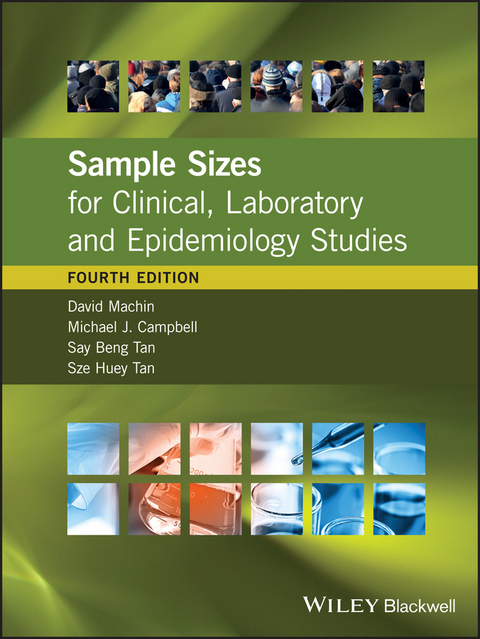
Sample Sizes for Clinical, Laboratory and Epidemiology Studies (eBook)
John Wiley & Sons (Verlag)
978-1-118-87492-9 (ISBN)
An authoritative resource that offers the statistical tools and software needed to design and plan valid clinical studies
Now in its fourth and extended edition, Sample Sizes for Clinical, Laboratory and Epidemiology Studiesincludes the sample size software (SSS) and formulae and numerical tables needed to design valid clinical studies. The text covers clinical as well as laboratory and epidemiology studies and contains the information needed to ensure a study will form a valid contribution to medical research.
The authors, noted experts in the field, explain step by step and explore the wide range of considerations necessary to assist investigational teams when deriving an appropriate sample size for their when planned study. The book contains sets of sample size tables with companion explanations and clear worked out examples based on real data. In addition, the text offers bibliography and references sections that are designed to be helpful with guidance on the principles discussed.
This revised fourth edition:
- Offers the only text available to include sample size software for use in designing and planning clinical studies
- Presents new and extended chapters with many additional and refreshed examples
- Includes clear explanations of the principles and methodologies involved with relevant practical examples
- Makes clear a complex but vital topic that is designed to ensure valid methodology and publishable results
- Contains guidance from an internationally recognised team of medical statistics experts
Written for medical researchers from all specialities and medical statisticians, Sample Sizes for Clinical, Laboratory and EpidemiologyStudies offers an updated fourth edition of the important guide for designing and planning reliable and evidence based clinical studies.
David Machin, Leicester Cancer Research Centre, University of Leicester, Leicester and Medical Statistics Group, School of Health and Related Research, University of Sheffield, Sheffield, UK.
Michael J. Campbell, Medical Statistics Group, School of Health and Related Research, University of Sheffield, Sheffield, UK.
Say Beng Tan, SingHealth Duke-NUS Academic Medical Centre, Singapore.
Sze Huey Tan, Division of Clinical Trials and Epidemiological Sciences, National Cancer Centre, Singapore.
An authoritative resource that offers the statistical tools and software needed to design and plan valid clinical studies Now in its fourth and extended edition, Sample Sizes for Clinical, Laboratory and Epidemiology Studiesincludes the sample size software (SSS) and formulae and numerical tables needed to design valid clinical studies. The text covers clinical as well as laboratory and epidemiology studies and contains the information needed to ensure a study will form a valid contribution to medical research. The authors, noted experts in the field, explain step by step and explore the wide range of considerations necessary to assist investigational teams when deriving an appropriate sample size for their when planned study. The book contains sets of sample size tables with companion explanations and clear worked out examples based on real data. In addition, the text offers bibliography and references sections that are designed to be helpful with guidance on the principles discussed. This revised fourth edition: Offers the only text available to include sample size software for use in designing and planning clinical studies Presents new and extended chapters with many additional and refreshed examples Includes clear explanations of the principles and methodologies involved with relevant practical examples Makes clear a complex but vital topic that is designed to ensure valid methodology and publishable results Contains guidance from an internationally recognised team of medical statistics experts Written for medical researchers from all specialities and medical statisticians, Sample Sizes for Clinical, Laboratory and EpidemiologyStudies offers an updated fourth edition of the important guide for designing and planning reliable and evidence based clinical studies.
David Machin, Leicester Cancer Research Centre, University of Leicester, Leicester and Medical Statistics Group, School of Health and Related Research, University of Sheffield, Sheffield, UK. Michael J. Campbell, Medical Statistics Group, School of Health and Related Research, University of Sheffield, Sheffield, UK. Say Beng Tan, SingHealth Duke-NUS Academic Medical Centre, Singapore. Sze Huey Tan, Division of Clinical Trials and Epidemiological Sciences, National Cancer Centre, Singapore.
Title Page 5
Copyright Page 6
Contents 7
Preface 9
Chapter 1 Basic Design Considerations 11
1.1 Why Sample Size Calculations? 11
1.2 Statistical Significance 12
Notation 12
Outcomes 13
The Effect Size 13
Significance Tests 13
The Null Hypothesis and Test Size 13
The Alternative Hypothesis and Power 14
1.3 Planning Issues 14
The Effect Size 14
One- or Two-Sided Significance Tests 15
Choosing ? and ? 16
Sample Size and Interpretation of Significance 16
1.4 The Normal Distribution 17
The ‘Fundamental Equation’ 18
Choice of Allocation Ratio 20
Notation 20
Use of Tables 1.1 and 1.2 21
1.5 Distributions 21
Central and Non?Central T?Distributions 21
Binomial 22
Poisson 25
Negative-Binomial 25
Beta 27
Exponential 27
1.6 Confidence Intervals 28
Normal 29
Use of Table 1.3 30
Binomial 30
Poisson 31
Exponential 32
1.7 Use of Sample Size Tables 33
Number of Subjects 33
Power of a Study 33
Size of Effect 33
1.8 Numerical Accuracy 33
1.9 Software for Sample Size Calculations 34
References 34
Chapter 2 Further Design Considerations 39
2.1 Group Allocation 39
2.2 More than Two Groups 40
Regression Model 40
Unstructured Groups 40
Ordered Groups 40
Factorial Designs 41
2.3 The Role of Covariates 42
Extending the Design Model 42
2.4 Multiple Endpoints 42
Ranking the Multiple Endpoints 43
2.5 Repeated Significance Tests 43
Bonferroni Correction 43
2.6 Epidemiological Studies 45
2.7 The Protocol and Publication 46
2.8 Ethical Issues and Sample Size 48
References 49
Chapter 3 Binary Outcomes 51
3.1 Introduction 51
3.2 Comparing Proportions 51
Effect Size 52
Analysis 52
?2 Test 53
Fisher’s Exact Test 53
3.3 One Proportion Known 54
?2 Test 54
3.4 Bibliography 54
3.5 Examples and Use of the Tables 55
Table 3.1 and Equations 3.2 and 3.3 55
Table 3.1 and Equations 3.2, 3.3, 3.4 and 3.5 55
Equations 3.2 and 3.5 56
Table 3.2 and Equations 3.1, 3.2, 3.3 and 3.4 56
Equations 3.1, 3.3 and 3.4 57
Equations 3.2, 3.3 and 3.4 57
Equation 3.6 58
References 59
Chapter 4 Ordered Categorical Outcomes 65
4.1 Introduction 65
4.2 Ordered Categorical Data 65
Mann?Whitney U?Test 65
Planning Values 66
Sample Size 67
4.3 Bibliography 69
4.4 Examples 69
Equations 4.2, 4.3 and 4.4 69
Equations 4.2, 4.3 and 4.4 70
Equations 4.2, 4.3 and 4.4 71
Equations 4.2, 4.3 and 4.4 71
Equations 4.3, 4.4 and 4.6 73
Equation 4.8 74
References 75
Chapter 5 Continuous Outcomes 77
5.1 Introduction 77
5.2 Comparing Means 77
Effect Size 78
Two-Sample T-Test 78
Wilcoxon-Mann-Whitney U-Test 80
5.3 One Mean Known 81
One-Sample T-Test 81
5.4 Bibliography 81
5.5 Examples 81
Table 5.1 and Equation 5.4 82
Table 5.1 and Equation 5.4 82
Equation 5.4 82
Equation 5.4 83
Table 5.2 and Equation 5.6 83
Table 5.3 and Equations 5.7, 5.8 and 5.9 84
Table 5.3 and Equations 5.9 and 5.10 85
Table 5.4 and Equation 5.11 85
References 86
Chapter 6 Rate Outcomes 93
6.1 Introduction 93
6.2 Comparing Rates 94
Effect Size 94
6.3 Post-Marketing Surveillance 95
Single Group Studies 95
Comparative Studies 96
Matched Case-Control Studies 97
Several Independent Reactions 97
6.4 Bibliography 97
6.5 Examples and Use of the Tables 98
Equation 6.2 98
Equation 6.2 98
Equations 6.4 and 6.5 99
Table 6.1 and Equation 6.6 100
Table 6.1 and Equations 6.6 and 6.7 100
Table 6.2 and Equation 6.8 101
Equations 6.2 and 6.9 101
Table 6.3 and Equations 6.9 and 6.10 102
Table 6.4 and Equations 6.11 and 6.12 102
References 103
Chapter 7 Survival Time Outcomes 109
7.1 Introduction 109
7.2 Events of a Single Type 110
Exponential Survival Times 110
Proportional Hazards 111
Number of Events 111
Number of Subjects 112
Study Duration 112
7.3 Competing Risks 113
Cause-Specific 113
Sub-Distribution 114
7.4 Subject Withdrawals 115
7.5 Bibliography 116
7.6 Examples 116
Table 7.1 and Equations 7.3 and 7.7 116
Tables 7.1, 7.2 and 7.3 and Equations 7.4, 7.7 and 7.8 117
Equations 7.3, 7.4, 7.7 and 7.8 117
Equations 7.3, 7.4, 7.7, 7.8 and 7.18 118
Equations 7.3, 7.7 and 7.8 119
Equations 7.6, 7.10, 7.11, 7.12, 7.13, 7.15 and 7.17 119
Equations 7.6, 7.8, 7.10. 7.11, 7.12 and 7.16 121
References 122
Chapter 8 Paired Binary, Ordered Categorical and Continuous Outcomes 127
8.1 Introduction 127
8.2 Within and Between Subject Variation 127
8.3 Designs 128
Cross-over Trial 128
Matched Case-control Study 128
Before-and-after Design 129
Paired Organs Design 129
Split-mouth Design 129
8.4 Binary Data 129
Mcnemar Test 129
8.5 Ordered Categorical Data 131
Wilcoxon Signed Rank Test 131
8.6 Continuous Data 133
Paired t-Test 133
Analysis of Variance (Anova) 134
8.7 Bibliography 136
8.8 Examples and Use of the Tables 136
Table 8.1 and Equation 8.1 136
Table 8.1 and Equations 8.1, 8.2 and 8.4 137
Table 8.1 and Equation 8.1 138
Table 8.1 and Equations 8.1 and 8.5 138
Table 8.2 and Equations 8.6, 8.7, 8.8 and 8.9 139
Equation 8.12 140
Table 8.2 and Equations 8.11, 8.12 and 8.14 141
Table 8.2 and Equations 8.11 and 8.12 141
Table 8.2 and Equations 8.11, 8.12 and 8.14 142
References 143
Chapter 9 Confidence Intervals 147
9.1 Introduction 147
Power Implications 148
9.2 Single Proportion 148
Large Populations - Response Rate not too Close to 0 or 1 148
High or Low Anticipated Response Rate 149
Finite Populations 149
9.3 Proportions from Two Groups 150
Independent Groups 150
Paired Groups 151
9.4 Single Mean 152
9.5 Difference Between Means 153
Independent Groups 153
Paired or Matched Groups 153
9.6 Bibliography 154
9.7 Examples and Use of the Tables 154
Table 9.1 and Equations 9.2 and 9.5 154
Equation 9.3 154
Equation 9.5 155
Equations 9.3 and 9.7 155
Table 9.2 and Equations 9.10 and 9.11 156
Table 9.3 and Equations 9.12 and 9.15 156
Table 9.4 and Equation 9.16 157
Tables 2.3 and 9.5 and Equations 9.18 and 9.19 157
Table 9.5 and Equation 9.22 158
Table 9.5 and Equation 9.24 158
References 159
Chapter 10 Repeated Outcome Measures 167
10.1 Design Features 167
Illustration 167
Models and Intra?class Correlation 168
10.2 Design Effects and Sample Size 169
Endpoint: Post-intervention Means 169
Endpoint: Post-intervention Slopes 171
Endpoint: Selected Post-intervention Assessements 171
10.3 Practicalities 172
10.4 Bibliography 173
10.5 Examples 173
Table 10.1 and Equations 10.7 and 10.8 173
Table 10.1 and Equations 10.7 and 10.8 174
Equations 10.7 and 10.9 175
Equations 10.7, 10.10 and 10.11 175
Equation 10.7, 10.12, 10.13, and 10.14 176
References 176
Chapter 11 Non-Inferiority and Equivalence 179
11.1 Introduction 179
11.2 Hypotheses 180
11.3 Non-Inferiority 181
Illustration 181
Difference of Means 182
Difference of Proportions 183
Hazard Ratio 185
Regulatory Recommendations 186
11.4 Equivalence 186
Sample Size 187
11.5 Bioequivalence 187
Cross-Over Design 188
Ratio of Means 188
Regulatory Recommendations 190
11.6 Practical Issues 190
Intention-to-Treat or Per Protocol 190
11.7 Bibliography 191
11.8 Examples 191
Non-Inferiority 191
Equivalence 195
Bioequivalence 196
References 196
Chapter 12 Cluster Designs 205
12.1 Introduction 205
12.2 Design Features 206
Intra-Cluster Correlation – (ICC) Continuous Outcome 206
The Design Effect (DE) 207
12.3 Sample Size for Cluster Trials 208
Non-aggregate and Aggregate Designs 208
Continuous Outcome 208
Binary Outcome 209
Ordinal Outcome 210
Rate Outcome 211
Time-to-Event Outcome 211
Matched Designs 212
Cross-over Designs 213
12.4 Baseline Observations 213
12.5 Number of Clusters Fixed 214
12.6 Practicalities 214
12.7 Bibliography 215
12.8 Examples 215
Numerical Accuracy 215
References 221
Chapter 13 Stepped Wedge Designs 225
13.1 Introduction 225
13.2 Basic Structure 225
13.3 Cross-Sectional Design 227
Illustration 227
Design Features 228
Sample Size 229
Specific Examples 231
13.4 Closed-Cohort Design 232
Illustration 232
Design Features 232
Sample Size 233
13.5 Link with a Repeated Measures Design 234
13.6 Bibliography 234
13.7 Examples 234
Numerical Accuracy 234
References 236
Chapter 14 More than Two Groups Designs 239
14.1 More than Two Groups 239
Unstructured Groups 240
Dose Response Designs 240
Several Comparisons with a Reference 241
Factorial Designs 243
14.2 Bibliography 243
14.3 Examples 244
Equation 3.2 244
Equations 14.3, 14.4 and 14.5 245
Equations 14.3 and 14.4 245
Equation 14.7 245
Equations 14.7, 14.8 and 14.11 246
Equation 5.4 247
References 247
Chapter 15 Genomic Targets and Dose-Finding 249
15.1 Introduction 249
15.2 Genomic Targets 249
Single Classifier 250
Enrichment Design 250
Biomarker Stratified Design 251
Adaptive Threshold Design 252
Other Developments 252
15.3 Dose-Finding 253
Step-by-Step Designs 253
Continual Reassessment Method 255
Which Design? 256
15.4 Examples 257
References 259
Chapter 16 Feasibility and Pilot Studies 261
16.1 Introduction 261
16.2 Feasibility or Pilot? 262
Feasibility Studies 262
Pilot Studies 263
External- and Internal-Pilot Studies 263
Proof-of-Concept Study 263
16.3 Design Criteria 264
16.4 External-Pilot 264
Sample Size Issues 265
Using the Results of a Pilot to Plan the Main Study 265
Accounting for Imprecision in the Standard Deviation 265
Sample Size of an External?pilot 267
16.5 Considerations Across External-Pilot and Main Trials 267
Optimising Overall Sample Size 268
16.6 Internal-Pilot Studies 268
16.7 Bibliography 269
16.8 Examples 269
Table 16.2 269
Tables 16.1 and 16.2 and Equations 5.4, 16.1 and 16.2 270
Table 16.2 and Equations 8.1, 8.2, 8.3 and 8.4 270
Table 16.2 271
Table 16.2 and Equation 5.4 271
Tables 16.3 and 16.4 272
Equation 5.4 272
References 273
Chapter 17 Therapeutic Exploratory Trials: Single Arm with Binary Outcomes 279
17.1 Introduction 279
17.2 Theory and Formulae 280
Single-Stage Design 281
Two-Stage Designs 281
Bayesian Designs 282
17.3 Bibliography 285
17.4 Examples 285
Table 17.1 285
Table 17.2 285
Tables 17.3 and 17.4 286
References 287
Chapter 18 Therapeutic Exploratory Trials: Survival, Dual Endpoints, Randomised and Genomic Targets 293
18.1 Time-to-Event (Survival) Endpoint 293
Case-Morgan 293
Case-Morgan Expected Duration of Accrual 296
Case-Morgan Expected Total Study Length 296
18.2 Response and Toxicity Endpoints 297
Bryant-Day 297
18.3 Randomised Designs 299
Simon-Wittes-Ellenberg 299
18.4 Genomic Targets 300
Single Arm Design 300
Randomised Design 301
18.5 Bibliography 302
18.6 Examples 304
Tables 18.1 and 18.2 and Equations 18.1, 18.4 and 18.5 304
Table 18.3 304
Equation 5.4 305
Table 18.4 305
References 306
Chapter 19 The Correlation Coefficient 315
19.1 Introduction 315
19.2 Theory and Formulae 316
Sample Size 316
Lack of Association 317
Confidence Intervals 317
19.3 Practical Considerations 318
19.4 Bibliography 319
19.5 Examples and Use of the Tables 319
Table 19.1 and Equations 19.1, 19.2 and 19.3 319
Table 19.1 and Equations 19.2 and 19.3 320
Table 19.1 and Equations 19.2 and 19.3 320
Table 19.1 and Equation 19.2 321
Table 19.2 and Equations 19.5, 19.6, 19.7 and 19.8 322
Table 19.3 and Equations 19.7, 19.8, 19.10 and 19.11 322
References 323
Chapter 20 Observer Agreement Studies 327
20.1 Introduction 327
20.2 Binary Outcomes 328
Agreement or Reproducibility 328
Agreement and Reproducibility 329
Cohen’s Kappa, ? 332
20.3 Continuous Outcomes 334
Intra-Class Correlation Coefficient 334
20.4 Bibliography 335
20.5 Examples and Use of the Tables 336
Table 20.1 and Equations 20.4 and 20.5 336
Table 20.2 and Equation 20.9 336
Tables 20.2 and 20.3 and Equations 20.9, 20.13, 20.14 and 20.15 337
Table 20.4 and Equation 20.18 338
Table 20.5 and Equations 20.20 and 20.21 338
Table 20.5 and Equations 20.20 and 20.21 339
Table 20.6 and Equations 20.22 and 20.23 339
Table 20.6 and Equations 20.22 and 20.23 340
References 341
Chapter 21 Reference Intervals and Receiver Operating Curves 349
21.1 Introduction 349
21.2 Reference Intervals 350
Choosing the Subjects 350
Normal Distribution 350
Non-normal Situation 351
21.3 Sensitivity and Specificity 353
One Sample Design 353
Two Sample Design 353
21.4 Receiver Operating Curvess 354
21.5 Bibliography 355
21.6 Examples and Use of the Tables 356
Table 21.1 and Equation 21.6 356
Table 21.2 and Equations 21.11 and 21.14 356
Table 21.3 and Equation 21.15 357
Tables 21.4 and 21.5 and Equations 21.16 and 21.17 357
Table 21.6 and Equations 21.19 and 21.20 358
References 359
Chapter 22 Sample Size Software 371
22.1 Introduction 371
22.2 System Requirements 371
22.3 Installation Instructions 372
22.4 Help Guide 372
Index 391
Supplemental Images 401
EULA 409
| Erscheint lt. Verlag | 29.5.2018 |
|---|---|
| Sprache | englisch |
| Themenwelt | Medizin / Pharmazie ► Allgemeines / Lexika |
| Medizin / Pharmazie ► Medizinische Fachgebiete | |
| Technik ► Medizintechnik | |
| Schlagworte | basic design considerations • binary outcomes • Clinical & Experimental Medical Research • cluster designs • confidence intervals for clinical studies • continuous outcomes • Epidemiologie • feasibility and pilot studies • further design considerations • genomic targets and dose-finding in clinical studies • Klinische u. experimentelle medizinische Forschung • <p>Guide to Sample Size Tables for Clinical, Laboratory and Epidemiology Studies • Medical Science • Medical Statistics & Epidemiology • Medizin • Medizinische Statistik • Medizinische Statistik u. Epidemiologie • more than two groups designs • non-inferiority and equivalence • observer agreement studies • ordered categorical outcomes • paired binary<b>,</b> ordered categorical and continuous outcomes • Pharmacology & Pharmaceutical Medicine • Pharmakologie u. Pharmazeutische Medizin • rate outcomes • reference intervals and receiver operating curves</p> • repeated outcome measures • resource for understanding Sample Size Tables for Clinical, Laboratory and Epidemiology Studies • stepped wedge designs • Stichprobe • Survival time • the correlation coefficient • therapeutic exploratory trials - single arm with binary outcomes • therapeutic exploratory trials - survival, dual endpoints, randomised and genomic targets |
| ISBN-10 | 1-118-87492-7 / 1118874927 |
| ISBN-13 | 978-1-118-87492-9 / 9781118874929 |
| Informationen gemäß Produktsicherheitsverordnung (GPSR) | |
| Haben Sie eine Frage zum Produkt? |
 PDF (Adobe DRM)
Kopierschutz: Adobe-DRM
Adobe-DRM ist ein Kopierschutz, der das eBook vor Mißbrauch schützen soll. Dabei wird das eBook bereits beim Download auf Ihre persönliche Adobe-ID autorisiert. Lesen können Sie das eBook dann nur auf den Geräten, welche ebenfalls auf Ihre Adobe-ID registriert sind.
Details zum Adobe-DRM
Dateiformat: PDF (Portable Document Format)
Mit einem festen Seitenlayout eignet sich die PDF besonders für Fachbücher mit Spalten, Tabellen und Abbildungen. Eine PDF kann auf fast allen Geräten angezeigt werden, ist aber für kleine Displays (Smartphone, eReader) nur eingeschränkt geeignet.
Systemvoraussetzungen:
PC/Mac: Mit einem PC oder Mac können Sie dieses eBook lesen. Sie benötigen eine
eReader: Dieses eBook kann mit (fast) allen eBook-Readern gelesen werden. Mit dem amazon-Kindle ist es aber nicht kompatibel.
Smartphone/Tablet: Egal ob Apple oder Android, dieses eBook können Sie lesen. Sie benötigen eine
Geräteliste und zusätzliche Hinweise
Buying eBooks from abroad
For tax law reasons we can sell eBooks just within Germany and Switzerland. Regrettably we cannot fulfill eBook-orders from other countries.
aus dem Bereich