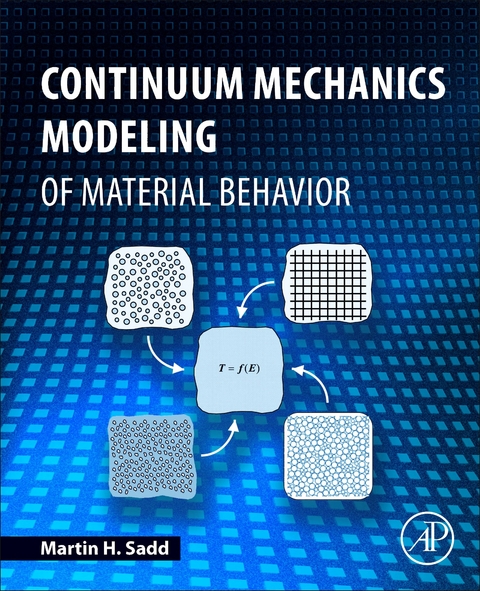
Continuum Mechanics Modeling of Material Behavior (eBook)
432 Seiten
Elsevier Science (Verlag)
978-0-12-811649-4 (ISBN)
Martin H. Sadd is Professor Emeritus of Mechanical Engineering and Applied Mechanics at the University of Rhode Island. He received his Ph.D. in mechanics from the Illinois Institute of Technology and began his academic career at Mississippi State University. In 1979 he joined the faculty at Rhode Island and served as department chair from 1991 to 2000. Professor Sadd's teaching background is in the area of solid mechanics with emphasis in elasticity, continuum mechanics, wave propagation, and computational methods. He has taught elasticity at two academic institutions, in several industries, and at a government laboratory. Professor Sadd's research has been in computational modeling of materials under static and dynamic loading conditions using finite, boundary, and discrete element methods. Much of his work has involved micromechanical modeling of geomaterials including granular soil, rock, and concretes. He has authored more than 75 publications and has given numerous presentations at national and international meetings.
Continuum Mechanics Modeling of Material Behavior offers a uniquely comprehensive introduction to topics like RVE theory, fabric tensor models, micropolar elasticity, elasticity with voids, nonlocal higher gradient elasticity and damage mechanics. Contemporary continuum mechanics research has been moving into areas of complex material microstructural behavior. Graduate students who are expected to do this type of research need a fundamental background beyond classical continuum theories. The book begins with several chapters that carefully and rigorously present mathematical preliminaries: kinematics of motion and deformation; force and stress measures; and general principles of mass, momentum and energy balance. The book then moves beyond other books by dedicating several chapters to constitutive equation development, exploring a wide collection of constitutive relations and developing the corresponding material model formulations. Such material behavior models include classical linear theories of elasticity, fluid mechanics, viscoelasticity and plasticity. Linear multiple field problems of thermoelasticity, poroelasticity and electoelasticity are also presented. Discussion of nonlinear theories of solids and fluids, including finite elasticity, nonlinear/non-Newtonian viscous fluids, and nonlinear viscoelastic materials are also given. Finally, several relatively new continuum theories based on incorporation of material microstructure are presented including: fabric tensor theories, micropolar elasticity, elasticity with voids, nonlocal higher gradient elasticity and damage mechanics. - Offers a thorough, concise and organized presentation of continuum mechanics formulation- Covers numerous applications in areas of contemporary continuum mechanics modeling, including micromechanical and multi-scale problems- Integration and use of MATLAB software gives students more tools to solve, evaluate and plot problems under study- Features extensive use of exercises, providing more material for student engagement and instructor presentation
| Erscheint lt. Verlag | 31.3.2018 |
|---|---|
| Sprache | englisch |
| Themenwelt | Naturwissenschaften ► Physik / Astronomie |
| Technik ► Bauwesen | |
| Technik ► Maschinenbau | |
| ISBN-10 | 0-12-811649-8 / 0128116498 |
| ISBN-13 | 978-0-12-811649-4 / 9780128116494 |
| Informationen gemäß Produktsicherheitsverordnung (GPSR) | |
| Haben Sie eine Frage zum Produkt? |
 EPUB (Adobe DRM)
Kopierschutz: Adobe-DRM
Adobe-DRM ist ein Kopierschutz, der das eBook vor Mißbrauch schützen soll. Dabei wird das eBook bereits beim Download auf Ihre persönliche Adobe-ID autorisiert. Lesen können Sie das eBook dann nur auf den Geräten, welche ebenfalls auf Ihre Adobe-ID registriert sind.
Details zum Adobe-DRM
Dateiformat: EPUB (Electronic Publication)
EPUB ist ein offener Standard für eBooks und eignet sich besonders zur Darstellung von Belletristik und Sachbüchern. Der Fließtext wird dynamisch an die Display- und Schriftgröße angepasst. Auch für mobile Lesegeräte ist EPUB daher gut geeignet.
Systemvoraussetzungen:
PC/Mac: Mit einem PC oder Mac können Sie dieses eBook lesen. Sie benötigen eine
eReader: Dieses eBook kann mit (fast) allen eBook-Readern gelesen werden. Mit dem amazon-Kindle ist es aber nicht kompatibel.
Smartphone/Tablet: Egal ob Apple oder Android, dieses eBook können Sie lesen. Sie benötigen eine
Geräteliste und zusätzliche Hinweise
Buying eBooks from abroad
For tax law reasons we can sell eBooks just within Germany and Switzerland. Regrettably we cannot fulfill eBook-orders from other countries.
aus dem Bereich