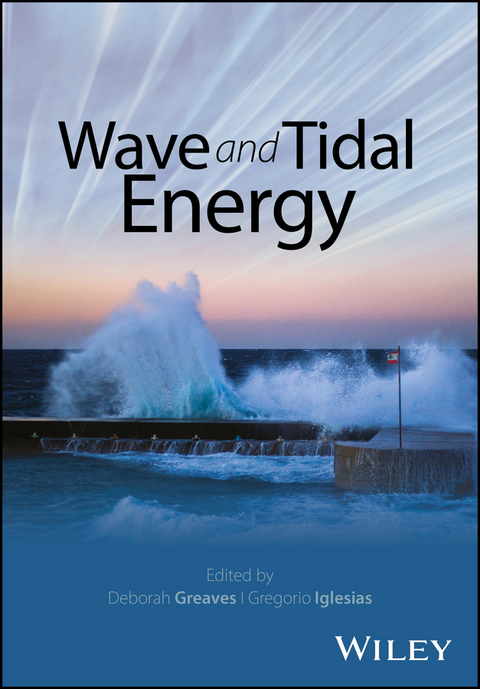
Wave and Tidal Energy (eBook)
John Wiley & Sons (Verlag)
978-1-119-01447-8 (ISBN)
A comprehensive text covering all aspects of wave and tidal energy
Wave and Tidal Energy provides a comprehensive and self-contained review of the developing marine renewable energy sector, drawing from the latest research and from the experience of device testing. The book has a twofold objective: to provide an overview of wave and tidal energy suitable for newcomers to the field and to serve as a reference text for advanced study and practice.
Including detail on key issues such as resource characterisation, wave and tidal technology, power systems, numerical and physical modelling, environmental impact and policy. The book also includes an up-to-date review of developments worldwide and case studies of selected projects.
Key features:
- A comprehensive and self-contained text covering all aspects of the multidisciplinary fields of wave and tidal energy.
- Draws upon the latest research in wave and tidal energy and the experience of leading practitioners in numerical and laboratory modelling.
- Regional developments worldwide are reviewed and representative projects are presented as case studies.
Wave and Tidal Energy is an invaluable resource to a wide range of readers, from engineering students to technical managers and policymakers to postgraduate students and researchers.
Deborah Greaves is Professor of Ocean Engineering and Director of the COAST (Coastal, Ocean and Sediment Transport) Laboratory at University of Plymouth and is Board Member and Inaugural Chair for PRIMaRE (the Partnership for Research In Marine Renewable Energy, www.primare.org). Her research interests include marine renewable energy, physical and numerical modelling of violent free surface flow and fluid-structure interaction. She leads and has led a number of research projects concerning marine renewable energy in collaboration with industrial and academic partners. She has published over 125 peer-reviewed papers, has secured £3.9 million research income as PI, is a Chartered Engineer and Fellow of the Institution of Civil Engineers, a Member of RINA (Royal Institution of Naval Architects), and a member of the technical committee for EWTEC (European Wave and Tidal Energy Conference), a reviewer for UK Research Councils, for several journals, and was shortlisted for the 2014 WISE Research Award.
Gregorio Iglesias (GI) is Professor of Coastal Engineering at University of Plymouth and Leader of the COAST (Coastal, Ocean and Sediment Transport) Research Group. He has over 20 years' experience in numerical and physical modelling applied to Marine Renewable Energy and Coastal Engineering, including the characterisation of wave and tidal resources, and the modelling of coastal morphodynamics accounting for the effects of wave and tidal farms. He participates in the design and laboratory tests of WECs and coastal and port structures, and acts as PI on research grants and contracts funded by the European Commission, various national research councils, coastal management agencies and port authorities. He is a member of the IEC Technical Committee for sub-prototype size wave energy device development (laboratory testing) and one of the inventors of the WaveCat, a floating overtopping WEC. Professor Iglesias has published over 100 peer-reviewed papers and secured over £5M research income.
A comprehensive text covering all aspects of wave and tidal energy Wave and Tidal Energy provides a comprehensive and self-contained review of the developing marine renewable energy sector, drawing from the latest research and from the experience of device testing. The book has a twofold objective: to provide an overview of wave and tidal energy suitable for newcomers to the field and to serve as a reference text for advanced study and practice. Including detail on key issues such as resource characterisation, wave and tidal technology, power systems, numerical and physical modelling, environmental impact and policy. The book also includes an up-to-date review of developments worldwide and case studies of selected projects.Key features: A comprehensive and self-contained text covering all aspects of the multidisciplinary fields of wave and tidal energy. Draws upon the latest research in wave and tidal energy and the experience of leading practitioners in numerical and laboratory modelling. Regional developments worldwide are reviewed and representative projects are presented as case studies. Wave and Tidal Energy is an invaluable resource to a wide range of readers, from engineering students to technical managers and policymakers to postgraduate students and researchers.
Deborah Greaves is Professor of Ocean Engineering and Director of the COAST (Coastal, Ocean and Sediment Transport) Laboratory at University of Plymouth and is Board Member and Inaugural Chair for PRIMaRE (the Partnership for Research In Marine Renewable Energy, www.primare.org). Her research interests include marine renewable energy, physical and numerical modelling of violent free surface flow and fluid-structure interaction. She leads and has led a number of research projects concerning marine renewable energy in collaboration with industrial and academic partners. She has published over 125 peer-reviewed papers, has secured £3.9 million research income as PI, is a Chartered Engineer and Fellow of the Institution of Civil Engineers, a Member of RINA (Royal Institution of Naval Architects), and a member of the technical committee for EWTEC (European Wave and Tidal Energy Conference), a reviewer for UK Research Councils, for several journals, and was shortlisted for the 2014 WISE Research Award. Gregorio Iglesias (GI) is Professor of Coastal Engineering at University of Plymouth and Leader of the COAST (Coastal, Ocean and Sediment Transport) Research Group. He has over 20 years' experience in numerical and physical modelling applied to Marine Renewable Energy and Coastal Engineering, including the characterisation of wave and tidal resources, and the modelling of coastal morphodynamics accounting for the effects of wave and tidal farms. He participates in the design and laboratory tests of WECs and coastal and port structures, and acts as PI on research grants and contracts funded by the European Commission, various national research councils, coastal management agencies and port authorities. He is a member of the IEC Technical Committee for sub-prototype size wave energy device development (laboratory testing) and one of the inventors of the WaveCat, a floating overtopping WEC. Professor Iglesias has published over 100 peer-reviewed papers and secured over £5M research income.
1
Introduction
Deborah Greavesa and Gregorio Iglesiasb
a Professor of Ocean Engineering, School of Engineering, University of Plymouth, UK
b Professor of Coastal Engineering, School of Engineering, University of Plymouth, UK
1.1 Background
More than 83% of the energy conversion in the world is today based on fossil fuels; meanwhile scientists all over the world are debating the topic of peak oil [1] and the secondary effects of the emissions from the fossil fuels [2, 3]. Fossil fuels are a finite resource; burning them generates significant carbon dioxide emissions that are changing the world’s climate. The impact of climate change is thought to be changing habitats at a rate faster than many species can adapt, and the level of pollution in many of the world’s cities is today causing concern. As a future worldwide shortage of useful energy supply can have devastating consequences on the political stability and economy of the world, there is a growing consensus that the world needs to switch to a more sustainable energy system. The focus and requirement for clean and cheap renewable energy conversion techniques has therefore increased.
The Paris Summit of 2015 [4] has driven further impetus for finding alternative sources of energy, and a deal was agreed to attempt to limit the rise in global temperatures to less than 2 °C. The Paris agreement is the first to commit all countries to cut carbon emissions, and is partly legally binding and partly voluntary. The measures in the agreement include [5]: to peak greenhouse gas emissions as soon as possible and achieve a balance between sources and sinks of greenhouse gases in the second half of this century; to keep global temperature increase ‘well below’ 2 °C (3.6 °F) and to pursue efforts to limit it to 1.5 °C; to review progress every 5 years; and $100 billion a year in climate finance for developing countries by 2020, with a commitment to further finance in the future. There is clear acknowledgement of climate change and also a clearly stated will to address the anthropogenic causes of climate change and to reduce emissions and seek alternative sustainable and environmentally benign sources of energy. How this new agreement will be implemented within individual countries will be influenced by local factors.
Renewable sources of energy are essential alternatives to fossil fuels and to nuclear energy, which also has a finite resource as well as long-term safety concerns. Renewable energy sources include solar, wind, geothermal and marine renewable energy (MRE). Their use reduces greenhouse gas emissions, diversifies energy supply and reduces dependence on unreliable and volatile fossil fuel markets. The world is moving on renewables, and they have become the cornerstone of any low-carbon economy today, not just in the future. The USA is targeting a 32% cut in power sector emissions by 2030, India plans 100 GW of solar by 2022, and China is investing heavily in wind and renewable energy: the transition to a low-carbon energy system is well under way.
Within this drive for renewable energy, MRE is poised to play a major role [6], in particular in certain countries where these resources are vast. Renewable energy from the sea is generated by the sun, wind and tides, and may be exploited through various technologies such as wave energy, tidal stream, tidal range, offshore wind energy and ocean thermal energy currents (OTEC). MRE, also often termed ‘ocean energy’, has a major part to play in closing the world’s energy gap and lowering carbon emissions. Key global challenges that remain for MRE relate to technology, grid infrastructure, cost and investment, environmental impact, and marine governance. Of these technologies, offshore wind is mature and many commercial projects exist in shallow waters, although new offshore wind technology is needed to develop sites further offshore in deeper water. Technologically, the development of offshore wind in shallower water is a natural extension of onshore wind, and typical difficulties for onshore wind in gaining social acceptability and approval are often less problematic if turbines are located offshore. Also, the wind resource offshore is greater due to lack of obstructions to the wind flow. Offshore wind turbines are typically similar to those used onshore and consist of three blades rotating about a hub, and in shallower water the wind turbine structures are typically on piled foundations or fixed jackets. However, as development of wind farms moves further offshore and into deeper water, other solutions need to be sought involving floating structures and the costs increase significantly. Although offshore wind technology is rapidly being implemented, there remain many fascinating engineering problems to overcome. These include: offshore foundations and floating support structures; alternative turbine designs based on three-dimensional computational fluid dynamics; use of advanced materials for blades; ship manoeuvring for safe maintenance; and shared offshore platform applications (such as energy production, storage, and marine aquaculture).
Tidal power is approaching commercial maturity, and recent investments and commercial developments have been made. Tidal range projects exist, but there are concerns about the extent of the environmental impact they bring, and tidal lagoon technology is emerging as an attractive alternative. Tidal steam technologies have seen great advances in recent years. On the other hand, wave energy encompasses emerging technologies that are currently not economically competitive, but still attract engineering interest thanks to the significant resource in high power density sea waves and its potential exploitation [7].
Within Europe, ocean energy is considered to have the potential to be an important component of Europe’s renewable energy mix, as part of its longer-term energy strategy. According to the recent studies [8,9], the potential resource of wave and tidal energy is 337 GW of installed capacity by 20508 globally, with 36 GW quoted as the practically extractable wave and tidal resource by 2035 in the UK, representing a marine energy industry worth up to £6.1 billion per annum. Today 45% of wave energy companies and 50% of tidal energy companies from the EU [9,10] have been tested in EU test centres [11,12], and the global market is estimated to be worth up to €53 billion annually by 2050 [13].
The need to address climate change and concerns over security of supply has driven European policy-makers to develop and implement a European energy policy. In 2009, the European Commission set ambitious targets for all member states through a directive on the promotion of the use of energy from renewable sources (2009/28/EC). This requires the EU to reach a 20% share of energy from renewable sources by 2020. The directive required member states to submit national renewable energy action plans (NREAPs), that establish pathways for the development of renewable energy sources, to the Commission by June 2010. From their NREAPs, it is clear that many member states predict a significant proportion of their renewable energy mix to come from wave and tidal energy by 2020. This commitment should act as a strong driver at national level to progress the sector.
MRE can significantly contribute to a low-carbon future. Ambitious development targets have been established in the EU, including an installed capacity of 188 GW and 460 GW for ocean (wave and tidal) and offshore wind energy, respectively, by 2050 [10]. To comprehend how challenging these targets are it is sufficient to consider the corresponding targets for 2020: 3.6 GW and 40 GW for ocean and offshore wind energy, respectively. It is clear that for the 2050 targets to be met, a major breakthrough must happen – and there are huge benefits to be reaped if these targets are met, such as the reduction of our carbon footprint.
1.2 History of Wave and Tidal Energy
Although MRE and ocean energy can be interpreted to include all energy conversion technologies located in the ocean environment, including offshore wind, OTEC as well as wave and tidal, in this book we focus on wave and tidal energy. Tidal energy converts the energy obtained from tides into useful forms of power, mainly electricity. Tides are more predictable than wind energy and solar power. Among the sources of renewable energy, tidal power has traditionally suffered from relatively high cost and limited availability of sites with sufficiently high tidal ranges or flow velocities, thus constricting its total availability. However, significant learning has been gained through relatively long-term deployments of tidal turbines [14], and together with developments in tidal lagoon technology [15], and first array scale deployments [16], it is expected that the total availability of tidal power is significant, and that economic and environmental costs may be brought down to competitive levels.
Historically, tide mills [17] have been used both in Europe and on the Atlantic coast of North America for milling grain, and in the nineteenth century the use of hydropower to create electricity was introduced in the USA and Europe [18]. Tidal range projects include the world's first large-scale tidal power plant, the La Rance Tidal Power Station in France, which became operational in 1966 [19]. It was the largest tidal power station in terms of power output, before Sihwa Lake Tidal Power Station in South Korea (described in Chapter 12) surpassed it. Many innovative tidal stream energy devices have been...
| Erscheint lt. Verlag | 28.3.2018 |
|---|---|
| Sprache | englisch |
| Themenwelt | Naturwissenschaften ► Physik / Astronomie |
| Technik ► Elektrotechnik / Energietechnik | |
| Schlagworte | Converter technologies • Electricity Generation • Energie • Energy • Environmental impact • Erneuerbare Energien • Gezeitenenergie • Gezeitenkraftwerk • Green Energy • Marine Energy • Marine Energy & Hydropower • Meeresenergie u. Wasserkraft • renewable energy • Tidal energy • Tidal power • Wasserkraft • Wave energy • wave mechanics • Wellenenergie • Wellenkraftwerk |
| ISBN-10 | 1-119-01447-6 / 1119014476 |
| ISBN-13 | 978-1-119-01447-8 / 9781119014478 |
| Informationen gemäß Produktsicherheitsverordnung (GPSR) | |
| Haben Sie eine Frage zum Produkt? |
 EPUB (Adobe DRM)
Kopierschutz: Adobe-DRM
Adobe-DRM ist ein Kopierschutz, der das eBook vor Mißbrauch schützen soll. Dabei wird das eBook bereits beim Download auf Ihre persönliche Adobe-ID autorisiert. Lesen können Sie das eBook dann nur auf den Geräten, welche ebenfalls auf Ihre Adobe-ID registriert sind.
Details zum Adobe-DRM
Dateiformat: EPUB (Electronic Publication)
EPUB ist ein offener Standard für eBooks und eignet sich besonders zur Darstellung von Belletristik und Sachbüchern. Der Fließtext wird dynamisch an die Display- und Schriftgröße angepasst. Auch für mobile Lesegeräte ist EPUB daher gut geeignet.
Systemvoraussetzungen:
PC/Mac: Mit einem PC oder Mac können Sie dieses eBook lesen. Sie benötigen eine
eReader: Dieses eBook kann mit (fast) allen eBook-Readern gelesen werden. Mit dem amazon-Kindle ist es aber nicht kompatibel.
Smartphone/Tablet: Egal ob Apple oder Android, dieses eBook können Sie lesen. Sie benötigen eine
Geräteliste und zusätzliche Hinweise
Buying eBooks from abroad
For tax law reasons we can sell eBooks just within Germany and Switzerland. Regrettably we cannot fulfill eBook-orders from other countries.
aus dem Bereich