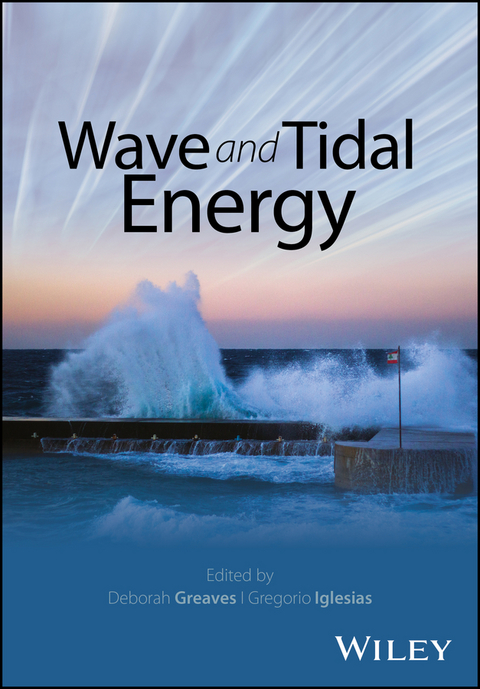
Wave and Tidal Energy (eBook)
John Wiley & Sons (Verlag)
978-1-119-01445-4 (ISBN)
A comprehensive text covering all aspects of wave and tidal energy
Wave and Tidal Energy provides a comprehensive and self-contained review of the developing marine renewable energy sector, drawing from the latest research and from the experience of device testing. The book has a twofold objective: to provide an overview of wave and tidal energy suitable for newcomers to the field and to serve as a reference text for advanced study and practice.
Including detail on key issues such as resource characterisation, wave and tidal technology, power systems, numerical and physical modelling, environmental impact and policy. The book also includes an up-to-date review of developments worldwide and case studies of selected projects.
Key features:
- A comprehensive and self-contained text covering all aspects of the multidisciplinary fields of wave and tidal energy.
- Draws upon the latest research in wave and tidal energy and the experience of leading practitioners in numerical and laboratory modelling.
- Regional developments worldwide are reviewed and representative projects are presented as case studies.
Wave and Tidal Energy is an invaluable resource to a wide range of readers, from engineering students to technical managers and policymakers to postgraduate students and researchers.
Deborah Greaves is Professor of Ocean Engineering and Director of the COAST (Coastal, Ocean and Sediment Transport) Laboratory at University of Plymouth and is Board Member and Inaugural Chair for PRIMaRE (the Partnership for Research In Marine Renewable Energy, www.primare.org). Her research interests include marine renewable energy, physical and numerical modelling of violent free surface flow and fluid-structure interaction. She leads and has led a number of research projects concerning marine renewable energy in collaboration with industrial and academic partners. She has published over 125 peer-reviewed papers, has secured £3.9 million research income as PI, is a Chartered Engineer and Fellow of the Institution of Civil Engineers, a Member of RINA (Royal Institution of Naval Architects), and a member of the technical committee for EWTEC (European Wave and Tidal Energy Conference), a reviewer for UK Research Councils, for several journals, and was shortlisted for the 2014 WISE Research Award.
Gregorio Iglesias (GI) is Professor of Coastal Engineering at University of Plymouth and Leader of the COAST (Coastal, Ocean and Sediment Transport) Research Group. He has over 20 years' experience in numerical and physical modelling applied to Marine Renewable Energy and Coastal Engineering, including the characterisation of wave and tidal resources, and the modelling of coastal morphodynamics accounting for the effects of wave and tidal farms. He participates in the design and laboratory tests of WECs and coastal and port structures, and acts as PI on research grants and contracts funded by the European Commission, various national research councils, coastal management agencies and port authorities. He is a member of the IEC Technical Committee for sub-prototype size wave energy device development (laboratory testing) and one of the inventors of the WaveCat, a floating overtopping WEC. Professor Iglesias has published over 100 peer-reviewed papers and secured over £5M research income.
A comprehensive text covering all aspects of wave and tidal energy Wave and Tidal Energy provides a comprehensive and self-contained review of the developing marine renewable energy sector, drawing from the latest research and from the experience of device testing. The book has a twofold objective: to provide an overview of wave and tidal energy suitable for newcomers to the field and to serve as a reference text for advanced study and practice. Including detail on key issues such as resource characterisation, wave and tidal technology, power systems, numerical and physical modelling, environmental impact and policy. The book also includes an up-to-date review of developments worldwide and case studies of selected projects.Key features: A comprehensive and self-contained text covering all aspects of the multidisciplinary fields of wave and tidal energy. Draws upon the latest research in wave and tidal energy and the experience of leading practitioners in numerical and laboratory modelling. Regional developments worldwide are reviewed and representative projects are presented as case studies. Wave and Tidal Energy is an invaluable resource to a wide range of readers, from engineering students to technical managers and policymakers to postgraduate students and researchers.
Deborah Greaves is Professor of Ocean Engineering and Director of the COAST (Coastal, Ocean and Sediment Transport) Laboratory at University of Plymouth and is Board Member and Inaugural Chair for PRIMaRE (the Partnership for Research In Marine Renewable Energy, www.primare.org). Her research interests include marine renewable energy, physical and numerical modelling of violent free surface flow and fluid-structure interaction. She leads and has led a number of research projects concerning marine renewable energy in collaboration with industrial and academic partners. She has published over 125 peer-reviewed papers, has secured £3.9 million research income as PI, is a Chartered Engineer and Fellow of the Institution of Civil Engineers, a Member of RINA (Royal Institution of Naval Architects), and a member of the technical committee for EWTEC (European Wave and Tidal Energy Conference), a reviewer for UK Research Councils, for several journals, and was shortlisted for the 2014 WISE Research Award. Gregorio Iglesias (GI) is Professor of Coastal Engineering at University of Plymouth and Leader of the COAST (Coastal, Ocean and Sediment Transport) Research Group. He has over 20 years' experience in numerical and physical modelling applied to Marine Renewable Energy and Coastal Engineering, including the characterisation of wave and tidal resources, and the modelling of coastal morphodynamics accounting for the effects of wave and tidal farms. He participates in the design and laboratory tests of WECs and coastal and port structures, and acts as PI on research grants and contracts funded by the European Commission, various national research councils, coastal management agencies and port authorities. He is a member of the IEC Technical Committee for sub-prototype size wave energy device development (laboratory testing) and one of the inventors of the WaveCat, a floating overtopping WEC. Professor Iglesias has published over 100 peer-reviewed papers and secured over £5M research income.
| Erscheint lt. Verlag | 28.3.2018 |
|---|---|
| Sprache | englisch |
| Themenwelt | Naturwissenschaften ► Physik / Astronomie |
| Technik ► Elektrotechnik / Energietechnik | |
| Schlagworte | Converter technologies • Electricity Generation • Energie • Energy • Environmental impact • Erneuerbare Energien • Gezeitenenergie • Gezeitenkraftwerk • Green Energy • Marine Energy • Marine Energy & Hydropower • Meeresenergie u. Wasserkraft • renewable energy • Tidal energy • Tidal power • Wasserkraft • Wave energy • wave mechanics • Wellenenergie • Wellenkraftwerk |
| ISBN-10 | 1-119-01445-X / 111901445X |
| ISBN-13 | 978-1-119-01445-4 / 9781119014454 |
| Informationen gemäß Produktsicherheitsverordnung (GPSR) | |
| Haben Sie eine Frage zum Produkt? |
 PDF (Adobe DRM)
Kopierschutz: Adobe-DRM
Adobe-DRM ist ein Kopierschutz, der das eBook vor Mißbrauch schützen soll. Dabei wird das eBook bereits beim Download auf Ihre persönliche Adobe-ID autorisiert. Lesen können Sie das eBook dann nur auf den Geräten, welche ebenfalls auf Ihre Adobe-ID registriert sind.
Details zum Adobe-DRM
Dateiformat: PDF (Portable Document Format)
Mit einem festen Seitenlayout eignet sich die PDF besonders für Fachbücher mit Spalten, Tabellen und Abbildungen. Eine PDF kann auf fast allen Geräten angezeigt werden, ist aber für kleine Displays (Smartphone, eReader) nur eingeschränkt geeignet.
Systemvoraussetzungen:
PC/Mac: Mit einem PC oder Mac können Sie dieses eBook lesen. Sie benötigen eine
eReader: Dieses eBook kann mit (fast) allen eBook-Readern gelesen werden. Mit dem amazon-Kindle ist es aber nicht kompatibel.
Smartphone/Tablet: Egal ob Apple oder Android, dieses eBook können Sie lesen. Sie benötigen eine
Geräteliste und zusätzliche Hinweise
Buying eBooks from abroad
For tax law reasons we can sell eBooks just within Germany and Switzerland. Regrettably we cannot fulfill eBook-orders from other countries.
aus dem Bereich