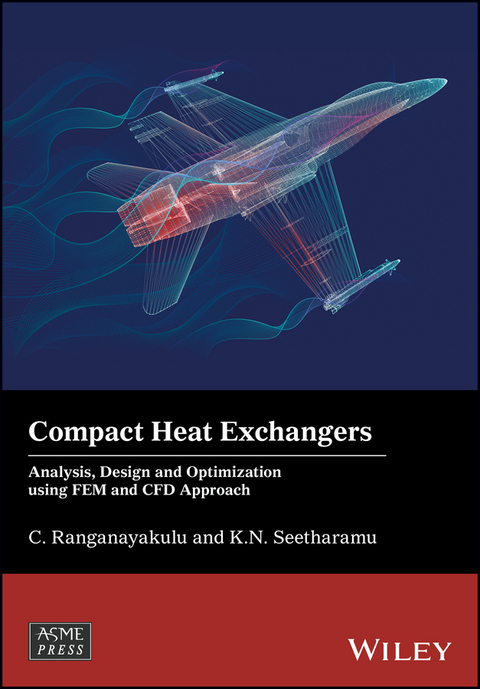
Compact Heat Exchangers (eBook)
John Wiley & Sons (Verlag)
978-1-119-42437-6 (ISBN)

A comprehensive source of generalized design data for most widely used fin surfaces in CHEs
Compact Heat Exchanger Analysis, Design and Optimization: FEM and CFD Approach brings new concepts of design data generation numerically (which is more cost effective than generic design data) and can be used by design and practicing engineers more effectively. The numerical methods/techniques are introduced for estimation of performance deteriorations like flow non-uniformity, temperature non-uniformity, and longitudinal heat conduction effects using FEM in CHE unit level and Colburn j factors and Fanning friction f factors data generation method for various types of CHE fins using CFD. In addition, worked examples for single and two-phase flow CHEs are provided and the complete qualification tests are given for CHEs use in aerospace applications.
Chapters cover: Basic Heat Transfer; Compact Heat Exchangers; Fundamentals of Finite Element and Finite Volume Methods; Finite Element Analysis of Compact Heat Exchangers; Generation of Design Data by CFD Analysis; Thermal and Mechanical Design of Compact Heat Exchanger; and Manufacturing and Qualification Testing of Compact Heat Exchanger.
- Provides complete information about basic design of Compact Heat Exchangers
- Design and data generation is based on numerical techniques such as FEM and CFD methods rather than experimental or analytical ones
- Intricate design aspects included, covering complete cycle of design, manufacturing, and qualification of a Compact Heat Exchanger
- Appendices on basic essential fluid properties, metal characteristics, and derivation of Fourier series mathematical equation
Compact Heat Exchanger Analysis, Design and Optimization: FEM and CFD Approach is ideal for senior undergraduate and graduate students studying equipment design and heat exchanger design.
C. Ranganayakulu, PhD, is an Outstanding Scientist and Group Director (GS-ECS) in the Aeronautical Development Agency, Ministry of Defence, India. Dr. Ranganayakulu is an Alexander von Humboldt re-visiting researcher at Helmut Schmidt University, Hamburg, and Leibniz University, Hannover, Germany, and Visiting Researcher at UNISA, Johannesburg, South Africa.
K.N. Seetharamu, PhD, is a professor of Thermal Engineering at PES Institute of Technology, Bangalore, and is a member of the editorial board of a number of journals including the International Journal for Numerical Methods in Biomedical Engineering. He was a Professor of Mechanical Engineering at IIT Madras from 1980 to 1998.
A comprehensive source of generalized design data for most widely used fin surfaces in CHEs Compact Heat Exchanger Analysis, Design and Optimization: FEM and CFD Approach brings new concepts of design data generation numerically (which is more cost effective than generic design data) and can be used by design and practicing engineers more effectively. The numerical methods/techniques are introduced for estimation of performance deteriorations like flow non-uniformity, temperature non-uniformity, and longitudinal heat conduction effects using FEM in CHE unit level and Colburn j factors and Fanning friction f factors data generation method for various types of CHE fins using CFD. In addition, worked examples for single and two-phase flow CHEs are provided and the complete qualification tests are given for CHEs use in aerospace applications. Chapters cover: Basic Heat Transfer; Compact Heat Exchangers; Fundamentals of Finite Element and Finite Volume Methods; Finite Element Analysis of Compact Heat Exchangers; Generation of Design Data by CFD Analysis; Thermal and Mechanical Design of Compact Heat Exchanger; and Manufacturing and Qualification Testing of Compact Heat Exchanger. Provides complete information about basic design of Compact Heat Exchangers Design and data generation is based on numerical techniques such as FEM and CFD methods rather than experimental or analytical ones Intricate design aspects included, covering complete cycle of design, manufacturing, and qualification of a Compact Heat Exchanger Appendices on basic essential fluid properties, metal characteristics, and derivation of Fourier series mathematical equation Compact Heat Exchanger Analysis, Design and Optimization: FEM and CFD Approach is ideal for senior undergraduate and graduate students studying equipment design and heat exchanger design.
C. Ranganayakulu, PhD, is an Outstanding Scientist and Group Director (GS-ECS) in the Aeronautical Development Agency, Ministry of Defence, India. Dr. Ranganayakulu is an Alexander von Humboldt re-visiting researcher at Helmut Schmidt University, Hamburg, and Leibniz University, Hannover, Germany, and Visiting Researcher at UNISA, Johannesburg, South Africa. K.N. Seetharamu, PhD, is a professor of Thermal Engineering at PES Institute of Technology, Bangalore, and is a member of the editorial board of a number of journals including the International Journal for Numerical Methods in Biomedical Engineering. He was a Professor of Mechanical Engineering at IIT Madras from 1980 to 1998.
1
Basic Heat Transfer
1.1 Importance of Heat Transfer
The subject of heat transfer is of fundamental importance in many branches of engineering. A mechanical engineer may be interested in knowing the mechanisms of heat transfer involved in the operation of equipment, such as boilers, condensers, air preheaters and economizers, and in thermal power plants, in order to improve performance. Refrigeration and air‐conditioning systems also involve heat‐exchanging devices, which need careful design. Electrical engineers are keen to avoid material damage due to hot spots, developed by improper heat transfer design in electric motors, generators and transformers. An electronic engineer is interested in knowing the most efficient methods of heat dissipation from chips and other semiconductor devices so that they can operate within safe operating temperatures. A computer hardware engineer wants to know the cooling requirements of circuit boards, as the miniaturization of computing devices is advancing rapidly. Chemical engineers are interested in heat transfer processes in various chemical reactions. A metallurgical engineer may need to know the rate of heat transfer required for a particular heat treatment process, such as the rate of cooling in a casting process, as this has a profound influence on the quality of the final product. Aeronautical engineers are interested in knowing the heat transfer rate in electronic equipment that uses compact heat exchangers for minimizing weight, in rocket nozzles and in heat shields used in re‐entry vehicles. An agricultural engineer would be interested in the drying of food grains, food processing and preservation. Civil engineers need to be aware of the thermal stresses developed in quick‐setting concrete, and the effect of heat and mass transfer on buildings and building materials. Finally, an environmental engineer is concerned with the effect of heat on the dispersion of pollutants in air, diffusion of pollutants in soils, thermal pollution in lakes and seas and their impact on life (Incropera et al. [1]).
The study of heat transfer can offer economical and efficient solutions to critical problems encountered in many branches of engineering. For example, we could consider the development of heat pipes that can transport heat at a much greater rate than copper or even silver rods of the same dimensions, even at almost isothermal conditions. The development of modern gas turbine blades, in which the gas temperature exceeds the melting point of the material of the blade, is possible by providing efficient cooling systems, and this is another example of the success of heat transfer design methods. The design of computer chips, which encounter heat fluxes of the same order those occurring in re‐entry vehicles, especially when the surface temperature of the chips is limited to less than 100 °C, is another success story for heat transfer analysis.
Although there are many successful heat transfer designs, further developments are still necessary in order to increase the lifespan and efficiency of the many devices discussed above, which can lead to many more inventions. Also, if we are to protect our environment, it is essential to understand the many heat transfer processes involved and to take appropriate action, where necessary.
1.2 Heat Transfer Modes
Heat transfer is the exchange of thermal energy between physical systems. The rate of heat transfer is dependent on the temperatures of the systems and the properties of the intervening medium through which the heat is transferred. The three fundamental modes of heat transfer are conduction, convection and radiation. Heat transfer, the flow of energy in the form of heat, is a process by which a system changes its internal energy, hence it is of vital use in applications of the first law of thermodynamics. Conduction is also known as diffusion, not to be confused with diffusion related to the mixing of constituents of a fluid.
The direction of heat transfer is from a region of high temperature to another region of lower temperature, and is governed by the second law of thermodynamics. Heat transfer changes the internal energy of the systems from which and to which the energy is transferred. Heat transfer will occur in a direction that increases the entropy of the collection of systems. Heat transfer is that section of engineering science that studies the energy transport between material bodies due to a temperature difference (Bejan [2], Holman [3], Incropera and Dewitt [4], Sukhatme [5]). The three modes of heat transfer are
- Conduction
- Convection
- Radiation.
The conduction mode of heat transport occurs either because of an exchange of energy from one molecule to another, without the actual motion of the molecules, or because of the motion of any free electrons that are present. Therefore, this form of heat transport depends heavily on the properties of the medium and takes place in solids, liquids and gases if a difference in temperature exists.
Molecules present in liquids and gases have freedom of motion, and by moving from a hot to a cold region, they carry energy with them. The transfer of heat from one region to another, due to such macroscopic motion in a liquid or gas, added to the energy transfer by conduction within the fluid, is called heat transfer by convection. Convection may be free, forced or mixed. When fluid motion occurs because of a density variation caused by temperature differences, the situation is said to be a free or natural convection. When the fluid motion is caused by an external force, such as pumping or blowing, the state is defined as being one of forced convection. A mixed convection state is one in which both natural and forced convections are present. Convection heat transfer also occurs in boiling and condensation processes.
All bodies emit thermal radiation at all temperatures. This is the only mode that does not require a material medium for heat transfer to occur. The nature of thermal radiation is such that a propagation of energy, carried by electromagnetic waves, is emitted from the surface of the body. When these electromagnetic waves strike other body surfaces, a part is reflected, a part is transmitted and the remaining part is absorbed. All modes of heat transfer are generally present in varying degrees in a real physical problem. The important aspects in solving heat transfer problems are identifying the significant modes and deciding whether the heat transferred by other modes can be neglected.
1.3 Laws of Heat Transfer
It is important to quantify the amount of energy being transferred per unit time, and this requires the use of rate equations. For heat conduction, the rate equation is known as Fourier’s law, which is expressed for one dimension as
where qx is the heat flux in the x direction (W/m2); k is the thermal conductivity (W/m · K), a property of material, and dT/dx is the temperature gradient (K/m).
For convective heat transfer, the rate equation is given by Newton’s law of cooling as
where q is the convective heat flux; (W/m2); (Tw − Ta) is the temperature difference between the wall and the fluid and h is the convection heat transfer coefficient, (W/m2K).
The convection heat transfer coefficient frequently appears as a boundary condition in the solution of heat conduction through solids. We assume h to be known in many such problems. In the analysis of thermal systems, we can again assume an appropriate h if not available (e.g. heat exchangers, combustion chambers). However, if required, h can be determined via suitable experiments, although this is a difficult option.
The maximum flux that can be emitted by radiation from a black surface is given by the Stefan–Boltzmann law:
where q is the radiative heat flux, (W/m2); σ is the Stefan–Boltzmann constant (5.669 × 10⁻⁸) in W/m2K4; and Tw is the surface temperature (K).
The heat flux emitted by a real surface is less than that of a black surface and is given by
where ε is the radiative property of the surface and is referred to as the emissivity. The net radiant energy exchange between any two surfaces, 1 and 2, is given by
where Fє is a factor that takes into account the nature of the two radiating surfaces; FG is a factor that takes into account the geometric orientation of the two radiating surfaces and A1 is the area of surface 1. When a heat transfer surface, at temperature T1, is completely enclosed by a much larger surface at temperature T2, the net radiant exchange can be calculated by
With respect to the laws of thermodynamics, only the first law is of interest in heat transfer problems. The increase of energy in a system is equal to the difference between the energy transfer by heat to the system and the energy transfer by work done on the surroundings by the system, that is,
where Q is the total heat entering the system and W is the work done on the surroundings. Since we are interested in the rate of energy...
| Erscheint lt. Verlag | 9.2.2018 |
|---|---|
| Reihe/Serie | Wiley-ASME Press Series |
| Wiley-ASME Press Series | Wiley-ASME Press Series |
| Sprache | englisch |
| Themenwelt | Technik ► Elektrotechnik / Energietechnik |
| Technik ► Maschinenbau | |
| Schlagworte | Aeronautic & Aerospace Engineering • CHEs and Longitudinal Heat Conduction (LHC), Flow non-uniformity (FN) and Temperature non-uniformity (TN) effects in CHEs • CHEs and new numerical data • CHEs for aerospace • CHEs for automobiles • CHEs process plants • Colburn factor j • compact heat exchangers for aircraft applications • Computational / Numerical Methods • environmental control systems • Fanning factor f data • FEM and CFD Approach to compact heat exchanger analysis • heat design • heat exchanger design • <i>Compact Heat Exchanger Analysis, Design and Optimization: FEM and CFD Approach</i></p> • <p>Compact Heat Exchangers (CHEs) • Luft- u. Raumfahrttechnik • Maschinenbau • mechanical engineering • numerical methods for heat and fluid flow • Rechnergestützte / Numerische Verfahren im Maschinenbau • thermodynamics • Thermodynamik |
| ISBN-10 | 1-119-42437-2 / 1119424372 |
| ISBN-13 | 978-1-119-42437-6 / 9781119424376 |
| Informationen gemäß Produktsicherheitsverordnung (GPSR) | |
| Haben Sie eine Frage zum Produkt? |
 EPUB (Adobe DRM)
Kopierschutz: Adobe-DRM
Adobe-DRM ist ein Kopierschutz, der das eBook vor Mißbrauch schützen soll. Dabei wird das eBook bereits beim Download auf Ihre persönliche Adobe-ID autorisiert. Lesen können Sie das eBook dann nur auf den Geräten, welche ebenfalls auf Ihre Adobe-ID registriert sind.
Details zum Adobe-DRM
Dateiformat: EPUB (Electronic Publication)
EPUB ist ein offener Standard für eBooks und eignet sich besonders zur Darstellung von Belletristik und Sachbüchern. Der Fließtext wird dynamisch an die Display- und Schriftgröße angepasst. Auch für mobile Lesegeräte ist EPUB daher gut geeignet.
Systemvoraussetzungen:
PC/Mac: Mit einem PC oder Mac können Sie dieses eBook lesen. Sie benötigen eine
eReader: Dieses eBook kann mit (fast) allen eBook-Readern gelesen werden. Mit dem amazon-Kindle ist es aber nicht kompatibel.
Smartphone/Tablet: Egal ob Apple oder Android, dieses eBook können Sie lesen. Sie benötigen eine
Geräteliste und zusätzliche Hinweise
Buying eBooks from abroad
For tax law reasons we can sell eBooks just within Germany and Switzerland. Regrettably we cannot fulfill eBook-orders from other countries.
aus dem Bereich