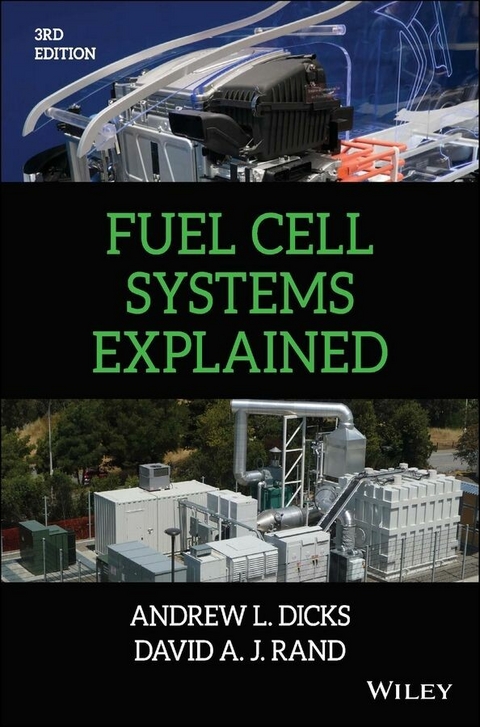
Fuel Cell Systems Explained (eBook)
John Wiley & Sons (Verlag)
978-1-118-70697-8 (ISBN)
Since publication of the first edition of Fuel Cell Systems Explained, three compelling drivers have supported the continuing development of fuel cell technology. These are: the need to maintain energy security in an energy-hungry world, the desire to move towards zero-emission vehicles and power plants, and the mitigation of climate change by lowering of CO2 emissions. New fuel cell materials, enhanced stack performance and increased lifetimes are leading to the emergence of the first truly commercial systems in applications that range from fork-lift trucks to power sources for mobile phone towers. Leading vehicle manufacturers have embraced the use of electric drive-trains and now see hydrogen fuel cells complementing advanced battery technology in zero-emission vehicles. After many decades of laboratory development, a global but fragile fuel cell industry is bringing the first commercial products to market.
This thoroughly revised edition includes several new sections devoted to, for example, fuel cell characterisation, improved materials for low-temperature hydrogen and liquid-fuelled systems, and real-world technology implementation.
Assuming no prior knowledge of fuel cell technology, the third edition comprehensively brings together all of the key topics encompassed in this diverse field. Practitioners, researchers and students in electrical, power, chemical and automotive engineering will continue to benefit from this essential guide to the principles, design and implementation of fuel cell systems.
ANDREW L. DICKS, PHD is an Independent Consultant and Adjunct Principal Research Fellow at Griffith University, Brisbane, Australia.
DAVID A. J. RAND, PHD, SCD was a Chief Research Scientist at CSIRO where, among other duties, he served as scientific advisor on hydrogen and renewable energy. In retirement, he is now a CSIRO Honorary Research Fellow, Melbourne, Australia.
Since publication of the first edition of Fuel Cell Systems Explained, three compelling drivers have supported the continuing development of fuel cell technology. These are: the need to maintain energy security in an energy-hungry world, the desire to move towards zero-emission vehicles and power plants, and the mitigation of climate change by lowering of CO2 emissions. New fuel cell materials, enhanced stack performance and increased lifetimes are leading to the emergence of the first truly commercial systems in applications that range from fork-lift trucks to power sources for mobile phone towers. Leading vehicle manufacturers have embraced the use of electric drive-trains and now see hydrogen fuel cells complementing advanced battery technology in zero-emission vehicles. After many decades of laboratory development, a global but fragile fuel cell industry is bringing the first commercial products to market. This thoroughly revised edition includes several new sections devoted to, for example, fuel cell characterisation, improved materials for low-temperature hydrogen and liquid-fuelled systems, and real-world technology implementation. Assuming no prior knowledge of fuel cell technology, the third edition comprehensively brings together all of the key topics encompassed in this diverse field. Practitioners, researchers and students in electrical, power, chemical and automotive engineering will continue to benefit from this essential guide to the principles, design and implementation of fuel cell systems.
ANDREW L. DICKS, PHD is an Independent Consultant and Adjunct Principal Research Fellow at Griffith University, Brisbane, Australia. DAVID A. J. RAND, PHD, SCD was a Chief Research Scientist at CSIRO where, among other duties, he served as scientific advisor on hydrogen and renewable energy. In retirement, he is now a CSIRO Honorary Research Fellow, Melbourne, Australia.
Ever since its initial publication, Fuel Cell Systems Explained has been one of the most approachable books on the subject. Well-written and concise, the third edition maintains that tradition. The scientific and technical sections are clear and logical, and lead the reader carefully through the complexities of fuel cell materials and operating conditions, from basic principles to specific fuel cell types. This is all prefaced by a history of the sector. While this latter may seem tangential to those seeking electrochemical equations, in fact it is both interesting and useful, for example in helping me understand some of the technology development decisions that have been made over the years. It is also interesting to discover that one of the very first applications was of a fuel cell developed by Bacon and trialled in a forklift, perhaps not coincidentally one of the most successful sectors today, and that fuel cells were viewed as superior to batteries as far back as the Gemini space missions; a technology supremacy discussion which is just as live today. - David Hart, Director, E4tech and lead author of the annual Fuel Cell Industry Review
The Third Edition of Fuel Cell Systems Explained is an updated version of a book that has always been essential reading for everyone entering into the fuel cell sector, be they student or industrial practitioner. This edition introduces the basic principles of thermodynamics and electrochemical kinetics pertinent to the understanding of fuel cell operation, and determining fuel cell efficiency and voltage losses. But the heart of the book are the six chapters detailing each of the principal fuel cell technologies; proton-exchange membrane fuel cells; alkaline fuel cells; direct liquid fuel cells; phosphoric acid fuel cells; molten carbonate fuel cells and solid oxide fuel cells. There are also useful chapters covering different fuels and fuel processing options, hydrogen storage and a short discussion of balance-of-plant. I am delighted to say that it is a book that I will continue to recommend highly as a first read to all those who join my own research group to work on this exciting technology. - Professor Nigel Brandon OBE FREng, Imperial College London, UK
| Erscheint lt. Verlag | 14.3.2018 |
|---|---|
| Sprache | englisch |
| Themenwelt | Technik ► Elektrotechnik / Energietechnik |
| Schlagworte | Alternative Energy • application of fuel cell systems • Brennstoffzelle • Chemie • Chemistry • Electrochemistry • Elektrochemie • Energie • Energy • Energy Research • fuel cell applications • fuel cell control • fuel cell engineering • fuel cell engines • fuel cell fundamentals • Fuel Cell Modeling • fuel cell science • fuel cell system design • fuel cell systems • Fuel Cell Systems Explained</p> • Fuel Cell Technology • fuelling fuel cells • guide to fuel cell systems • Heterogeneous catalysis • high temperature fuel cell systems • Hydrogen, Batteries & Fuel Cells • hydrogen storage • <p>fuel cells • Maschinenbau • mechanical engineering • medium and high temperature fuel cells • Molten Carbonate Fuel Cells • principles of fuel cell systems • renewable energy • Solid Oxide Fuel Cells • Wasserstoff, Batterien u. Brennstoffzellen |
| ISBN-10 | 1-118-70697-8 / 1118706978 |
| ISBN-13 | 978-1-118-70697-8 / 9781118706978 |
| Informationen gemäß Produktsicherheitsverordnung (GPSR) | |
| Haben Sie eine Frage zum Produkt? |
 PDF (Adobe DRM)
Kopierschutz: Adobe-DRM
Adobe-DRM ist ein Kopierschutz, der das eBook vor Mißbrauch schützen soll. Dabei wird das eBook bereits beim Download auf Ihre persönliche Adobe-ID autorisiert. Lesen können Sie das eBook dann nur auf den Geräten, welche ebenfalls auf Ihre Adobe-ID registriert sind.
Details zum Adobe-DRM
Dateiformat: PDF (Portable Document Format)
Mit einem festen Seitenlayout eignet sich die PDF besonders für Fachbücher mit Spalten, Tabellen und Abbildungen. Eine PDF kann auf fast allen Geräten angezeigt werden, ist aber für kleine Displays (Smartphone, eReader) nur eingeschränkt geeignet.
Systemvoraussetzungen:
PC/Mac: Mit einem PC oder Mac können Sie dieses eBook lesen. Sie benötigen eine
eReader: Dieses eBook kann mit (fast) allen eBook-Readern gelesen werden. Mit dem amazon-Kindle ist es aber nicht kompatibel.
Smartphone/Tablet: Egal ob Apple oder Android, dieses eBook können Sie lesen. Sie benötigen eine
Geräteliste und zusätzliche Hinweise
Buying eBooks from abroad
For tax law reasons we can sell eBooks just within Germany and Switzerland. Regrettably we cannot fulfill eBook-orders from other countries.
aus dem Bereich