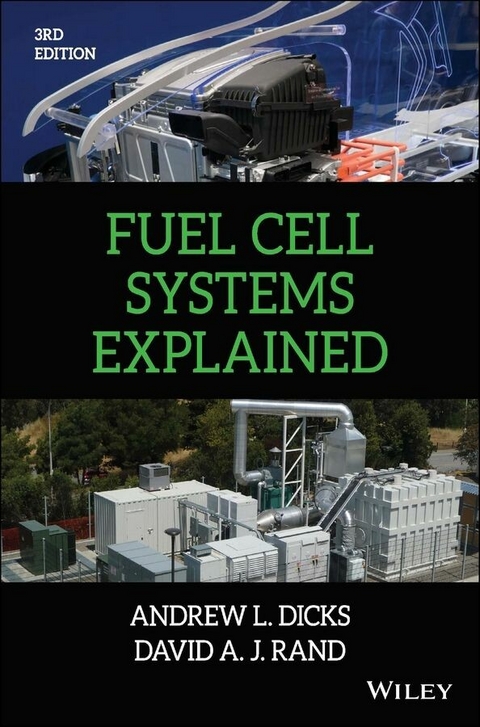
Fuel Cell Systems Explained (eBook)
John Wiley & Sons (Verlag)
978-1-118-70696-1 (ISBN)
Since publication of the first edition of Fuel Cell Systems Explained, three compelling drivers have supported the continuing development of fuel cell technology. These are: the need to maintain energy security in an energy-hungry world, the desire to move towards zero-emission vehicles and power plants, and the mitigation of climate change by lowering of CO2 emissions. New fuel cell materials, enhanced stack performance and increased lifetimes are leading to the emergence of the first truly commercial systems in applications that range from fork-lift trucks to power sources for mobile phone towers. Leading vehicle manufacturers have embraced the use of electric drive-trains and now see hydrogen fuel cells complementing advanced battery technology in zero-emission vehicles. After many decades of laboratory development, a global but fragile fuel cell industry is bringing the first commercial products to market.
This thoroughly revised edition includes several new sections devoted to, for example, fuel cell characterisation, improved materials for low-temperature hydrogen and liquid-fuelled systems, and real-world technology implementation.
Assuming no prior knowledge of fuel cell technology, the third edition comprehensively brings together all of the key topics encompassed in this diverse field. Practitioners, researchers and students in electrical, power, chemical and automotive engineering will continue to benefit from this essential guide to the principles, design and implementation of fuel cell systems.
Andrew L Dicks PhD is an Independent Consultant and Adjunct Principal Research Fellow at Griffith University.
David A J Rand PhD ScD was a Chief Research Scientist at CSIRO where, among other duties he served as scientific advisor on hydrogen and renewable energy. In retirement, he is now a CSIRO Honorary Research Fellow.
Since publication of the first edition of Fuel Cell Systems Explained, three compelling drivers have supported the continuing development of fuel cell technology. These are: the need to maintain energy security in an energy-hungry world, the desire to move towards zero-emission vehicles and power plants, and the mitigation of climate change by lowering of CO2 emissions. New fuel cell materials, enhanced stack performance and increased lifetimes are leading to the emergence of the first truly commercial systems in applications that range from fork-lift trucks to power sources for mobile phone towers. Leading vehicle manufacturers have embraced the use of electric drive-trains and now see hydrogen fuel cells complementing advanced battery technology in zero-emission vehicles. After many decades of laboratory development, a global but fragile fuel cell industry is bringing the first commercial products to market. This thoroughly revised edition includes several new sections devoted to, for example, fuel cell characterisation, improved materials for low-temperature hydrogen and liquid-fuelled systems, and real-world technology implementation. Assuming no prior knowledge of fuel cell technology, the third edition comprehensively brings together all of the key topics encompassed in this diverse field. Practitioners, researchers and students in electrical, power, chemical and automotive engineering will continue to benefit from this essential guide to the principles, design and implementation of fuel cell systems.
ANDREW L. DICKS, PHD is an Independent Consultant and Adjunct Principal Research Fellow at Griffith University, Brisbane, Australia. DAVID A. J. RAND, PHD, SCD was a Chief Research Scientist at CSIRO where, among other duties, he served as scientific advisor on hydrogen and renewable energy. In retirement, he is now a CSIRO Honorary Research Fellow, Melbourne, Australia.
Ever since its initial publication, Fuel Cell Systems Explained has been one of the most approachable books on the subject. Well-written and concise, the third edition maintains that tradition. The scientific and technical sections are clear and logical, and lead the reader carefully through the complexities of fuel cell materials and operating conditions, from basic principles to specific fuel cell types. This is all prefaced by a history of the sector. While this latter may seem tangential to those seeking electrochemical equations, in fact it is both interesting and useful, for example in helping me understand some of the technology development decisions that have been made over the years. It is also interesting to discover that one of the very first applications was of a fuel cell developed by Bacon and trialled in a forklift, perhaps not coincidentally one of the most successful sectors today, and that fuel cells were viewed as superior to batteries as far back as the Gemini space missions; a technology supremacy discussion which is just as live today. - David Hart, Director, E4tech and lead author of the annual Fuel Cell Industry Review
The Third Edition of Fuel Cell Systems Explained is an updated version of a book that has always been essential reading for everyone entering into the fuel cell sector, be they student or industrial practitioner. This edition introduces the basic principles of thermodynamics and electrochemical kinetics pertinent to the understanding of fuel cell operation, and determining fuel cell efficiency and voltage losses. But the heart of the book are the six chapters detailing each of the principal fuel cell technologies; proton-exchange membrane fuel cells; alkaline fuel cells; direct liquid fuel cells; phosphoric acid fuel cells; molten carbonate fuel cells and solid oxide fuel cells. There are also useful chapters covering different fuels and fuel processing options, hydrogen storage and a short discussion of balance-of-plant. I am delighted to say that it is a book that I will continue to recommend highly as a first read to all those who join my own research group to work on this exciting technology. - Professor Nigel Brandon OBE FREng, Imperial College London, UK
Acronyms and Initialisms
- ABPBI
- phosphoric acid doped poly(2,5‐benzimidazole)
- AC
- alternating current
- ADP
- adenosine 5’‐triphosphate
- AEM
- alkaline‐electrolyte membrane
- AEMFC
- alkaline‐electrolyte membrane fuel cell
- AES
- air‐electrode supported
- AFC
- alkaline fuel cell
- AMFC
- anion‐exchange membrane fuel cell
- ANL
- Argonne National Laboratory
- APEMFC
- alkaline proton‐exchange membrane fuel cell
- APU
- auxiliary power unit
- ASR
- area specific resistance
- BCN
- Dutch Fuel Cell Corporation
- BG
- British Gas
- BIMEVOX
- bismuth metal vanadium oxide (Bi4V2O11)
- BOP
- balance‐of‐plant
- BPS
- Ballard Power Systems
- BSF
- Boudouard Safety Factor
- CAN bus
- Controller Area Network
- CBM
- coal‐bed methane
- CCS
- carbon capture and storage
- CFCL
- Ceramic Fuel Cells Ltd
- CGO
- cerium–gadolinium oxide (same as GDC)
- CHP
- combined heat and power
- CLC
- chemical looping combustion
- CNR
- Consiglio Nazionale delle Ricerche (Italy)
- CNT
- carbon nanotube
- CODH‐1
- carbon monoxide dehydrogenase
- CPE
- constant phase element
- CPO
- catalytic partial oxidation
- CRG
- catalytic rich gas
- CSG
- coal‐seam gas
- CSIRO
- Commonwealth Scientific and Industrial Research Organisation
- CSO
- cerium‐samarium oxide (same as SDC)
- CSZ
- calcia‐stabilized zirconia
- CV
- cyclic voltammetry
- CVD
- chemical vapour deposition
- DBFC
- direct borohydride fuel cell
- DC
- direct current
- DCFC
- direct carbon fuel cell
- DEFC
- direct ethanol fuel cell
- DEGFC
- direct ethylene glycol fuel cell
- DFAFC
- direct formic acid fuel cell (also formic acid fuel cell, FAFC)
- DFT
- density functional theory
- DG
- distributed generator
- DIR
- direct internal reforming
- DIVRR
- directly irradiated, volumetric receiver–reactor
- DLFC
- direct liquid fuel cell
- DMFC
- direct methanol fuel cell
- DOE
- Department of Energy (United States)
- DPFC
- direct propanol fuel cell
- DPFC(2)
- direct propan‐2‐ol fuel cell
- DSSC
- dye‐sensitized solar cell
- EC
- evaporatively cooled
- ECN
- Energy Research Centre of the Netherlands
- EFOY
- Energy for You
- EIS
- electrochemical impedance spectroscopy
- EPFL
- Swiss Federal Institute of Technology
- EU
- European Union
- EVD
- electrochemical vapour deposition
- EW
- membrane equivalent weight
- FCE
- Fuel Cell Energy Inc.
- FCES
- Fuel Cell Energy Solutions GmbH
- FCV
- fuel cell vehicle
- FRA
- frequency response analyser
- FT
- Fischer–Tropsch
- GDC
- gadolinium‐doped ceria/gadolinia‐doped ceria (same as CGO)
- GDL
- gas‐diffusion layer
- GE
- General Electric
- GHG
- greenhouse gas
- GM
- General Motors
- GPS
- Global Positioning System
- GTL
- gas‐to‐liquid
- GTO
- gate turn‐off (thyristor)
- HAZID
- hazard identification
- HAZOP
- hazard and operability study
- HCNG
- hydrogen‐compressed natural gas
- HDS
- hydrodesulfurization
- HEMFC
- hydroxide‐exchange polymer membrane fuel cell
- HEV
- hybrid electric vehicle
- HHV
- higher heating value
- HOR
- hydrogen oxidation reaction
- HPE
- high‐pressure proton‐exchange membrane electrolyser
- IBFC
- indirect borohydride fuel cell
- ICE
- internal combustion engine
- ICEV
- internal combustion engine vehicle
- IFC
- International Fuel Cells
- IGBT
- insulated‐gate bipolar transistor
- IHI
- Ishikawajima‐Harima Heavy Industries Co., Ltd
- IHP
- inner Helmholtz plane
- IIR
- indirect internal reforming (also known as ‘integrated reforming’)
- ITM
- ion transport membrane, also refers to company ITM Power
- IT‐SOFC
- intermediate‐temperature solid oxide fuel cell
- IUPAC
- International Union of Pure and Applied Chemistry
- KEPCO
- Korea Electric Power Corporation
- KIST
- Korea Institute of Science and Technology
- LAMOX
- lanthanum molybdate (La2Mo2O9)
- LCA
- life‐cycle assessment (also known as ‘life‐cycle analysis’ and ‘cradle‐to‐grave analysis’)
- LCOE
- levelized cost of electricity
- LH2
- liquid hydrogen
- LHV
- lower heating value
- LNG
- liquefied natural gas
- LPG
- liquefied petroleum gas
- LSCF
- lanthanum strontium cobaltite ferrite
- LSCV
- strontium‐doped lanthanum vanadate
- LSGM
- lanthanum gallate (LaSrGaMgO3)
- LSM
- strontium‐doped lanthanum manganite
- LT‐SOFC
- low‐temperature solid oxide fuel cell
- MCFC
- molten carbonate fuel cell
- MCR
- microchannel reactor
- MEA
- membrane–electrode assembly
- MEMS
- microelectromechanical systems
- METI
- Ministry of Economy, Trade and Industry (Japan)
- MFC
- microbial fuel cell
- MFF
- mass flow factor
- MHPS
- Mitsubishi Hitachi Power Systems
- MIEC
- mixed ionic–electronic conductor (oxides)
- MOF
- metal–organic framework
- MOSFET
- metal‐oxide‐semiconductor field‐effect transistor
- MPMDMS
- (3‐mercaptopropyl)methyldimethoxysilane
- MRFC
- mixed‐reactant fuel cell
- MSW
- municipal solid waste
- MTBF
- mean time between failures
- MWCNT
- multiwalled carbon nanotube
- NADP
- nicotinamide adenine dinucleotide phosphate
- NASA
- National Aeronautics and Space Administration
- NCPO
- non‐catalytic partial oxidation
- NEDO
- New Energy Development Organization (Japan)
- NOMO
- Notice of Market Opportunities
- NTP
- normal temperature and pressure
- OCV
- open‐circuit voltage
- OEM
- original equipment manufacturer
- OER
- oxygen evolution reaction
- OHP
- outer Helmholtz plane
- ORR
- oxygen reduction reaction
- P2G
- power‐to‐gas
- P3MT
- poly(3‐methylthiophene)
- PAFC
- phosphoric acid fuel cell
- PANI
- polyaniline
- PAR
- photosynthetically active radiation
- PBI
- polybenzimidazole
- PBSS
- poly(benzylsulfonic acid)siloxane
- PC
- phthalocyanine
- PCT
- pressure composition isotherm
- PEC
- photoelectrochemical cell
- PEMFC
- proton‐exchange membrane fuel cell (also called ‘polymer electrolyte membrane fuel cell’ and same as SPEFC and SPFC)
- PET
- polyethylene terephthalate
- PF
- power factor, also PFC power factor correction
- PFD
- process flow diagram
- PFSA
- perfluorinated sulfonic acid
- plc
- programmable logic controller
- POX
- partial oxidation
- PPA
- polyphosphoric acid
- PPBP
- poly(1,4‐phenylene), poly(4 phenoxybenzoyl‐1,4‐phenylene)
- Ppy
- polypyrrole
- PROX
- preferential oxidation
- PrOx
- preferential oxidation reactor
- PSA
- pressure swing adsorption
- PTFE
- polytetrafluoroethylene
- PV
- photovoltaic
- PWM
- pulse width modulation
- QA
- quaternary ammonium
- RDE
- rotating disc electrode
- RFB
- redox flow battery
- RH
- relative humidity
- RHE
- reversible hydrogen electrode
- RRDE
- rotating ring‐disc electrode
- RSF
- rotational speed factor
- SATP
- standard ambient temperature and pressure
- SCG
- simulated coal gas
- SCT‐CPO
- short contact time catalytic partial oxidation
- SDC
- samarium‐doped ceria/samaria‐doped ceria (same as CSO)
- SECA
- Solid State Energy Conversion Alliance
- SFCM
- standard cubic foot per minute
- SHE
- standard hydrogen electrode
- SI
- International...
| Erscheint lt. Verlag | 14.3.2018 |
|---|---|
| Sprache | englisch |
| Themenwelt | Technik ► Elektrotechnik / Energietechnik |
| Technik ► Maschinenbau | |
| Schlagworte | Alternative Energy • application of fuel cell systems • Brennstoffzelle • Chemie • Chemistry • Electrochemistry • Elektrochemie • Energie • Energy • Energy Research • fuel cell applications • fuel cell control • fuel cell engineering • fuel cell engines • fuel cell fundamentals • Fuel Cell Modeling • fuel cell science • fuel cell system design • fuel cell systems • Fuel Cell Systems Explained</p> • Fuel Cell Technology • fuelling fuel cells • guide to fuel cell systems • Heterogeneous catalysis • high temperature fuel cell systems • Hydrogen, Batteries & Fuel Cells • hydrogen storage • <p>fuel cells • Maschinenbau • mechanical engineering • medium and high temperature fuel cells • Molten Carbonate Fuel Cells • principles of fuel cell systems • renewable energy • Solid Oxide Fuel Cells • Wasserstoff, Batterien u. Brennstoffzellen |
| ISBN-10 | 1-118-70696-X / 111870696X |
| ISBN-13 | 978-1-118-70696-1 / 9781118706961 |
| Informationen gemäß Produktsicherheitsverordnung (GPSR) | |
| Haben Sie eine Frage zum Produkt? |
 EPUB (Adobe DRM)
Kopierschutz: Adobe-DRM
Adobe-DRM ist ein Kopierschutz, der das eBook vor Mißbrauch schützen soll. Dabei wird das eBook bereits beim Download auf Ihre persönliche Adobe-ID autorisiert. Lesen können Sie das eBook dann nur auf den Geräten, welche ebenfalls auf Ihre Adobe-ID registriert sind.
Details zum Adobe-DRM
Dateiformat: EPUB (Electronic Publication)
EPUB ist ein offener Standard für eBooks und eignet sich besonders zur Darstellung von Belletristik und Sachbüchern. Der Fließtext wird dynamisch an die Display- und Schriftgröße angepasst. Auch für mobile Lesegeräte ist EPUB daher gut geeignet.
Systemvoraussetzungen:
PC/Mac: Mit einem PC oder Mac können Sie dieses eBook lesen. Sie benötigen eine
eReader: Dieses eBook kann mit (fast) allen eBook-Readern gelesen werden. Mit dem amazon-Kindle ist es aber nicht kompatibel.
Smartphone/Tablet: Egal ob Apple oder Android, dieses eBook können Sie lesen. Sie benötigen eine
Geräteliste und zusätzliche Hinweise
Buying eBooks from abroad
For tax law reasons we can sell eBooks just within Germany and Switzerland. Regrettably we cannot fulfill eBook-orders from other countries.
aus dem Bereich