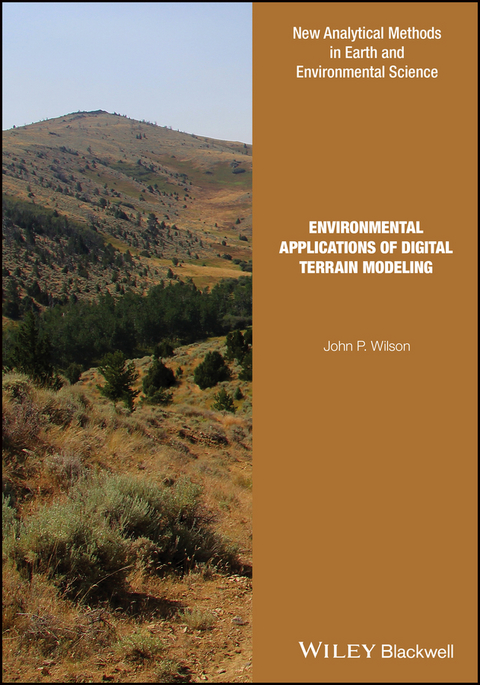
Environmental Applications of Digital Terrain Modeling (eBook)
John Wiley & Sons (Verlag)
978-1-118-93817-1 (ISBN)

A digital elevation model (DEM) is a digital representation of ground surface topography or terrain. It is also widely known as a digital terrain model (DTM). A DEM can be represented as a raster (a grid of squares) or as a vector based triangular irregular network (TIN). DEMs are commonly built using remote sensing techniques, but they may also be built from land surveying. DEMs are used often in geographic information systems, and are the most common basis for digitally-produced relief maps. The terrain surface can be described as compromising of two different elements; random and systematic. The random (stochastic) elements are the continuous surfaces with continuously varying relief. It would take an endless number of points to describe exactly the random terrain shapes, but these can be described in practice with a network of point. It is usual to use a network that creates sloping triangles or regular quadrants.
This book examines how the methods and data sources used to generate DEMs and calculate land surface parameters have changed over the past 25 years. The primary goal is to describe the state-of-the-art for a typical digital terrain modeling workflow that starts with data capture, continues with data preprocessing and DEM generation, and concludes with the calculation of one or more primary and secondary land surface parameters. Taken as a whole, this book covers the basic theory behind the methods, the instrumentation, analysis and interpretation that are embedded in the modern digital terrain modeling workflow, the strengths and weaknesses of the various methods that the terrain analyst must choose among, typical applications of the results emanating from these terrain modeling workflows, and future directions.
This book is intended for researchers and practitioners who wish to use DEMs, land surface parameters, land surface objects and landforms in environmental projects. The book will also be valuable as a reference text for environmental scientists who are specialists in related fields and wish to integrate these kinds of digital terrain workflows and outputs into their own specialized work environments.
Dr. John P. Wilson is Professor of Spatial Sciences in the Dana and David Dornsife College of Letters, Arts and Sciences at the University of Southern California (USC) where he directs the Spatial Sciences Institute as well as the Geographic Information Science & Technology (GIST) Graduate Programs and GIS Research Laboratory, and also holds adjunct appointments as Professor in the School of Architecture and in the Viterbi School of Engineering???s Departments of Computer Science and Civil & Environmental Engineering.
Dr. John P. Wilson is Professor of Spatial Sciences in the Dana and David Dornsife College of Letters, Arts and Sciences at the University of Southern California (USC) where he directs the Spatial Sciences Institute as well as the Geographic Information Science & Technology (GIST) Graduate Programs and GIS Research Laboratory, and also holds adjunct appointments as Professor in the School of Architecture and in the Viterbi School of Engineering???s Departments of Computer Science and Civil & Environmental Engineering.
List of Figures
| 1.1 | Scales at which various biophysical processes dominate calculation of primary environmental regimes. |
| 1.2 | Map of Cottonwood Creek, MT study site. |
| 1.3 | NED 10‐m contour and NHD‐Plus streamline data for the Cottonwood Creek, MT study site, with the catchment boundary overlaid. |
| 2.1 | The main tasks associated with digital terrain modeling. |
| 2.2 | The three principal methods of structuring an elevation data network: (a) a contour‐based network; (b) a square‐grid network showing a 3 × 3 moving window; and (c) a triangulated irregular network (TIN). |
| 2.3 | Streamline data in green and (a) initial gridded streamlines at 1‐second resolution in red and (b) adjusted gridded streamlines at 1‐second resolution in red. |
| 3.1 | Schematic showing site‐specific, local, and regional interactions as a function of time. |
| 3.2 | A 3 × 3 moving grid used to calculate selected local land surface parameters. |
| 3.3 | Node numbering convention used for calculation of local land surface parameters. |
| 3.4 | Percent slope grid derived for Cottonwood Creek, MT study site using the finite difference equation, with the catchment boundary overlaid. |
| 3.5 | Aspect in degrees from north derived for Cottonwood Creek, MT study site using the finite difference equation, with the catchment boundary overlaid. |
| 3.6 | Northness derived for Cottonwood Creek, MT study site, with the catchment boundary overlaid. |
| 3.7 | Eastness derived for Cottonwood Creek, MT study site, with the catchment boundary overlaid. |
| 3.8 | Profile curvature (radians per 100 m, convex curvatures are positive) derived for Cottonwood Creek, MT study site using the finite difference formula, with the catchment boundary overlaid. |
| 3.9 | Plan curvature (radians per 100 m, convex curvatures are positive) derived for Cottonwood Creek, MT study site using the finite difference formula, with the catchment boundary overlaid. |
| 3.10 | Single‐ and multiple‐flow directions assigned to the central grid cell in a 3 × 3 moving window using the D8 and FMFD flow‐direction algorithms. Gray shading represents elevation decreasing with the darkness of the cell. Multiple‐flow directions are assigned in (b) and a fraction of the flow of the central cell is distributed to each of the three cells that the arrows point to. |
| 3.11 | Concept of flow apportioning in D∞. |
| 3.12 | Upslope contributing area (ha) derived for Cottonwood Creek, MT study site using the D8 single‐flow direction algorithm, with the catchment boundary overlaid. |
| 3.13 | Upslope contributing area (ha) derived for Cottonwood Creek, MT study site using the D∞ single‐flow direction algorithm, with the catchment boundary overlaid. |
| 3.14 | The four mathematical surfaces commonly used for data‐independent assessment of different flow‐direction algorithms. |
| 3.15 | Concept of flow apportioning in MD∞ based on the construction of triangular facets around one cell. |
| 3.16 | Distribution of the number of cells that receive accumulated area (i.e. flow) from one cell in a sample DEM for an area in central Sweden. |
| 3.17 | Flow apportioning between two cardinal neighbors in the Mass Flux method. L1 and L2 denote the projected flow widths into the upper and right neighbor and together equal the projected flow width ω. n1 and n2 are vectors normal to the cell boundaries, q is the flow vector and θ is the flow direction. |
| 3.18 | (a) Two triangular facets are formed in a 2 × 2 cell moving window using the spot heights at the center of each grid cell; (b) a 4 × 4 cell moving window is used to estimate elevation at P by fitting a bivariate cubic spline surface. |
| 3.19 | Flow line over a TFN: the numbers at the nodes of triangles represent elevation, the light lines show the original grid cells, and the flow lines represented by the arrow chains are formed by tracking the movement of flow (i.e. the flow directions). |
| 3.20 | The decomposition of grid cells into a set of eight triangular facets defined by the nine‐cell kernel nodes (black circles) in Dtrig. The node’s elevations are listed next to each node and facet boundaries are denoted by dashed lines. The surface extent is limited to the central cell so that the only node within this domain is the element‐centered node. The contours and gray scale illustrate the elevation variability within the element and the rounding of the contours adjacent to facet boundaries is an artifact of the contouring algorithm. |
| 3.21 | Examples of flow partitioning from a triangular facet. (a) A triangular facet, the local coordinates, and the î, ĵ directions. (b) The case where the line oriented in the direction of intersects node [x2, y2, z2] and is plunging toward this node. The dashed lines that bound denote the range of orientations where intersects this node and divides the area into two triangles. In this case, the facet’s drainage area is partitioned proportionally to the area of each of the triangles bounded by the facet’s drainage divide (i.e. the dashed intersecting line) and the facet’s bounding legs. The area is partitioned into the two facets sharing the bold colored facet legs. (c) Same as (b) except that is dipping toward node [x1, y1, z1]. (d) Same as (b) except is plunging away from node [x2, y2, z2]. (e) Same as (d) except that is plunging away from node [x1, y1, z1]. |
| 3.22 | The center cell in a 3 × 3 grid cell window divided into eight triangular facets (1–8) with each facet formed from three points; one is the center of the central grid cell (M) and the other two are the centers of two adjacent grid cells (e.g. C1 and C2). |
| 3.23 | Upslope contributing area (ha) derived for the Cottonwood Creek, MT study site using the MD∞ multiple‐flow direction algorithm, with the catchment boundary overlaid. |
| 3.24 | Upslope contributing area (ha) derived for the Cottonwood Creek, MT study site using the TFM multiple‐flow direction algorithm, with the catchment boundary overlaid. |
| 3.25 | An idealized stream tube originating at a hilltop and terminating at a contour on a hillslope. The average specific catchment area a along the contour segment is the ratio of contributing area A to flow width w. |
| 3.26 | Difference from mean elevation for the Cottonwood Creek, MT study site using a 15 × 15 cell moving window, with the catchment boundary overlaid. |
| 3.27 | Elevation percentile for the Cottonwood Creek, MT study site using a 15 × 15 cell moving window, with the catchment boundary overlaid. |
| 3.28 | Standard deviation of elevation for the Cottonwood Creek, MT study site using a 15 × 15 cell moving window, with the catchment boundary overlaid. |
| 3.29 | A comparison of the shape complexity index values for a perfectly oval shape (left) and for different levels of complexity (right). |
| 3.30 | (a) The local gradient in the original topographic wetness index and (b) with the new slope term proposed by Hjerdt et al. (2004). The dotted lines represent the gradient of the groundwater table that is constant in the original topographic wetness index (a) and variable in the slope‐adjusted topographic wetness index... |
| Erscheint lt. Verlag | 15.2.2018 |
|---|---|
| Reihe/Serie | Analytical Methods in Earth and Environmental Science |
| Analytical Methods in Earth and Environmental Science | Analytical Methods in Earth and Environmental Science |
| Sprache | englisch |
| Themenwelt | Naturwissenschaften ► Geowissenschaften ► Geografie / Kartografie |
| Naturwissenschaften ► Geowissenschaften ► Geologie | |
| Technik ► Umwelttechnik / Biotechnologie | |
| Schlagworte | built • commonly • DEM • Dems • digital • earth sciences • elevation • Geographie • Geography • Geomorphologie • geomorphology • Geowissenschaften • GIS & Remote Sensing • GIS, Fernerkundung u. Kartographie • GIS, Remote Sensing & Cartography • GIS u. Fernerkundung • GRID • Ground • Irregular • known • Land surveying • Model • Network • Raster • remote • Representation • represented • Sensing Techniques • Squares • Surface • Terrain • Triangular • Vector |
| ISBN-10 | 1-118-93817-8 / 1118938178 |
| ISBN-13 | 978-1-118-93817-1 / 9781118938171 |
| Informationen gemäß Produktsicherheitsverordnung (GPSR) | |
| Haben Sie eine Frage zum Produkt? |
 EPUB (Adobe DRM)
Kopierschutz: Adobe-DRM
Adobe-DRM ist ein Kopierschutz, der das eBook vor Mißbrauch schützen soll. Dabei wird das eBook bereits beim Download auf Ihre persönliche Adobe-ID autorisiert. Lesen können Sie das eBook dann nur auf den Geräten, welche ebenfalls auf Ihre Adobe-ID registriert sind.
Details zum Adobe-DRM
Dateiformat: EPUB (Electronic Publication)
EPUB ist ein offener Standard für eBooks und eignet sich besonders zur Darstellung von Belletristik und Sachbüchern. Der Fließtext wird dynamisch an die Display- und Schriftgröße angepasst. Auch für mobile Lesegeräte ist EPUB daher gut geeignet.
Systemvoraussetzungen:
PC/Mac: Mit einem PC oder Mac können Sie dieses eBook lesen. Sie benötigen eine
eReader: Dieses eBook kann mit (fast) allen eBook-Readern gelesen werden. Mit dem amazon-Kindle ist es aber nicht kompatibel.
Smartphone/Tablet: Egal ob Apple oder Android, dieses eBook können Sie lesen. Sie benötigen eine
Geräteliste und zusätzliche Hinweise
Buying eBooks from abroad
For tax law reasons we can sell eBooks just within Germany and Switzerland. Regrettably we cannot fulfill eBook-orders from other countries.
aus dem Bereich