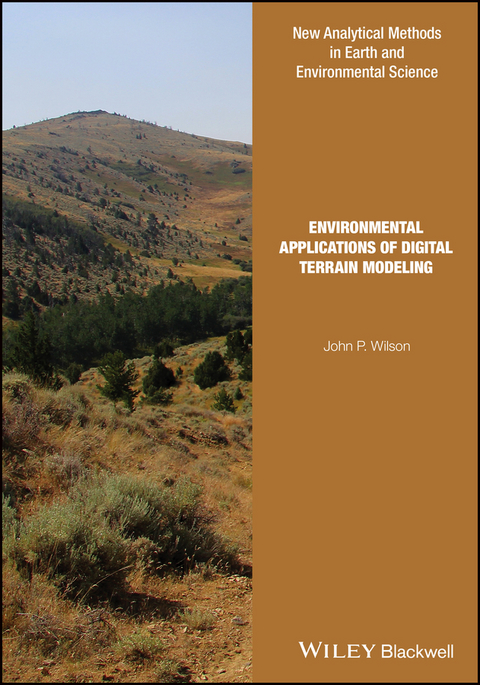
Environmental Applications of Digital Terrain Modeling (eBook)
John Wiley & Sons (Verlag)
978-1-118-93620-7 (ISBN)
A digital elevation model (DEM) is a digital representation of ground surface topography or terrain. It is also widely known as a digital terrain model (DTM). A DEM can be represented as a raster (a grid of squares) or as a vector based triangular irregular network (TIN). DEMs are commonly built using remote sensing techniques, but they may also be built from land surveying. DEMs are used often in geographic information systems, and are the most common basis for digitally-produced relief maps. The terrain surface can be described as compromising of two different elements; random and systematic. The random (stochastic) elements are the continuous surfaces with continuously varying relief. It would take an endless number of points to describe exactly the random terrain shapes, but these can be described in practice with a network of point. It is usual to use a network that creates sloping triangles or regular quadrants.
This book examines how the methods and data sources used to generate DEMs and calculate land surface parameters have changed over the past 25 years. The primary goal is to describe the state-of-the-art for a typical digital terrain modeling workflow that starts with data capture, continues with data preprocessing and DEM generation, and concludes with the calculation of one or more primary and secondary land surface parameters. Taken as a whole, this book covers the basic theory behind the methods, the instrumentation, analysis and interpretation that are embedded in the modern digital terrain modeling workflow, the strengths and weaknesses of the various methods that the terrain analyst must choose among, typical applications of the results emanating from these terrain modeling workflows, and future directions.
This book is intended for researchers and practitioners who wish to use DEMs, land surface parameters, land surface objects and landforms in environmental projects. The book will also be valuable as a reference text for environmental scientists who are specialists in related fields and wish to integrate these kinds of digital terrain workflows and outputs into their own specialized work environments.
Dr. John P. Wilson is Professor of Spatial Sciences in the Dana and David Dornsife College of Letters, Arts and Sciences at the University of Southern California (USC) where he directs the Spatial Sciences Institute as well as the Geographic Information Science & Technology (GIST) Graduate Programs and GIS Research Laboratory, and also holds adjunct appointments as Professor in the School of Architecture and in the Viterbi School of Engineering???s Departments of Computer Science and Civil & Environmental Engineering.
Dr. John P. Wilson is Professor of Spatial Sciences in the Dana and David Dornsife College of Letters, Arts and Sciences at the University of Southern California (USC) where he directs the Spatial Sciences Institute as well as the Geographic Information Science & Technology (GIST) Graduate Programs and GIS Research Laboratory, and also holds adjunct appointments as Professor in the School of Architecture and in the Viterbi School of Engineering???s Departments of Computer Science and Civil & Environmental Engineering.
Title Page 5
Copyright Page 6
Contents 9
List of Figures 12
List of Tables 16
Preface 18
Abbreviations 20
Chapter 1 Introduction 27
1.1 Role of DEMs 29
1.2 Role of Scale 32
1.3 Survey of Applications 38
1.4 Study Site and Software Tools 42
1.5 Structure of Book 46
Chapter 2 Constructing Digital Elevation Models 49
2.1 Elevation Data Networks 49
2.2 Elevation Data Sources 55
2.2.1 Ground Surveys 57
2.2.2 Kinematic GPS Surveys 58
2.2.3 Topographic Maps 59
2.2.4 Photogrammetry Datasets 61
2.2.5 Airborne Laser Scanning Datasets 62
2.2.6 Interferometric Synthetic Aperture Radar Datasets 63
2.2.7 Shuttle Radar Topographic Mission DEMs 64
2.2.8 Advanced Spaceborne Thermal Emission and Reflectance Radiometer DEMs 66
2.2.9 WorldDEM Datasets 69
2.3 Fitness-For-Use 69
2.4 Data Preprocessing and DEM Construction 70
2.5 US National Elevation Dataset 76
Chapter 3 Calculating Land Surface Parameters 79
3.1 Primary Land Surface Parameters 80
3.1.1 Elevation and Surface Area 80
3.1.2 Slope, Aspect, and Curvature 85
3.1.3 Slope Direction and Width 95
3.1.4 Flow Accumulation 126
3.1.5 Elevation Residuals 131
3.1.6 Statistical Parameters 135
3.1.7 Upslope Parameters 139
3.1.8 Downslope Parameters 140
3.1.9 Visibility and Visual Exposure 140
3.2 Secondary Land Surface Parameters 141
3.2.1 Water Flow and Soil Redistribution 142
3.2.2 Energy and Thermal Regimes 161
3.3 Final Comments 174
Chapter 4 Delineating Land Surface Objects and Landforms 176
4.1 Extracting and Classifying Specific Landform Elements 178
4.1.1 Fuzzy Concepts and Fuzzy Classification Methods 180
4.2 Extraction and Classification of Land Surface Objects Based on Flow Variables 184
4.2.1 Drainage Networks and Channel Attributes 185
4.2.2 Basin Boundaries and Attributes 190
4.3 Extracting and Classifying Specific (Fuzzy) Landforms 191
4.4 Extracting and Classifying Repeating Landform Types 194
4.5 Discrete Geomorphometry: Coupling Multiscale Pattern Analysis and Object Delineation 200
Chapter 5 Measuring Error and Uncertainty 205
5.1 Identification and Treatment of Error and Uncertainty 206
5.1.1 Error 208
5.1.2 Uncertainty 220
5.2 Fitness-for-Use Revisited 225
5.2.1 Predictive Vegetation Modeling 225
5.2.2 Modeling Soil Erosion and Deposition 229
5.2.3 Numerical Simulations of Landscape Development 231
5.2.4 Modeling Soil–Water–Vegetation Interactions 233
5.2.5 Modeling Global Wetlands 235
5.3 Multiscale Analysis and Cross?scale Inference 240
5.4 The US National Water Model 249
Chapter 6 Terrain Modeling Software and Services 254
6.1 Changes in Data Capture and Computing Systems 256
6.2 Esri’s ArcGIS Ecosystem 260
6.3 Third-party Esri Add-ons 270
6.3.1 ArcGIS Geomorphometry Toolbox 270
6.3.2 ArcGIS Geomorphometry and Gradient Metrics Toolbox 271
6.3.3 ArcGeomorphometry Toolbox 272
6.4 Other Software Choices 274
6.4.1 GRASS 274
6.4.2 ILWIS 276
6.4.3 LandSerf 277
6.4.4 MicroDEM 278
6.4.5 QGIS 279
6.4.6 RiverTools 280
6.4.7 SAGA 281
6.4.8 TauDEM 283
6.4.9 Whitebox GAT 284
6.5 Future Trends 285
Chapter 7 Conclusions 287
7.1 Current State of the Art 289
7.2 Future Needs and Opportunities 295
7.2.1 Finding Ways to Use Provenance, Credibility, and Digital Terrain Modeling Application?context Knowledge 295
7.2.2 Rediscovering and Using What We Already Know! 296
7.2.3 Developing New Digital Terrain Methods 298
7.2.4 Clarifying and Strengthening the Role of Theory 300
7.2.5 Developing High-fidelity, Multi-resolution Digital Elevation Models 301
7.2.6 Developing and Embracing New Visualization Opportunities 301
7.2.7 Adopting and Using New Information Technologies and Workflows 302
7.2.8 Solving “Wicked” Problems of Varying Magnitudes 303
7.3 Call To Action 304
References 305
Index 359
EULA 363
| Erscheint lt. Verlag | 15.2.2018 |
|---|---|
| Reihe/Serie | Analytical Methods in Earth and Environmental Science |
| Analytical Methods in Earth and Environmental Science | Analytical Methods in Earth and Environmental Science |
| Sprache | englisch |
| Themenwelt | Naturwissenschaften ► Geowissenschaften ► Geografie / Kartografie |
| Naturwissenschaften ► Geowissenschaften ► Geologie | |
| Technik ► Umwelttechnik / Biotechnologie | |
| Schlagworte | built • commonly • DEM • Dems • digital • earth sciences • elevation • Geographie • Geography • Geomorphologie • geomorphology • Geowissenschaften • GIS & Remote Sensing • GIS, Fernerkundung u. Kartographie • GIS, Remote Sensing & Cartography • GIS u. Fernerkundung • GRID • Ground • Irregular • known • Land surveying • Model • Network • Raster • remote • Representation • represented • Sensing Techniques • Squares • Surface • Terrain • Triangular • Vector |
| ISBN-10 | 1-118-93620-5 / 1118936205 |
| ISBN-13 | 978-1-118-93620-7 / 9781118936207 |
| Informationen gemäß Produktsicherheitsverordnung (GPSR) | |
| Haben Sie eine Frage zum Produkt? |
 PDF (Adobe DRM)
Kopierschutz: Adobe-DRM
Adobe-DRM ist ein Kopierschutz, der das eBook vor Mißbrauch schützen soll. Dabei wird das eBook bereits beim Download auf Ihre persönliche Adobe-ID autorisiert. Lesen können Sie das eBook dann nur auf den Geräten, welche ebenfalls auf Ihre Adobe-ID registriert sind.
Details zum Adobe-DRM
Dateiformat: PDF (Portable Document Format)
Mit einem festen Seitenlayout eignet sich die PDF besonders für Fachbücher mit Spalten, Tabellen und Abbildungen. Eine PDF kann auf fast allen Geräten angezeigt werden, ist aber für kleine Displays (Smartphone, eReader) nur eingeschränkt geeignet.
Systemvoraussetzungen:
PC/Mac: Mit einem PC oder Mac können Sie dieses eBook lesen. Sie benötigen eine
eReader: Dieses eBook kann mit (fast) allen eBook-Readern gelesen werden. Mit dem amazon-Kindle ist es aber nicht kompatibel.
Smartphone/Tablet: Egal ob Apple oder Android, dieses eBook können Sie lesen. Sie benötigen eine
Geräteliste und zusätzliche Hinweise
Buying eBooks from abroad
For tax law reasons we can sell eBooks just within Germany and Switzerland. Regrettably we cannot fulfill eBook-orders from other countries.
aus dem Bereich