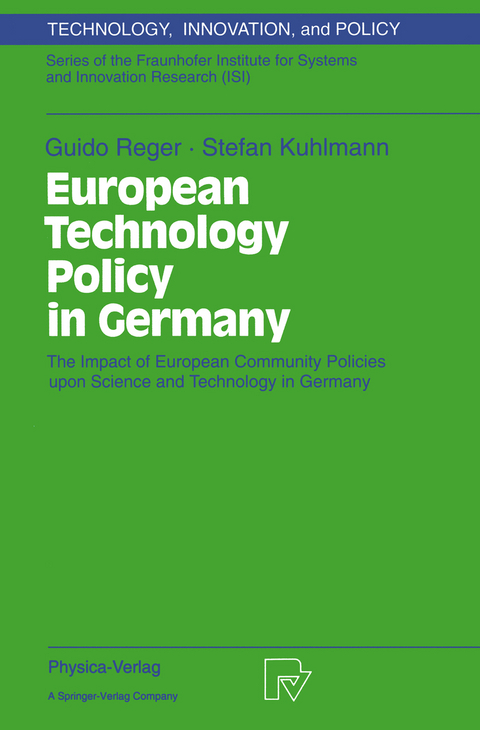
European Technology Policy in Germany
1. Introduction.- 1.1 Purpose of the Study.- 1.2 Subject of the Study.- 1.3 Methods.- 1.4 Structure of the Study.- 2. The RTD Policy of Germany and the European Community.- 2.1 The German Research Landscape.- 2.2 RTD Policy of the European Community.- 2.3 Interfaces between German and Community Policy.- 3. The Structure of German Participants in the Second Framework Programme.- 3.1 DataBase.- 3.2 Structure of Participants according to Types of Institutions.- 3.3 Structure according to Participants' Position in Project Consortium.- 3.4 Participation in Specific Programmes.- 3.5 Regional Distribution.- 3.6 Summary and Conclusions.- 4. Importance of EC RTD Policy and its Influence on Enterprises.- 4.1 Characteristics of Participants and Non-participants in the Survey.- 4.2 Description of Sample and Comparison with Basic Population.- 4.3 Importance and Strategic Significance for Participating Enterprises.- 4.4 Reasons and Aims of Participation, Results and Success Factors.- 4.5 Impacts on Participating Enterprises.- 4.6 Importance of EC RTD Policy for Non-participating Enterprises.- 4.7 The Future Development of National and Community Policy.- 4.8 Summary and Conclusions.- 5. Importance of EC RTD Policy and its Influence on Institutes of Higher Education.- 5.1 Characteristics of Participants and Non-participants in the Survey.- 5.2 Description of Sample and Comparison with Basic Population.- 5.3 Importance and Strategic Role for Participating Institutes.- 5.4 Reasons and Aims of Participation, Results and Success Factors.- 5.5 Impacts on Participating Institutes.- 6. The Importance of EC RTD Policy and its Influence on Non-university R&D Institutes.- 6.1 Characteristics of Participants and Non-participants in the Survey.- 6.2 Importance and Strategic Significance forParticipants.- 6.3 Reasons and Aims for Participation, Results and Success Factors.- 6.4 Impacts on Participating R&D Institutes.- 6.5 Importance of EC RTD Policy for Non-participating R&D Institutes.- 6.6 The Future Development of National and Community Policy.- 6.7 Summary and Conclusions.- 7. RTD Support and the New Länder.- 7.1 The Special Situation of Research Institutions in the New Länder.- 7.2 Empirical Basis of the Results.- 7.3 Indications from East German Participants.- 7.4 Characteristics of Non-participants in the New Länder.- 7.5 Future Importance of EC RTD Policy.- 7.6 Summary and Conclusions.- 8. Assessment and Conclusions: Impact of Community Policy for the German Research Landscape.- 8.1 Importance and Scope of Community Technology Policy.- 8.2 Character and Aims of EC Projects.- 8.3 Results and Impacts on German Actors.- 8.4 Impacts on Policy.- 9. Outlook.- References.- Annex: Tables and Figures.
| Erscheint lt. Verlag | 9.1.1995 |
|---|---|
| Reihe/Serie | Technology, Innovation and Policy (ISI) |
| Zusatzinfo | XII, 195 p. |
| Verlagsort | Heidelberg |
| Sprache | englisch |
| Maße | 155 x 235 mm |
| Gewicht | 314 g |
| Themenwelt | Sozialwissenschaften |
| Technik | |
| Wirtschaft ► Betriebswirtschaft / Management ► Unternehmensführung / Management | |
| Wirtschaft ► Volkswirtschaftslehre | |
| Schlagworte | Database • Deutschland; Politik/Zeitgeschichte (Europapolitik) • Development • Environment • Europäische Gemeinschaft • Europäische Gemeinschaft (EG) • European Community • Forschungspolitik • Forschung und Entwicklung • Import • Research and Development • science and technology • Technical Development Policy • Technische Entwicklung • Technologiepolitik • Technology • Technology Policy |
| ISBN-10 | 3-7908-0826-1 / 3790808261 |
| ISBN-13 | 978-3-7908-0826-1 / 9783790808261 |
| Zustand | Neuware |
| Informationen gemäß Produktsicherheitsverordnung (GPSR) | |
| Haben Sie eine Frage zum Produkt? |
aus dem Bereich