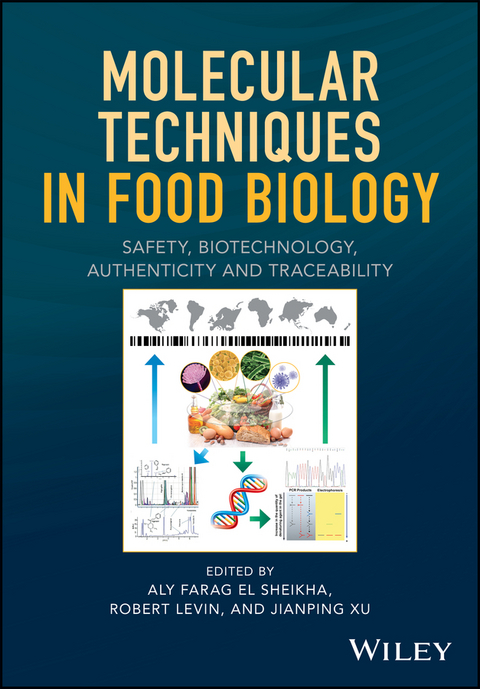
Molecular Techniques in Food Biology (eBook)
472 Seiten
Wiley (Verlag)
978-1-119-37461-9 (ISBN)
Molecular Techniques in Food Biology: Safety, Biotechnology, Authenticity & Traceability explores all aspects of microbe-food interactions, especially as they pertain to food safety. Traditional morphological, physiological, and biochemical techniques for the detection, differentiation, and identification of microorganisms have severe limitations. As an alternative, many of those responsible for monitoring food safety are turning to molecular tools for identifying foodborne microorganisms. This book reviews the latest molecular techniques for detecting, identifying, and tracing microorganisms in food, addressing both good foodborne microbes, such as those used for fermentation and in probiotics, and harmful ones responsible for foodborne illness and food quality control problems.
Molecular Techniques in Food Biology: Safety, Biotechnology, Authenticity & Traceability brings together contributions by leading international authorities in food biology from academe, industry, and government. Chapters cover food microbiology, food mycology, biochemistry, microbial ecology, food biotechnology and bio-processing, food authenticity, food origin traceability, and food science and technology. Throughout, special emphasis is placed on novel molecular techniques relevant to food biology research and for monitoring and assessing food safety and quality.
- Brings together contributions from scientists at the leading edge of the revolution in molecular food biology
- Explores how molecular techniques can satisfy the dire need to deepen our understanding of how microbial communities develop in foods of all types and in all forms
- Covers all aspects of food safety and hygiene, microbial ecology, food biotechnology and bio-processing, food authenticity, food origin traceability, and more
- Fills a yawning gap in the world literature on food traceability using molecular techniques
Aly Farag El Sheikha, PhD is a Researcher at Department of Biology, McMaster University, Hamilton, Ontario, Canada
Robert Levin, PhD is a Professor Emeritus at Department of Food Science at the University of Massachusetts, Amherst, MA, USA
Jianping Xu, PhD is a Professor at Department of Biology at McMaster University, Hamilton, Ontario, Canada
Molecular Techniques in Food Biology: Safety, Biotechnology, Authenticity & Traceability explores all aspects of microbe-food interactions, especially as they pertain to food safety. Traditional morphological, physiological, and biochemical techniques for the detection, differentiation, and identification of microorganisms have severe limitations. As an alternative, many of those responsible for monitoring food safety are turning to molecular tools for identifying foodborne microorganisms. This book reviews the latest molecular techniques for detecting, identifying, and tracing microorganisms in food, addressing both good foodborne microbes, such as those used for fermentation and in probiotics, and harmful ones responsible for foodborne illness and food quality control problems. Molecular Techniques in Food Biology: Safety, Biotechnology, Authenticity & Traceability brings together contributions by leading international authorities in food biology from academe, industry, and government. Chapters cover food microbiology, food mycology, biochemistry, microbial ecology, food biotechnology and bio-processing, food authenticity, food origin traceability, and food science and technology. Throughout, special emphasis is placed on novel molecular techniques relevant to food biology research and for monitoring and assessing food safety and quality. Brings together contributions from scientists at the leading edge of the revolution in molecular food biology Explores how molecular techniques can satisfy the dire need to deepen our understanding of how microbial communities develop in foods of all types and in all forms Covers all aspects of food safety and hygiene, microbial ecology, food biotechnology and bio-processing, food authenticity, food origin traceability, and more Fills a yawning gap in the world literature on food traceability using molecular techniques This book is an important working resource for professionals in agricultural, food science, biomedicine, and government involved in food regulation and safety. It is also an excellent reference for advanced students in agriculture, food science and food technology, biochemistry, microbiology, and biotechnology, as well as academic researchers in those fields.
Aly Farag El Sheikha, PhD is a Researcher at Department of Biology, McMaster University, Hamilton, Ontario, Canada Robert Levin, PhD is a Professor Emeritus at Department of Food Science at the University of Massachusetts, Amherst, MA, USA Jianping Xu, PhD is a Professor at Department of Biology at McMaster University, Hamilton, Ontario, Canada
1
How to Determine the Geographical Origin of Food by Molecular Techniques
Aly Farag El Sheikha1,2
1 Department of Biology, McMaster University, Hamilton, Ontario, Canada
2 Faculty of Agriculture, Department of Food Science and Technology, Minufiya University, Minufiya Government, Egypt
1.1 Linkage Between Food and Its Geographical Origin: Historical View
Historically, food products have always been linked with a specific geographical origin. Regional product identities have a long history. In ancient Egypt, places of origin were used to identify products and to signal their quality. In the Middle Ages, European guilds gave their products certain names to ensure consumers got consistent quality, assure market exclusivity, and protect producers legally (Institut National des Appellations d’Origine [INAO] 2005). The history of some well‐known cheeses can be traced back to this period, for example Parmigiano Reggiano in Italy, Stilton in the UK, and Comté in France. The process of establishing a regional reputation went parallel with the emergence of the concept of individual brands. In both cases, producers tried to enhance their products’ value by associating consumers with a name: a single producer in the case of a brand, on a collective scale in the case of regional products (Boto et al. 2013).
Several regional products identified in the marketplace by geographical names date from the 19th century, including Opperdoezer Ronde potatoes (Netherlands) and Washington apples (USA). While such regional indications remained important, their significance gradually shrank with time. National and international trade evolved, and technical grades and standards developed and became more important in trade. During the 20th century, internationalization expanded rapidly. The urge for economies of scale meant that certain regions began to specialize in producing a few products. Firms marketed their products over an ever wider area. Product specialization also occurred; instead of producing a broad product assortment, companies specialized in a few standard products. This mass production resulted in the loss of many unique, specific regional products. In time, the globalization of business and markets increased further (Boto et al. 2013).
By the late 1990s, a new geographical diversity of foods had emerged. While the globalization of trade in food produce continues apace, Europe has experienced an increasing interest in foods with local and regional identities. Local food production systems have indeed been characterized by various strategies to promote local/regional food products (Goodman 2004; Ilbery & Maye 2005; Marsden et al. 2002; Murdoch 2000).
An image of the region and regional names are often used to market products that may have a strong reputation associated with their place of production (INAO 2005). As Bérard and Marchenay (2005) point out, products do not just “come from” a region; they “are” from a region. This means that they convey values and culture, that is, an identity. In general, these products have, to a greater or lesser extent, specific qualities based on human expertise and the natural environment where they are produced. The mix of these specific qualities and the regional image creates a unique identity for the product, therefore raising its value (van de Kop & Sautier 2006).
Food quality and authentication are becoming of primary importance for both consumers and industries, at all levels of the production process, from raw materials (farm) to finished products (fork). Moreover, consumers around the world have shown an increasing interest for typical food products with reliable indicators of geographical origin. Typical food products have an important economic role at both national and international levels, as confirmed by certifications and trademarks of quality (e.g., Protected Denomination of Origin, PDO; Protected Geographical Identification, PGI; and Traditional Specialities Guaranteed, TSG), assigned to guarantee typicity and quality standards (Longobardi et al. 2015).
Figure 1.1 highlights the significant stages in determining the geographic origins of products through human history.
Figure 1.1 Developments in the history of geographical origin determination.
1.2 Scope and Approach
This chapter focuses on how to determine the geographical origin of food. Figure 1.2 illustrates the scope of the chapter and the major issues related to determining the geographical origin of foodstuffs. The demand to know the geographical origin of food has been a driving force for implementation of determining the geographic origins of food. Technological innovations, the benefits of using molecular techniques, and the drawbacks of existing approaches are reviewed below.
Figure 1.2 Analytic structure illustrating the scope of this chapter on determining the geo‐origin of food.
1.3 Definitions Related to Tracking of Food Origins
1.3.1 Geographical Area
This is the area in which the production and/or processing take place. Generally, the limits of the area are defined by natural and/or human factors which give the final product its particular characteristics. Supporting documents, such as maps, must be provided (Patent Office of the Republic of Poland [PPO] 2010).
1.3.2 Regional Products
In a general sense, van de Kop and Sautier (2006) defined a regional product as a “local product based on a territorial identity and reputation, and/or a typical product based on specific mode of production and whose quality, reputation or any other characteristics are attributable essentially to its geographical origin.” The geographical origin can be a province, state, department or country, but also cross‐border areas that are culturally, naturally or climatically similar.
1.3.3 Appellation of Origin (AO)
This term is defined through the World Intellectual Property Organization (WIPO 2013) as “The geographical name of a country, region, or locality, which serves to designate a product originating therein, the quality and characteristics of which are due exclusively or essentially to the geographical environment, including natural and human factors.”
Appellation of Origin was one of the earliest forms of Geographical Indication (GI) recognition and protection (WIPO 1979). Although mentioned in earlier treaties, the 26 contracting parties to the Lisbon System in 1958 first formally recognized the term “Appellation of Origin” as a form of GI, by using a single registration procedure, effective for all the signatories (Boto et al. 2013).
1.3.4 Geographical Indication (GI)
Geographical Indication is defined by the TRIPS Agreement 1994 as “Indication which identifies a good as originating in the territory of a member (country), or a region or locality in that territory, where a given quality, reputation or other characteristic of the good is essentially attributable to its geographical origin” (World Trade Organization [WTO] 2005).
1.3.5 Protected Designation of Origin (PDO)
The Protected Designation of Origin is for products closely associated with the area whose name they bear (European Commission 1992, Regulation No. 2081/92). Such a product must meet two conditions.
- Quality or characteristics of the product must be connected with the particular geographical environment of the place of origin; this environment includes inherent natural and human factors, such as climate, soil quality, and local know‐how.
- Production and processing of the raw materials, up to the stage of the finished product, must take place in the defined geographical area whose name the product bears.
The PDO covers agricultural products that are produced, processed, and prepared in a given geographical area using recognized know‐how. Well‐known PDO products are prosciutto di Parma (ham) from Italy, Kalamata (olive oil) from Greece, and Camembert de Normandie (cheese) from France (Drivelos & Georgiou 2012).
1.3.6 Protected Geographical Indication (PGI)
Protected Geographical Indications also designate products attached to the region whose name they bear but the link is different from that between a product with a PDO and its geographical area of origin (European Commission 1992). To be eligible to use a PGI, a product must meet two conditions.
- It must have been produced in the geographical area whose name it bears. Unlike the Protected Designation of Origin, it is sufficient that one of the stages of production has taken place in the defined area. For example, the raw materials used in production may have come from another region.
- There must also be a link between the product and the area which gives it its name. However, this feature need not be essential, as in the case of a designation of origin. It is sufficient that a specific quality, reputation or other characteristic be attributable to the geographical origin of a given product.
The PGI covers agricultural products and foodstuffs closely linked to the geographical area. At least one of the stages of production, processing or preparation takes place in the area. Typical products with recognized PGIs are Scotch beef from the UK, Calcot de Valls (onion) from Spain, and Budějovické pivo (beer) from the Czech Republic (Drivelos...
| Erscheint lt. Verlag | 2.1.2018 |
|---|---|
| Sprache | englisch |
| Themenwelt | Naturwissenschaften ► Biologie |
| Technik ► Lebensmitteltechnologie | |
| Weitere Fachgebiete ► Land- / Forstwirtschaft / Fischerei | |
| Schlagworte | Food Science & Technology • Lebensmittelforschung u. -technologie • Microbiology, Food Safety & Security • Mikrobiologie u. Nahrungsmittelsicherheit |
| ISBN-10 | 1-119-37461-8 / 1119374618 |
| ISBN-13 | 978-1-119-37461-9 / 9781119374619 |
| Informationen gemäß Produktsicherheitsverordnung (GPSR) | |
| Haben Sie eine Frage zum Produkt? |
 EPUB (Adobe DRM)
Größe: 11,1 MB
Kopierschutz: Adobe-DRM
Adobe-DRM ist ein Kopierschutz, der das eBook vor Mißbrauch schützen soll. Dabei wird das eBook bereits beim Download auf Ihre persönliche Adobe-ID autorisiert. Lesen können Sie das eBook dann nur auf den Geräten, welche ebenfalls auf Ihre Adobe-ID registriert sind.
Details zum Adobe-DRM
Dateiformat: EPUB (Electronic Publication)
EPUB ist ein offener Standard für eBooks und eignet sich besonders zur Darstellung von Belletristik und Sachbüchern. Der Fließtext wird dynamisch an die Display- und Schriftgröße angepasst. Auch für mobile Lesegeräte ist EPUB daher gut geeignet.
Systemvoraussetzungen:
PC/Mac: Mit einem PC oder Mac können Sie dieses eBook lesen. Sie benötigen eine
eReader: Dieses eBook kann mit (fast) allen eBook-Readern gelesen werden. Mit dem amazon-Kindle ist es aber nicht kompatibel.
Smartphone/Tablet: Egal ob Apple oder Android, dieses eBook können Sie lesen. Sie benötigen eine
Geräteliste und zusätzliche Hinweise
Buying eBooks from abroad
For tax law reasons we can sell eBooks just within Germany and Switzerland. Regrettably we cannot fulfill eBook-orders from other countries.
aus dem Bereich